
Mellinger Minutes: Royals’ dream season, KU’s nightmare, Chiefs’ free agents, Sal’s $$
The Royals will play a real baseball game at Kauffman Stadium in front of real humans in eight days. There will be lemonade and popcorn and hot dogs. Kids will get foul balls. The air will fill with catchers mitts popping and bats cracking and hopefully the umpire doing some ridiculous and overproduced strike three call.
You know, all the good stuff.
I will be there, assuming I’m still breathing, and I’m too old for this but I am already excited about the day. The column I write will almost certainly have nothing to do with the specifics of the game, or any decision Mike Matheny makes, or whether Brad Keller is repeating his mechanics or effective with his slider.
So with the Chiefs offseason still incomplete and plenty below about all three local college basketball teams, Bobby Witt Jr.’s reassignment, Sal Perez’s contract and other stuff let’s do something different here at the top:
What would a Royals playoff run look like?
This is an unlikely scenario, to be sure. If the Royals are in meaningful games the last week of the season it would be one of the bigger stories in the sport. But what good is this time of year if you can’t dream on a baseball team a little?
So here we go.
The Royals’ lineup would need to jump significantly from 13th in runs last year (and 14th in 2019, if you don’t trust the shortened season).
They would do this first and most importantly by covering holes. Last year, of the nine players with the most plate appearances, five had an adjusted OPS below league average.
Nicky Lopez had the lowest OPS in the American League. If Alex Gordon had enough plate appearances to qualify, he’d have tied for third-worst.
Another way to look at it: the Royals had just two positions (right field and catcher) that produced better than league average. They had just two spots in the lineup (first and third) that produced better than league average.
Sal Perez, Adalberto Mondesi, Whit Merrifield and Jorge Soler are back and in the same position on the field as last year.
Of the other five spots, it’s reasonable to believe that none will be significantly downgraded offensively, and that three will be significantly upgraded.
So if things go well offensively, it’ll be because Whit Merrifield continues to be Whit Merrifield, and Carlos Santana proves 2020 was a one-off and not the cliff’s edge, and Hunter Dozier breaks out, and Jorge Soler provides power, and Adalberto Mondesi has a few stretches where he crushes, and Michael A. Taylor’s shortened swing provides more consistency, and Benintendi does a little of everything (but lots of line drives in gaps), and Sal Perez hits another 25 homers, and the Royals get enough from second base that it’s no longer the place where rallies go to die.
Whatever it’s worth, I do believe Bobby Witt Jr. will be in the big leagues this summer, perhaps even before the All-Star break. He’s going to be great, and he might even be good right away, but I wonder if anything less than insta-Trout is going to be a letdown to some.
Let’s stay with the position players. The Royals should be at least average at every spot, and above average everywhere up the middle — Perez at catcher, Mondesi at short, Lopez (or Witt Jr. or Merrifield) at second, and Taylor in center.
Dozier (or Witt Jr.) could be above average at third. Benintendi has been worth 22 Defensive Runs Saved in left field over the last four seasons, though most of that is from 2017 and 2018. There is enough positional versatility between Dozier, Witt. Jr. and Merrifield to help cover the inevitable injuries.
The rotation lacks a headlining Cy Young candidate like Shane Bieber, but Brad Keller remains an under appreciated breakout candidate and for the first time in a while the Royals have a real chance to roll out a rotation without an obvious hole:
Keller, Mike Minor, Brady Singer, Danny Duffy and Kris Bubic. That’s five, with Daniel Lynch and Jackson Kowar and maybe even Asa Lacy on the come. Jakob Junis can offer a spot start. There will be injuries and underperformance but this is a good place to start.
A steady rotation can build on itself, and help the bullpen succeed. An organization that believes deeply in intangibles also values players arriving at the ballpark everyday believing they can with their starter.
The bullpen could use some depth, and Josh Staumont’s recover from Covid-19 is at least a mild concern, and in an ideal world there would be at least one lefty. But there’s enough talent back there to get guys out, and when he’s right Staumont is virtually unhittable.
So, that’s the way this thing would happen. That’s how the 2021 Royals would look if they are lucky and good and healthy enough to threaten a postseason — diverse skills, winning with different guys doing different things on different nights, taking away more runs defensively than they let in, a balanced rotation with Keller as the anchor, and a bullpen protected by that rotation with the best and hottest arms deployed for the most dangerous spots.
But, honestly, between you and me I’ll take 70-92 right now if it means we have 162 games with fans able to watch in person.
This week’s eating recommendation is the KC burrito from Tiki Taco and the reading recommendation is Dana O’Neil watching four NCAA Tournament games in three arenas in one day — because she could, and because she hadn’t.
Thanks to everyone who’s listened to our Mellinger Minutes For Your Ears podcast, and here is a big warm invitation to start if you haven’t already. We’re out from behind the paywall and free on Apple or Spotify or Stitcher or wherever you get your shows.
Reminder: If you’d like to participate in the show — and I’d love for you to do that — please call 816-234-4365 and leave your first name, where you’re calling from, and almost literally any question.
Please give me a follow on Twitter and Facebook and, as always, thanks for your help and thanks for reading.
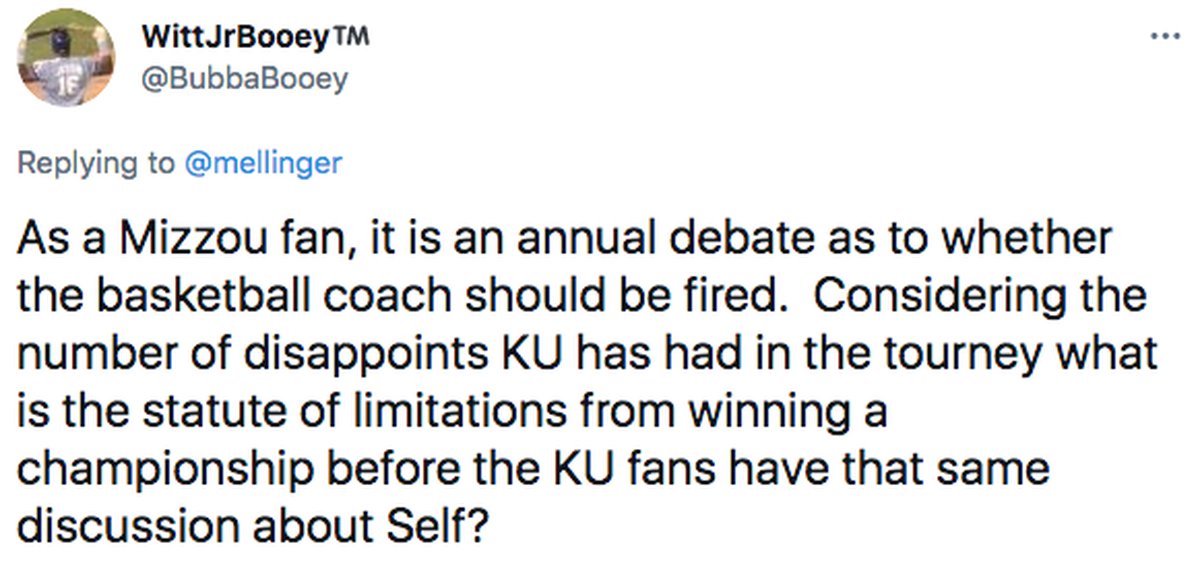
We’re leading off with this not because it’s a great question (no offense, Bubba) but because it’s being said enough that we might as well address it.
Here is what I believe:
- Bill Self is one of the best coaches in the country.
- Bill Self should probably have another Final Four or two at KU by now, and a second national championship.
- Bill Self has a higher NCAA Tournament win percentage than Tom Izzo and Jay Wright, among many others, so the narrative of him as a choker is flimsy at best.
The next six to 12 months will go a very long way to determining Self’s future at Kansas and as a coach, and also how he’s remembered when he’s done.
The NCAA infractions case is expected to come to some conclusion by the end of the summer or fall. I have no idea how that will go. KU could win the case, and is fighting with righteousness. Then again, the NCAA doesn’t often bring five Level I violations without drawing blood.
Depending on what happens with the case, Self isn’t going anywhere. KU isn’t firing him unless they have no choice, and I know this might be counterintuitive but I don’t believe Self would outrun potential sanctions.
Think about this. His entire worldview is based on soft or tough. His favorite player is not Andrew Wiggins, the No. 1 pick in a draft. His favorite player is not even Mario Chalmers, who hit the shot. His favorite player is Jamari Traylor, who averaged 3.6 points per game in his career but spent part of his high school days homeless and played with undeniable commitment and toughness.
Self often tells the story of talking through the Kansas job with his father. Self had some hesitations, to which his father replied, “If you’re too soft to take the job, then don’t do it.”
What would be softer than leaving a place because you didn’t want to deal with sanctions for violations that happened on your watch?
It’s a weird situation. Self is 58, and I’ve always assumed he’d eventually take an NBA job. But the infractions case may have tied him to KU, instead of driven him away.
I could be totally wrong about this, of course. If major sanctions come, maybe Self would become convinced that Kansas would be better off starting fresh, with a new coach. His first boss was Larry Brown, who left KU while the NCAA investigated. Depending on the case’s outcome, Self’s employment at KU could become untenable for both sides.
But if we’re debating this on the merits of Self’s ability to win, come on.
Recruiting will continue to be a challenge until the case’s cloud is lifted, but we just saw a team without a first-round pick finish second in the Big 12 and earn a No. 3 seed in the NCAA Tournament. A year ago, KU was the nation’s best team when the world shutdown.
Let’s not pretend Self is cooked as an effective basketball coach. We can be smarter than that. Please.
Well, at the risk of being repetitive the Jayhawks need a conclusion of the NCAA case. Even if the penalties are severe — and there are people in the athletic department expecting severe — KU is better off with an answer.
Better off knowing what the challenges will be, and formulating a plan.
Think about it like this: if the penalties include a one-year postseason ban, high school seniors would know they would be unaffected.
Self mentioned this after the USC game, but KU needs more size and athleticism. They need better shooting. Self’s best teams have usually been driven by guards, and the lack of a boss point guard limited everything.
College basketball is an emotional sport. That’s one of its greatest charms. It also leads to overreactions in the moments immediately following NCAA Tournament losses.
Kansas basketball will be fine. There is too much history, too much support, too much infrastructure for it to be anything less.
This is a program where a No. 3 seed and second-place conference finish leaves fans frustrated, for crying out loud.
The standards are high for a reason. KU will get back there. It always does. But they need to know what penalties they’ll be dealing with. That’s effecting everything right now, and that will be truer every day until the case is concluded.
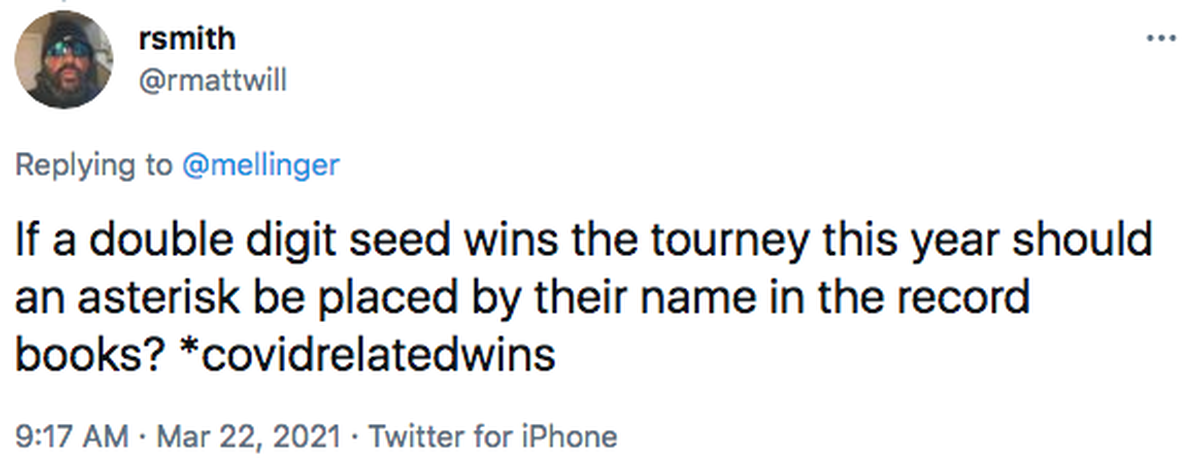
Well, first let us agree that a double digit seed will not win the tournament. Anything is possible, upsets happen, yada, yada, and yada ... but a double digit seed is not going to win this tournament.
Gonzaga is going to win this tournament.
But you bring up a very smart point. Seeding any NCAA Tournament is a fool’s errand, because it’s never going to be perfect. The only certainty from NCAA Tournaments is that there will be upsets, and people will dog cuss the selection committee with impunity.
The challenges of seeding a tournament were multiplied eleventy-fold this season, with virtually no non-conference games to work off, programs getting paused or worse, and schedules going awkward with an imbalance of home games and several conferences going to back-to-backs.
Loyola Chicago is a great example. Should the Ramblers have been higher than a No. 8 seed?
... probably?
They won the Valley regular season and conference tournament, but they also lost by 14 to the only Power 5 school they played (Wisconsin).
People want to dunk on the committee for Oral Roberts being a No. 15 seed, but isn’t that where the fourth-place team from the Summit should probably be?
But seeding doesn’t matter as much as people like me sometimes make it out. There are times that being a lower seed can be better, because maybe you’re out of that 8-9 game and you get a more beatable opponent in the second round. Or maybe you avoid that team with the pick-and-pop big man who was going to kill you.
It’s a cliche, but it’s true: you can play your way out of a bad seed, but you can’t play your way into the tournament once the brackets are announced.
I’m getting a little off topic here. Let’s focus. I believe at least two things here with all of my mind, heart, and soul.
The first is that upsets happen every year, usually early, and by the later rounds the favorites often take over. Upsets are part of what makes the NCAA Tournament the greatest sports event in American sports, and upsets are virtually guaranteed with the format.
The analogy isn’t perfect, but the 1998 Bulls — The Last Dance Bulls — lost Game 1 of the NBA Finals. If the NBA was one-and-done like college basketball, maybe the Jazz win the title and basketball history is rewritten.
Having upsets does not invalidate the NCAA Tournament champion. I think we all understand that the best team doesn’t always win, and perhaps even doesn’t usually win.
The second thing is that high level sports are usually about who adjust better. Great teams and great athletes adapt. They’re able to navigate different challenges.
I believe that the Bucs, then, are a particularly worthy Super Bowl champion because they did it in the most difficult year in league history. I believe the same about the Lakers, and even about the Dodgers after a 60-game MLB season.
Some of this is bad luck, and I do feel horribly for the teams that navigated the virus well all season and then get torpedoed at the worst time. But I also believe that these seasons have been played with even more stress than usual, and more restrictions, and that whoever earns the trophy at the end should not apologize to anyone.

This is such a great question, in large part because two opposite answers can be given emphatically and genuinely.
Because if you do this on a spreadsheet, it’s a bad contract for the Royals. They gave him something like the ceiling of what he might have received in free agency if he has a good year at the plate.
Four years with $82 million guaranteed would be a strong offer in free agency; the Royals made it a year out. That means they took on extra risk, without the exchange of a lower cost.
In a video call with reporters shortly after the announcement on Sunday, Royals general manager Dayton Moore said he wanted fans to understand that Perez “worked with us on this.” I do not know this for sure, but I believe Perez wanted an even longer deal. Maybe he agreed to take the fifth year as a club option, in exchange for a bigger chunk of the total guarantee to be packed into the first four years.
Either way, the chances of Perez getting a significantly higher offer in free agency were small.
In 2025, when Perez is 35 years old, the Royals will be paying him $22 million with a $2 million buyout on a team option for $13.5 million in 2026.
That 2026 salary is probably about what he’d be worth on the open market in the last few years of this deal. The Royals are willingly paying a premium. That’s bad business*.
* You can argue that I’m being generous to the Royals here, too. According to FanGraphs, he’s been worth an average of $11.4 million since 2013, and that’s throwing out 2019 when he was recovering from Tommy John surgery.
So, there. That is an emphatic and genuine answer: no, he is not worth the cost.
Let’s do this another way. The Royals are not led by their spreadsheets. Never have been. They are led by their hearts, and that worldview is both drastically different than virtually every other team in baseball and at the root of their greatest successes and misses.
So in this way, Perez is more than a catcher who’s been worth between 2.2 and 2.9 Wins Above Replacement in his last four full seasons by Baseball-Reference’s calculations*.
* FanGraphs is less complimentary: less than 1.0 WAR over those same seasons. It’s worth noting here that WAR is particularly imperfect for judging catchers.
For the Royals, Perez is more than a catcher with a good defensive reputation who can hit 25 home runs every season.
For the Royals, Perez is the clubhouse’s energy. He is a rock for a pitching staff in the beginning stages of transitioning a load of promising prospects to the big leagues. He is a World Series MVP and champion on a team that’s lost the third-most games in baseball over the last three seasons.
The Royals need to win with value, and with young players outperforming their pre-free agency salaries but it’s really hard to have an entire team like that.
You need to spend somewhere. Danny Duffy is in the last year of a $65 million contract. Jorge Soler is making $8 million and scheduled for free agency. Mike Minor and Carlos Santana are the only other players set to make more than $10 million next year, and they’ll be free agents after 2022.
Notably, the Royals do not have a star catching prospect.
So if you look at it this way, the rhythm of baseball’s salary system means that Perez’s big money will come in years when the vast majority of the rest of the roster is making baseball’s version of peanuts.
If they’re overpaying for Perez, they know that will be balanced by underpaying many of his teammates.
The calculation is that the trade with be worth it because of Perez’s specific strengths, the lack of a great alternative, and continuing to actively fight the old narrative of the Royals as the place that can’t or doesn’t sign their stars.
Now, all that said, this contract will become very difficult for even the most generous to justify if Perez has to switch positions or is no longer a strong defensive catcher.
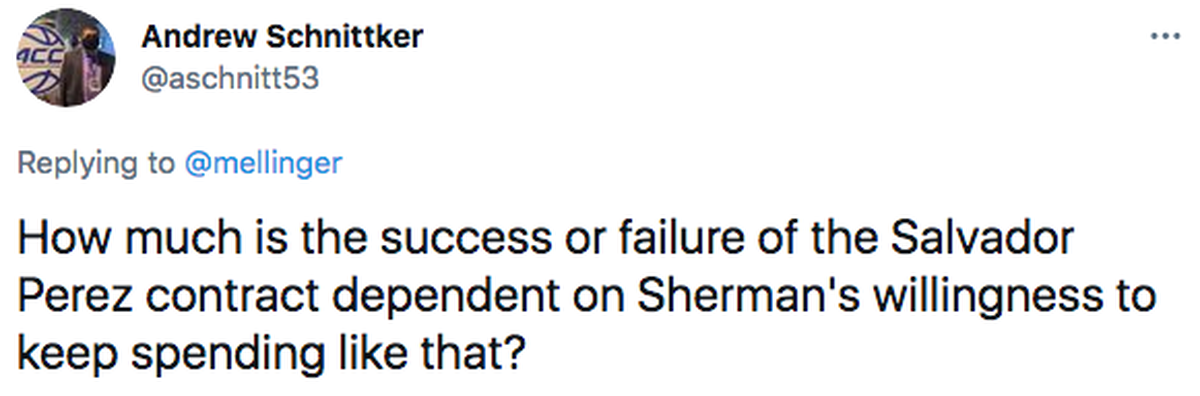
Lots, which is why I made that part No. 1 in this column.
We’re still learning about John Sherman and how he’ll run the Royals, but everything we know so far is positive.
This is the biggest contract in club history, and Sherman had plenty of reasons not to do it. If he decided that lost revenue from a shortened season without fans came at the wrong time to give an aging catcher $82 million, well, would anyone have ripped him for that?
There is a concern from some fans that the Perez contract will make the Royals something like house poor, where the next contract can’t get done because Perez is taking up all the money.
Most of that is paranoia and muscle memory from the dark years. The Royals will never have a $238 million payroll like the Dodgers, and they probably can’t often get to $123 million or so like the White Sox.
But David Glass had a history of the Royals’ payrolls ranking higher than their attendance, and there is nothing in Sherman’s leadership so far to believe that won’t continue and even enhance.
Again, it’s worth noting that most of Perez’s money will come when many of his teammates are in the cheapest years of club control, but even setting that to the side this is a clear statement that Sherman is willing to invest.
If that means he’ll be similarly aggressive with the young pitchers when it’s time, or Adalberto Mondesi if they can work through the complications, or even Bobby Witt Jr. then this is a welcomed development for Royals fans.
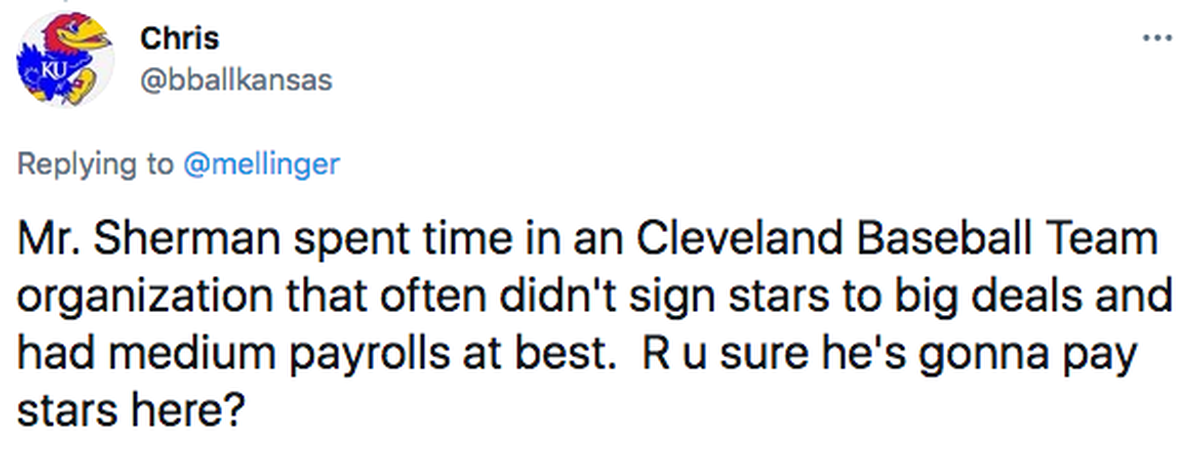
It’s a fair question.
And, no. I’m not sure about anything with Sherman. Owning a baseball team is a decades thing, and we haven’t even seen the Royals in one full season with him yet. So I don’t think anything is a lock.
But I also know that just because the Dolans operate a certain way in Cleveland does not mean Sherman will do the same in Kansas City. Sherman is his own man, with his own ideas.
He built his fortune on his own, as an entrepreneur, and I have to believe there is a confidence and trust-in-self that comes along with that and applies to owning the Royals.
The Royals are evolving with him. Some of that was already in the works when he took over, but he’s also pushing the franchise forward. That should be welcomed.
There is no way to know what Sherman would have done with Francisco Lindor. If things break the right way maybe we’ll see a version of the answer someday with Bobby Witt Jr.
But a lot of this is about front office recommendations and personalities and factors out of a club’s control.
So, the point: we’ll continue to learn more about Sherman as time goes on. But I don’t think it’s smart to assume anything from Cleveland — good or bad — will dictate how he operates in Kansas City.
I also don’t know what he’s shown so far to make you think he’s not willing to spend on the right players.
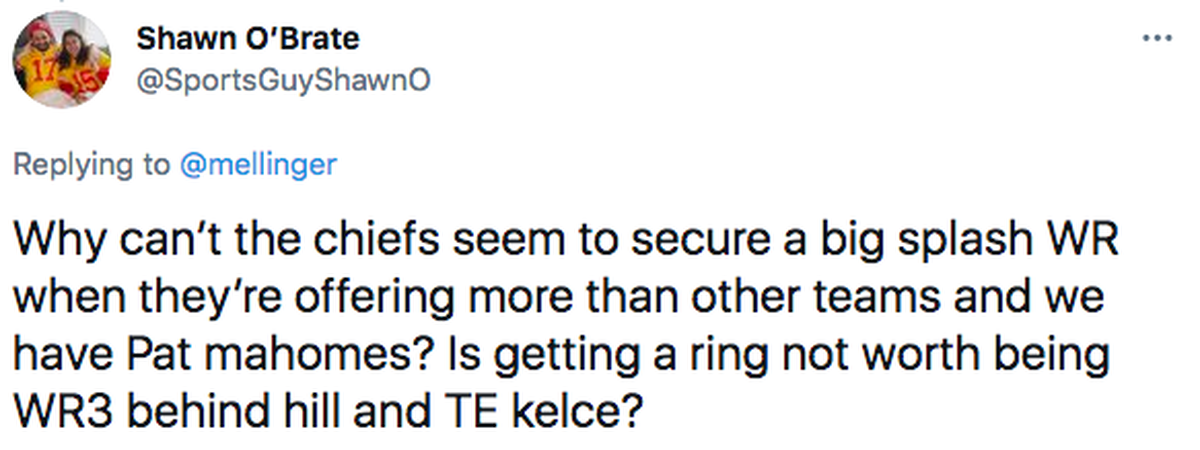
The most logical explanation would be a lack of perceived opportunity.
This would be particularly understandable for JuJu Smith-Schuster, who has had 166 and 128 targets in his two full seasons.
Last year, Mecole Hardman was third on the Chiefs with 62 targets. Sammy Watkins is the player Smith-Schuster would effectively replace (and upgrade), and if you prorate Watkins’ numbers with the Chiefs over 16 games you get 61 catches for 759 yards and four touchdowns.
You can see why that’s a no for a player looking to flip a productive 2021 into a big free agent deal when the cap goes up in 2022, and that doesn’t even consider the comfort Smith-Schuster must feel with his teammates and coaches in Pittsburgh.
Now, all that said, yes, I would have expected the Chiefs to have been able to land at least one of the receivers they’ve pursued.
But, again, this needs to be the main point right now: any definitive judgments on the Chiefs’ offseason right now are something like a definitive judgment on a 3-point game early in the third quarter.
We don’t have all the information yet. The game is not over.
The Chiefs are a solid left tackle, promising No. 3 receiver, and probably a corner and pass rusher away from having a good offseason.
There are plenty of free agents remaining, and the draft is particularly long on linemen and receivers.
There’s a long way to go still.
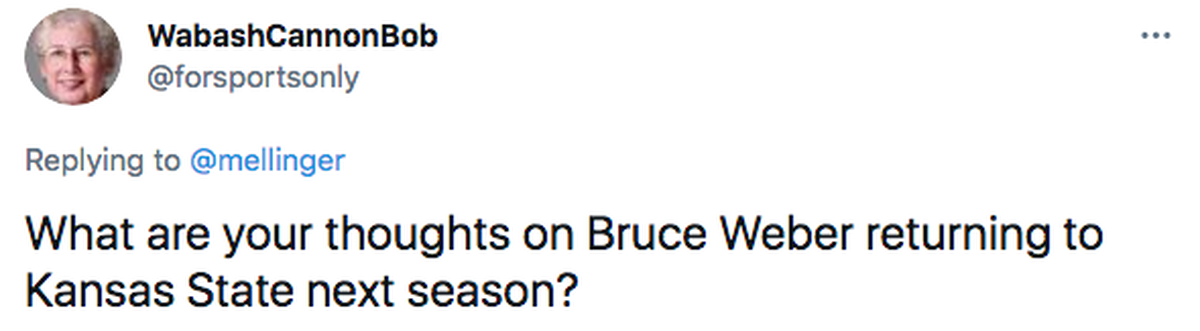
Complicated. My feelings about Bruce are conflicting and layered but can generally be summarized like this:
I respect him as a coach and like him as a man while recognizing that he doesn’t always make it easy.
If Weber was fired today, you would not get a passionate outcry from me or, I’m guessing, anyone else. K-State is 20-41 over the last two seasons, and just 7-29 in the Big 12.
Coaches of Weber’s experience should be able to avoid bottoming out like that, and even as he has objectively accomplished more than Frank Martin at K-State there is an undeniable feeling that Weber’s teams have a ceiling that Martin’s just didn’t.
Perception impacts reality in college sports in a way it just doesn’t in the pros, and that’s something Weber often struggles with.
Weber has been close to being fired before, and there are only so many times you can fly that close to the sun.
So if K-State fired him, fine. That’s justifiable.
But!
There is every reason to believe K-State will be significantly better next season. That should be an NCAA Tournament team. They are building around a core, and the players seem to believe in him, and with Covid and everything else maybe this isn’t the best time to fire a coach you know can succeed.
So giving him (at least) one more year makes plain sense, too.
Now, all that said, four players entering the transfer portal — including Dajuan Gordon, their second-leading returning scorer — is a suboptimal look.
Weber needs to get guys bought in, and it sure looked like he had that at the end of the season.
One more year of K-State on the bubble, one more year of Weber coaching for his job.
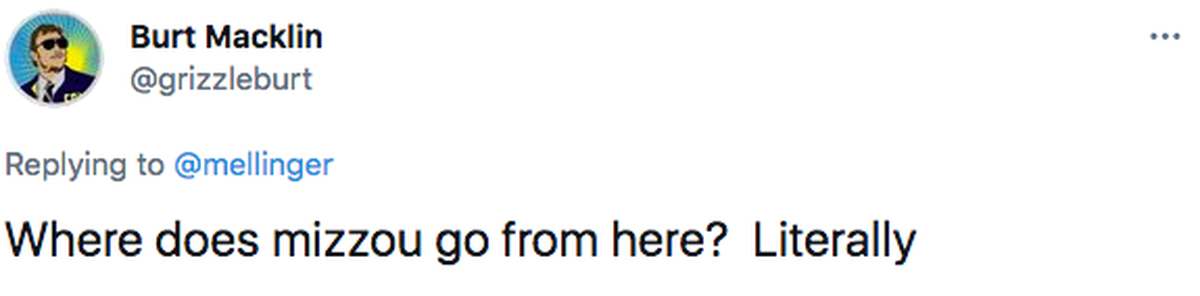
Yeah, this is not good. Vahe — as he does — put this in the perfect tone. You should read the column if you haven’t, but it was basically “it’s now been 11 years since Mizzou won an NCAA Tournament game, and it’s impossible to know how much longer it’ll be for the next one.”
I didn’t realize this until Steven St. John pointed it out: Cuonzo Martin has been a head coach for 14 seasons and he’s won an NCAA Tournament game in one of them.
This Missouri team had some nice moments — wins over Oregon, Illinois, Tennessee and Alabama — but far too many second-half fades and stretches without baskets. The lineups Martin played against Oklahoma, particularly at the end, did not make logical sense.
Worse than all that, Mizzou is likely to lose its top four scorers from this season. That should be an opportunity to reload, but at the moment Mizzou’s recruiting class ranks 40th nationally and ninth in the SEC according to 247sports.
Martin will be the coach at Mizzou. His contract gives him security rare for college basketball coaches.
I’m not here to tell you that’s a bad thing. Cuonzo is easy to root for. He stands for the right things.
What here telling you is that Mizzou just finished a season it underperformed, and is now going into a future that is uncertain at best.
Part of the appeal with Martin was that he’d land recruits that had recently been off-limits for MU, especially talent from St. Louis. That hasn’t materialized.
This is a rough moment for Mizzou. The immediate past was not as good as the hope, and the immediate future looks difficult. These are the moments where coaches earn their money. These are the moments that Martin needs to rise.
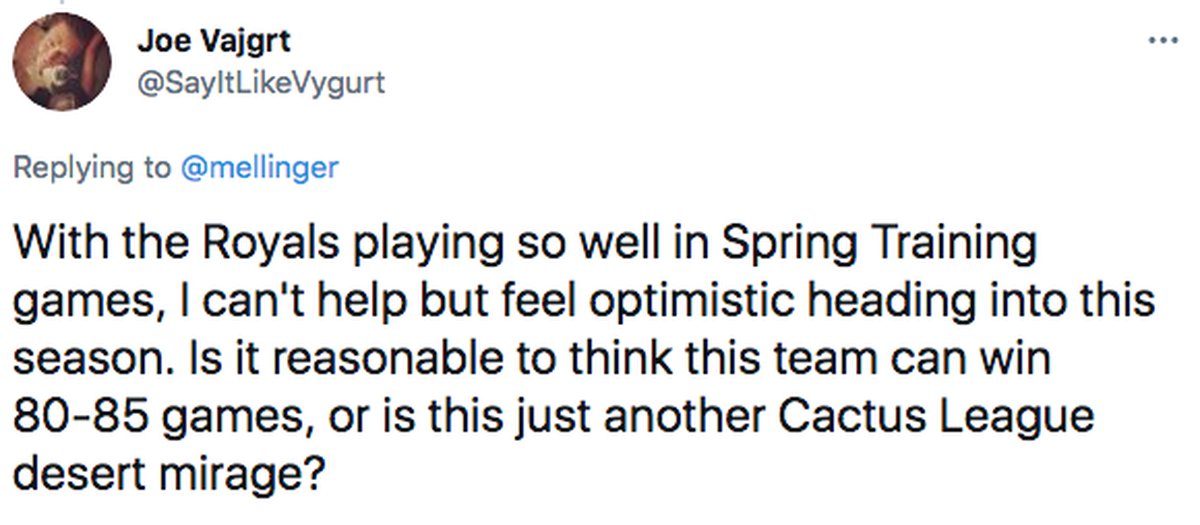
That’s not unreasonable, but I do think it’s fair to say they’d need a lot of good breaks to get there. They’d need health, they’d need development, they’d need a bunch of 50-50s and even some 40-60s to go their way.
But it’s possible, and I suppose here I should say that none of this has anything to do with spring training performances.
There is an old baseball saying that the biggest lies are what you see in March and September, because the context of the competition is often only vaguely similar to the games that determine which teams are winners and which teams are flipping rosters and coaches.
The Royals carry even more variables than normal teams, in part because of experience but also because they are relying on young pitchers in a season of unprecedented challenges for young pitchers.
Teams have always seen anything above a 20 percent jump in workload as a red flag for major injury, and here we have a 60-game season followed 162. You can do that math.
All teams are in the same spot, of course, but few will rely on so many pitchers who have never completed a full big league season. Even Brad Keller, the opening day starter, has topped out at 165 1/3 innings and was shut down with a few starts left in 2019.
The Royals, like all teams, developed a plan that attempted to mimic the lost action — bullpens thrown a few innings at a time, on video, with feedback from coaches — but nobody is under the illusion that real game action can be replicated that way.
So, the Royals have some flaws. The lineup might be a bat or two short. The pitching is hard to project. They finished 13th in the American League in runs with Sal Perez hitting like Prime Mike Piazza. The bullpen was pretty good last year, but going hard for 60 is a different thing than covering 162.
All that said, there are a lot of reasons to believe. Or at least to hope. They have a diverse set of skills, with a recent home run champion, two recent stolen base champions, premium defenders at center, short, second base and catcher, and some genuine momentum and good vibes within the clubhouse.
The AL Central is loaded, and there will be a dozen unexpected challenges the Royals must navigate. But they have a chance, which is something we haven’t been able to say since 2017. And they’re trying, which is something not every team can say.
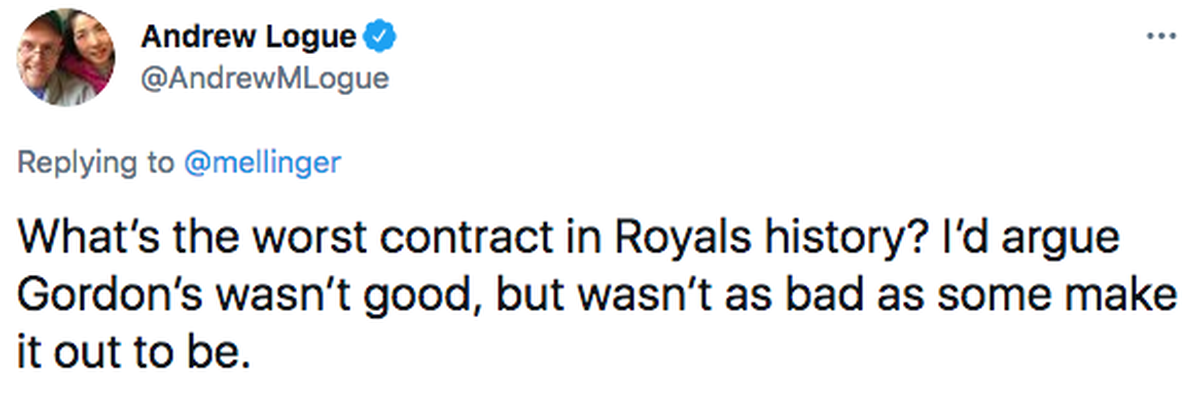
Before we answer, let’s all agree that you could do this game for any team in baseball and come up with some whoppers. Even the Rays once overpaid Pat Burrell for a DH role he wanted no part of.
This might sound counterintuitive, but the first that comes to mind is Mike Sweeney’s $55 million extension. Not because it didn’t work out — Sweeney’s back gave out, so what are you going to do?
But because it became a franchise albatross — this is what some Royals fans are afraid will happen with Perez’s deal — and worse it turned ugly, with Sweeney being routinely booed at home, the unwitting receptacle for fan frustration that predated him.
Jose Guillen for $36 million was really bad, too. The Royals wanted his lineup presence to make it easier for Billy Butler and Alex Gordon, but he underperformed on the field and the combination of Guillen being emboldened by the contract and the weak leadership from manager Trey Hillman was dead from the start.
But for me, the worst one might be five years and $70 million for Ian Kennedy. And not just because Kennedy was 31 years old, and had an adjusted ERA 15 percent worse than league average the previous three seasons, which made it an overpayment from the jump.
It’s because the Royals included an opt-out after two seasons, which guaranteed it would be a bad deal. Because if Kennedy performed well, he was gone. If he didn’t, he stayed.
As it turned out, the Royals got one good season out of Kennedy, two bad, one sort of good year as a closer and then essentially nothing in the last year of the deal. He was worth a total of 6.3 bWAR in the deal, and just 2.0 in the last four years.
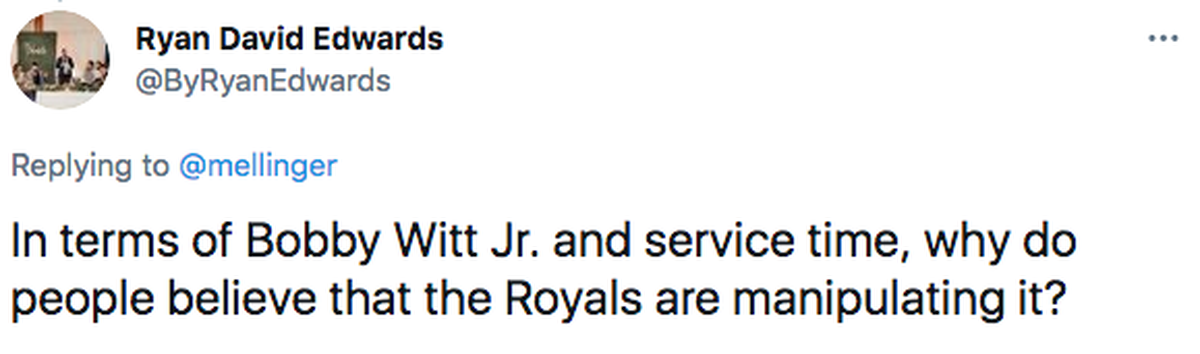
If you don’t know any of the context, this fits some of the general checkboxes for service time manipulation:
- Top prospect, check.
- Small market team, check.
- Hype including standout spring performance, check.
- Established big leaguers singing the kid’s praises, check.
So you can see how this catches momentum. It’s tempting to trash teams for taking advantage of a horrific rule that incentivizes the best talent from being in the big leagues.
Everyone should want the rule changed, so I’m not going to come down too hard on anyone looking out for examples. Maybe I’m being naive, but that’s what I think is going on here. We see a headline on social media and we react.
We all do it, including me, and I have more motivation and reason to avoid doing that than most.
But there is zero manipulation here. The Royals don’t play that game, and we have a thousand examples, most recently the time they started Brady Singer in the second game of the season when waiting a few days — A FEW DAYS — would have given them an entire extra year of control.
If you’re a baseball dork like I am, it’s kind of fun to imagine what a union grievance about Bobby Witt Jr. being reassigned to the minor leagues would’ve looked like.
“Sir, it is patently absurd that this team without even a crumb of history of service time manipulation has callously reassigned this 20-year-old to Class AA even after his extensive professional production of...” — here the lawyer puts on his bifocals, reads from notes — “...hitting .262 in 37 games of Rookie ball two years ago and backing that up with .289 in 40 plate appearances of spring training this year against mostly minor league competition while also not being quite what we expected at second base.”
Bobby Witt Jr. will probably be a star big leaguer. He has a real chance to be the best player the Royals have drafted since Carlos Beltran. If he doesn’t turn into at least an All-Star caliber player, we do not yet know what it would be to hold him back.
He is strong and fast. He has soft hands and a big arm. He’s made adjustments, earned the respect of older teammates, and has an innate ability to balance the confidence of someone with enormous talent and the humility required for a young ballplayer. He does appear to be the entire package.
But there is nothing sinister in letting him get a few months against minor leaguers, to soften the whiplash of going from an alternate site last summer to (I believe) the big leagues this summer.
Speaking of that inevitable promotion...
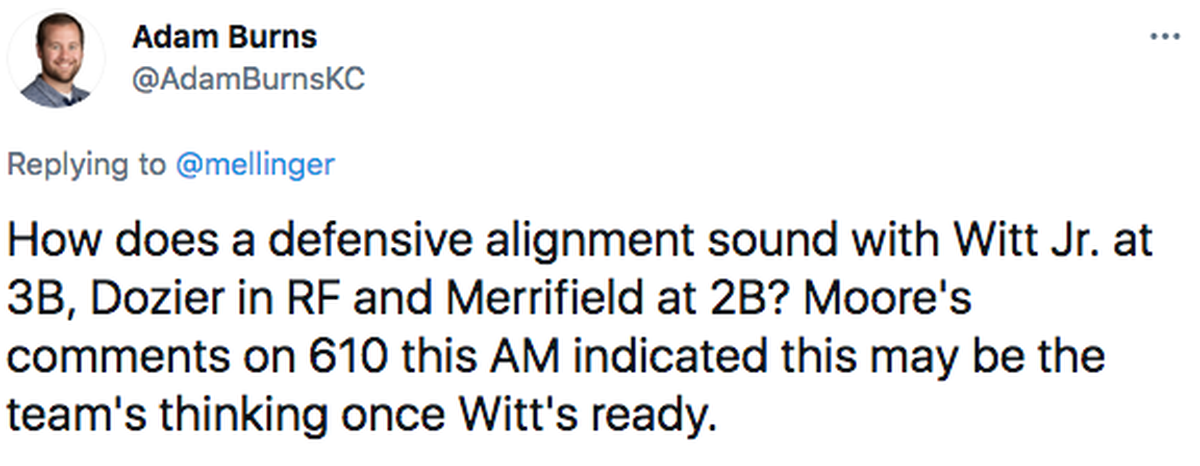
The Royals are all-in on the sport-wide trend of positional versatility, and they have the athletes to pull it off.
Whit Merrifield can play anywhere but shortstop. Hunter Dozier can play either corner infield spot or right field. I assume he could play left field, too, but he’s only played 16 innings there. Adalberto Mondesi can play shortstop, which means he can play literally anywhere.
The Royals believe Bobby Witt Jr. is in the same spot.
The rough plan has always been for him to come up as a second baseman, but have believed he could also play third base or anywhere in the outfield. They drafted him believing he could be a big league shortstop, but with Mondesi there it doesn’t make as much sense to put a lot of time into that.
That rough plan of Witt Jr. at second, Dozier at third, and Merrifield in right was created primarily from two beliefs:
1. Be as good and athletic up the middle as possible, and...
2. Dozier has a chance to be above average at third, but probably tops out at average in right field.
I have to say, that makes a lot of sense.
But the Royals are going to give him more time at third base, which would open the scenario you’re talking about here: Dozier would go to right field, Merrifield goes to second.
If the calculation is that Witt Jr. is an upgrade at third, Dozier can be fine in the outfield, and that Merrifield is better at his natural position than Witt Jr. is at a new one, then cool.
But I also wonder about Witt Jr. eventually in centerfield. Please keep in mind, I’ve never seen him there. But he profiles well athletically, and if the Royals — and I’m using the if here literally, because I don’t know — believe he can handle centerfield then that’s a pretty good way to maximize your best athletes.
I don’t know what will happen with Michael A. Taylor. Maybe he’ll hit enough. But he’s on a one-year deal, so it’s worth keeping in the back of the mind.
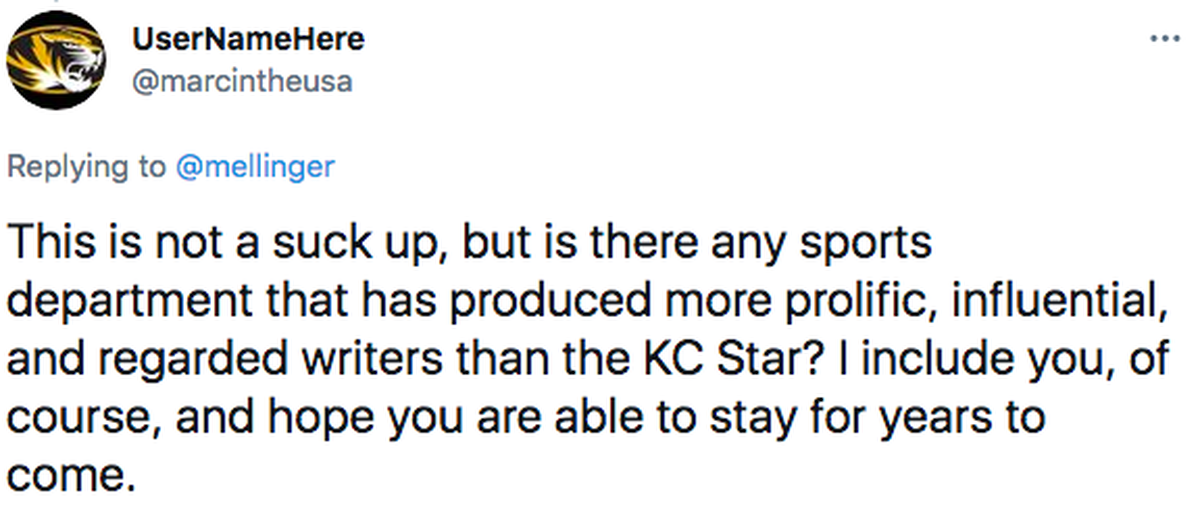
Hey, that’s very cool of you to say. One of my favorite parts of this job is the opportunity to be around, learn from, and become friends with some really talented and dedicated people.
I do believe those good vibes — and there are exceptions; no place is perfect — can have a snowball effect. The Star is able to attract more talented people than a newspaper in a similar city, and it’s been able to retain them longer than maybe would otherwise be the case.
Again, there are exceptions, but I think for the most part if you asked people who no longer work here about their experience they’d have positive things to say.
I know I have and continue to learn from old friends like Passan and Liz and Wright and Vac and Andy and I’m going to quit before I name so many that the others aren’t left out, and I could say the same about the people we have now.
Vahe and Blair are straight up two of the best human beings I know, and care deeply about doing good work. Sam Jr. is a consistently terrific reporter with a great voice. Herbie has a relentless energy and focus that can rub off, and a ridiculously hideous collection of footwear that makes you feel stylish by comparison. Newell and Gary have to be among the best pair on a college beat, and Kellis tells me everything I need to know.
The writers probably get more attention than we deserve, but we’re all better with the support of editors like Rosen and Fickett and Fannin and Farmer.
I know I probably sound like a bad infomercial here, but if you give me a chance to brag on people I work with I’m probably going to take it.
I don’t think I’ll be here forever. That’s just not how this business works. But I do love this specific job, and the biggest reason is the connections I feel with so many readers and sources. That’s a special thing, and something I’ll never take for granted.
This week, I’m particularly grateful to be getting my second dose of a COVID-19 vaccine. I cannot believe the miracle that is a vaccine created and distributed essentially within a year of the start of a pandemic.
If you are on the fence about this, I want you to know that I and others who’ve had shots feel better than fine. It’s a gift to yourself and others. If you’re having trouble scheduling an appointment, follow this account and turn notifications for it on. Or you can sign up for various volunteer opportunities that often have shots for workers.
That’s how I got mine, and I promise that being a small part of that miracle and seeing what it meant to people made it one of my favorite days before I knew I’d get a shot.