
Mellinger Minutes: The Chop, what Arrowhead will feel like, GMDM’s future and NFL/COVID
I have to tell you: I believe the theory now even more than I did then.
This is not I Told You So.
This is Lets Notice What We See.
In the 11 days since that column posted, Chiefs president Mark Donovan and then chairman Clark Hunt avoided or offered non-answers when asked about the chop.
Donovan may have misunderstood a question about the chop, giving an answer that focused on the war drum. Hunt did not talk about the chop when asked directly, instead focusing on the process of educating the franchise and fans about Native American imagery.
In July, when explaining the club’s approach to Native American imagery, Donovan intimated that the decision on headdresses would be easier than the chop because headdresses don’t have a vocal or large support. The chop does.
The team’s actions have fallen in line: announcing a ban on headdresses two weeks ago, and nothing beyond further discussions on the chop.
The Chiefs are trying to figure out just how vocal, and just how large, the chop’s support is.
The clock is ticking. The Chiefs will play America’s Game — the NFL’s standalone season opener, the celebration of the gift that is football — in nine days. With some 16,000 fans set to be there in person, it’s hard to imagine the Chiefs not wanting a buffer between announcing the policy and kickoff.
That’s particularly true if they decide to change policy.
The Chiefs can be fairly criticized for a lot, but they do listen to fans, and that’s true with everything from adopting Travis Kelce’s “Fight For Your Right To Lombardi” thing to, actually, the reversal of a ban on the chop in the 1990s.
In the 10 years I’ve covered the Chiefs, a not insignificant number of season ticket holders have told me stories of Clark responding to a letter or call. They’re not always happy with the response, but the frequency of these stories and others makes me believe the Chiefs put real effort into being in tune with their fans.
There are few areas the team needs more clarity on fan sentiment than the chop, which has become both a signature part of the gameday experience and increasingly controversial.
It stands to reason that they want as much information as possible about how many of their fans would be angry if the chop was discouraged* and how many would be angry if it wasn’t.
* I’m saying discouraged here and not banned because, unlike the tangible (and ridiculous) headdresses, I’m not sure how it’s possible to ban the chop. You can stop playing the song, and you could even have players record messages about it if you feel strongly, but I don’t know how a ban would work if (in normal times) 70,000 people start chanting and chopping.
I don’t have access to that information, obviously. My sense is that many Chiefs fans love the chop, but that it’s a vocal minority that would be angry or stop cheering if it was discouraged, same as I believe it’s a vocal minority who would be angry or stop cheering if it wasn’t.
If I’m right about that, it would help explain why this is taking so long. It’s a tough decision for the team. They want as much fan feedback as possible before making it.
This week’s eating recommendation is the pastrami at Milwaukee Deli and the reading recommendation is Dan LeBatard on how the NBA became political.
Thanks to everyone who’s listened to our Mellinger Minutes For Your Ears podcast, and here is a big warm invitation to start if you haven’t already. We had some delivery issues in the beginning, but those are fixed now that we’re out from behind the paywall and free on Apple or Spotify or Stitcher or whoever you kids get your shows these days.
Last week, I shared some insights from watching training camp practices and Brett Veach explained in his own words how the Chiefs turned the salary cap into a well-trained poodle.
A reminder: if you’d like to participate in the show — and we’re better the more questions we have — please call 816.234.4365 and leave your first name, where you’re calling from, and almost literally any question.
Please give me a follow on Twitter and Facebook and, as always, thanks for your help and thanks for reading.
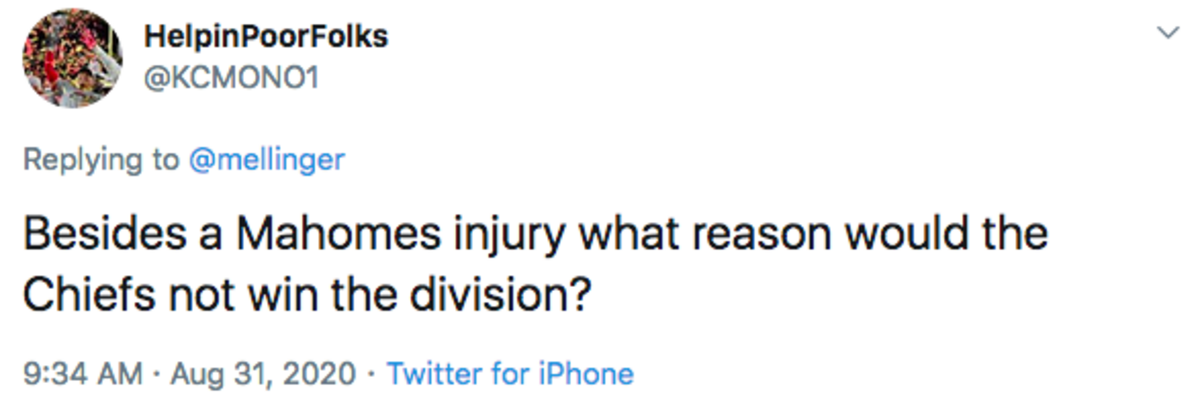
The list is unrealistic, to be honest, and I’d go a step more: the Chiefs would win the AFC West with Chad Henne at quarterback.
But, sure. We can do this. We can come up with a situation.
Let’s start with the competition. You can make a logical case for any of the other teams in the division, but to me the Broncos have the best chance of jumping up. They have a young, rising quarterback, and surrounded him with weapons. The defense is aging in places, but also dotted with some stars, most notably safety Justin Simmons.
The worry is about the offensive line, and that’s significant because if the line is garbage then the whole thing could crash down.
But for our purposes here, let’s say the line is OK, and everything else comes along and the Broncos win 10 or 11 games. It’s certainly possible.
You only mentioned Mahomes, but lets leave all injuries to the side here. They are impossible to predict, and can happen to any team.
The way for the Chiefs to fall back is some combination of bad luck, complacency, and opposing coaches figuring out something in year three against Mahomes that they have not so far.
It’s honestly hard to imagine the offense struggling, but perhaps there’s a way for opposing defenses to bracket Tyreek Hill, hit Travis Kelce early and often, and exploit the one part of the Chiefs’ offense that isn’t at least above average — the interior of the offensive line.
You can’t really force the Chiefs to run. Reid’s playbook includes so many passes that function like runs, which is part of why the interior line’s struggles with power blocking don’t show up as much.
But you can beat the Chiefs with stunts. We’ve seen opposing defenses have some success with that. So, maybe if you limit the long passes and beat the Chiefs inside you can drag the offense closer to normal.
One of the many things I’m curious to watch about the Chiefs this year is the pass rush. They have two premiere guys on the line, obviously, with Chris Jones and Frank Clark. But the rush was inconsistent last year.
They were remarkably clutch, best illustrated by Chris Jones’ fourth quarter in the Super Bowl, but the down-to-down production wasn’t there.
Was that by design somehow? Either with guys setting up blockers for the right moments, or Steve Spagnuolo saving his best calls for the most important snaps?
Or was there an element of luck, or just fortunate timing?
Willie Gay Jr. seems like a fix to the Chiefs’ problems covering running backs on pass plays, but there’s no tangible reason to believe they’ll be better against the run.
One of the great magic tricks of the Chiefs’ improvement defensively last year is that they remained awful against the run in the view of both analytics (dead last in Pro Football Focus’ run defense grades) and traditional statistics (29th with 4.9 yards per carry against).
It was a weakness that was never fully exploited, even by the 49ers, who had every reason and opportunity to do it.
So, anyway, that to me would be formula: drag the Chiefs’ offense toward reality by eliminating big plays and pressuring up the middle, and grind them down on the other side (and keep Mahomes on the bench) by running the ball.
The Chiefs appear to have a difficult schedule — Texans, Ravens, Patriots, Bills, Bucs, Saints — so maybe this is all enough to find six or seven losses.
If that happens, the Broncos and Chargers (if they can stop getting injured) could find 10 or 11 wins.

I am, and I have no idea.
Lets do these in order.
I believe in data. I believe in experts. And I particularly believe in experts acting on data. That’s why I wear a mask in public, and why I try to distance with everyone but my wife and kids. It’s also why I believe young kids should be in school.
Now, determinations around COVID-19 are not the same as determinations around, say, heart disease. I think we all understand that. We’re all guessing, even the experts.
But Arrowhead Stadium is outside. The Chiefs’ protocols are strong. The experts have signed off.
They’re giving it a try, and if the thing sinks, it’s going to sink because fans aren’t following the guidelines. I have many doubts about whether fans will follow those guidelines, and certainly understand why (at last count) 27 of 32 NFL teams are not allowing fans.
But again, this all speaks to the guesswork involved.
If I had a normal job, I wouldn’t go to a game this season, but that has more to do with the insane prices and the quality of the home experience.
If you’re in the Arrowhead stands, outdoors and mask on, distanced from others who also are masked up, are you taking on higher risk than going to the grocery store? Or to a restaurant? Or to, say, the Nelson-Atkins Museum?
So, sure. Limited fans. Sounds as reasonable as anything else.
Your second question. It’ll look weird, I’m sure of that, but beyond that I’m not sure of anything. The joy from being at Sporting’s first game with fans last week caught me by surprise. I didn’t know what to expect, but hearing an actual crowd cheer for the first time in more than five months lifted me.
My guess is that compliance will be inconsistent. Some will follow everything, others will find a way to be “actively eating or drinking” for four quarters, and some will be in the middle.
But I do think those who go will enjoy the experience, and not just to see the championship banner unveiled. They’ll enjoy the noise, the action, the teeny-tiny slice of kind-of-maybe-just-a-little normal.
I also feel certain that anyone watching at home will feel those same emotions, and could buy a 55-inch QLED 8K TV with the money they saved.

A list? A list!
1. Lots of energy. The Chiefs are not a plug-and-play Super Bowl champion. They dropped passes, they lined up in the wrong spots, they missed assignments. That happens. But there was a consistent energy in every practice I watched, both from players and coaches.
With a team in this situation, you can’t help but wonder about complacency. Complacency is human nature. And maybe the Chiefs will have some of that, at some point.
But I didn’t see it in camp. They were focused, active, audible.
2. Clyde Edwards-Helaire is going to be a star. The only question is whether he can pass protect, and that’s an enormous question for any Chiefs running back*, but assuming he can check that box he’s going to be a problem.
* Honestly, the most important job for any Chiefs employee is to protect the quarterback.
The Chiefs have pass plays that include Tyreek Hill and Mecole Hardman stretching vertical, Travis Kelce and Sammy Watkins ripping through intermediate routes, and Edwards-Helaire out of the backfield.
Unless the defense is going with seven defensive backs, the choice is to blitz and hope you can force Mahomes into a mistake or cover Kelce or Edwards-Helaire with a linebacker, and that just doesn’t seem like a good way to go through life.
3. Willie Gay Jr. made a lot of progress. They started him slow, but you could tell by the way he was used that he earned trust. His speed was always a potential good fit in sub packages. One of the ways to beat the Chiefs last year was to isolate your running back on their linebackers, and the Chiefs have a much better counter to that now.
Bonus: much of training camp is set up in a way that already benefits the skill guys, and nobody wants to think about this, but Chad Henne and Matt Moore each looked good to me. It’s hard to evaluate decision making, and going through progressions in camp, but they were each consistently accurate, particularly on deep passes.
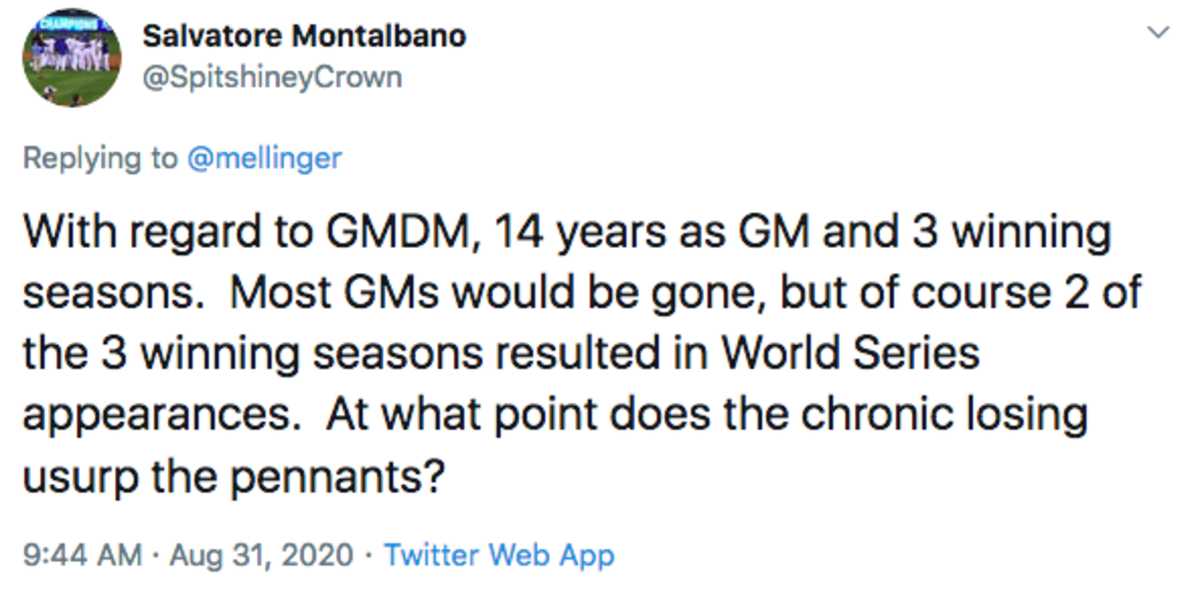
Sooner than some might think, but also not as quickly as others might want.
Consecutive pennants and a World Series championship in Kansas City might be the most impressive accomplishment by any baseball front office in the 21st century.
I’ve made this point before, but if Dayton Moore was fired today, an excellent candidate would be a man with a proven track record of building a strong farm system and success in a small market. Which is Dayton Moore.
But it’s also true that the group should have had more success in 2016 and 2017 and that — notably, at the order of David Glass — mismanaged the offseason after 2016 by neither going all-in on winning or rebuilding.
The thing to watch here is the relationship between Dayton Moore and John Sherman.
A lot of owners would’ve fired Moore after the 2012 season, and a lot of GMs would’ve gone back home to Atlanta after the 2014 season. Glass believed in Moore, and Moore believed in Glass. It worked, but theirs was more than a business relationship. They had a deep and genuine mutual appreciation. Without it, they would not have lasted as long together.
Moore and Glass did not have that kind of relationship immediately. Sherman and Moore are building it, but real relationships take time.
I have no doubt that they respect each other, but I also have no doubt that Sherman sees consecutive 100-loss seasons as unacceptable and that with his time in the game has a name or two of people he’d trust to run a front office.
The Royals are building something. You can make a joke about that if you want, and the truth is nobody can be sure how this will go either way. But it’s an interesting group, particularly with the young pitchers. It’s hard to imagine Moore not being entrusted with seeing this out.
But the Royals have lost 207 games the last two years. They are terribly positioned long-term when compared to the rest of the division — the Royals’ young pitching is promising, but take a look at the White Sox’s young hitting. It’s hard to imagine Sherman reaching the point that he believes this push won’t take, and then not simultaneously reaching the conclusion that he needs a new general manager.
This is not a GMDM On The Hot Seat take.
But a new owner means the timing has reset.
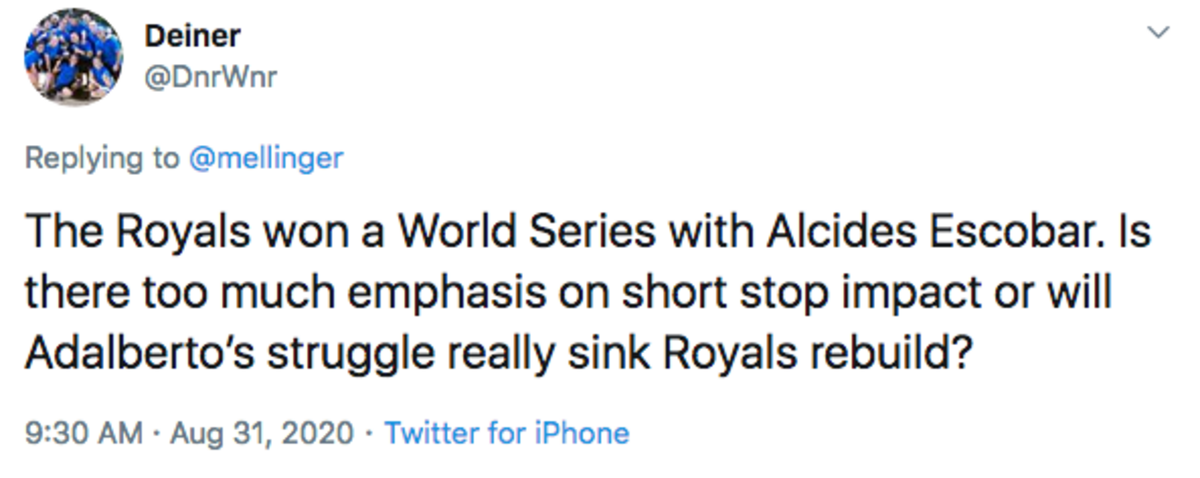
The truth is in the middle. Shortstops matter. They’re more important than most other positions, harder to find, and harder to replace.
I know it’s fun to dunk on Escobar, but he was a good player. There’s a lot of value that can’t easily be quantified in a man who can provide very good defense at a premium position while starting all 162. He should not have been the leadoff hitter, but somehow it did work, and he was a very good baserunner.
Escobar gave the Royals what they needed, in other words.
The long-term plan for Mondesi has always been with him as a more central role than Escobar was. They saw him as a superior defender, with elite speed and a potential power bat.
Baseball’s structure means one player cannot make or break a franchise. We have examples of this all over the sport, from Mike Trout to Bubba Starling.
And, actually, if the worst possible outcome becomes reality and the Royals need to move on from Mondesi they could be well positioned with Bobby Witt Jr.
But Mondesi’s potential is so enormous, and his production in 2018 was real. The Royals have put a lot of time, energy, and belief into Mondesi. If it turns out he can’t contribute, it would be a big blow for the baseball team and a bigger blow for morale.
I’m going to write about this more this week, but for now, let me leave a thought here.
When Alex Gordon was 25, he was a broken prospect, injured and pushed from his position. When Mike Moustakas was 25, he was demoted.
Neither had a season as productive as Mondesi’s in 2018.
Let’s not pretend we know how this will end, good or bad.
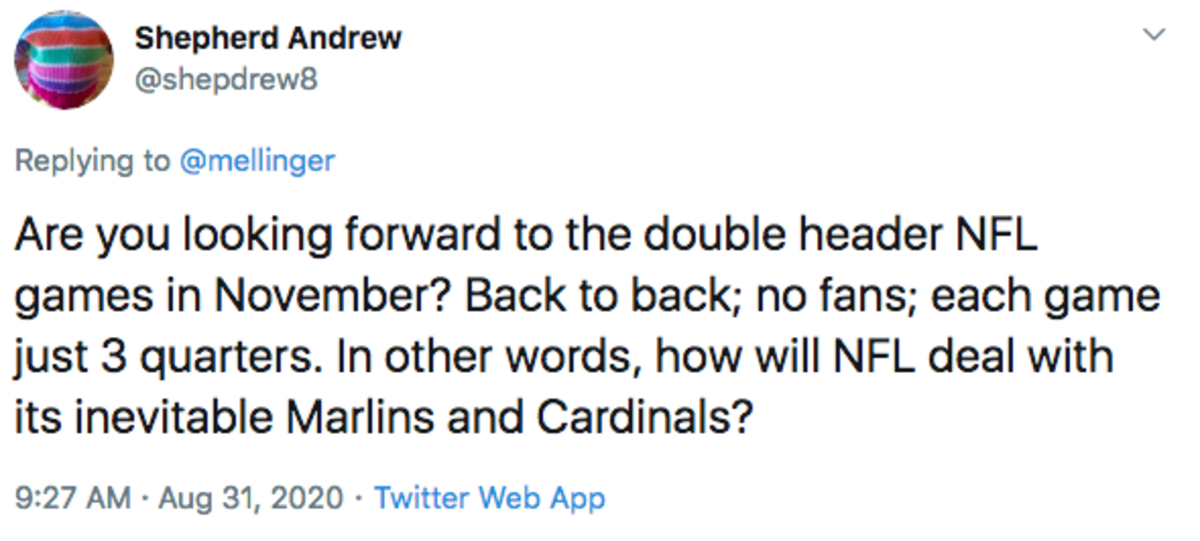
Look, I can be as cynical as anyone, but I have to say the structures in place are really good. The test results have been almost unbelievably encouraging.
There are very few players — at one point recently, it was just one — on the league’s reserve/COVID-19 list. It’s worth noting here that being on the list does not necessarily mean a player tested positive. It could mean the player was exposed to a positive or presumed positive.
That’s a hell of a record, and I hope I’m not getting too far off your question here to mention this should be proof that we can have a balance between caution and living our lives if we’re all careful.
Our employers don’t have the resources of the NFL, with daily testing, but going through a very small form of the league’s guidelines through training camp opened my eyes to a few things.
Rick Burkholder made the point multiple times that it’s not testing that’s keeping the league from case numbers. It’s precaution. It’s constant distancing whenever possible, masks, regular hand washing, stuff like that.
The league is not immune, of course, and if you had to bet one way or the other you’d probably take the side of at least one outbreak.
The NFL, it seems to me, could be better positioned to control one than MLB, though.
I believe the risk of travel has been exaggerated by many — there has not been a single outbreak among flight attendants, for instance, or one tied to a flight or airport. That’s especially true with professional sports teams, who fly charter, and avoid the busier terminals and TSA lines that the rest of us commoners deal with.
But, all that said, it’s worth mentioning that NFL teams stay in a hotel one night every two weeks*.
* I’m assuming teams won’t stay in hotels the night before home games this year, but even if I’m wrong about that, it’s still less time in a hotel than a baseball team.
More to the point of preventing outbreaks, NFL players are pushing to continue daily testing. It’s hard to imagine what convincing argument the owners could present to relax testing.
Now, all that said, the league has built some escape clauses into the schedule. All teams share the same bye week as their week 2 opponent, for instance.
The NFL has seen how close baseball came to shutting down. The Nationals played their season opener the same day Juan Soto went on the COVID-19 list.
Daily testing and fear of failure should get the NFL a chance to do better than MLB, but if games need to be canceled or postponed the league’s incentive will be in finishing the playoffs, not necessarily in playing every game on its originally scheduled date.
That’s not much of an answer for you, but then, does anyone have much of an answer for any of this?
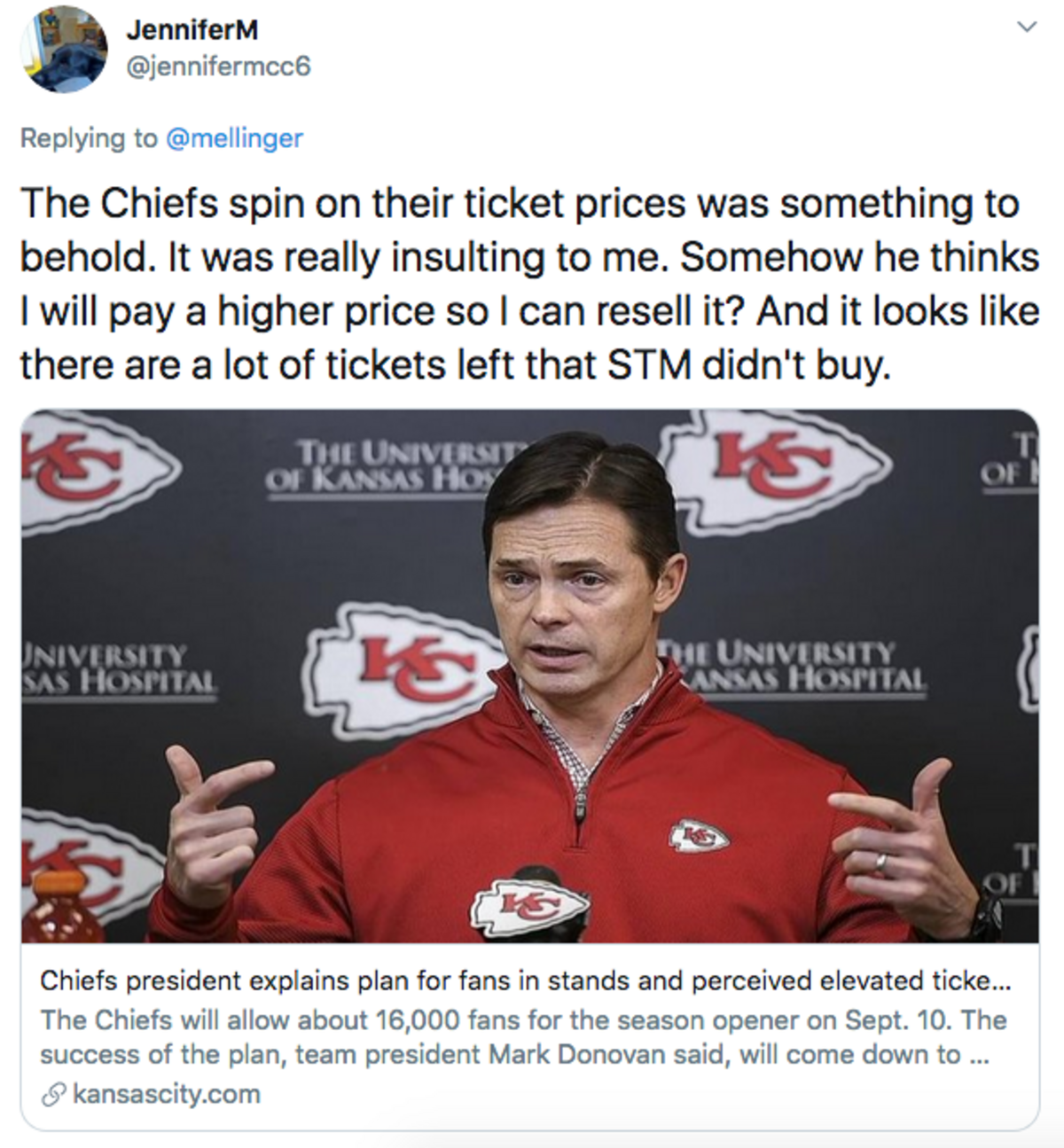
(NOTE: Enough of you have told me you prefer the screenshots here for questions, so that’s what we do, but if you want to read the story that Jennifer is referencing click here.)
There is no solution here that would’ve made all fans happy, but the Chiefs screwed this up.
They are offering benefits to fans to transfer 2020 season ticket money to 2021, which is great, but also something like the bare minimum for what amounts to an interest free loan.
The problem began around the time the Chiefs decided to charge their most loyal fans three times or more the accustomed rate, often for worse seats.
Now, one place where I do understand the team’s motivation is with the secondary market. They and many teams watch their product re-sold at higher rates. The Chiefs are a football team, but more than that they are a business, and businesses generally don’t like creating a product and selling it and then watching an unaffiliated third party sell it for even more.
Now, the Chiefs have been aggressive and proud of an increasing role in technology with ticketing, and I have to believe there’s a way to guarantee tickets can’t be transferred or resold.
But doing that would mean taking less money, which is quite literally not what the Chiefs are in business to do.
I do understand the frustration in the spin. The Chiefs could’ve instituted a fair Super Bowl, Mahomes-ian bump in prices without leaving many season ticket members feeling like marks. I’ve heard from many who are frustrated, and who couldn’t empathize with that?
But I also don’t know how logical it is to criticize a business for trying to maximize revenue or, perhaps in this case, minimize losses.
The great power of professional sports is that the allow us to forget we’re rooting for businesses. It’s no more logical to criticize the Chiefs for charging a lot of money right now as it was to criticize Chiefs fans for staying away in 2012.
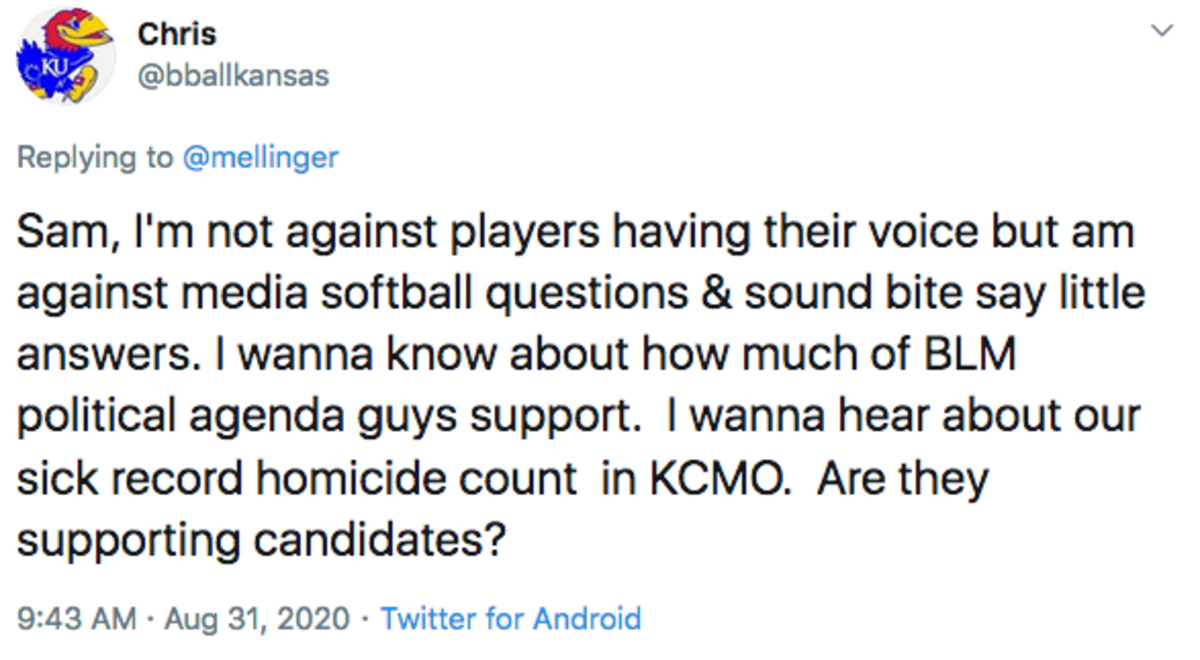
What questions are you wanting?
The athletes have been given every opportunity to speak what’s in their heart, and have been asked about alienating some fans in the process.
This is also worth pointing out: different people hear the words “black lives matter” in vastly different ways.
There is a lot of backlash against the capital letters Black Lives Matter movement, enough that I went to their website and clicked the “what we believe” section. A sampling of what it says:
- “build local power and to intervene when violence was inflicted on Black communities by the state and vigilantes.”
- “creating a world free of anti-Blackness, where every Black person has the social, economic, and political power to thrive.”
- “We acknowledge, respect, and celebrate differences and commonalities.”
I don’t know. Doesn’t seem terrible.
Again, I don’t believe any athlete agrees 100 percent with everything someone associated with capital letters BLM has said or done, same as I don’t believe any person capable of their own thoughts aligns completely with either major political party.
If you’re looking for a complete listing of an athlete’s political beliefs, point by point, then we see what’s going on totally differently.
What I see is athletes being frustrated to the point of protesting that America continues to produce evidence that (no capital letters) black lives do not matter as much as white.
Some people will scoff at that, call it nonsense, but like I said earlier in a very different answer I believe in data. The data is clear. People who look like me are treated better by cops and courts than Black people.
I’m probably getting off point here, and this may simply be a false perception on my part, but it seems that at least some of the resistance to change is baed on a natural insecurity that if I’m white and doing OK for myself then my hard work is invalidated.
That if I’m white and we put in the work to create a fairer society then it means a worse outcome from me or my family.
But when I hear athletes talk about — and, again, here I’m hearing lower case — black lives mattering I hear a desire for equal treatment, not better.
I don’t particularly care about an athlete’s political views. I don’t believe they are qualified to talk about how to lower homicide rates, I’m not interested in which political candidates they support and, actually, believe it’s smart of them to not focus on any candidates or either major party.
What they’ve talked about is getting more people involved in the process, particularly those in demographics that have been traditionally less involved.
That a stance like that is taken as political is a symptom of our failed politics.
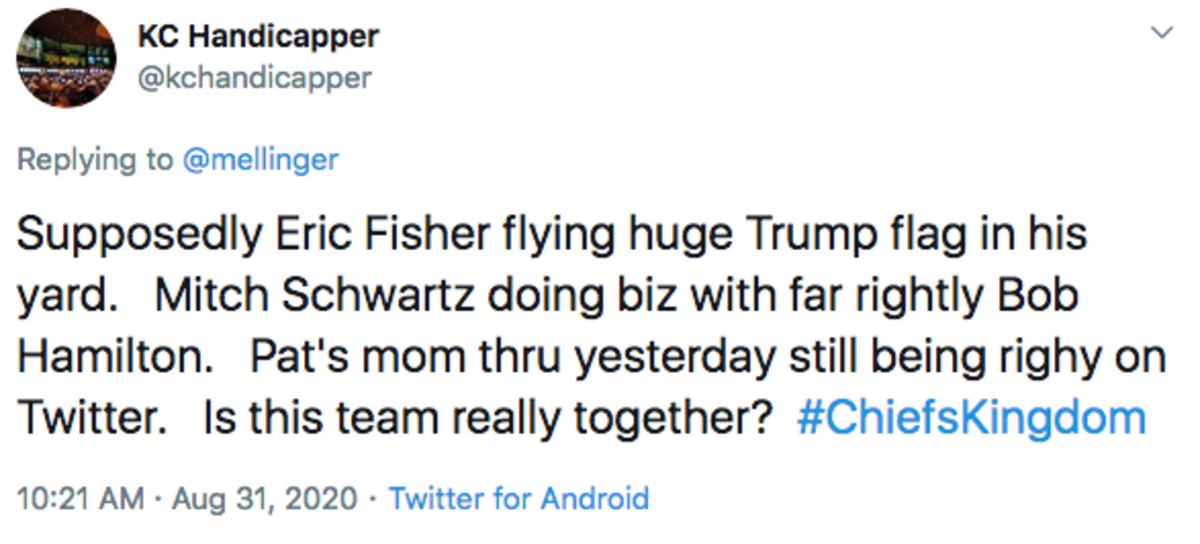
Are they not allowed to express support for Republicans? What are we doing here?
If this is sarcastic, apologies, but I’m including this here because it’s emblematic of a problem I’ve written and talked a lot about.
Being together doesn’t mean you have to agree politically, and it sure as heck doesn’t mean you have to agree on a particular candidate or party. No NFL locker room has ever agreed on a presidential election, and it shouldn’t.
I hope you have friends or family or co-workers who you disagree with politically. If you don’t, I hope you seek out information or perspectives from people who think differently than you.
This is becoming a broad theme in this space lately, but we have let ourselves become so counterproductively divided. Ronald Reagan had the great line: “The person who agrees with you 80 percent of the time is a friend and an ally, not a 20 percent traitor.”
We’ve somehow created this new reality where someone who agrees with you 99 percent of time is a 100 percent traitor.
It’s complete nonsense, same as anyone who believes you can’t want fairer treatment for minorities and better conditions for cops.
A great irony here is that the extremism has made things worse for everyone. Protecting bad cops, or condoning any violence — the extremes on both sides — have conspired to create a worse situation for all.
We need to get way past this. We have more in common than we’ve been led to believe by politicians. Respecting differences and trying to learn from each other would be a nice change.
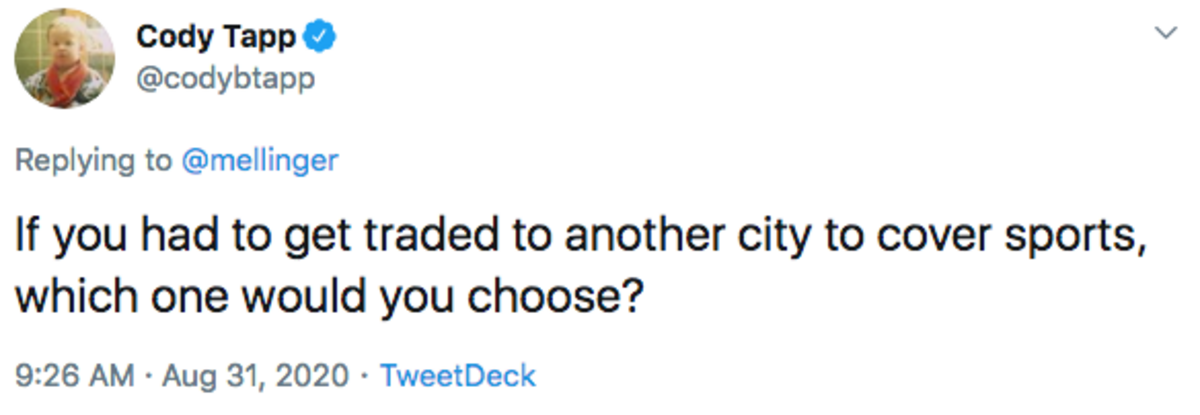
My favorite cities are Chicago, New York and San Diego. I’ve never thought I’d be happy living in New York long-term, and it seems to me that Chicagoans don’t want their sports from people who aren’t Chicagoans.
That leaves San Diego, which is an amazing place, with perfect weather and lots of beach and great restaurants and everything else, but I’m surprising myself here by going off the map.
I choose Denver.
The weather fits, there’s a ton of great options for a three-day weekend with the family, and there’s as much sports passion there (plus four pro teams) as any city in the country.
One wild card: Detroit. The summers in Michigan are pretty magical, my wife has a lot of family and friends there, and the same plusses apply from Denver with the three-day weekends and sports passion. It’s basically Denver without mountains, and I’ve never been skiing in my life, so all good there.
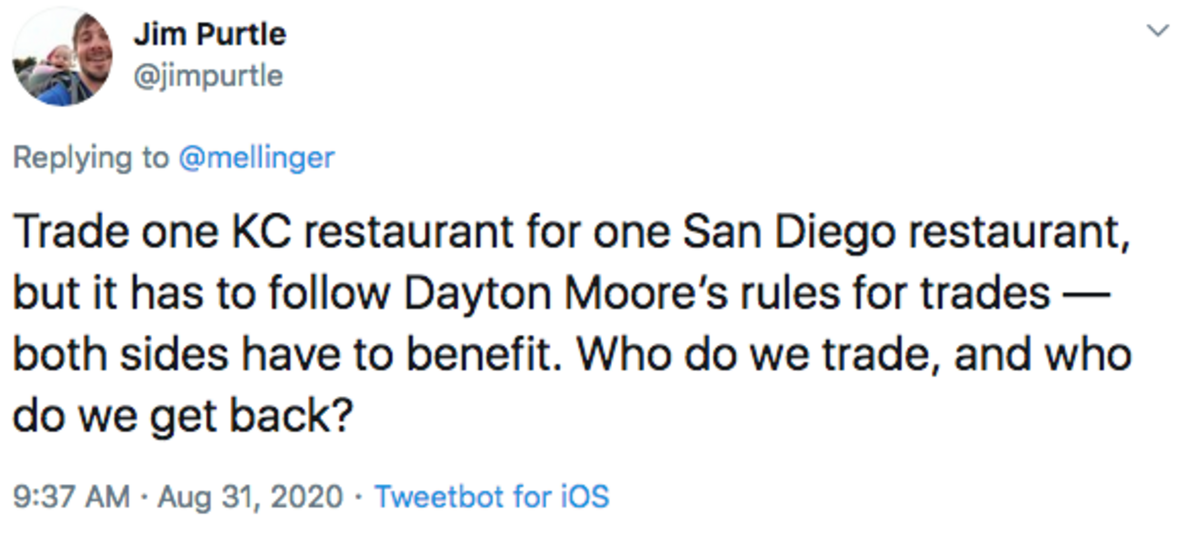
Slap’s for Blue Water Seafood.
I thought about going after El Indio here, or even trying to figure out the name of this crazy good sushi place, but we’re already covered here with plenty of great Mexican food and better sushi than anyone who’s not from here believes.
So I’m targeting Blue Water, ignoring the plain fact that the whole concept of a wild variety of super fresh fish cooked perfectly to order is going to be harder to pull off here than across the street from the ocean.
We have some good seafood spots, but nothing like Blue Water, and now I can’t stop thinking about the ceviche there.
It might be too expected to trade a barbecue spot, but it just makes too much sense. We have more good ones than you could reasonably go to in a year, and it should be our honor to spread the good word of real barbecue to new audiences.
The San Diego delegation may decide this is not an even trade, and I don’t like to negotiate through the media, but I’d be willing to go as high as Q39 here.
This week, I’m particularly grateful for how my family has been able to navigate this summer. We really made out pretty well, all things considered. I desperately miss going to Royals games as a family, and our younger son’s 4th birthday party in April was basically just us and videos that friends and family sent, but we got to spend a lot of time together, road tripped to Michigan for a week, rode bikes, played baseball, and spent time at the lake. We’re lucky.
This story was originally published September 1, 2020 at 8:38 AM.