
Mellinger Minutes: Chiefs’ consistency, enforcing mask-wearing, Royals’ future and more
Four of us have been able to watch every Chiefs training camp practice, which is great, but it’s also worthless if we don’t share anything with you so here goes:
Of all the takeaways from camp so far, the most important (other than Patrick Mahomes remaining healthy) might be what appears to be a daily war on complacency.
In all preseasons, but especially this one, it can be hard to know where the line is between legitimate and manufactured storylines. By definition, a good day for a team’s defensive line means a rough day for its offensive line. Hitting is limited, so it’s hard to judge defenders, and easier for receivers to standout.
But I have been curious about how this camp would generally feel. About the energy. The focus.
A thousand reasons exist to explain why no team has defended a Super Bowl title in 16 years, but one that makes a lot of sense is complacency. Football games are won on the margins, especially in the NFL. It’s hard to maintain the level of diligence and work required to win a championship.
Athletes sometimes go to comedic lengths to motivate themselves with stories of disrespect. That’s hard to do when you’re getting fitted for rings, watching banners drop, and hearing everyone call you champ.
With all the justified disclaimers about this only being training camp, this does not look like a complacent group.
Tyrann Mathieu’s energy is impossible to miss. He’s constantly talking, both to motivate and educate. Patrick Mahomes is an insatiable perfectionist, demanding to know if a receiver’s feet were inbounds or out — the difference was less than an inch either way — in a one-on-one rep.
The running backs finish their reps to the goal line. The corners celebrate PBUs. Tyreek Hill whipped his helmet off and screamed to the sky after an incompletion in the end zone, and my best guess is that he was upset he ran a route a step or two shallower than Mahomes expected.
The coaches are something, too. The soundtrack of a Chiefs practice is Mahomes’ unmistakably raspy voice shouting pre snap, and Eric Bieniemy’s unmistakably direct voice screaming after the play.
If you’ve never watched one of the Chiefs’ open training camp practices, Andy Reid is an impressive leader. He sees everything, but rarely talks directly with players* on the field. Much more often, he lets his assistants coach their guys, or relay messages from the head coach.
* Other than the quarterbacks, at least.
The approach accomplishes at least three objectives. First, it frees Reid to focus entirely on watching and absorbing. He seems more this way. Second, it empowers his assistants. They’re not waiting on him. They can act. You can see why so many of his former assistants are head coaches now.
And third, it means that when he says something practice sort of shuts down for a brief second, the message taken straight to heart.
Reid’s hiring and the restructure of the organization’s power is the best thing Clark Hunt has done as chairman. You see it in so many ways, most of them big and far reaching, but perhaps none more intimately than in these practices.
It’s a heck of a thing to see. The NFL is built for parity. It’s built for 3-13 teams to have hope the next year, and for 12-4 teams know nothing is secure.
All of that is true, and the Chiefs have won 11, 9, 11, 12, 10, 12 and 12 games in Reid’s seven years. In the seven years before he arrived they won 9, 4, 2, 4, 10, 7 and 2 games.
That’s not luck. That’s the result of a million moments like the ones we’re seeing in camp, with talented players motivated in the right ways, with one of the most successful coaches in modern NFL history operating without ego — players can show personality, assistants can make decisions, everyone is empowered to move forward together.
None of this means the Chiefs will win another Super Bowl, this year or ever. They might. But the highlights of the game in Miami and the parade down Grand can hide how much had to go right. There are no guarantees.
But it’s also hard to watch this group operate and not believe they have a very good chance.
This week’s reading recommendation is Bill Shea on whether athletes are paid too much, and the eating recommendation is the cheeseburger at the Green Room.
Thanks to everyone who’s listened to our Mellinger Minutes For Your Ears podcast, and here we have a special announcement:
The show is now free and available to all.
Over the last five months, we’ve heard from so many of you about the show. We’ve listened. We’ve heard you say you enjoy the content, but that it’s hard to access. Just guessing, 90 percent of the feedback has included one or both of those points.
People much smarter than me have tried to create alternatives that make it more accessible but remain as a subscriber benefit. The decision has been made to make it available to everyone, starting this week. It’s already up on Spotify, and should be everywhere else in the next few days.
I’m excited about the switch, and if you’ve been locked out by our failure to make it more accessible, I hope you’ll check out some of the past episodes. We’ve talked to John Sherman about his vision for the Royals, Mark Donovan about the discussions around the tomahawk chop, Peter Vermes about his days at Jiffy Lube, Mike Matheny about his faith, and more. It’s been fun, and hopefully now it’ll be even better.
If you’d like to participate in the show — and I’d love for you to do that — please call 816.234.4365 and leave your first name, where you’re calling from, and almost literally any question.
Please give me a follow on Twitter and Facebook and, as always, thanks for your help and thanks for reading.
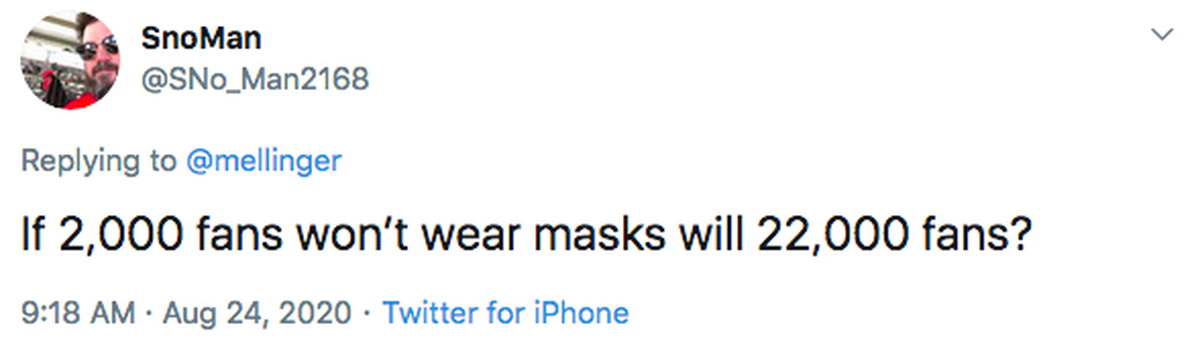
No, they won’t.
The Chiefs posted videos and pictures showing fans masked up, but the truth was significantly different. This should surprise nobody.
We talked about this last week, right? The protocols the Chiefs announced are great. Masks, sanitizing, distancing, limitations on tailgates, the list goes on. Public spaces working to open back up should learn.
But being good on paper is much different than being good in reality. Ask the Browns, AmIRite???
The enforcement is the biggest gap between theory and reality. Enforcement is the part the Chiefs and public officials haven’t satisfied, or explained sufficiently, and there’s a reason — they can’t.
Because who is the enforcer?
They’re not having cops do it. So we’re talking about ushers? How exactly do we think that will go?
This is not me arguing against having fans. You might know the next sentence I’m about to write: I believe in listening to the experts. The experts say wear masks, cool. The experts say teams can host games with diminished capacity, cool.
The Nelson-Atkins Museum is opening next month, and the reaction was mostly applause, some of it from the same people who think fans at games right now is reckless.
How does that make sense?
Tonight, Sporting Kansas City will host the area’s first major game with fans since the Big 12 tournament was shut down. Attendance will be limited even more than the Chiefs, with just 14 percent of capacity.
I’m curious to see how this goes. How many fans are in masks. How well the distancing policies work.
This is one of the ultimate buyer beware situations. Those who lean cautious won’t consider going, either to Children’s Mercy Park tonight or Arrowhead Stadium this fall. It will be up to those who go to self-police, but then, how inclined will those comfortable gathering in crowds be to play hall monitor on strangers?
There is just so much we don’t know, and local sports right now paint a telling picture:
The Chiefs and Sporting are hosting fans, with the blessing of both league commissioners and local health officials. The Royals — with the same geography, same case data, same everything — are not hosting fans.
The same information, viewed by smart and well-intentioned people, with two opposite conclusions.
Who can say which is right?
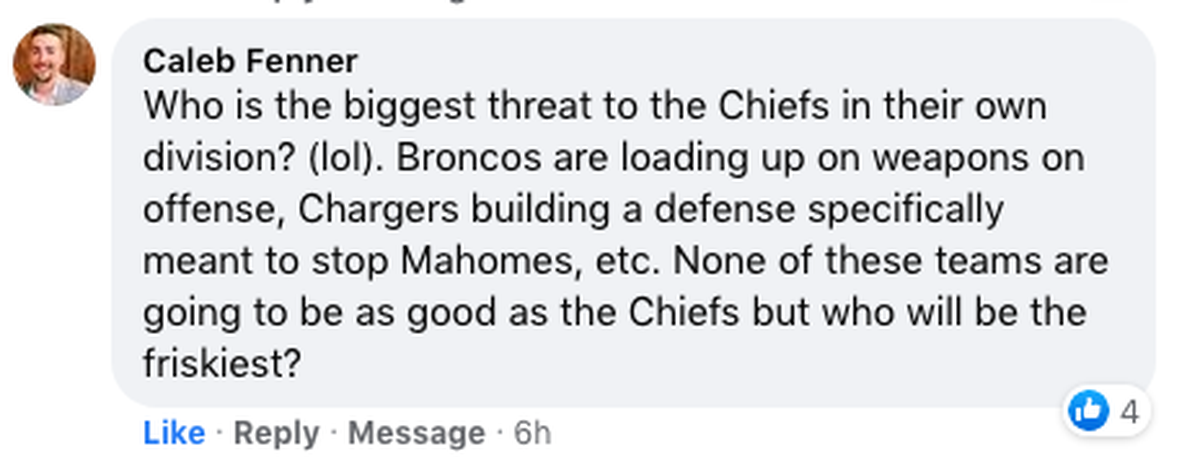
I actually like what both of those teams are doing. It’s hard to see the Chiefs being threatened this year, but particularly if the Chargers are right about Justin Herbert the division will be more competitive in the future.
The Broncos are interesting. Drew Lock is being given a platform for success that never fully materialized at Mizzou. They have three good running backs, two stud receivers, and Noah Fant could grow into a star tight end. I have some reservations about the offensive line, and they’ll need to get younger on defense*, but you can see what they’re trying to do there.
* Though Justin Simmons is a STUD.
The Chargers are doing it the other way, with a mess of talented and versatile defenders. That is swimming upstream in some ways because this is obviously a scoring league, but sometimes the best approach is to zig when others zag. If Herbert turns into what the Chargers envision, that would obviously go a long way.
The Raiders have some pieces, and the potential of Henry Ruggs with Jon Gruden could be fun. Mike Mayock seems to have helped stabilize an organization that needed stability. But they’ll need to be better at quarterback.
If we’re talking about the next two or three years, the Broncos have the potential to become one of the league’s best offenses, assuming Lock is what some of us believe he can be.
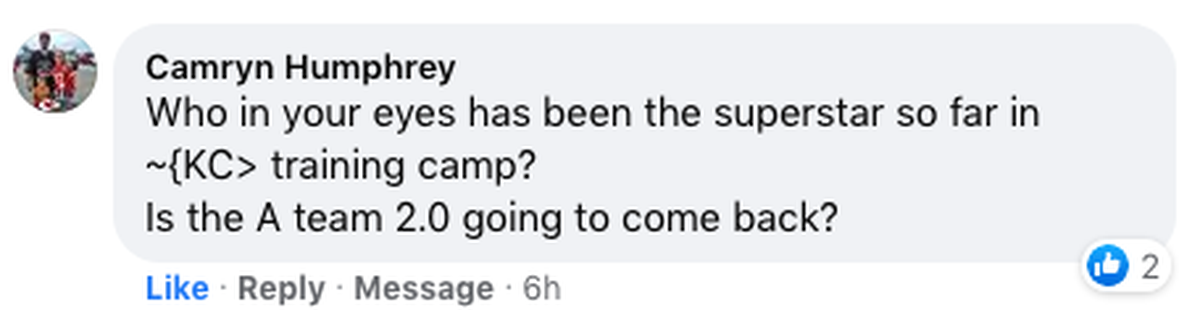
Is the A team 2.0 going to come back?
Well, look. If I’m reading the spirit of your question correctly the first two answers aren’t at all what you’re looking for but here goes:
1. Patrick Mahomes does something absurd every day. The other day, my goodness, it’s weird to type these words in this order but in a red zone snap he took like one or two quick steps back and threw the ball submarine style, like he’s Dan Quisenberry or something, and I have to tell you it was perfectly placed for a touchdown. And it was the right way to throw the ball in that situation, somehow. The pass sort of went underneath the defense. It was wild.
2. It can be hard to take your eyes off Tyrann Mathieu. He is constantly in motion, constantly in communication, as competitive an SOB as the Chiefs have, but also consistently encouraging. If a player — especially on defense, and ESPECIALLY a defensive back, but really anyone — has a moment Mathieu is often the first one over to encourage or celebrate.
But, like I said, this might not be answering the spirit of your question. Usually fans want to know about lower profile guys who might be ready to bust out. A few have stood out.
- Jody Fortson is listed first here for a reason. He’s made some terrific catches, looked good enough to play on special teams, and I’m coming up empty trying to remember drops or mistakes. Wide receiver is the wrong position group to try to climb on this roster, but he’s looked good.
- Willie Gay Jr. has consistently progressed. You can tell the coaches are giving him a little more everyday, and he’s responded well. They drafted him for his speed, but he also has the look of a willing hitter between the tackles, and he plays with a ton of energy and confidence.
And, yes, of course we’ll be back. Everyone — reporters and teams — are trying to figure out what coverage will look like this fall. I’m actually not sure how many or who will be at games, not just on the road but at Arrowhead. Even distanced, the idea of being in a closed, indoor press box for that long with that many people isn’t awesome.
But no matter what, we will again have more Chiefs coverage than any other independent outlet.
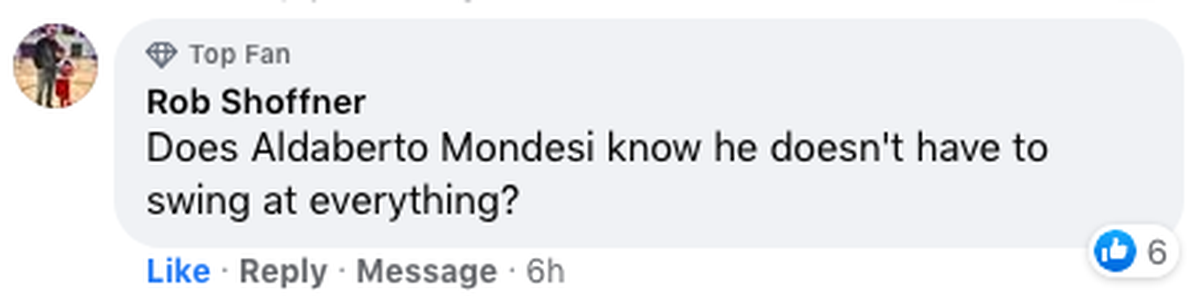
He’s been awful. There are other ways to put it, but you get the point.
He’s striking out nearly one in every three times to the plate, and walking one out of 50. That’s un-good. He’s not hitting for power, not laying off bad pitches, and not making nearly enough contact when he swings. Entering the week, he’d been the plate 103 teams and only driven in two runs.
Basketball teams can rise or sink with one player. Football teams need to be right about their quarterback, or little else matters. That kind of dynamic does not exist in baseball, so any statements about Mondesi’s development being make-or-break for the future are hyperbole.
But he is pretty dang important.
The Royals have built a chunk of their future around him, and have believed both publicly and privately that he will be a star. “Francisco Lindor with less plate discipline,” is how a scout described him to me a few years back.
But what if the plate discipline is something like the original sin?
What if that specific weakness torpedoes everything else? What if it diminishes what he’s capable of offensively so severely that he is an incapable hitter, and what if the struggles there bang away at his confidence enough to limit what he does defensively and on the bases?
That’s at least on the table.
The Royals have handled Mondesi so strangely. They debuted him in the 2015 World Series, essentially as a super pinch runner, then made him their starting second baseman two days before his 21st birthday.
The next spring training, the Royals made Mondesi their opening day second baseman instead of Whit Merrifield. It was a curious decision in real time that is harder to understand as time goes on.
The most frustrating part of watching him is that you know it’s in there. Two seasons ago, Mondesi slashed .276/.306/.498. His adjusted OPS was 15 percent better than the league average, and he stole 32 bases in just 75 games. Project that over a full season and he’s the star the Royals have envisioned.
But since then, lots of struggles. So much of it seems to be about pitch recognition, about chasing sliders and curveballs outside the zone.
Mondesi knows this is a problem. He works on it. But hitting a baseball is the hardest thing in sports for a reason.
His ability to improve on this has an outsized impact on the Royals’ future.
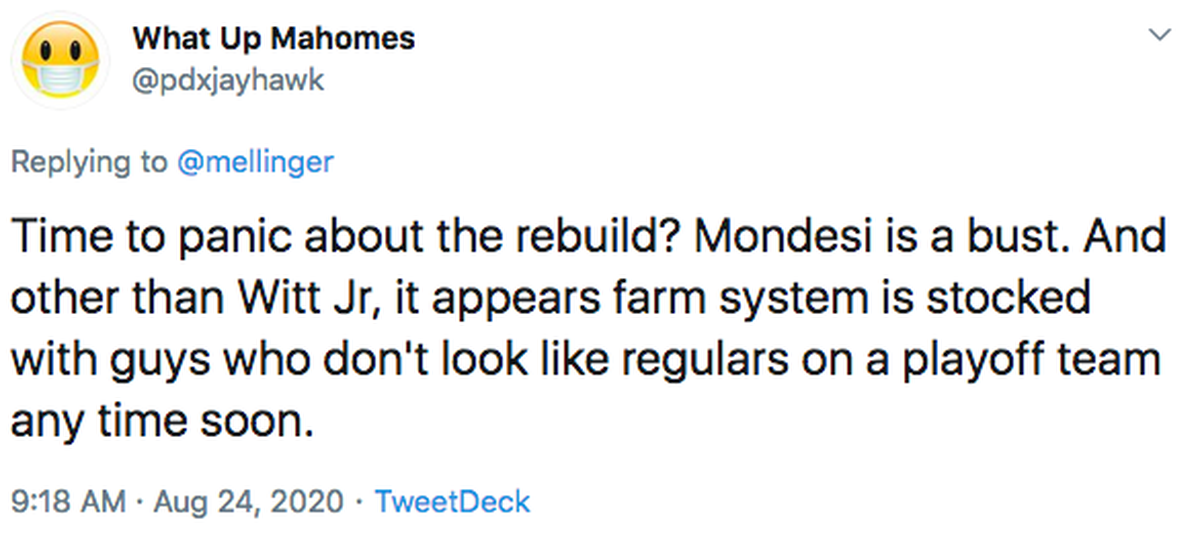
We don’t know that Mondesi is a bust, first. He might be. But we’re not there yet.
You can scoff if you want, but when Alex Gordon was Mondesi’s age he was basically a broken prospect. That’s the year the Royals asked him to change positions, and then he got hurt. When Whit Merrifield turned 25 he was coming off a season in which he hit .270/.319/.391 at Class AA. Mike Moustakas slashed .212/.271/.361 when he was 25.
At the moment, you would not bet any money you wanted to keep on Mondesi becoming a star. But baseball players are unpredictable. It’s a wild sport. We don’t know what Mondesi is quite yet.
The Royals are in a weird spot of the rebuild. You can build a credible case either way, that it’ll take or tank.
They have enough pitching that the bar for the hitters is lower. And they have enough athletes in the system that finding four or five productive big leaguers is well within the limits of possibility.
Then again, Hunter Dozier is 28 years old and the closest thing the Royals have to a young and proven position player. They’re again in this awkward spot offensively: Sal Perez (who is now on the IL), Merrifield, Dozier, Jorge Soler and Ryan McBroom are all producing — and the Royals are next-to-last in runs.
The biggest challenge might be one that’s out of the Royals’ control — the Tigers and especially the White Sox are loaded with young talent, and a step or three ahead in rebuilding.
The Royals have a lot of obstacles. A lot of problems that need solutions. This is the stage when everything can seem more important than it really is, good or bad. Think about how the Royals were perceived from 2010 to 2012.
The most common view was that it was a waste in 2010, then the forecast called for loads of championships when everybody debuted in 2011, and then they stunk again in 2012.
This is not me saying the Royals will win a World Series with this push, or even be in the playoffs. This is me saying it’s too early to be sure either way.
I know that’s the boring answer, but it’s also the honest one.
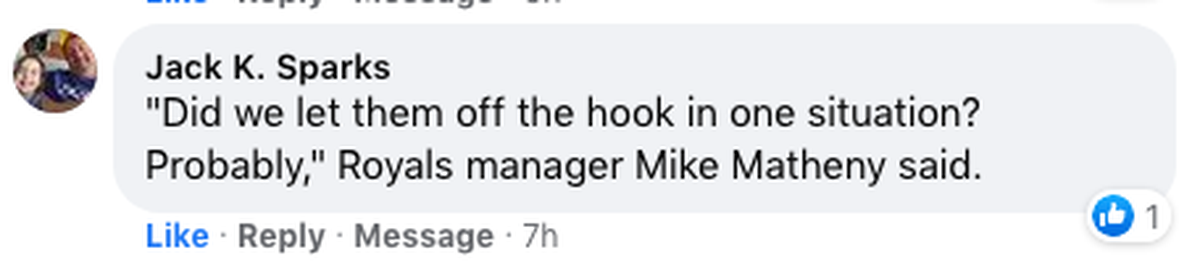
Mike Matheny has a lot of challenges. You know I often say the importance of big league managers is often overrated by fans and media, and I believe that, but we’re about to talk about an exception.
Managers have very little direct impact on how players perform. They can manipulate platoon advantages, and they can raise or lower the pressure on certain guys. But they can’t call plays. They can’t run an easy slant so the quarterback can get a rhythm, or call that pet inbounds play to get the dunk.
But managers do have a lot of influence on how players feel. That sounds funny sometimes, because these are big leaguers. They’ve been through so much to reach this point. They shouldn’t need a swag coach.
But little things matter. Some guys respond better in the middle of a lineup. Some are more comfortable lower. Some never want to sit. Others need the occasional rest.
The manager must know these tendencies and act accordingly.
This is all a setup to the question about whether Mike Matheny did the right thing in letting Mondesi hit in an important spot the other day. The at bat went horribly — Mondesi was wiped out on three consecutive sliders — but if following the Royals has proved nothing else it’s that The Process™ is more important than the results.
Matheny’s inclination in that spot was to pinch hit. I think we’ve heard enough from Matheny already to know that.
But if his decision was based in the belief that Mondesi needs experiences like that to breakthrough later, or that Mondesi’s reaction to being replaced in that situation would be counterproductive long-term, then it’s pretty easy to understand, even if it’s frustrating in the moment.
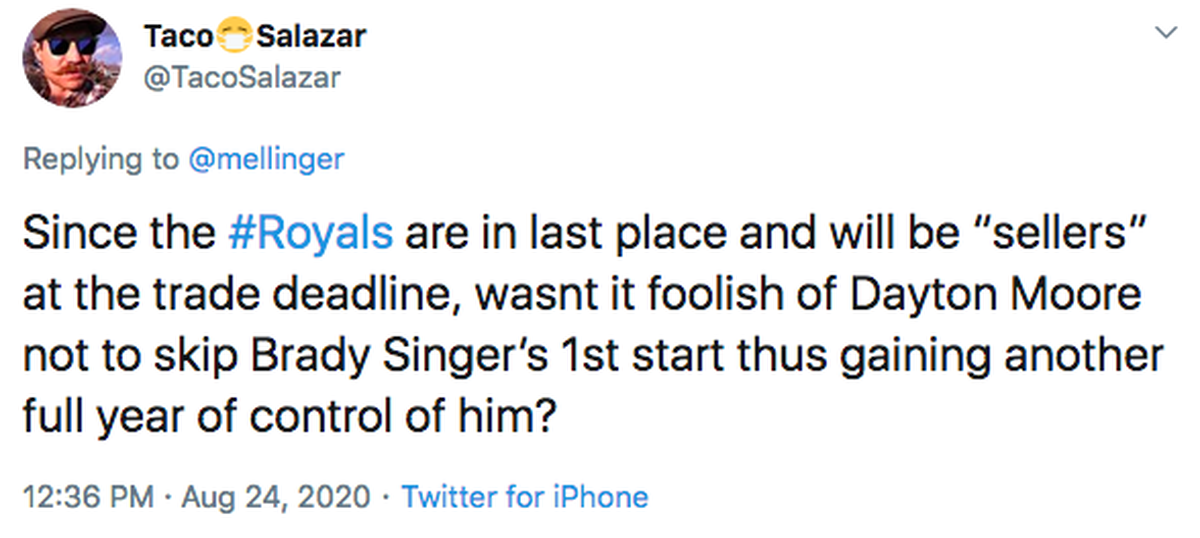
Generally speaking, this is the issue the Royals and I most strongly disagree.
My view is that the rules exist, so it’s up to each team to use those rules to their advantage. My view is that this is particularly important for clubs with limited resources.
The Royals’ view is more holistic, with the belief that players perform best when they feel supported. Their view is that development is the most important thing, and anything that distracts from that top priority should be shot into the sun.
Again, we disagree. The Royals could’ve saved a lot of money by delaying Eric Hosmer’s debut just a week or so, avoiding the so-called Super 2 status and an extra year of arbitration.
They debuted Alex Gordon on opening day which, if Gordon’s career went the way everyone expected at the time, meant they were essentially trading three weeks of him in April 2007 for an extra full season on the back end of the initial club control.
I’m paraphrasing, but from time to time when we get into these conversations and I point out that the team is acting against its self interests in some ways, the response from various club officials goes like this:
“I understand what you’re saying, but if you were this player, what would you want us to do? If this was your son, what would you be telling me?”
It’s admirable, you have to admit. I don’t think they’re motivated by this particular point, but there is an argument that their approach is a competitive advantage, too. Players feel valued. They are proud to be in the organization. They know their bosses have their best interests.
There’s value in that. You’re more likely to get a player’s best that way, and you could see some of that spirit in the culture that built around the 2014 and 2015 playoff runs.
The Singer situation is extreme. The Royals potentially gave up a full season — 32 or so starts — of Singer as a developed big leaguer in exchange for six days of service time in a pandemic-shortened year in 2020.
What’s more is the Royals were in position to open the season without Singer, if they chose, but then Brad Keller, Jakob Junis and Jesse Hahn all missed opening day for various reasons.
My point here isn’t to defend what the Royals did. Again: I disagree with the decision.
But I also believe it’s worth explaining, because the priorities and discipline required are extremely admirable.
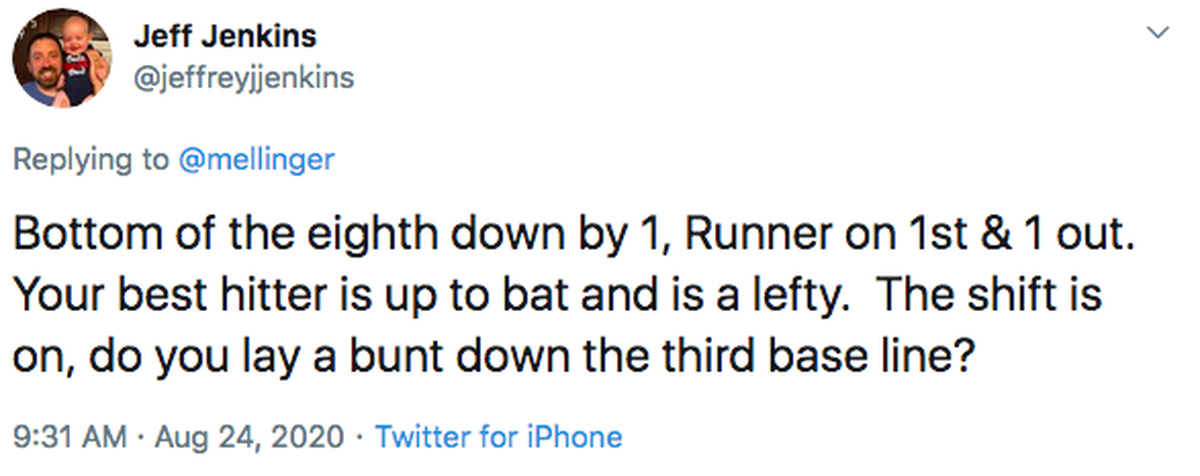
There are too many unknowns here, from who’s on the mound to who’s hitting behind my best player to what I have in the bullpen to how confident I am that my guy can lay down a bunt* and more.
* Matt Carpenter is no longer the Cardinals’ best hitter but he’s one of the game’s foremost shift beaters. You might remember last summer when he bunted for a double.
So that’s a lot of information I’d want before making a decision.
But, in general, I’d want my guy hitting there.
If he’s my best hitter, I’m hoping his on-base percentage is between .370 and .430. I don’t know what the math would say about the success rate of a bunt, but my guess is the difference can be viewed as a fair trade for possibility of the runner advancing more than one base, a home run that would give me the lead, and any negative outcomes from the bunt — smashed fingers, an 0-2 count after two foul bunts, etc.
Ideally, I want my guy there to have shown he can bunt at some point, because I’d rather they not shift. And I’d reserve the right to change my mind if he keeps grounding out to the second baseman who’s in shallow right field.
But I’d start with wanting my best hitter to do what he does best.
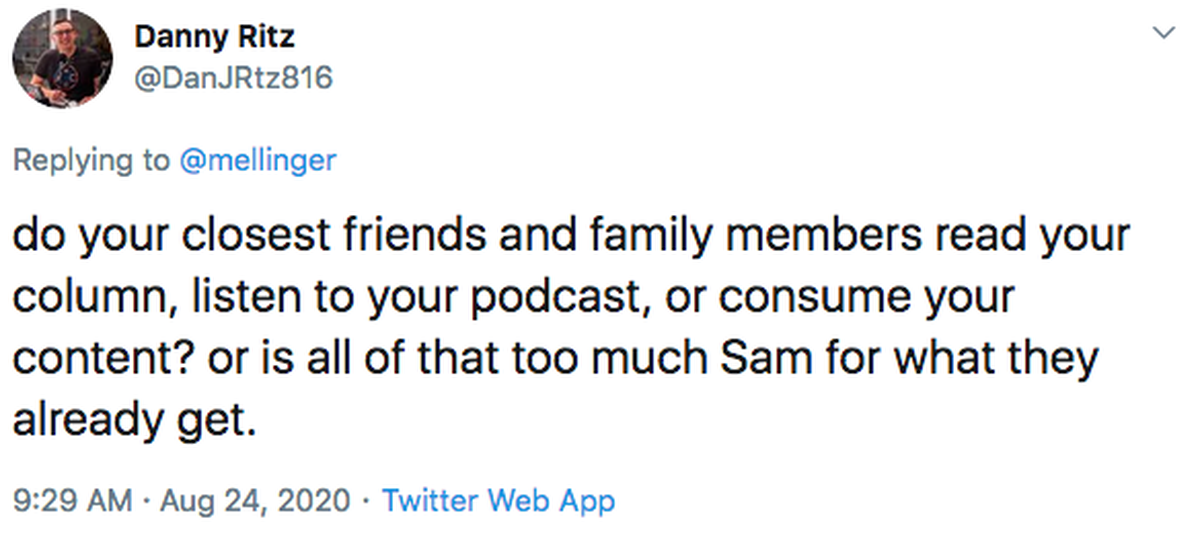
Once in a while I’ll walk in a room, see my wife on her phone, and hear, “I’m catching up on Sam Mellinger columns.” There’s a tinge of an audible eye roll in those words, and she certainly isn’t reading everything.
If I’m breaking down some Mahomes pass, for instance, she’s skipping. But I’m working on a Mondesi column this week that she’ll probably read. She gets more of my b.s. than any person on the planet, so there’s less than a 50 percent chance she’s read this far and, really, could you blame her?
You all know me well enough to know this is not a complaint, because I love my job, but it does tend to bend social settings. A lot of my friends are big sports fans. That’s what they talk about with their friends. I’m obviously a big sports fan. That’s often what I want to talk about, too.
But the conversations are a lot easier when it’s about the PGA or NBA or English Premier League than it is the Royals or Chiefs. When I’m having a beer with friends, nobody wants to turn it into Around The Horn or whatever.
“I saw on Twitter you said...”
“Sorry if I missed you writing about this but...”
It’s just a little different than the conversation would be if I had a normal job. Not better, not worse, just different. I’m friendly but introverted in my most natural state, and sometimes I wonder if that’s amplified by this sort of weird social reality.
I didn’t expect this answer to turn into a self psych evaluation, but sometimes I’ve thought this is why my closest friends are also my oldest. We happen to live in a neighborhood with a lot of adults and kids around the same ages, and we’re past this now, but I know for a while when the topic went to the Royals or Chiefs I could get weird.
But, jeez, holy cow, this answer has taken some twists.
I’d say all of my closest friends who are on Twitter follow me there, and I follow them too, but they have the advantage of not being as active and just make fun of me.
One more twist of this wild answer: you’re making me think of my mom, who read everything I ever wrote except for the schoolwork I was able to keep from her. She wouldn’t say something about everything, but did it enough that I have always thought of her when a Word doc is open — that was true when she was alive, and I’m grateful that it’s still true now.
She was a casual sports fan, so reading 1,700 words about Mahomes’ touchdown against the 49ers in 2018 must’ve been like I feel when I read about the stock market, but I always appreciated it. Even if you didn’t know she was a talented writer you’d have guessed it by the feedback she gave. It was always a level or two deeper.
Anyway. That might be the biggest ping-pong of an answer in the 10-year history of this time suck.
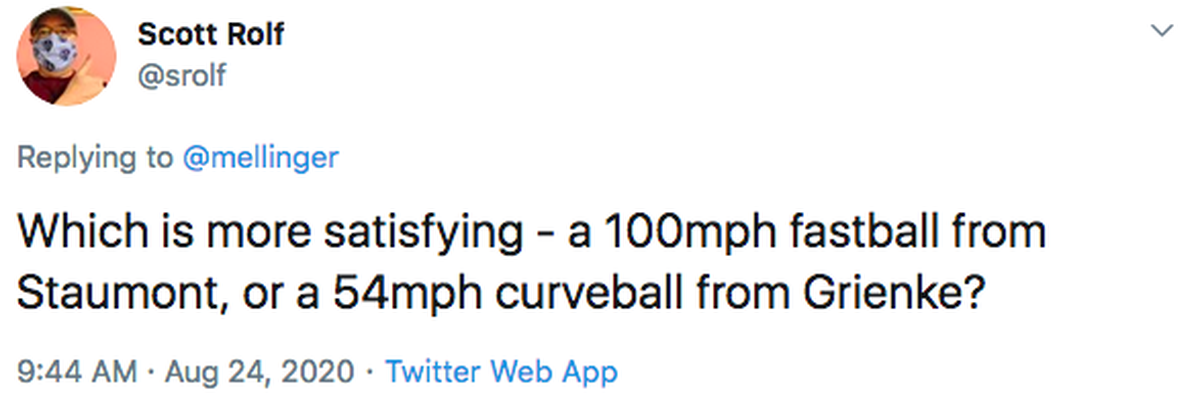
First, let us go to the tape and, fine, yes, this is Aaron Hicks throwing 104 (!) and not Josh Staumont but you get the idea:
I love both, but I’m all in on the 54 mph. There’s an old baseball line about how pitching like Nolan Ryan or Noah Syndergaard or Aroldis Chapman doesn’t take guts — but pitching like Jamie Moyer sure as hell does.
There is something thrilling about watching someone challenge and take down the world’s best hitters with raw velocity they both know is coming. It’s baseball’s version of LeBron and a shot blocker meeting at the rim, or Bobby Wagner against Alvin Kamara in space.
You can’t look away.
But velocity is also cheap now. We know guys can throw 100. Unofficially, the last closer not to throw at least 95 was back when Rod Beck’s fastball had an arch to it, and would not have been pulled over in a school zone.
So give me Greinke’s slow curve, or Yu Darvish doing the same. Anibal Sanchez has a changeup he calls “La Mariposa” that comes in around 60. Heck, I’m all for the eephus coming back, or a knuckler to take Tim Wakefield’s place.
It’s different.
It’s fun.
Baseball needs more different and fun.
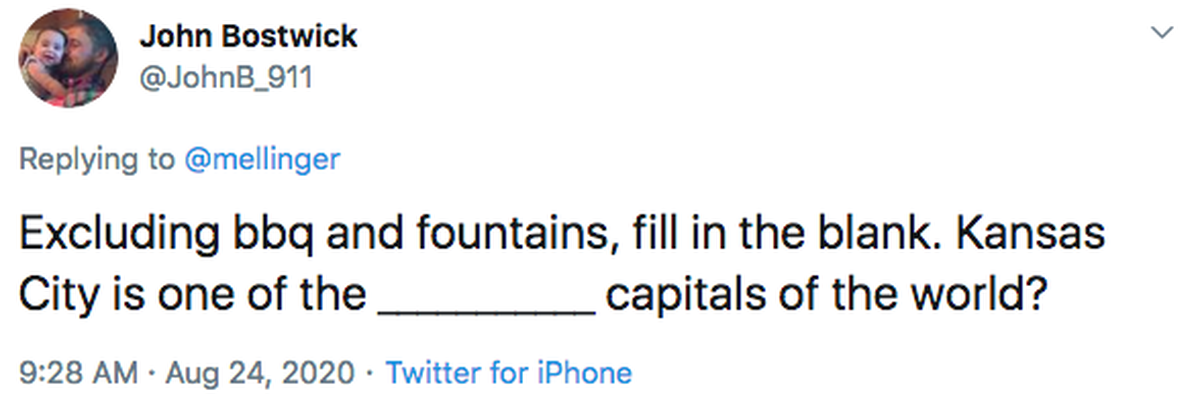
A list? A list!
Humidity.
Civic pride.
Also civic insecurity.
College basketball.
Tailgating.
Demographically segregated*.
* Sucks, but it’s true.
Chef.
Counterproductive competing interest.
Suburban-urban divide.
Car driving, no traffic jam having.
Potholes.
Patrick Mahomes.
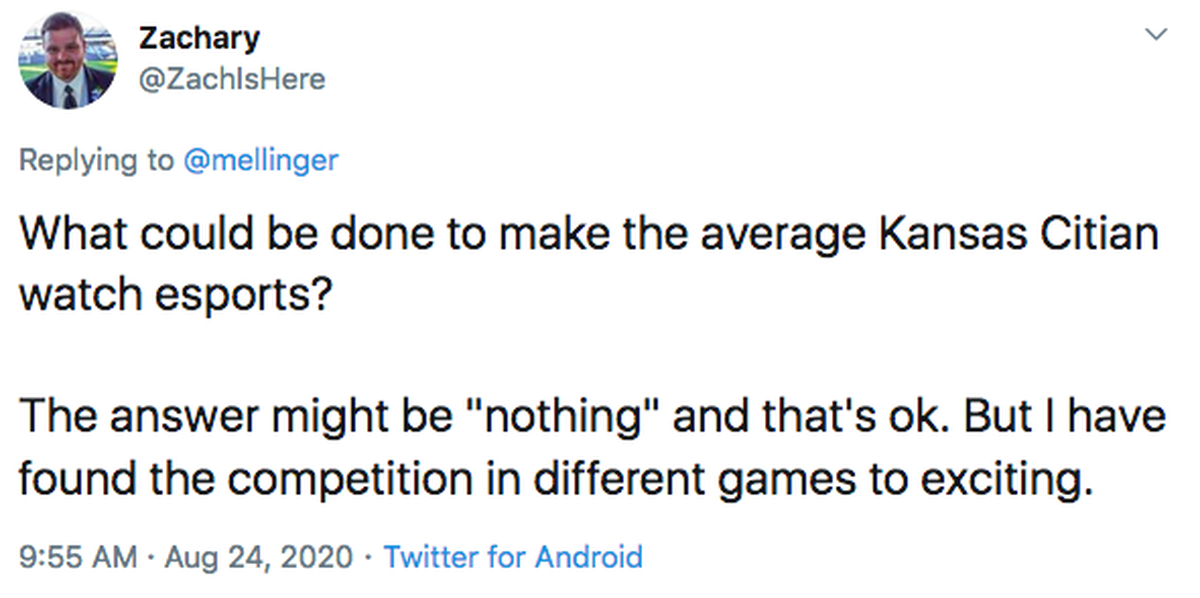
The first thing that comes to mind is for a star to be from here. There isn’t anything Kansas City likes more than something from Kansas City. Let the Patrick Mahomes of esports be a Shawnee Mission South grad or something. Overland Park would represent.
Look, my instinct is to roll my eyes at esports. That’s probably the most common reaction among readers of this time suck. I’ve played many a video game in my day, and my hesitation the last 10 years or so has been mostly about a lack of self-discipline.
If I start playing, there is a non-zero chance that I’ll become a stranger to my wife and kids, and start skipping work assignments to build a dynasty team. All that said, my wife has no idea how close I am to making a questionable COVID-19 purchase*. I could even say it’s for the kids.
* I probably would have done it already, actually but can’t decide what to get. Love the idea that you can play old NES games on the Switch, but it doesn’t have Madden? What does the PS4 have that Xbox doesn’t? I need help here, you guys.
But I also have no interest in watching anyone play a video game.
Is that a generation thing? Probably?
My oldest nephew plays a lot. Fortnite, mostly, but also sports games. They live in Oakland, and my sister once told me that is Steph Curry walked in their house with (I forgot the name but some famous YouTube gamer) her kids would not even notice Steph Curry.
I made the point that I just can’t get into the idea of watching someone play a game instead of being the one to play myself, and the counterargument was made that watching someone play a game instead of being the one to play myself is literally how I’ve spent my life and feed my family.
I had no sensible comeback.
I’ve often wondered about esports these last five months or so. Esports would seem to be uniquely positioned for a pandemic, for lots of obvious reasons, but also well placed for a future in which our entertainment is increasingly streaming. Technology improves constantly. The games are visually stunning. Sometimes I think the most creative people we have are making either video games or Pixar movies.
The base is there. And it’s hard for me to pretend to be the marketer for something I’m not into, and don’t know a lot about, but I do know this:
Kansas City loves itself some Kansas City. Give us some kid from SM South or Central or Park Hill or whatever whupping up on some folks while wearing a Charlie Hustle Gates shirt and talking about spending his summers on the Timber Wolf and you might just have yourself a winner.
This week, I’m particularly grateful for how much our boys get along. There was a time we didn’t have much more than hope to go on, but they’re best friends, and it’s amazing. I’m excited for school to start for a million reasons, but one thing I’ll miss is their laughter filling the house all day. Then, eventually, sometimes, an argument. But then more laughter. It’s great.
This story was originally published August 25, 2020 at 12:00 AM.