
Mellinger Minutes: college football bad, Royals good. Can Americans PLEASE get along?
It’s been said that the coronavirus is acting as an accelerant.
Things that would happen eventually are happening quicker. Businesses trying to hang on close. Companies wobbling between the red and black lay off employees. For the fortunate able to stay home without financial worry, maybe that kitchen remodel is happening faster.
But College football could be remembered as our country’s ultimate example of the virus as an accelerant.
We’ve talked about this before, but among America’s most popular sports, college football’s structure was always uniquely vulnerable to a major disruption.
Well, that disruption is here. At best, we will have very little college football this fall. At worst, we will have none and instead see a 19-month break between LSU beating Clemson in January and two random teams opening the season on a Friday night a year from now.
Hopefully the conferences that have canceled their fall seasons can find a way to play in the spring. Actually, if that happens, a compelling case could be made to keep it that way. NFL in the fall, college in the spring, football filling our weekends from August to May.
We’d need to find a way to protect March Madness, but I wonder if there’s a workable long-term change in there somewhere.
Anyway, here’s a lesson I wish we’d all take from sports, but also a lesson I’m quite sure won’t find any traction:
The virus can be managed, but only with diligence, caution and organization.
Europe’s top soccer leagues — even in Spain and Italy, which were ravaged in the spring — came back long before major American leagues.
Here, the bubble approaches by the NBA, NHL, MLS and WNBA are working magnificently. Baseball is bubbleless, and was recently pushed to the brink, but even the overall case numbers in that sport have been much better than for the general public.
We’ll soon see how the NFL’s approach — basically baseball but with better testing and tracing — works, but we already know that college football has failed.
There are a million reasons for that, but central among them is an abject and embarrassing lack of leadership that for some reason the sport has long viewed not as a bug but a feature.
The strategy seemed to be everyone agreeing to not a make a decision until someone else made a decision, but nobody wanted to do even that because, hey, maybe the virus will burn off in the summer heat or something.
It was the equivalent of not paying your mortgage for a few months because, you never know, an alien might come down and give you a stack of cash.
College football is paying for that lack of preparation now, and that’s literal: The sport is paying for it.
We can be prisoners of the moment sometimes, but this feels like a historical moment.
Let’s circle back: The virus is acting as an accelerant. College athletes were already gaining voice and were probably always going to organize at some point.
But with the profitability and disorganization of college football, they’ve never had a better reason to do so than to make sure they can return to play safely. Once that happens, isn’t the next step to be compensated with money instead of free sweatpants, snacks and a scholarship?
The wheels are turning here. College football could’ve been much better prepared for this moment. The sport should have been much better prepared. Every other major sport was.
The consequences are starting now, this week, and it’s hard to know when they’ll ever stop.
This week’s reading recommendation is Adam Kilgore talking to health experts worried that COVID-19 will leave athletes with heart complications, and the eating recommendation is the queso fundido at El Patron.
Thank you to everyone who’s listened to our Mellinger Minutes For Your Ears podcast. Last week, we highlighted a subtle point about the Royals that will make you smarter than your friends and talked to a leading epidemiologist and Chiefs GM Brett Veach on the league’s plan to manage COVID-19.
We have a great guest set up for this week, with audio you won’t hear anyone else. The episode should be up Friday. Hope you look for it, and hope you find it worth your time.
Please give me a follow on Twitter and Facebook and, as always, thanks for your help and thanks for reading.

Totally. People will focus on the pitching, and for good reason. That’s where the fun is on this team. That’s where the planning is with the front office. That’s where the future is with the organization.
But the offense, you guys.
A week ago, it was basically Whit Merrifield and eight guys on the struggle bus. Now they’re in the top five in hitting, on-base, slugging and runs.
Ned Yost used to joke that his players got along so well they’d slump and get hot together, and maybe this group is doing the same thing. The Royals have eight guys with at least 28 plate appearances and an adjusted OPS above league average.
The most encouraging part is the deeper stats signal that this is not a fluke. Their rates for hard contact and barrels indicate that the process is just as good as the results right now.
Now, you’d take the under on Sal Perez finishing with a .333 on-base percentage, or Maikel Franco slugging .545, or Brett Phillips slashing .280/.357/.480. But the point is that as a group the Royals are seeing much better results, and that those results are coming from hard contact rather than bloopers falling in the right places.
We’re still talking about a 7-10 team, so let’s not get crazy right now. But with the expanded postseason and encouraging signs from the pitching (more on that soon) it’s enough to be excited about right now.
I’m still where I was before the season, which is basically that both sides are illustrative.
This is true: The Royals are getting better in the broad strokes, from a 30,000-foot view.
This is true, too: The Royals are a ways from being a true championship contender.
It’ll probably be a while before I talk about this stuff without the disclaimers about pitching prospects breaking your heart, but the Royals’ pitching prospects are as encouraging as could be reasonably expected.
This is the best way I know how to put it. Brady Singer is an instant big-leaguer, a guy who looked the part of a front-of-the-rotation starter from the first moment. There is a reasonable case to be made that Kris Bubic is even better. There are scouts who believe Jackson Kowar and Daniel Lynch will be better than Singer and Bubic. There aren’t many scouts who don’t believe Asa Lacy will be better than all of them.
Also, meanwhile, Brad Keller is the one with a successful big-league track record and he’s less than a year older than Singer.
That’s a hell of a foundation for success. This group is starting to get a bit of a 2011 vibe.
Now, holes need to be filled. This is most obviously true with the Royals’ position players. Who’s the regular first baseman? Is Nicky Lopez truly finding his way? Can Adalberto Mondesi graduate from these extreme valleys and stay healthy? Where does Hunter Dozier fit? Who’s the center fielder? How many of the minor-leaguers can make an impact?
Also, internally, the Royals believe 2022 to be the year they’re fully prepped and seasoned to make a run. Sal Perez’s second extension will have expired by then, and he’ll turn 32. He’s unlikely to remain their regular catcher, so what happens behind the plate?
Lots of questions.
Some of them will be answered naturally, but the Royals will have difficult decisions with others.
They don’t need to be perfect. We saw that the last time. But they do need some breakouts, and they do need some luck.
Well, slow down. We’re not there yet.
The temptation to add at the deadline could be there, but the smart approach would be prudence.
I’m not saying the Royals shouldn’t make a deal if they’re in the race. A thought exists among many in the industry that the price teams are willing to pay for deadline help will be less than in a normal year.
If the Royals find the right (read: desperate) team willing to take less on a deal that solidifies their big-league roster and is at least neutral long-term, then sure. Let’s get nuts.
But that’s unlikely, and the worst mistake the Royals could make would be to send away someone who can help in 2021 and beyond for someone who can help for a month of a truncated season and an expanded postseason.
The Royals’ front office doesn’t think this way — or, at least, they won’t say it publicly — but I’d argue a top-five pick in next year’s draft would be better than losing a three-game series in the wild-card round.
Baseball teams take time to build. Kansas City knows that better than anyone, and it’s particularly true if the goal is — as John Sherman has said — sustainability over peaks and valleys.
If sustainability is truly the mission, then the baseball operations department needs to be protective of its prospects.
That doesn’t mean you never make a deal. But it does mean you don’t start dangling your best prospects for shortcut support of a team with a losing record.
This is related to the above answer, but the Royals are too early in this to know what they need and what they can trade. It sure feels like they have an abundance of pitching, particularly starting pitching, but a few Tommy Johns and a loss of control on a third guy can eat into depth pretty quickly.
Also, the Royals control Keller for four more seasons. He’s not a free agent until after the 2023 season. They could wait until the winter before the 2023 season to get serious on this. That’s traditionally when these deals get made. Players still get long-term security, and both sides have a better idea what the player’s value is.
Keller retains the potential to be an important part of a championship rotation, perhaps even in the front half.
It could be tempting to trade him for a center fielder, for instance, but you want to be as sure as possible that you’re not trading a guy who’d start your first playoff game.
I haven’t asked around on this, but my suspicion is the Royals would be open to a long-term deal with Keller right now but won’t be pushy. The team views these negotiations as a collaboration, a partnership. There’s no rush right now.
If they’re going to make a seller’s trade, I continue to think the likeliest candidates are the relievers scheduled for free agency — Ian Kennedy, Trevor Rosenthal, Greg Holland.
Danny Duffy (more on him soon) is also an interesting possibility. These are good problems.
Meh. I’m not sure about that. Football people would probably believe that. They should want to believe that.
I don’t know that it’s tangible to say that’s reality.
First, there’s a lot more involved than “players staying in line.” The Marlins had a breakdown that caused an outbreak. We know that. But the Cardinals’ casino story was hashtag fake news.
The Indians sent Zach Plesac home — in a rental car! — for leaving the hotel to go out with friends in Chicago, and maybe you read that as an example of players misbehaving but I read it as an example of baseball’s peer pressure working the right way.
This was part of a column and the podcast last week, but the idea that football has an advantage in player behavior seems to be based more on hope than evidence.
The travel risk is likely overblown. Also, baseball players are in club protocol more than football when you consider travel.
The two advantages I see football having are in testing and tracing. Those could prove significant, perhaps even game-changers.
The NFL is testing every day, with results back within 24 hours and so far without logistical problems. That’s an advantage when compared with baseball.
Also, players and staff are carrying contact-tracers — badges that track who’s been in close contact with whom. In the event of a positive test, this makes backstopping potential spread much more possible.
Those are the reasons to be optimistic.
We’re all hoping this works. But, again, hope is not a strategy. This is going to be determined by adherence to protocol, testing, what we do as a country and luck.
These are guesses. All of them.

If you know, please tell me. At the moment, things are changing so drastically and quickly that the ground may shift in the time between me typing this and you reading it.
Games and seasons are being postponed, and perhaps canceled. College football programs are monstrous operations and they’re being forced to be nimble. Players good enough to have professional futures have difficult choices to make.
The fear is that one missed season becomes two, and what the games will look like when they return.
Here’s my guess: Some college football will be played this fall, and some in the spring. At some point in the next year, we will have a vaccine, or at least an effective treatment, which, combined with more understanding of how the virus spreads, will allow even the leaderless dopes in college football to hold a normal season in the fall of 2021.
But the chaos of the moment and the next few months will have lasting impacts. First, it will drive home the need for some centralized authority, even if it’s sort of like the old New York mob’s commission — commissioners of the Power Five leagues working together.
That’s fine and all, but athletes are also going to want more of a voice. They’ll be offered a seat with the commission, but not a vote, and at that point there’s a standoff. My guess is the athletes will stand down, but coaches are going to need to be increasingly player-friendly to both recruit effectively and coach effectively.
The change will be easy to miss from the outside but important and noticeable on the inside.
Again, these are all just guesses. But this moment feels too big not to believe there won’t be long-term effects.
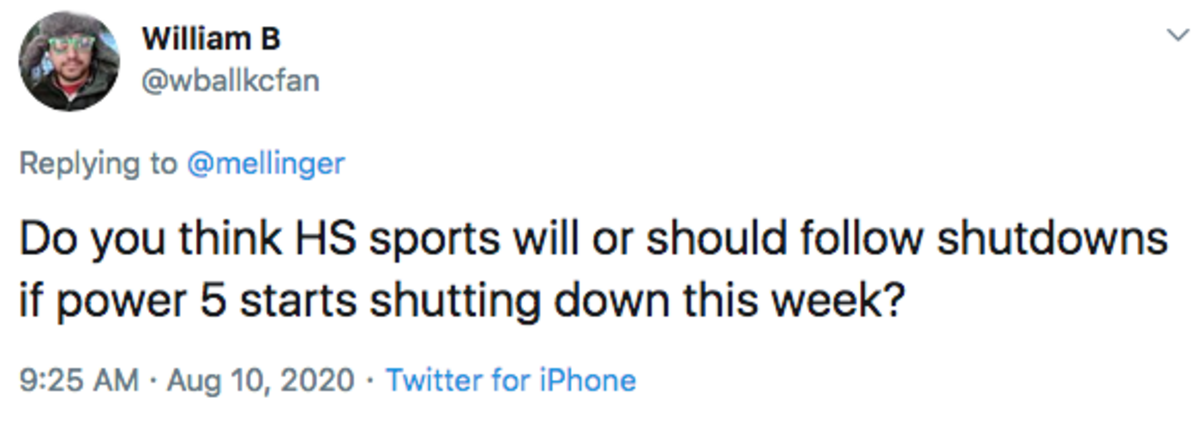
You guys know me well enough to know I love when a question can be used to tease a future column, so here we are.
I’m going to have a lot more on this soon.
My instant, on-the-surface reaction is that it’s batspit crazy that high school sports — and I’m thinking mostly of football, wrestling and volleyball here, not golf or tennis — will play this fall.
I draw a firm line between professional and amateur sports. If we zoom in on football to make the point here, the NFL has central authority and protocols, massive resources to set up and enforce those protocols, regular and advanced testing and well-compensated adults who can make decisions for themselves.
Colleges lack most of this.
High schools lack all of it.
All that said, I’m also empathetic to the idea that these sports are important to the athletes and coaches. These sports have value. And if the sports aren’t happening, the athletes and coaches aren’t escaping the virus. They’re going into the real world. There’s virus in the real world.
I’m empathetic to the idea that the athletes and coaches will have more incentive to be careful if they have sports. That matters, too.
This is complicated, in other words. We all want easy answers, and for everything to be black or white. That’s not this. Never has been.
We don’t know enough about the virus for clear or easy answers, and we all carry varying levels of comfort with the unknown.
High school sports have more centralized power than college, but Missouri’s governing body is in charge of schools as different as Pembroke Hill and Central, Blue Springs and Adrian.
How can that work cohesively?
Here’s the plan I’d push for:
Allow athletes and schools to make their own choices on whether they want to play. Establish minimum procedures and safety measures, including masks and testing and sanitizing and distancing.
Then remove school principals, athletic directors and coaches from the decision on whether and when to stop. Turn that over to independent and local health experts, who are paid a flat fee in advance.
Won’t ever happen. But that’s what should happen.
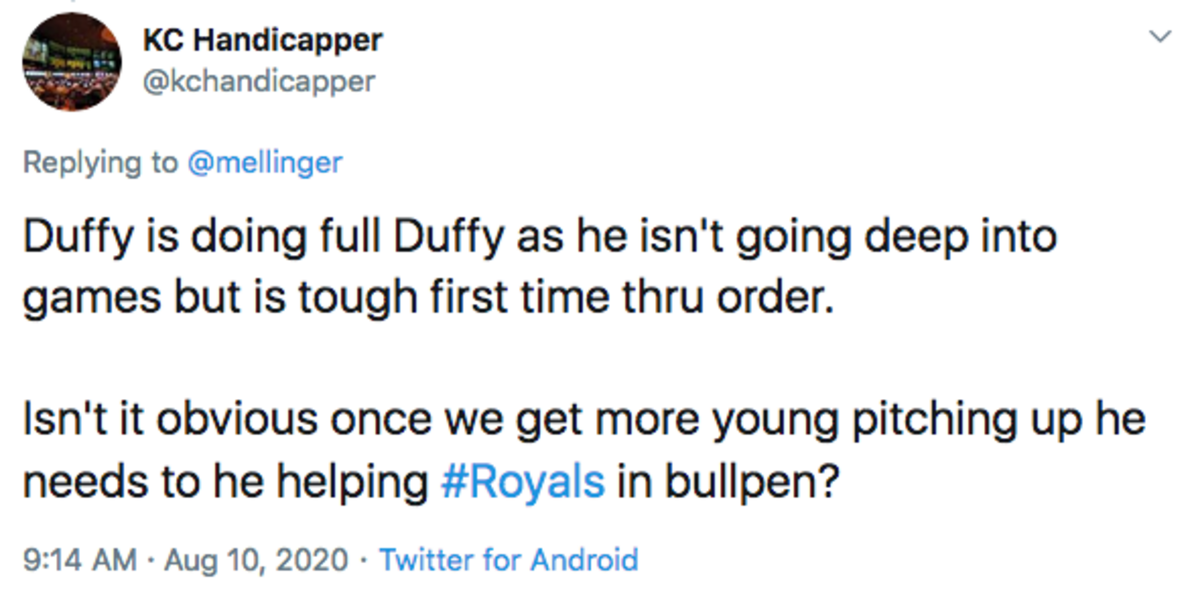
Or in the trade market.
Look, Duffy is a personal favorite. That’s true for me, and more to the point here it’s true of most who’ve talked with him. But the Royals are becoming more transactional — we talked about this on the podcast last week — which means loyalty is less of a factor.
Duffy is a proven professional who can help a winning team in the rotation or the bullpen. That’s valuable. He’s also due $15.5 million next season — nearly a quarter of the Royals’ projected payroll next season without additional additions or subtractions — which is a lot for a team trying to build around young players.
Now, your point is valid. Duffy has long had the look of a shutdown reliever. Velocity and movement always jump for relievers, and Duffy’s control has improved the last few years. That’s the basis of a really good back-end reliever.
This is now officially a theme: It’s too early to know what the Royals’ next championship contender will look like and what it’ll need.
My guess is it won’t need Duffy as much as a contender might need him now, and that him being under contract next season (even if the Royals had to cover part of the money) would be a plus.
But trades are complicated.
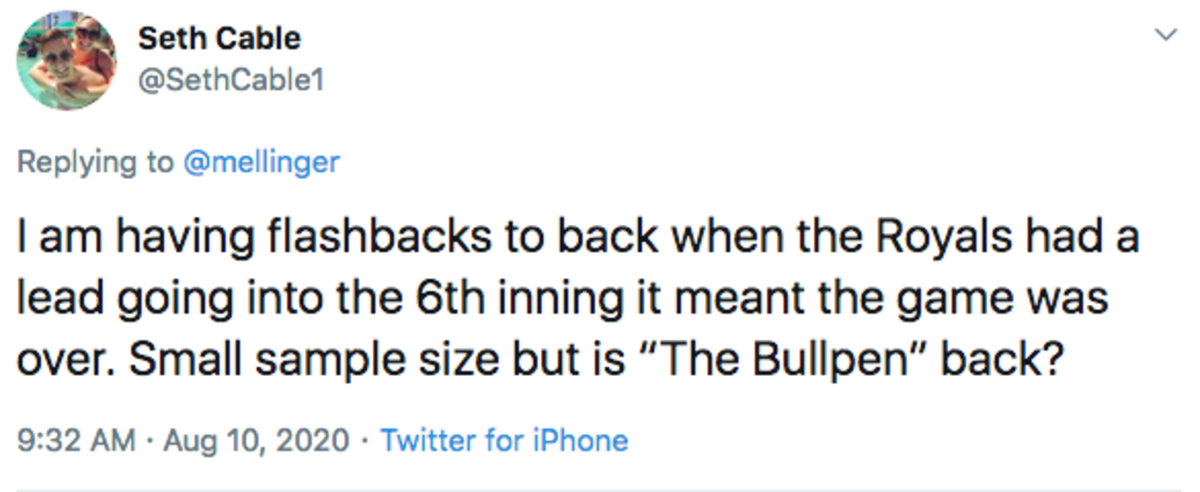
Trevor Rosenthal, Greg Holland and Ian Kennedy have been a big part of that. Those guys are veterans, and each is scheduled for free agency.
So even if we make the leap that each of those guys will perform this well all season, we should also see the reality that this is not a long-term fix. Heck, there are no long-term fixes with bullpens. With rare exceptions, they all need to be rebuilt every year.
But it is an encouraging development. A lot of us figured the bullpen would be vastly improved from a year ago, but that’s different than actually seeing it perform so much better.
Bullpens and rotations work together. Last year, the Royals gave 49 starts to Glenn Sparkman, Jorge Lopez, Brian Flynn, Eric Skoglund and Heath Fillmyer. That’s nearly a third of the season.
This year, the Royals don’t have that obvious hole. They don’t have a day where you wake up, see who’s starting, and know it’s going to be a struggle. That matters. The bullpen isn’t being blown out once or twice every turn through the rotation.
But, just being honest here, the biggest reasons for optimism with the bullpen are also reasons for long-term optimism.
Kyle Zimmer may or may not be fixed, but he is definitely pitching better than he ever has in his professional career. He’s repeatable, he’s missing bats, he’s throwing strikes, he’s extending for multiple innings. This is what the Royals envisioned.
And, holy crap, Josh Staumont is happening. He’s always had an overwhelming fastball — 101 mph somehow looks relatively easy with him — but now he has quality breaking stuff and he’s throwing strikes.
His walk rate is slightly below the league average, and hitters are making contact on just 58 percent of swings. That’s insane. If he can continue to throw strikes, he’ll be a dominant reliever as long as he’s healthy.
That’ll be a fun thing to watch over the coming years.
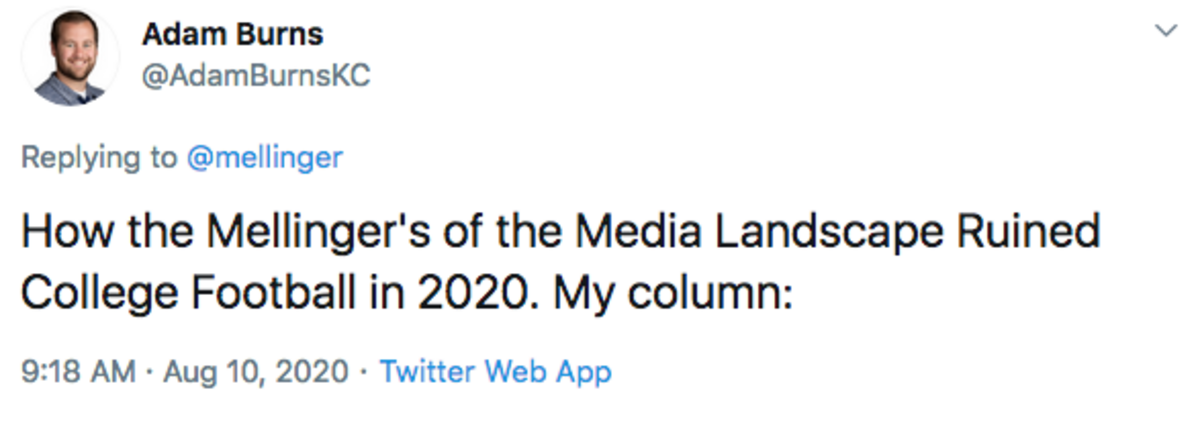
I’m usually pretty good about ignoring nonsense, but I broke protocol the other day. There is so much b.s. in this idea making the rounds that sportswriters want college football to be canceled.
Here is an incomplete list:
- Sportswriters need sports to be able to work and receive American currency that they can exchange for things like food and housing.
- Sportswriters do not have the power to cancel sports. Hell, most of the time we’re happy if we have the power of a direct flight.
- If a sportswriter talks to a health expert or league decision-maker who expresses pessimism about a season happening, it doesn’t mean the sportswriter is hoping the season doesn’t happen.
- To go a step further, it doesn’t mean that health expert or league decision-maker wants the season canceled. The best analogy I can think of: When my kids are sick, and we keep them home from school, it doesn’t mean we hate school or are rooting for our kids not to go.
- The idea that sportswriters are pushing this “fear narrative” is hogwash. We write what we hear from people who know more than we do. That’s a huge part of the job. And if people who know more than we do are expressing hesitation or even fear, that’s not pushing a narrative. That’s reporting.
I’ll stop with the list now, but in some ways, I get it. We’ve been talking about this a million different ways here, but we all want easy answers. We want to be able to blame someone, and when looking at targets for blame, some dopey dude who makes his living writing about sports is tempting.
But I can promise you I want sports to happen. I do not know of a single sportswriter rooting for a single sport not to happen, and I know a lot of sportswriters.
Sometimes I go to a butcher. It’s a great place. Staff is friendly, helpful, very knowledgeable. Once I went in there for ribs and chicken. They were out of one and had to throw out the last of the other because it had expired.
I was bummed but did not come to the conclusion that the butcher hates meat or wants to keep me from cooking.
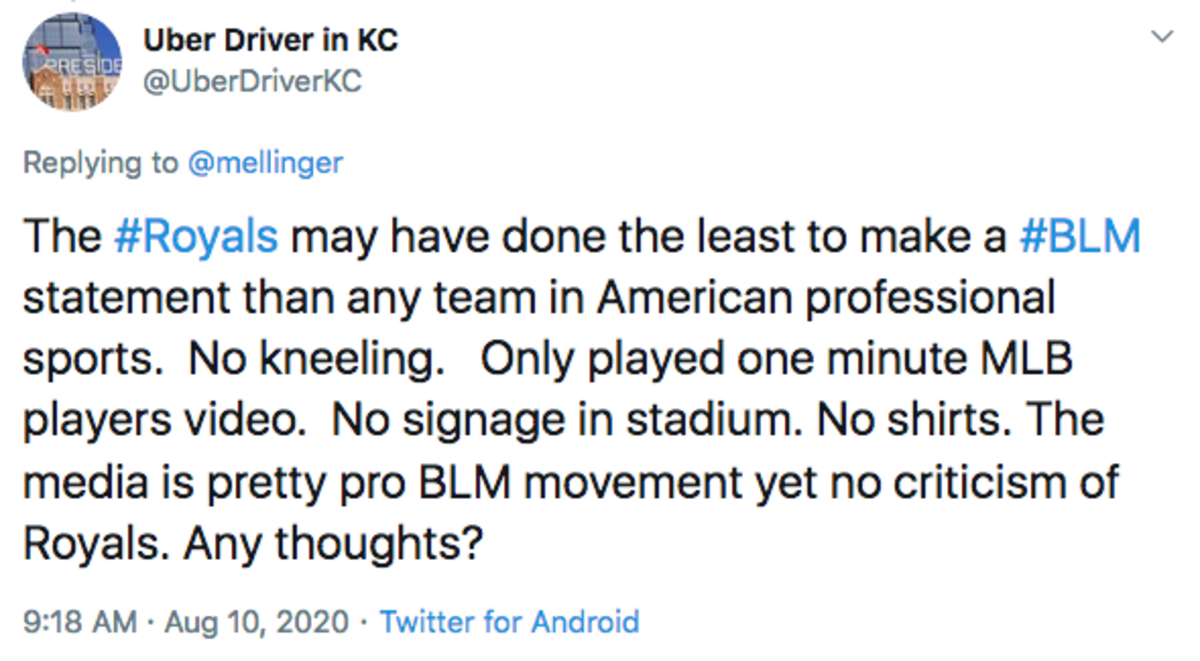
Well, first, I’m not sure I agree with the premise. Less than any team in pro sports? How is that measured? What does that even mean?
Royals players have worn BLM T-shirts, the club made a statement, they played the video. They can’t force any players to kneel, same as they can’t force anyone to stand.
I don’t know what you’d want the club to do, or what you’d want the media to do. The issues of social justice and racial equality have been distilled in some circles to Black Lives Matter, and that’s not helpful in the broader mission or with anyone’s understanding of it.
The Royals have created the Urban Youth Academy, which is MLB’s model for spreading the game to urban cores and minorities. A case could be made that Dayton Moore’s front office has done more to promote racial equality and understanding than any other in baseball. Not just with the Urban Youth Academy, but with a staff trip to Atlanta to see the Civil Rights Museum and some of the groups Moore has spoken to and worked with.
John Sherman has long been involved with promoting education to underserved communities, and it would make sense that the Royals would push in that direction a bit more now.
As a quick aside, we’ll have much more on Sherman in a column later this week. Please look out for it.
This is just one sportswriter typing, but this issue has been vastly oversimplified. We’ve sort of demanded that people take one side or the other, as if that’s all it is. If you kneel, you’re woke. If you don’t, you’re racist. That’s garbage. That’s counterproductive. That’s destructive.
We need to move past that. The sooner the better.
I don’t think you’re making this point specifically, but there seems to be a segment of Americans who believe an athlete’s entire worldview can be explained by whether they kneel for the anthem. And that a journalist’s entire worldview can be explained by whether he or she supports it.
How did we get here? And just as importantly: why?
I stand for the anthem, hand on my heart. I’m proud to live here. Feel lucky to live here. But that doesn’t mean I don’t think we can do better, and it sure as hell doesn’t mean I believe someone else shouldn’t be able to express himself or herself non-violently.
We all come from different life experiences. We have different backgrounds. We come to our perspectives in our own way. That’s supposed to be a strength, but too often it’s a reason for division.
If we spent as much time listening to each other and being kind to each other as we do judging each other, we’d be much better off. If we spent as much time trying to create a country that made all of us want to stand for the anthem as we did trying to force all of us to stand, we’d be better off.
I think we can get there. I’m an optimist.
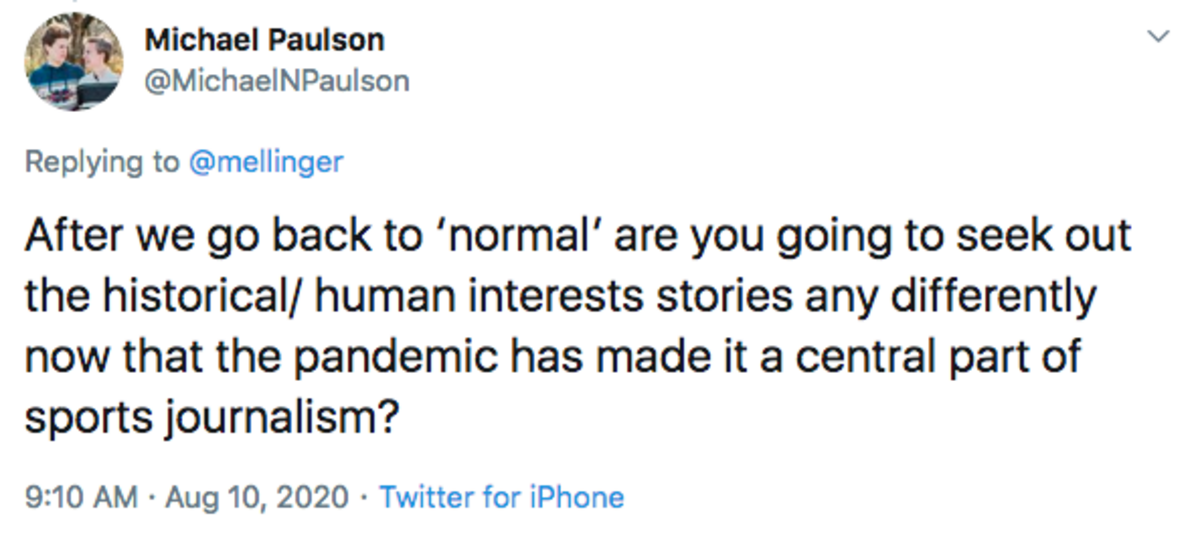
We’re getting closer to normal, even if “closer to normal” means I have to be tested for COVID-19 before covering a Chiefs practice.
So even if it’s too early to plant the flag and declare normalcy, we do have games again, after months of no games, which creates the opportunity to at least say this much:
The break wasn’t as jarring as I expected.
Don’t get me wrong. We were scrambling for a while, and might be scrambling again soon. I once did a list of the top 56 games to rewatch online, for crying out loud.
But the stuff you’re talking about here — the human interest and lookback pieces — are things I’ve always loved doing. We’ve always wanted to tell the stories of athletes as human beings and look back at important or interesting moments in history.
If anything, games coming back might make focusing on one specific play or moment even more appealing. But that’s also something I’ve always enjoyed.
I’ve thought about the general push of your question a lot. About what I’ll do differently now. I do believe the last five months or so have amplified the beauty and occasional importance of sports, and that those are gifts worth cherishing. I also believe that, just functionally here, it’s amplified the need for good relationships to do this job well.
Zooms can serve a purpose, but if you want to do this job well you better also have relationships established where you can get other information.
This is a small thing, but we here at The Star had the elite idea to start a subscriber-only sports podcast built in large part around exclusive audio just as coronavirus shuttered sports.
I’m proud that we’re 18 episodes in and we’ve had a run of great guests, with conversations that aren’t happening in other places — from Dayton Moore gathering some top assistants to show how they make personnel decisions to Mark Donovan explaining the Chiefs’ approach to Native American imagery to Charvarius Ward on just how bad his vision was and what he did to fix it. We’ll have another great guest this week.
The world has flipped upside-down on all of us. Some have handled it beautifully, others terribly. Most of us are in the middle, winning sometimes and losing others.
But some athlete cliches apply. We’re best served controlling what we can control, and seeing every problem as an opportunity.
This week, I’m particularly grateful for the weather. You might know I hold enough hate for July and August to power a thousand suns. But I’m not sure there’s been a single unbearable day so far, and if I could pick any summer for that to be the case, it would be the summer where we can’t blow an afternoon in a movie theater.