
Mellinger Minutes: NFL players’ moment, Royals’ struggles ... and baseball on the brink
Baseball may continue. Baseball may finish. Baseball may remember the last week or so as a crisis averted, instead of the end, and I can’t imagine anyone who is rooting against that.
But I also keep thinking that baseball will get what it deserves, one way or the other, and that if football doesn’t learn from the experience then it deserves the worst.
Let’s start with baseball. We always knew this was possible. We always knew that keeping 30 young men on 30 different teams from giving into temptation for four or five months was unlikely.
We always knew that a demographic already prone to assuming invincibility might see a virus that often kills seniors while often leaving younger people asymptomatic might not take the proper precautions.
That they might take a few boneheaded risks, not considering the risk of contracting the virus, the risk of testing positive, the risk of spreading that virus to others. The risk that the spread would be wide enough and fast enough to necessitate teams and eventually, perhaps, the league shutting down.
We always knew that this would, in fact, be the easy part. That human nature would tend to hold up better early, that the bigger risk would likely come as teams drop out of contention and the personal incentive and self-interest to avoid a positive test might fade.
In other words, baseball is having a heck of a difficult time right now, and we’re not even to the difficult part yet.
Again: Whether they can pull out of this and learn the right lessons and complete a season is up to them. They’ll get what they’ve earned, either way.
Football, though, is out of excuses.
They’ve seen what (so far, at least) works with MLS, the NBA and NHL. NFL teams have 53-man rosters plus practice squads and extensive coaching and medical and support staff.
A bubble is not impossible. The bubbles for the other leagues are bigger than any team’s would be. But impossible and impractical are two different things, so if we are to agree that an NFL team operating from a bubble is impractical then we better also agree that the richest sports league in the world’s richest country dang sure better go way above and beyond in every other way.
This hits on everything from testing to contact tracing to distancing to sanitizing and anything else you can think of.
More than all of that, it also hits on personal discipline. Because when a league goes to a bubble, it is greatly diminishing the discipline required of its players.
But when a league tries to operate without a bubble, all of its testing and protocols and everything else are worth the gum on the bottom of your shoe if the players and staff are spending their free time at the casino.
That puts NFL players in a heck of a spot. By the luxurious standards of major professional sports, they have the worst setup in terms of both money and power. They deserve more of each and, increasingly, are understanding that.
But this is their moment. Fair or not, right or wrong, there will be people waiting to see how the players navigate a brutal situation. Fair or not, right or wrong, there will be people waiting to judge whether the players deserve more money or power based on how they handle this.
We still have more unanswered questions about the virus and its spread than answered, but one thing we do know is that a person can behave responsibly and still get sick.
So, particularly without a bubble, that means the NFL knows it is in for a certain number of positives even if everyone behaves perfectly. We know they will not, because perfect behavior is not what humans do.
The margin for error is razor thin, then. It may prove to be — literally — impossibly thin.
We know the league and its teams will do what they can. We also know that without a bubble the important stuff will be in what the players and staff do when they’re outside the facility, making decisions on their own, without a co-worker or superior looking over their shoulder.
This is the NFL’s moment, starting this month. Here’s hoping for the best.
This week’s eating recommendation is the phad kee mow nua at Waldo Thai, and the reading recommendation is the essay John Lewis wrote shortly before he died.
Deeply appreciative of everyone who’s been listening to the Mellinger Minutes For Your ears podcast. In the last two episodes, Chiefs president Mark Donovan offered what I believe is still his only recent public comment about the team’s approach to Native American imagery, and Chiefs cornerback Charvarius Ward explained the process of fixing his eyesight.
We’ll have another episode later this week, too, as always with audio you can’t hear anywhere else.
Please give me a follow on Twitter and Facebook, and thanks for your help and thanks for reading.
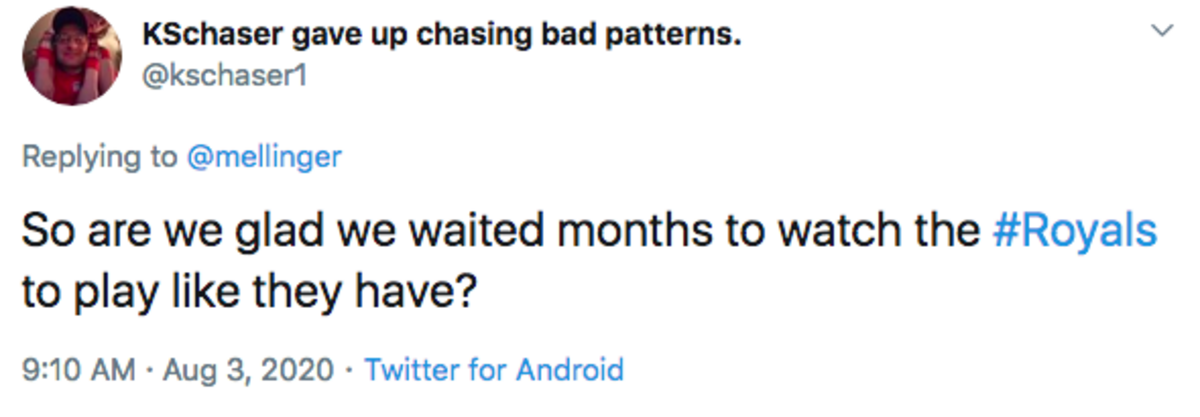
The Royals are in a rough spot. We’ve talked about this before, but a group that needed some breaks and breakouts to compete with more talented teams began the season needing to overcome some bad breaks.
That’s not how you draw it up.
Then they forgot how to take a walk.
And how to put the ball in play.
And how to play defense.
And have had two balls bounce off gloves and over the fence for home runs.
We’re only 11 games in, which isn’t enough to freak out about either way, but 11 games now is the equivalent of nearly 30 in a normal season .... and at that point we are starting to make some judgments.
This 60-game season gave the Royals a window that realistically did not exist for them over 162 games. We aren’t even two weeks in and that window is slowly closing, which sucks for a lot of reasons, not the least of which is it would’ve been nice to have this distraction maximized over the next two months.
Their hitters have to be better, their fielders have to be cleaner, their starters have to be healthier and their bullpen has to be more consistent.
Other than that, things are great!
We’ll get into this more below, but a good way to look at this might be to differentiate between reasons to be bummed out over the slow start and what we can take from the future.
Because if we isolate it like that, we see there are a million reasons to be discouraged by what’s happening right now. Entering Monday night’s game at the Chicago Cubs, the Royals had struck out 94 times and walked just 16. They’re actually hitting for some power, but their on-base percentage after Sunday’s loss to the White Sox (.284) remained almost prohibitively low.
I still believe the bullpen is vastly improved from a year ago, but the seventh inning against the White Sox Sunday wasn’t awesome. The rotation was always thin, and then they began the season without Brad Keller and Jakob Junis — two of their three best starting pitchers — and they’re now without Mike Montgomery.
That’s a team needing the good kinds of breaks instead getting the opposite.
Some of that will course correct, but there are clear cracks at the base here. The lineup isn’t playing as long as could’ve been expected. We could go on.
But if we zoom out a bit and look at the broader picture, it’s ... not as terrible? Brady Singer is only two starts and 10 innings into his big-league career, but the information we have so far — not just from those two starts, but everything leading to this point — would lead us to believe the Royals are right about him.
Kyle Zimmer is getting outs, Kris Bubic competed and there are many more young arms on the way. Again, it’s early, but the lineup is hitting with some power. Ryan O’Hearn looks like the guy Mike Matheny was raving about all spring and summer.
Big picture here, the most concerning part of the start is Adalberto Mondesi. He looks like a mess. He’s getting into bad counts, he’s pressing, he’s making errors, he committed an atrocious base-running mistake last week and now he’s even picked up a bruised quad.
Baseball isn’t basketball, and Mondesi isn’t a quarterback, so you can’t say one player will make or break a franchise’s build-up, but if the Royals are wrong on him it’s a significant step backward.
More than anything else — even the young pitchers — that’s what I’m watching going forward about whether the Royals can make progress this season.
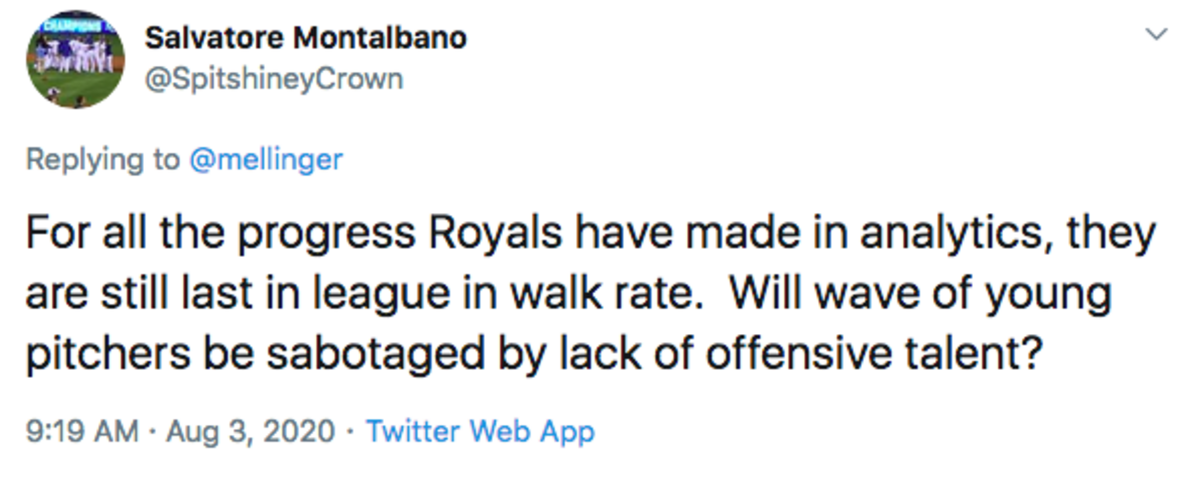
Maybe!
We talked about this a bit on the Border Patrol, but I appreciate the chance to do it here, too: I don’t equate walk rate to progress in analytics.
The Royals have always had to zig when others zag. That’s the deal with a small-market team, even with the financial structure in 2020 not quite as tilted as some would lead you to believe.
They were among the first to exploit a general undervaluing of the bullpen, for instance, and while much of the rest of baseball chased walk rates the Royals built a World Series winner on a lineup that consistently banged the ball in play.
The point, then, isn’t that a lack of walks means a lack of analytics. If the rest of the industry is prioritizing walks, then by definition it’s an opportunity to prioritize something else. That’s a huge part of why the Royals have chased so much college starting pitching prospects in the draft, for instance.
But ... if you’re not taking walks, you probably can’t afford to also be unable to put the ball in play.
The Royals are the only team to rank in either league’s bottom three in walks and strikeouts, and that’s a huge problem.
I’m not trying to bang on this too hard, but this makes Mondesi’s development even more important. The Royals have enough pitching prospects that they can miss on a few. They need to have a higher hit rate on the position players, and none of them other than Bobby Witt Jr. can match Mondesi’s ceiling.
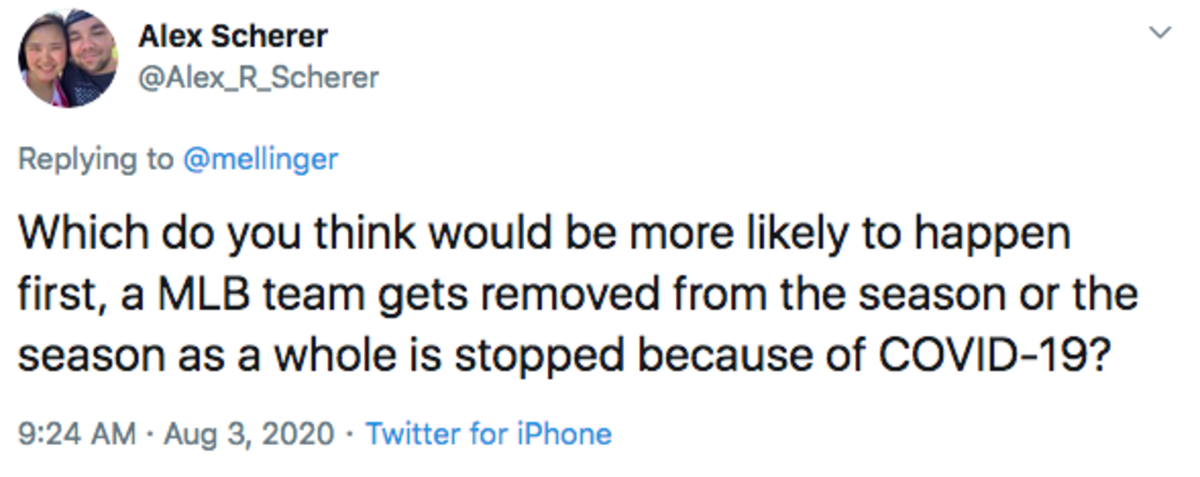
Did you hear that Rob Manfred is not a quitter?
It seems as if this is an increasingly minority opinion, but I still think baseball has a chance to see this season out. The Marlins made it more difficult on everyone, and the viability of this season has been pushed toward the cliff’s edge as a result, but there’s nothing so far that couldn’t have been reasonably expected.
Remember: The standard isn’t perfection. The standard is whether MLB’s testing and protocols can help keep players and staff at a rate equal to or lower than the general population.
So far, that’s holding, though at this point we should probably add the word barely.
The cold truth is that there is too much money at stake to believe baseball won’t give itself every chance. The owners can talk about losing money without selling tickets, but those TV checks still cash, and they know the devastation for the sport if it goes two years with only two weeks of games.
I’m also corny enough to believe that there would be a real negative psychological impact if baseball had to stop.
Vahe put it predictably well in his column last week, but sports have never been a clearer microcosm of society than at this moment.
Baseball’s leadership has been weak, its messaging disjointed, its adherence to common sense protocols inconsistent at best.
That very well could prove the killer of this experiment — and any day now, really — but if they’ve gone this far it seems they’ll be willing to go a little more.
Baseball has taken a lot of criticism for not having a preset criteria for what would require shutting down a team or the whole league, but to me that’s misguided.
There are too many factors involved to productively go through every possible outcome, and prejudge the reaction. That’s unrealistic and, if you listen to the health experts, unproductive.
The fairer and perhaps harsher criticism is that baseball’s mistake was to put noted public health professional Rob Manfred in charge of the decision about when and whether to shut down.
He had the leverage to do it, obviously, but if he was truly looking out for best interests of both his sport and public health he’d have had the confidence and (just being honest here) maturity to give that decision to someone (again, just honest) qualified to make it.
Nobody trusts Rob.
This is a decision that needs to be made by someone with credibility on the topic.
That’s the biggest sham in this whole thing.
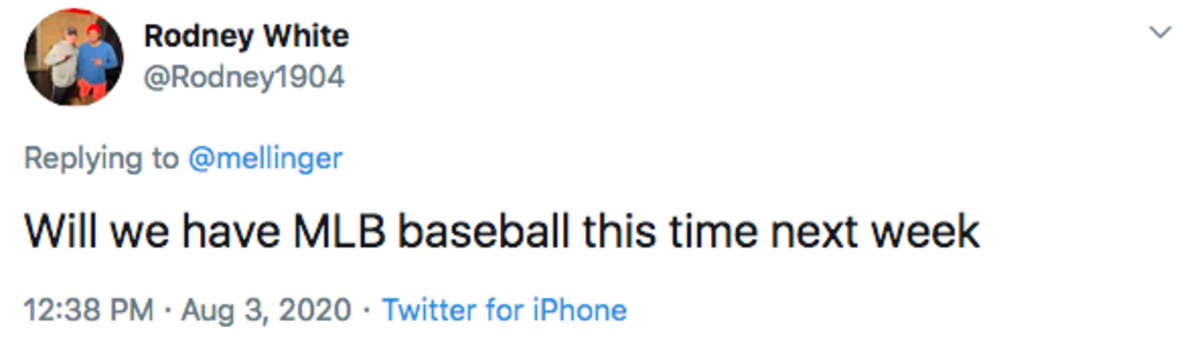
Rodney just cuts to the chase.
I think I think so, Rodney.
I know I hope so.
But guys need to stay the fudge out of the casinos and bars.
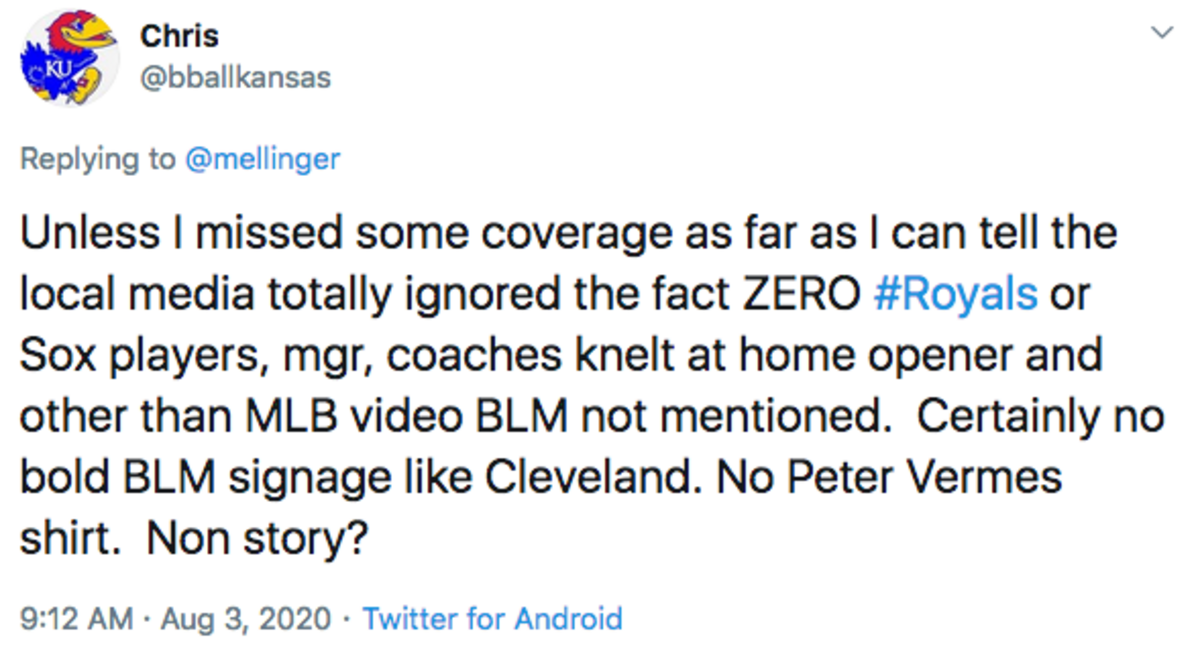
Was on vacation last week and watched the games when I could, but must admit I wasn’t consuming coverage the way I normally do.
That said, are we at the point where a lack of protest is noteworthy?
Two Royals players — Erick Mejia and Franchy Cordero, if you’re curious — knelt during the anthem before the season opener in Cleveland. Honestly can’t remember, I might’ve tweeted it, but didn’t think it was worth a column or news story.
The Black Lives Matter video and recognition is a significant move by MLB, but just talking practically here, it also gives players an out from kneeling during the anthem. It’s a smart move by the league on a few levels.
But, also, are we still counting the kneelers and non-kneelers?
That stopped being productive a while back when the intended message was essentially blocked by a segment of people who didn’t want to hear it. The movement has steadily gone beyond symbolism, too, and into real action that does not require the approval or acceptance of those who are offended or bothered.
The clearest example is with Patrick Mahomes and LeBron James and others partnering to increase voter registration.
Colin Kaepernick first took his knee four years ago. If the movement hadn’t advanced beyond that, we could shut the whole thing down without much being lost.
But it has. You’re seeing the biggest sports leagues and major companies speak. You’re seeing NFL players force the commissioner into an apology, and to action. You’re seeing white athletes speak, too, most supportive and some not.
If we’re no longer short-handing this to who and how many kneel, I take that as progress.
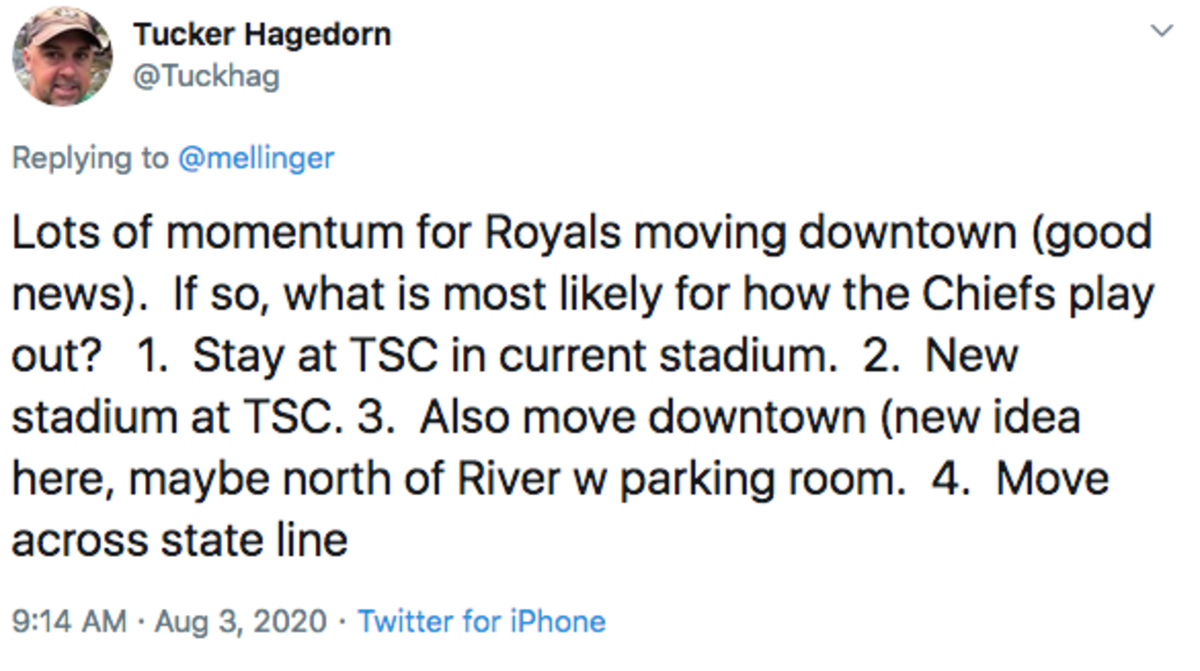
The momentum isn’t new. I’ve written before that the Royals had internal momentum toward a downtown stadium even before Sherman looked into the purchase, and that Sherman’s shopping process included a full exploration into potentially moving the team downtown.
If you’re looking for flashing neon signs, the Dunn family and JE Dunn being listed in the top half of Sherman’s co-investors is pretty decent.
This is also true: Anyone who tells you with any certainty where the Royals will be playing after their current lease is up is only guessing. There are a million things that need to happen that are out of any one person’s control, including (presumably) a vote for public funds.
Anyway, to answer your question, the outcome that’s always made the most sense for me would be that the Chiefs stay at Truman Sports Complex.
The location is among the most convenient in the metro area, and it would allow Clark Hunt to continue modernizing the Chiefs while holding onto the franchise’s history and traditions.
That, more than anything, has defined his leadership of the team. Sometimes it’s worked, and sometimes it hasn’t, but that’s what he’s been chasing since taking over in 2005.
The Royals moving downtown would accelerate that process and open new possibilities for the Chiefs.
My guess is that the Chiefs would want to use the extra space to create some sort of multi-use development to create a year-round moneymaker instead of just on game days.
This could be done in any number of ways. They could stay at Arrowhead and use Kauffman Stadium (or at least the land) for shops, restaurants, a movie theater, stuff like that. Or they could build a new football stadium where Kauffman is now, then repurpose Arrowhead, which would obviously have some sentimental appeal.
However they do it, the Royals moving would give the Chiefs some options.
Kauffman Stadium (or at least the land) could be used for some sort of multi-use development that would potentially turn the complex into a year-round money-maker instead of just on game days.
I want to be clear about something here. This isn’t something I’ve heard anyone with the Chiefs talk about, even informally or privately. But I do think it fits what Hunt and Mark Donovan have been about.
The Patriots and Eagles and Rams and other teams have created profit centers around their stadiums. The Chiefs have been sort of landlocked at the intersection of Interstates 435 and 70, and Hunt is too respectful and tied to the team’s history for me to believe he’d want to move to the Legends or Northland or Johnson County or anywhere else.
This is a potential solution that would check a lot of boxes.
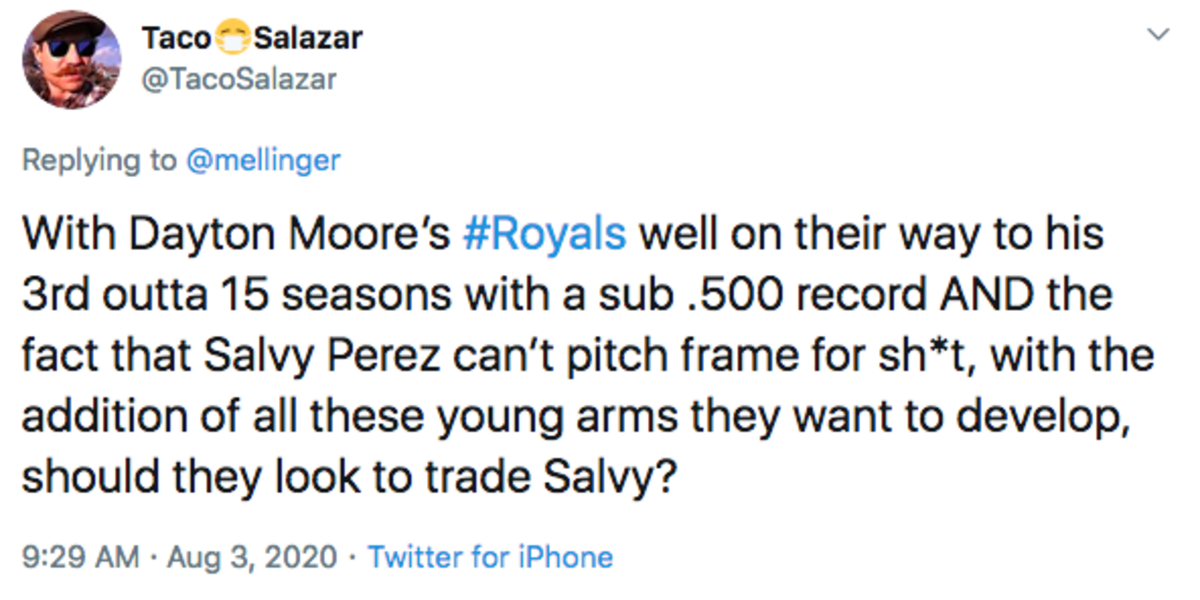
Taco has a typo here, but this would be the Royals’ 10th season with a below-.500 record out of Moore’s 14 (full) seasons in charge.
Not awesome!
Team officials and coaches don’t want to say this publicly, for obvious reasons, but they don’t see Perez’s career going like (for instance) Carlton Fisk’s, where he’s catching 100 games a year in his 40s.
That’s part of why the development of young catchers like MJ Melendez is so important, but that’s a tangent, so let’s answer your question:
A lot of you would be disappointed in the return the Royals would get for Sal Perez.
He’s 30 years old, coming off a major injury, has just one season with an OPS+ above league average since 2013, and almost certainly will need to move off a position that gives him value and to a position (first base or DH) that diminishes his value.
What would you expect to get for that?
This isn’t to say Perez has no value. He does. He’s good for 25 or so home runs in a full season, his energy on the field and in the clubhouse is valued, and he was a major piece of a World Series winner.
But you might notice that those are traits the Royals generally value more than other teams might.
Perez is an important part of the team’s past success, which is an increasingly rare thing for the Royals. Danny Duffy can be had for the right price, Alex Gordon has considered retirement and Greg Holland is with the Royals on a minor-league invite.
So, anyway, short of a salary dump I’m not sure you’re going to see that trade being made.
But I do think it’s as likely as not that someone else leads the team in innings caught next season or in 2022.
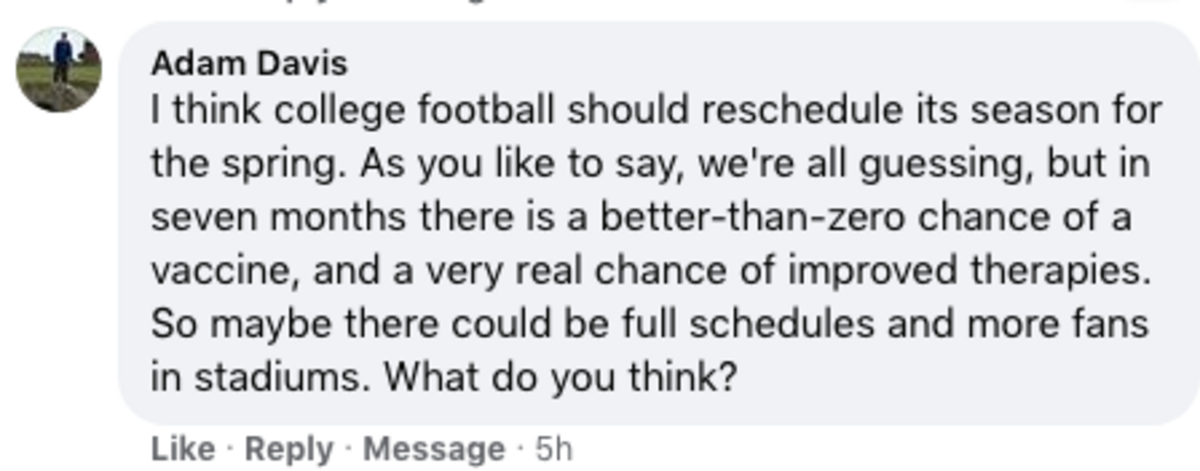
My full endorsement here.
I remain gobsmacked that humans believe the possibility of a full college football season is above zero, or that there is not an apparently wider recognition that the whole thing is wrong-headed.
Some of you feel like professional sports shouldn’t be playing right now. I disagree, but who knows? Yes, we’re all guessing. But at least the professionals are adults, well-compensated for the risks and in most cases liberated to make their own informed and independent decisions.
The dynamics are just so fundamentally different with college sports, and the decisions by the Ivy and Patriot leagues have made plain what was already plain: These decisions are being made because of money, and that money is not being reasonably shared with the athletes.
Never underestimate the motivation of profits, but the whole thing is ridiculous.
Now, will it be any different in the spring? Maybe not. Maybe we’re in the same spot, and there are some who would mention here about the difficulty of moving games around the likelihood of top prospects skipping a spring season to prepare for the NFL and yada yada yada.
But it does seem fairly obvious that you’d have a better chance at a full season then than now. Not just the vaccine, which you mention, but hopefully we’ll have more information and data and understanding as to how the virus spreads, long-term effects, and so on.
The college sports model is fundamentally unprepared for something like this. There is no central authority, very little accountability and a general lack of resources and discipline to deal with a pandemic that even the best scientists are still working to understand.
Football in the spring would be weird. You might have Michigan and Ohio State playing at the Big House on Sweet 16 weekend or something.
But isn’t that a favorable outcome when compared with what can reasonably be expected this fall?
Also: Wouldn’t you sign up for virtually any circumstance that led to a Sweet 16 weekend in March 2021?
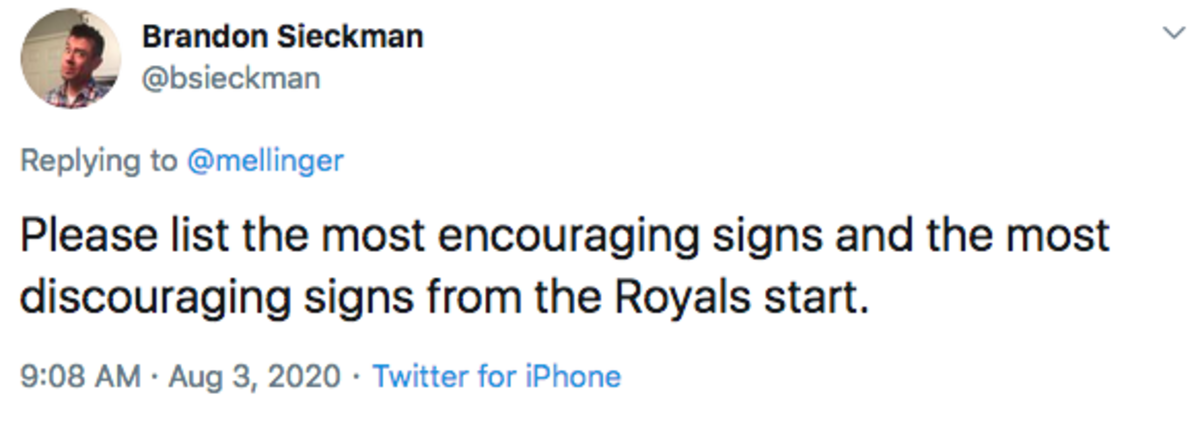
Two lists? Two lists!
Let’s do three of each. First, because we could all use some positivity, the encouraging:
1. Brady Singer. He has made just two starts, and if things go well and he stays healthy he will make something like 135 more for the Royals before he’s scheduled for free agency.
We are, then, working with an outrageously small sample size.
But doesn’t he look like what the Royals have been talking about? Doesn’t he look like what they reasonably hoped for when they used their first pick on him two summers ago?
He looks like a successful big-leaguer already, both in terms of stuff and presence. He’s always been on the fastest track of that group, and his success instills just a little more confidence in how the rest of them might look.
2. Kyle Zimmer. I know! It’s three games! And six innings! And he looked good early last season, too, before the problems came on hot and heavy!
But, he has seven strikeouts in those six innings and — just as importantly — only two walks. He seems more confident in his slider, he’s throwing more strikes (those two things are related), and he’s getting more chases outside the zone.
A thousand steps remain for Zimmer to begin fulfilling his promise, but, hey, you asked the question.
3. Mike Matheny. If I believed that big-league managers are as important as most fans and some media believe, he would be higher on this list.
But at least so far, he has been what he said he’d try to be which, among many other things, is vastly different than what he was in St. Louis. His communication throughout the clubhouse is said to be thorough, he’s empowering his coaches and he’s showing not just a willingness but a desire to embrace anti-establishment concepts like extreme shifts and roving bullpen usage.
He has a potential crisis on his hands with Mondesi, so we’ll see his bedside manner tested in a new way.
Which is a good-enough transition to the discouraging parts.
1. Mondesi. We’ve been over this already, so I’ll just say that it’s rare the gap between potential and production is this wide for a player who debuted four years ago and who the franchise still believes can be a star.
Still, he’s only 24. And he has had bursts of production.
2. The offense. I’m trying not to be I-told-you-so guy here, but it seemed like a lot of people ignored the fact that the Royals finished next-to-last in scoring last year and assumed the return of Perez would mean runs would pour down like cats and dogs.
The Royals are actually hitting with some power, but striking out six times as often as walking is no way to go through a season. It’s easy to pick on Mondesi right now, but Perez, Gordon, Starling, Cordero and Lopez need to be better, too.
3. Defense. If I thought this was a long-term problem it would be higher on the list. Mondesi is a better defender than he’s shown. Starling is going to make more plays against the wall than not. Franco is an upgrade defensively. And so on. But the Royals just aren’t talented enough to test the margins like this, and we can talk about anything we want, but the Royals aren’t going to win a lot of games without being clean defensively.
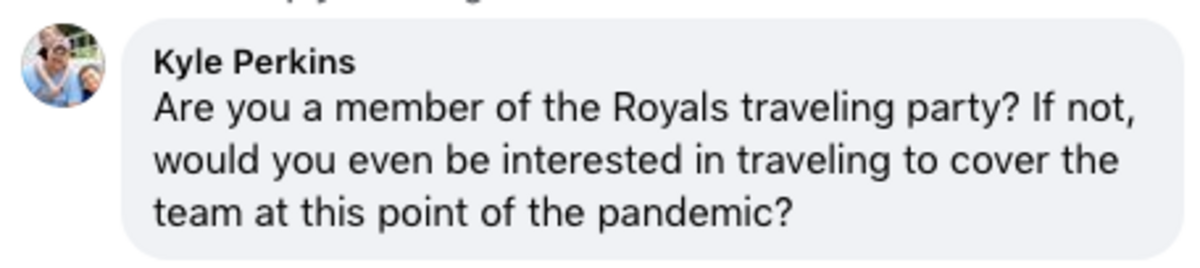
We never travel with the team. We book and pay for our own.
I went to the season opener in Cleveland, and I’m glad I did. It was an experience I’ll never forget, and one that I would’ve wanted the local newspaper to send a columnist for if I had a normal job.
I was surprised at how I felt, too. Surprised at the experience.
I felt safer than I expected, and I’m fully aware that none of us know exactly how to act right now. But the flights and airports weren’t full, which made distancing easier. I’m guessing that 90 percent of the people I saw in the airports or in Cleveland had masks. Hand sanitizer was everywhere.
The actual game was surreal. The fake crowd noise is really bad. It’s not loud enough to be replicate normal life. There is no spontaneity, no random screams, no lemonade man. The traffic outside Cleveland’s downtown ballpark still usurped most of what played on the speakers.
I want to answer your question. I do feel like there is something to be gained by being there in person, though that gap is smaller than ever with interviews conducted online. The same information is available from your couch as from the press box.
The question is about interest in traveling. Again, I’m glad I did the season opener. But I’m not sure I’d want to do them all.
I understand that our kids are young enough that the data says they’d be fine, but I still think about them, and my wife, and our parents who are in their 70s, and neighbors, and so on.
If there was something more to be gained or learned by going in person, I’d fight for the ability. And that point may come back.
But for now, I’m OK doing my thing online when they’re on the road and perhaps at the ballpark when they’re at home, supplemented with phone conversations with people who know more about this stuff than I do.
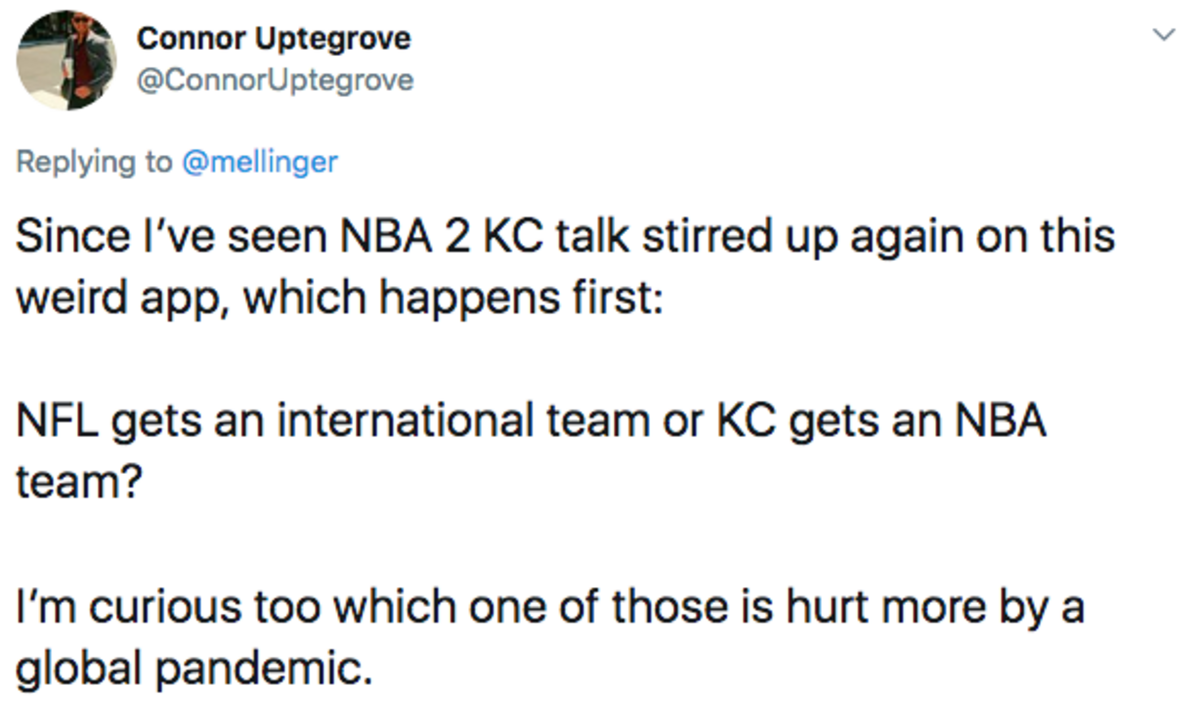
I’m morally obligated to mention two things here: I remain skeptical that the NBA will come to Kansas City, but I’m less skeptical than I used to be, because AEG’s apathy has been replaced by some actual grassroots action.
Both of these face significant obstacles, obviously, though my sense is that the NFL sees foreign markets as largely untapped resources. Mexico City has as many people as New York, for instance. London isn’t far behind and could be a gateway to capture more of Europe.
Kansas City needs an owner with local ties, presumably, or at least one who believes deeply in our potential and is willing to put many millions into upgrading the 13-year-old Sprint/T-Mobile Center.
Forced to choose between the two, I’d say an NFL team in a foreign country would happen first, but you bring up an interesting point.
I believe the COVID-19 disruption — that’s a weird word to use, but lets go with it — works better for an NBA team in Kansas City than it does an NFL team in a foreign country.
It’s not hard to imagine an NBA team owner who wasn’t fully committed to the team even before the virus, and who now is feeling some fatigue or simply wants out to let someone with more energy and focus take over.
Any change in ownership of a team in a less-than-fully-desirable market — and I’m looking dead at you, New Orleans — is a potentially positive development for Kansas City landing a team.
Again: This is a huge longshot.
But it’s not as much of a stretch as it was when Kansas City’s strategy was basically waiting on AEG.
Yes! My wife has a lot of family and friends in Michigan, and we try to get up there every year around this time.
It was, by far, the best family trip we’ve been on.
Some of that was probably that we’ve never needed a trip this bad. But a lot of it, too, was the feeling that we got to spend more focused time with each other.
Does that sound corny? It probably is. But it was the first time we’ve driven. That was different.
That was the plan even before the coronavirus, except that we were going to spend a few days in Chicago to take them to the Shedd Aquarium and Museum of Science and Industry and Planetarium and everything else my wife and I (separately, obviously) used to do on trips as kids.
That didn’t happen, but the driving — something like 34 hours total, if my math is right — was still oddly enjoyable. The kids had iPads out for chunks of it, don’t get me wrong, but it was cool to see different things on the drive and hear what their little minds were thinking along the way.
We swam, went on boats and a wave runner, played catch, made s’mores, caught lightning bugs, raced, laughed, played laser tag, went on ski lifts, opened football cards, and more.
My wife admitted she was secretly waiting until April or so to talk me out of driving. But now that it went this well, I think we’re all-in going forward. Hopefully next year we can do the Chicago part, too.
This week, incidentally, I’m particularly grateful for all that time with my wife and kids. I know it won’t always work out that way. Trips in the future will be harder, I’m sure. The kids will have more activities holding them back at home, and they won’t be as awed by everything, and it’ll be harder to get them to talk.
So I’m going to cherish every second of this now while we have it.