
Mellinger Minutes: On Patrick Mahomes’ money, sports and the virus, and Chris Jones
A NOTE ABOUT THIS TIMESUCK: Most of this was written before news broke about Patrick Mahomes’ 10-year contract extension with the Chiefs worth more than $400 million. We could have done 5,000 words on that alone, and parts of this have been reworked, though for now I hope you see my column, Vahe’s column, and of course analysis from Herbie and Blair.
OK, back to our regularly scheduled behemoth, starting with the way sports news consumption is now different:
This is one those topics the little sportswriter on my left shoulder is telling me not to bother with, it’s not worth it, just fire off another Manfred take. You’ll be safe that way.
But the little guy on my right is telling me to proceed but carefully and today I’m feeling like he’s making good points so here come the disclaimers:
- This is not me complaining. I love my job. I’ve worked hard for it, but I’m also lucky to have it, and believe that personal complaints from a sportswriter should be like flies on a windshield even if fans wanted to hear them. Which they don’t.
- Whatever reasonable precautions are being taken to slow the spread of a virus that is surging in many parts of the country and has killed 132,000 Americans already is not only understandable but welcomed.
- There are many important issues in the United States right now. This is not one of them.
OK, disclaimered up, here goes: You will not have the same level of information as a sports fan that you are used to.
Sports are happening again, which a lot of us are thrilled about, but the packaging they’re returning in will make “normal” news gathering effectively impossible. All protocols I’ve seen have media interviews on Zoom calls or similar. Locker room and clubhouse access will be prohibited.
Again: thumbs up. Totally get it. No complaints here about all of us staying safe and giving games the best chance possible.
But none of us are going to know as much about the teams we follow. The relationships will be different. The understanding less. Last year, a series of one-on-one conversations led me to seeing, being floored by, sort of understanding, and then listening to Tyrann Mathieu explain the time in a playoff game when he faked a blitz, covered Deshaun Watson’s first read, then covered his second, and then chased him out of bounds, all without earning a single official statistic.
It’s how I learned Charvarius Ward spent part of his childhood in a wheelchair, another part sleeping with 19 people in a house that didn’t have running water, and had a breakout season while not being able to see the ball.
And that’s just me.
Sam McDowell formed a relationship that led to the most insightful story that’s been written about Chris Jones, and Vahe has provided more insight on Andy Reid than anyone else. All the news Herbie breaks? It’s relationships, formed with human to human interaction.
We’ll do our best, and lean on relationships in new ways now, but something will be missing. There’s no alternative.
The best information has never come from press conferences or group interviews. It’s in finding the right time for the right question for the right person with whom you’ve earned trust.
Teams are increasingly protective of information. More specifically, they’re increasingly protective of the information they want protected. That means we’ll still know when Mathieu funds schoolroom technology, which is great, but we won’t be able to know whose assignment was broken on a bad play, or how a locker room responds to certain leaders or coaches or, just as a personal favorite example, that the play where Dontari Poe caught a touchdown was called Hungry Pig Right.
We’ll have to adjust. Which, again, is fine. The best reporters will find ways. The others will fall behind.
But being a sports fan won’t be quite the same, even with games coming back.
I hope we can make up for it in other ways.
This week’s reading recommendation is Ryan McGee’s definitive oral history of Days Of Thunder, and the eating recommendation is the taco at In-A-Tub.
If you haven’t already, please give our Mellinger Minutes For Your Ears podcast a try. I appreciate your time and hope we’re worth it. The newest episode includes insight from an epidemiologist as well as trainers for the Royals and Sporting Kansas City about how sports are returning and the challenges they now face.
Please give me a follow on Twitter and Facebook and, as always, thanks for your help and thanks for reading.
OK, here’s the show:
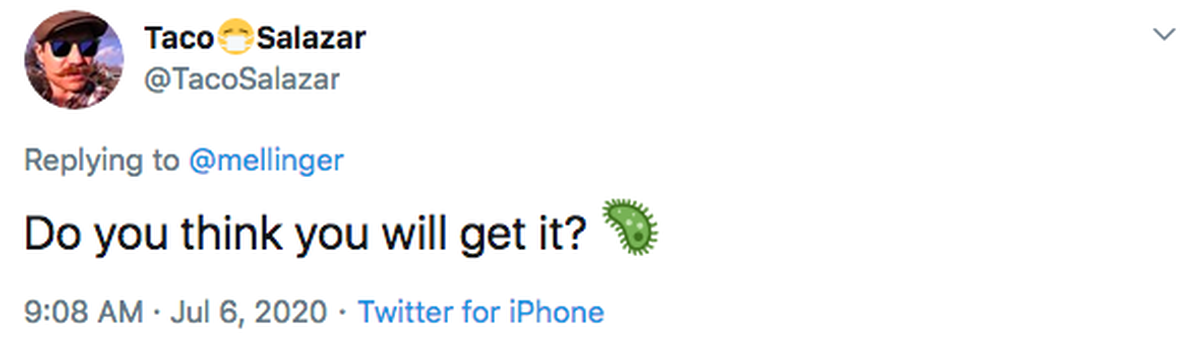
Maybe?
I don’t think any of us can be sure one way or the other. For the thousandth time: we’re all guessing.
Here is a non-comprehensive list of ways my family has tried to limit exposure: cancelled two separate vacations, pulled our oldest from a baseball league, have eaten out once in four months, froze gym membership, limit in-person shopping to essentials, masks indoors, distancing when possible outdoors, more bike rides and lake time as family activities.
Here is a non-comprehensive list of ways we’re not following the strictest guidelines: dinner and not-strictly-distanced hangouts with kids’ grandparents, a long road trip later this month, dinner and drinks out with friends a few weeks ago, baseball leagues for each kid, and a sort of general agreement with some neighborhood families with kids that we’ll do our best to limit exposure while also allowing the kids to play.
You can see we’re not on either extreme. Is it enough? Too much? I don’t know.
So far, nobody in our family or immediate circle has tested positive or experienced symptoms.
So far, nobody we know personally has tested positive in a timeframe that would mean we’ve been exposed.
Maybe we’ve just been lucky. Maybe we’ve had it and not known. Maybe we’re navigating this middle ground — living life, but not recklessly — the right way. Maybe we should do more.
I simply don’t know. You don’t know. An epidemiologist can’t know. Not for certain, anyway.
Some of this stuff is pretty basic to me. Wear a mask, particularly indoors. Don’t go to big public gatherings where distancing will be impossible. Think about who you interact with directly. Don’t take your (particularly unmasked) kids to the grocery store or Target or wherever like it’s some sort of field trip.
But other than that? Definite answers are illusive.
I feel like we’ve found a workable middle ground between wearing hazmat suits and going to a packed bar at the Ozarks. But we all have choices. We should all understand the risks by now, and hopefully all understand that our choices impact others, even (and sometimes especially) people we will never know.
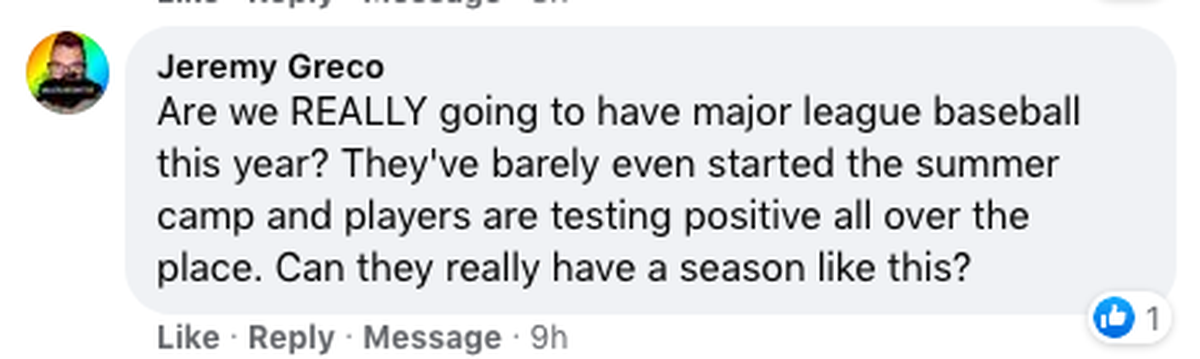
Yes.
There are two ways to look at these test results. Well, that’s not true. There are a million ways you can look at them. But these two seem particularly relevant at the moment:
1. Too many positives! Shut it down!
2. MLB announced a 1.2 percent positive rate, which is below both the roughly 5 percent positive rate announced by the NBA and NHL, and the 7.5 percent positive rate on the national 7-day moving average, according to Johns Hopkins.
Listening to epidemiologists, the second point is generally viewed as more important. For a few reasons. First, there will be positive tests. That’s a lock. The virus can’t be ignored, or locked out.
Second, it’s a compelling argument that protocols are working, at least for now. Because by holding workouts and practices and eventually games, leagues are by definition increasing risk of spread.
The goal, then, is to establish and follow protocols that will bring that risk down to (at minimum) the rate you’d expect if athletes and staff were living their lives at home and (hopefully) even lower.
If you accomplish that, then you have a convincing case that you’re not adding to and could be diminishing risk to public health.
At that point, you can proceed with a clear conscience.
This is worth reiterating: nobody can be sure how this will end. No league can begin right now with any certainty that it will finish, and no protocols can fully eliminate risk. You probably know that Orlando dropped out of the NWSL’s restart, and FC Dallas won’t be playing in MLS’ tournament.
I know and understand the temptation to see positive tests and want it all stopped. Nobody wants cases.
But it’s also true that shutting down would not eliminate risk or cases, and that, in fact, players and staff could be safer in this environment than they would on their own.
Although, ahem, you know, it would help if MLB could pretend to be a functioning entity capable of getting test results back inside the agreed upon timeframe.
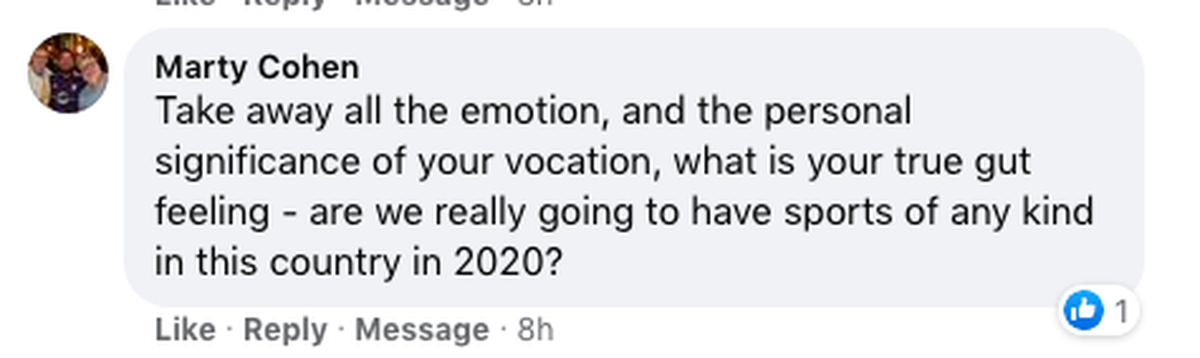
So, this is a similar question, but I’m including it here because of the reference to my job.
I hope you guys will agree with this: I try to be as self-aware as possible with my biases, and be upfront with you about them here.
I also hope you’ll trust me on this: I desperately want sports back for a million reasons, but not if it means an increased risk to public health.
Here it’s worth noting that I believe college football is insane right now. I can’t understand why that sport isn’t delaying until the spring, and short of that, can’t understand how anyone believes that sport will have a season without major disruptions.
I’d bet straight-up that we do not have a national champion this season.
But that’s largely because college sports don’t have the discipline, structure, resources or centralized authority available in pro leagues.
You can’t bubble or quarantine college football teams the way you can in the NBA or MLS. A 20-year-old outside linebacker is not going to have the same humility or discipline or resources to distance and be careful as, say, Alex Gordon. They don’t have the same testing, the same resources, at least not below the richest schools.
It’s just a completely different thing.
So as long we all understand we’re talking about pro sports here, and not college, then yes, I do believe we’ll have sports in 2020.
One more distinction: I would not bet that all five major leagues — NFL, MLB, NBA, NHL and MLS — will crown a champion.
But I’d bet that some will.
This is just spitballing, and it’s not a question you asked, but it seems to me that the NFL and MLB face the biggest obstacles.
With baseball, they need four months to complete their season, and they’re traveling, no bubbles, with a pool of 1,800 players across the sport. The league office has also exposed itself as so far unable to conduct proper testing. That’s a big issue.
With the NFL, the scope of the league is just so unwieldy. The nature of the sport makes distancing and other “best practices” virtually impossible. They’ll be playing during flu season. They have the benefit of the calendar, which affords them the ability to learn from other leagues’ mistakes and successes.
But that’s going to be a huge lift.
I hope they and all the leagues can do it. You’re objectively correct that at least some of that is coming from my job, but I wouldn’t have this job if I didn’t love sports. And I think anyone who loves sports want them back.
All we can do is hope they do it successfully. You’re asking about my gut feeling. Again, my guess is that some will finish and others won’t. Beyond that, I honestly don’t have one either way and, what’s more, I don’t trust anyone who views the immediate future with any certainty.
There are simply too many unknowns.
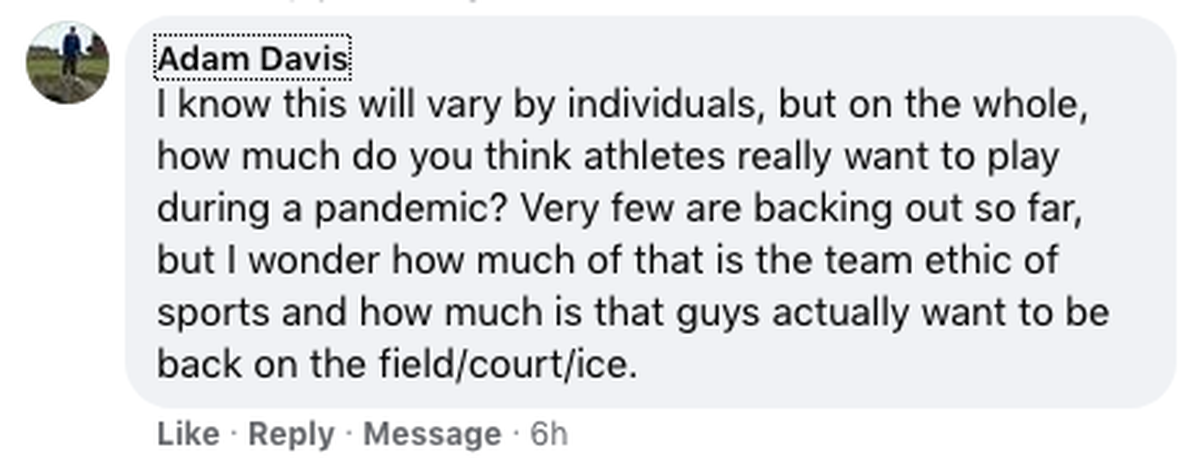
I’ve evolved a bit on this. There are athletes who are in it for the money, sure, but the vast majority needed to love the sport and be able to grind through problems to get to this point.
I’m probably parsing your last sentence a bit too much, but to me, that team ethic of sports is inseparable from wanting to be competing with your team. They’re connected.
There are certain profiles of athletes that will be more likely to opt out. Guys who’ve already made millions, with young families at home, perhaps someone in their circle who qualifies as high risk.
There are certain profiles that won’t opt out. Guys who need the money, even at a significant paycut from what they originally signed for. Guys who need this season as a platform for free agency, or for arbitration.
But for the most part, even while making 37 percent of what they believed they’d make just four months ago, I think most athletes are coming back because this is what they do. They play. They only get a small window to do this, and the coronavirus is already shrinking that window. There’s urgency. You don’t get these opportunities back.
This will (I think) be a column later this week, so I’ll keep this relatively short but...
Better than they were with a 162-game season.
A hell of a lot better, actually.
Players are expressing optimism, and, yes, that’s as newsworthy as one of them saying they’re in the best shape of their life.
But it’s also been reiterated to me by enough club officials with enough enthusiasm that I believe there’s something to it. Every team can talk optimistically in spring training, and every season includes surprises.
But baseball people also know that a 162-game schedule is professional sports’ great equalizer, that warts will be exposed, and nobody other than the 2006 Cardinals can luck into the postseason.
Sixty games? That’s entirely different. You can’t have a bad first month, but what about a hot month?
What if, for instance, Adalberto Mondesi can floor it for 60 games in a way that he’s so far been unable to over 162?
What if Sal Perez’s body doesn’t become overworked?
What if power bullpen arms — the Royals have two guys who will regularly throw 100 mph — can air it out more than usual, and the high-ceiling rookies-to-be don’t have to worry about pace or fatigue?
I’d still bet against the Royals playing in the postseason.
But I wouldn’t bet as much as I would’ve across 162 games.
Without knowing the specifics of the structure and what exactly “guarantee mechanisms” are, I’m proceeding with the assumption that Mahomes’ deal does not impact salary cap until it kicks in for the 2022 season.
It that’s incorrect, it changes the rest of this, but at least for now I’m assuming that’s how it works. The signing bonus, assuming there is one, would be spread across a maximum of the first five years of the deal.
Anyway, if Mahomes’ deal doesn’t change things immediately, the Chiefs have about $6.2 million in cap space, according to both Over The Cap and the NFLPA. That is, basically, enough to sign the draft class and not much else.
Now, as always, the cap is malleable. Existing contracts can be restructured to clear more space. An extension with Jones could actually create space, at least in the short-term. He’s currently on the books for a $16.1 million cap hit with the franchise tag, but that number could come down with a signing bonus.
So, sure, a long-term extension for Jones is possible.
But at least two things probably aren’t possible: Jones isn’t going to sign an extension for the $15.4 million salary he’d be in line for with the franchise tag, and the Chiefs aren’t going to offer the $21 million a year he’s looking for.
There’s a middle ground, but both sides have to agree to meet there.
Also want to address your last point. I don’t agree that the players get lazy. We can both find examples of players who might’ve coasted a year or two after a payday but keep in mind that by definition we’re talking about players signing at or near the peak of their value.
Justin Houston might be the clearest example. He set a franchise record with 22 sacks in 2014, and then signed for $52.5 million guaranteed. He was never going to have 22 more sacks in 2015.
Part of the calculus has to be trust. A team has to decide whether it trusts the player with a big contract. That’s true in all sports, but particularly true in football where guys typically only get one shot at a big payday, and success is often determined by work ethic and a willingness to put team over self.
I’m not sure what Jones has shown to lose trust.
I know I say this a lot but I say it because it’s true: he’s been a model professional. Lot of guys skip the first week or two of training camp. He showed up on time. Lot of guys would hold a grudge against a team that gave the contract to someone else, or the player who signed it. Jones showed through his play that he wanted to help the Chiefs win, and with his actions that he bonded with Frank Clark.
Reasonable people can disagree about whether a model professional would skip parts of training camp or even the regular season now, but there are no red flags in who Jones has shown himself to be.
Now, all that said, I continue to believe what I believed from the moment the Chiefs traded for and signed Frank Clark to that big contract: the likeliest outcome is that the Chiefs will trade Jones after the 2020 season, likely for draft picks.
At some point, teams do run out of space for superstar contracts.
Sporting has passed every test so far, literally and figuratively. Peter Vermes announced on Monday that the team had all negative tests after arriving in Orlando.
MLS’ plan is generally what epidemiologists have been pushing for — lots of testing, teams isolated, bubbles formed, contact with the public eliminated and contact with people outside the immediate bubble limited.
That said, I’m cautiously optimistic here.
I’m sure the discipline will vary between teams across the league, and FC Dallas’ outbreak isn’t generating confidence. So I’m not naive enough to think this thing can be eliminated with protocols.
But I do think this has a chance.
I’m not sure what MLS or Sporting can do that they’re not doing.
These are adults. They’re going into this with open eyes.
I don’t know how to quantify that. My instinct is the same as yours. Anecdotally — both from what’s been in the news and what I hear from friends — yes, I agree. There is data that would back the point.
But I also know of people in their 20s who are being more careful than I am, and I’m always hesitant to blame big problems on those dang kids.
More to the point, it doesn’t matter. We need to get away from this blame game. It doesn’t matter if it’s all 24 year olds at the bar. The virus is spreading, and we all live here.
The list of failures to get us to this point while other developed countries have so significantly decreased cases is long. Leadership has been atrocious, political and otherwise. The messaging has varied between misleading and inconsistent.
We can blame individuals or groups, and that’s fine, because we’re all adults and we should be able to make the best decisions. But it’s also unfair to scapegoat anyone with how disjointed and divided the messaging has been.
The fact that there’s usually weeks of lagtime between a change in public guidelines and a change in case numbers only adds to the confusion.
But, again. It doesn’t really matter which demographic takes which share of the blame. We live in this country together, and together we’ve done an objectively awful job with the virus when compared to other countries.
Protocols in professional sports would not need to be so strict, and more importantly would have a better chance at success, if America as a whole had been more diligent about containing the virus when we had a shot.
It’s a massive failing, and I don’t have much interest in blaming it all on (for instance) the president or people in their 20s. It’s bigger than that, and more complicated.
Nobody operates in a vacuum.
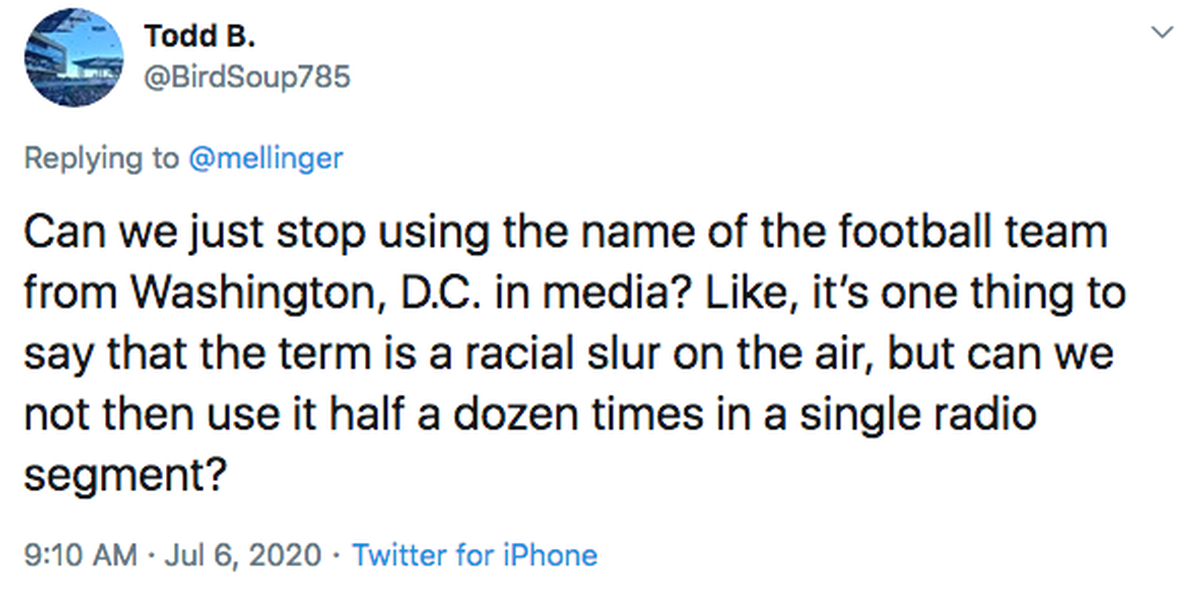
I’ve worked at the Star for almost 20 years, which is a crazy thing to type out loud here, but anyway, the Star’s policy of not using “Redskins” in print predates my time here.
But, you might say!
You just used it!
Same as you said it on the radio!
The policy is, basically, to not use it the way we use Chiefs or Royals or Lions or Tigers. But when the subject of the story or conversation is the name itself then it makes sense to say the word.
The Star is far from alone on this, by the way. The Washington Post is among the many outlets that don’t use the name.
But I also want to take this chance to make another point. We have, are, and will continue to talk about this issue. But changing the name is — to borrow a phrase from another sport — mere eyewash if that’s all that happens.
Going a step further, anyone pushing for a name change with the idea of respecting a group of people is lying to themselves if that’s as far as it goes.
The conversation should be about more than the name. It should be about the line between honoring and appropriating, and whether a team is taking the responsibility seriously.
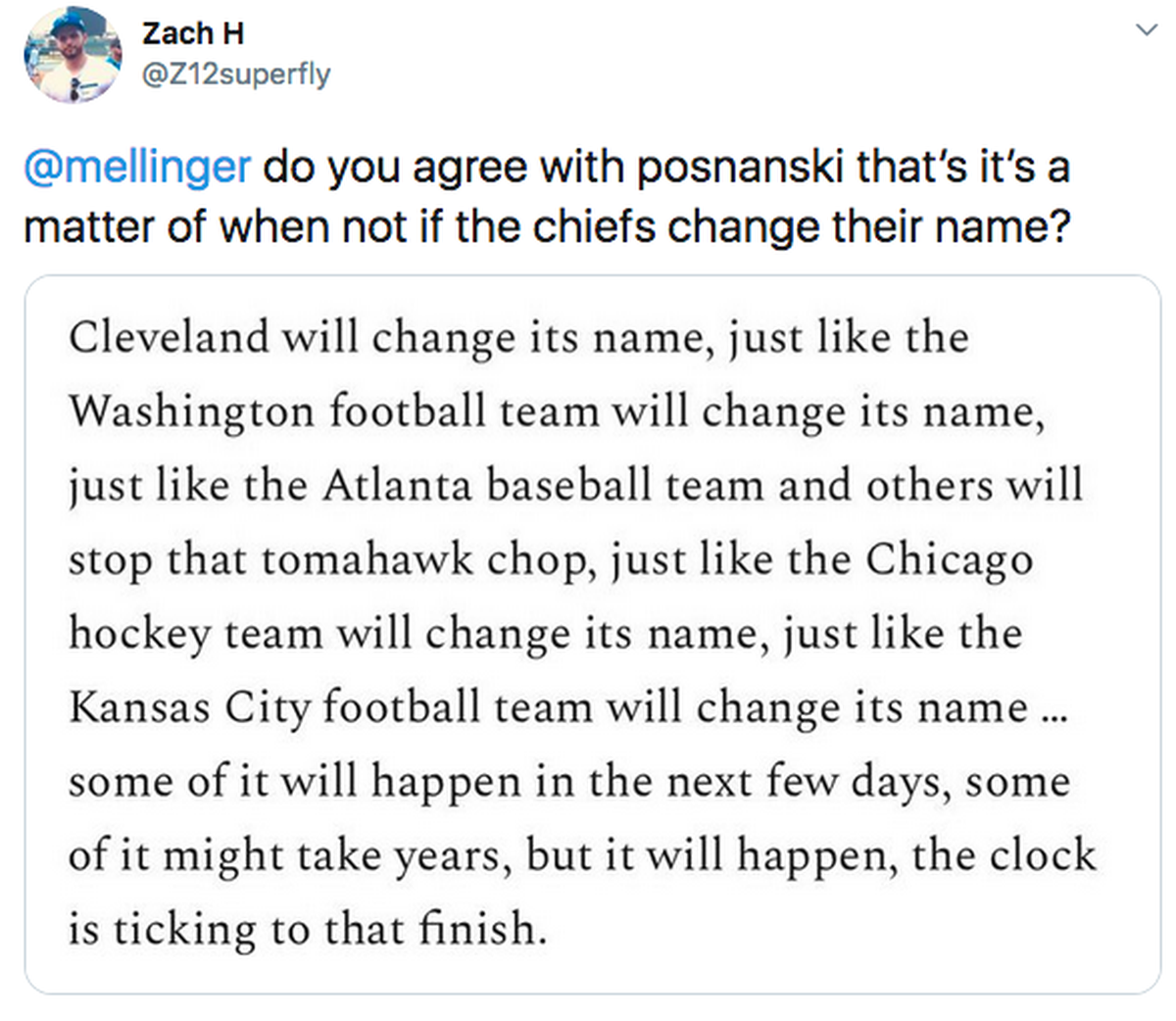
This is almost certainly going to be its own column later this week, and will include some reporting and conversations I haven’t been able to get to quite yet.
I do believe that Dan Snyder’s team will make the overdue decision to change its name. I don’t believe that means the Chiefs will change their name.
They might change!
They could!
But equating the teams here and in Washington is a leap.
The Chiefs have done their homework on this. They have partnered with — if you read that as “paid” you wouldn’t be wrong — Native American groups and advocates. November is Native American Heritage Month and the Chiefs use a home game every year to honor that history. They invite groups in to do a blessing, to share, to be seen and heard.
This is not me presenting the Chiefs as some Native American rights advocacy group. You can point out that the name originally comes from former mayor H. Roe Bartle’s nickname, and technically you’d be correct, but do a quick Google to see how the franchise branded itself in the formative years.
The tomahawk chop is, by virtually any definition, cultural appropriation and was popularized by the Chiefs before it was adopted by the Braves and Florida State and others. The team asks broadcast partners not to show fans in headdresses, and for a while stopped playing the tomahawk chop.
After years of fans asking for it back, and starting the chop on their own anyway, the team began playing the song again.
Again, I’m not saying the Chiefs will be unaffected by the way the winds are blowing. My guess is they’ll stop playing the chop, and will make other steps that will be presented as “our continued efforts to honor Native Americans” or something.
But at least for now, I’m not sure why the name has to change.
Well, that’s true always, but the worst part is it hasn’t gotten hot yet. Not really hot. We haven’t had a day yet worth openly complaining about.
Ninety is fine. It’s not ideal, it’s not awesome, and it’s not as good as 50. But it’s fine. Unless the humidity is outrageous — and, to be fair, the humidity is often outrageous — you can usually get through a day of minimal outdoor exposure without breaking into the kind of sweat that turns everyone into a dad joke machine:
I didn’t know it was raining!
Did you walk here, or take a shower?
You look nervous, anything you want to get off your chest?
First of all, screw each and every one of you who make those jokes. You should be ashamed. If you make those jokes you have no idea the struggles my people endure, and I’d appreciate you not talking to me until November at the earliest.
But when the 95’s with humidity start coming — and they’re coming — it’s going to be worse than most years because we’re all a little stir crazy anyway and a lot of pools around town are closed or open with limited access.
Our choices, then, will be to stay inside and get even more claustrophobic, or go outside like some dolt and pretend this is weather suitable for humans.
I’m already miserable.
This week, I’m particularly grateful for our younger son. He had a scary moment over the weekend (all good now) and handled it like an absolute boss. He’s only 4, but tough, and blessed with a naturally positive outlook on a lot of things.