
Mellinger Minutes: We’re grading this MLB restart. And should Clark Hunt apologize?
Major League Baseball players will begin official training Wednesday. MLS will begin games a week from Wednesday, and the NBA restarts on July 30.
These are real games, on the schedule, that will count. But if you talk to people inside these leagues, a familiar phrase comes up:
“I know we’ll start, but I’m not sure we’ll finish.”
That’s because the spread of the novel coronavirus remains a constant foe to normal daily life, and in places across the country case numbers are going up, not down. Some of this is due to increased testing, but it’s also bad enough that Florida has closed beaches and Texas has shuttered bars.
Texas, as you know, is home to one team in the NHL (which will get going next month), two MLS teams, two MLB teams and three NBA teams. Florida, as you know, is home to two teams in the NHL and two in MLB, and will play host to the restarts of the NBA and MLS.
Again: The virus remains a real threat to these leagues completing their seasons.
And the heck of it is that these leagues can do something about it.
Picture this: Patrick Mahomes, LeBron James, Aaron Rodgers, Gerrit Cole, Steph Curry, Cody Bellinger, Russell Wilson, Mike Trout, Kawhi Leonard, Carlos Vela and Sidney Crosby appear together on a video.
Rodgers: The spread of Covid-19 has impacted all of us.
Trout: More than 120,000 Americans have died, and 44 million have filed for unemployment.
Vela: We’ve missed hugging our friends and family.
Bellinger: But we’re resilient, and we’re taking back familiar routines.
Curry: That includes professional athletes getting back to work, and playing the games we love.
Wilson: But we need your help.
Crosby: Because we might need to play games without you in the stands.
Cole: But we can’t play without you helping slow this virus’ spread.
Leonard: That’s why we’re challenging you to wear masks in public.
Mahomes: And please practice social distancing.
ALL TOGETHER NOW: Because without you staying safe, we can’t stay safe.
I mean, please, don’t be harsh about the script. This was written in about 30 seconds. I underestimated how many lines I’d have, so I added Leonard there at the end. I think he’d be hilarious with it, actually.
But athletes have influence and, more to the point, they’re among the few left in our divided world who have influence with people across the political spectrum. More on this later.
Right now, a lot of people who want to watch sports this summer and fall are gathering in big crowds without masks and seemingly without any care about the virus’ spread.
I can’t know whether the influence of athletes would make wearing masks acceptable to all, or whether it would change enough behaviors to limit the virus’ progression.
But I do think it could help, even a little, and it’s in their best interests, and ours, to try.
This week’s eating recommendation is the chorizo and black bean meatballs at Brewery Emperial, and the reading recommendation is Caroline Randall Williams: You Want a Confederate Monument? My Body is a Confederate Monument.
If you haven’t already, please give our Mellinger Minutes For Your Ears podcast a try. I appreciate your time and hope we’re worth it. The newest episode includes clips from one of my favorite interviews, in which I talked with Royals manager Mike Matheny about his faith, his world view, baseball and how he plans to lead. Dynamite drop-in from Sal Perez, too.
Please give me a follow on Twitter and Facebook and, as always, thanks for your help and thanks for reading.
OK, here’s the show:
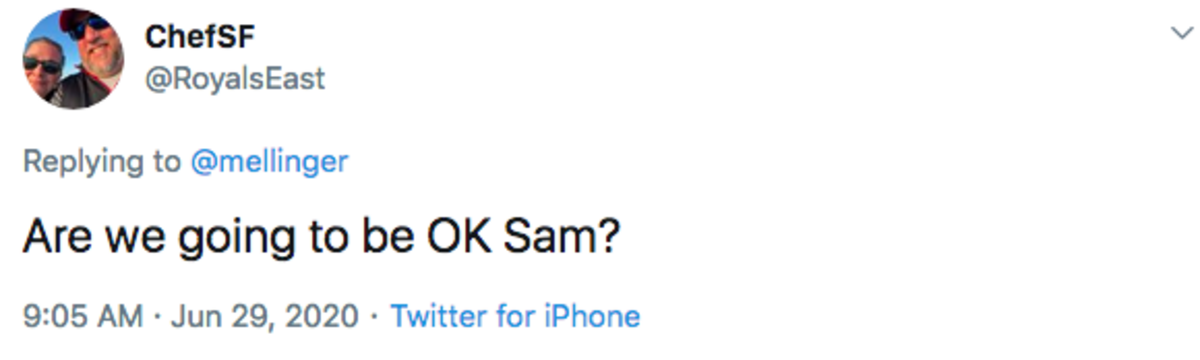
Most of us?
Look, and this is painting with broad strokes here, but two groups of people I have very little patience for right now:
1. Those who believe we’re all going to die yesterday, wearing masks while driving their own cars by themselves, convinced anyone who goes for a bike ride or grills a burger outside has a death wish and is endangering their neighbors.
2. Those who believe this is just the flu, no big deal, that the case numbers and death counts are inflated and that wearing a mask is a sign of weakness and any recommendation or requirement of masks is an infringement on their personal freedom.
Both of ya, get the hell out.
Good news: I actually don’t think there are many on either extreme. They take up the most metaphorical oxygen right now, especially online, but most of us are in the middle somewhere making the best guesses we can.
Is that naive? Maybe.
The most jarring part of all this is that I — and this is definitely naive — believed we were past this. That science and technology and medicine had advanced to the point that we would not be caught off-guard by a deadly disease without a cure.
The second most jarring part is that we’ve somehow created a country where a virus is politicized. That’s not helping, and it’s not a coincidence that the line graphs in other countries look better than ours.
I have to say here, too, along those lines it’s heartbreaking to see how Black Lives Matter has been twisted and distorted by some. The first time I heard the phrase, it made me sad, like, My goodness we’re still at the point where this has to be said?
And in the years since it’s made me sad in new ways, like, My goodness it really does have to be said because some (white) people seem to believe that saying Black Lives Matter somehow means that White Lives Don’t.
This shouldn’t be difficult. Anyway. Back to the virus.
I am not an infectious disease expert, and I don’t pretend to play one online. But I do listen to those who are, understanding that while they know a hell of a lot more than me or any of my friends, they also don’t know everything.
They’ve been wrong, they’ll be wrong again, but they’re the best guides we have.
We went out the other night. My wife and I, with two other couples. First time either of us had been to a restaurant for anything other than carryout. When everything was shut down, I remember thinking how much I was looking forward to eating out again.
I love eating out. My family, for better or worse, usually celebrates with food. We go out on birthdays, graduations, whatever. Christmas and Thanksgiving traditions revolve around specific menu items. It’s a big part of who we are.
But I have to say: Eating out was weird.
Don’t get me wrong. It was a great night. We had a blast. Hopefully we’ll do it again. But the reminders are everywhere — capacity limits, no physical menus, to-go boxes for eating in, etc.
At some point, the lockdown became like a second cousin to normal. We developed new routines. We adapted. We emphasized the positives, like more time with family and the opportunity to create new traditions* and do new things** and enjoy old routines in a new way***.
* Friday sushi nights, where we get takeout and the kids have pizza, a movie, and popcorn (what’d I say about celebrating with food?).
** Family bike rides, boat rentals, more reading.
*** Kid baseball games, wake-ups, bed times.
In other words, we adapted. I’m sure that you can tell similar stories of how you’ve rearranged your life and moved on.
Now we get to the answer. You’re asking the question somewhat in jest, I understand that, but the reason I believe we’ll be OK is that we adapt. We adjust. We move on.
I wish more of us did so with basic levels of courtesy, specifically with masks and avoiding big crowds. The less we ignore these things, the longer this will take and the worse it’ll be. The conflation of wearing masks and feeling an infringement of personal freedom is pretty gross, if we’re honest.
But I do think enough of us are trying that we’ll be OK.
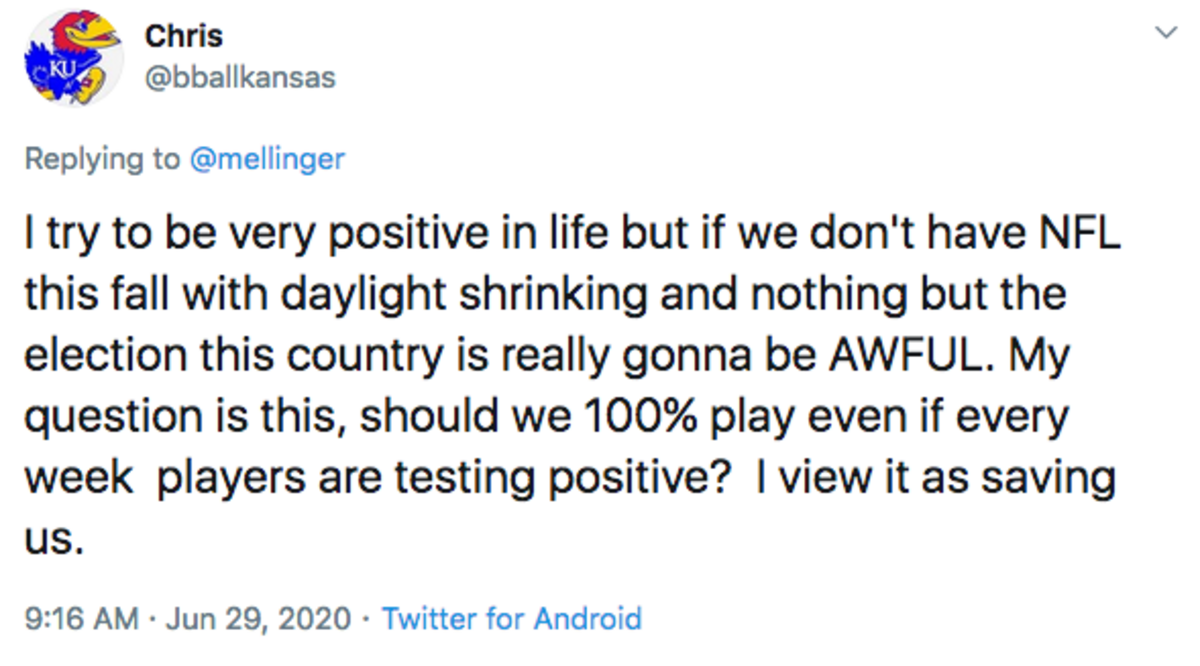
Yes, leagues should make every attempt to play. Absolutely. I feel strongly about this. You could (fairly) point that, well, of course that’s how I feel because this directly affects my ability to work and provide for my family.
But I’m as sure as I can possibly be that I’d feel the same way if I had a real job.
A few points to make here. First, nobody should be expecting perfection. There will be positive tests. There will be outbreaks. That’s inevitable. The goal here should be to limit them as best we can. Lots of testing. Lots of screening. Isolation for symptoms. Contact tracing. Strict adherence to distancing and mask guidelines.
Because I’m with you. I don’t know that I’d go as far as saying sports can “save” us, because they’re just games. It’s up to us to treat each other with respect. Football can’t do that for us.
But I do think sports can be a critical part of the healing process. Having games again will give our lives a familiar rhythm, a conversation starter that doesn’t begin with coronavirus case numbers.
The games will be different. We all understand that. Particularly in baseball, a league champion will come with an asterisk so big it’ll make the Astros jealous. The Yankees could secure the American League’s top seed and then get news that Gerrit Cole, Aaron Judge and Gleyber Torres* all tested positive and will have to be isolated during the postseason.
* Did you know he’s only 23?!?!?
That’s all on the table, and so is the possibility that the virus’ spread is too much for the leagues’ best intentions, and the whole thing has to be shut down. We all understand that.
But we have to try.
One more point to make: Everything above applies only to professional leagues.
College sports is a very, very different topic.
Because I can sit here and justify the risks for professional athletes because of their pay, and because they’re adults who can make their own decisions about their personal risk-reward balance. We’re seeing some pro athletes, such as Mike Leake and Avery Bradley, opt out. They make their own decisions.
The context is vastly different for college athletes, and I’m not sure why we’re not talking more about pushing college football to the spring. This feels like a place where a commissioner of some sort would help, to get some uniformity and organization into the sport’s response.
NFL teams have resources that most colleges just don’t. NFL players have incentives and, generally, a more mature world view that should mean better adherence to protocols.
It’s hard to imagine college football happening without major disruption, and that’s without accounting for the wisdom of forcing kids on campus to play a contact sport and hoping it doesn’t lead to outbreaks.
Maybe this is a column.
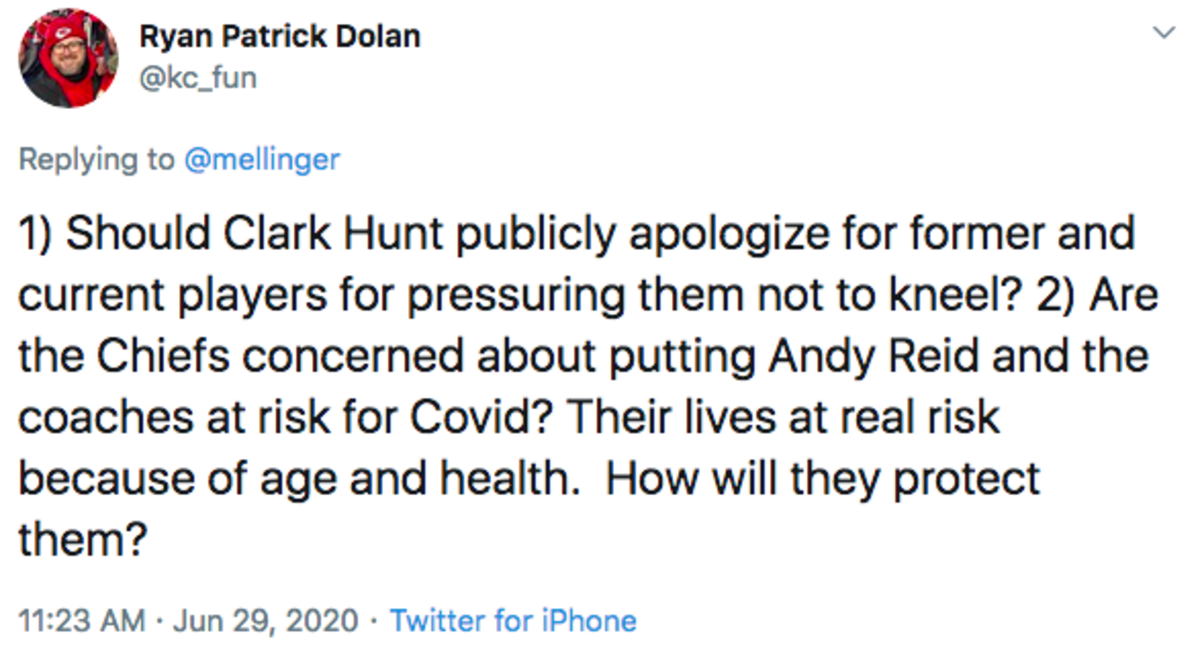
This is interesting, because actions are more important than words, and Hunt’s actions — reaching out directly to Patrick Mahomes and Tyrann Mathieu and others and working with them on voter turnout — are a practical apology.
Credit Hunt for reading the room.
Four years ago, he talked with Marcus Peters and others and the result was the players standing (or, in Peters’ case, staying in the locker room).
Now, the result is a tangible action.
I care more about that than I do any words, but you’re right to say that words also matter. When Hunt next talks publicly, an apology or some other form of humility or expression of growth would be significant.
Hunt has his faults, but he does have a strong record of rising to the moment.
Even if it’s more of a read-the-room-type thing than being personally moved, Hunt has a chance to make a real difference.
A significant portion of NFL fans are dismissive of Black Lives Matter. Star players using their voice to push Roger Goodell into an apology is one thing, but the movement doesn’t work without powerful white people pushing along.
This is another chance for Hunt.
Which brings us to ...

Well, for one, and some have already said as much, we’re beyond kneeling. The NFL can start by refusing to feed into the divisiveness of kneeling, and I honestly don’t care how they do it — don’t have players on the field for the anthem, stop playing the anthem, make clear that kneeling is not disrespect to the military, take basic flag code more seriously, whatever.
But it’s not about kneeling. The purpose of Black Lives Matter has been distorted and bastardized by some, the message muddied, and the NFL is uniquely positioned to help clarify this.
For starters, whites in power — owners, coaches, quarterbacks, stars, etc. — could present a message (unified or otherwise) about what this moment means to them.
If I’m the type of (white) football fan who doesn’t know much about BLM, perhaps my mind could be opened by seeing people who look like me taking this seriously and articulating what it means.
Maybe, if I’m offended by the kneeling and haven’t listened to anything since, seeing someone with credibility in my eyes talk about what social injustice really means could open my mind.
We’ve spent decades listening to Black people talk about social injustice.
What if Clark Hunt or Andy Reid or Travis Kelce spoke about Black people being more than three times as likely to be arrested for marijuana infractions than white people, despite similar rates of usage?
What if Bill Belichick or Pete Carroll or J.J. Watt or Aaron Rodgers talked about Black people receiving statistically higher conviction rates and stiffer sentencing than white people for the same crimes?
Sports have great power here. They’re a gathering place. A source of unification. Right or wrong, fans listen to sports figures differently than they do community leaders. There’s a bigger platform available.
We’ve become so damn polarized. Political beliefs often dictate the cable channels we watch, or the entertainment we consume, or whether we wear masks in public, or even the friendships we have. It’s all so thoughtless.
Sports is — and please correct me if I’m wrong — the last place, or among the last places, where far-right conservatives and far-left liberals willingly gather for a shared passion.
For years, that’s incentivized teams and leagues to stay out of politics. Don’t make anyone angry. Protect the money.
But sports have also prided themselves and built some of their attraction on being a vehicle for social change. We see that most clearly here in Kansas City with the Negro Leagues Baseball Museum, and the celebrations for Jackie Robinson Day. Baseball integrated before the military — how many times have we heard that?
Well, maybe it’s time for sports to get back to this. To be on the right side of history, and be remembered as a positive influence.
This is a specific but significant example: The 1968 Tigers are often credited for helping Detroit heal after riots and citywide racial tension.
Sports can still have that power. And if they are indeed among this country’s last shared experience for all demographics and political beliefs, maybe sports needs to find that power again.
Maybe that was a column.
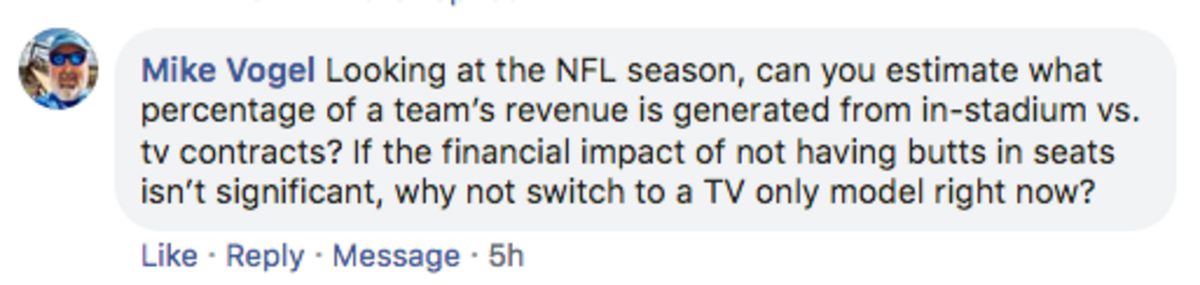
Various estimates have TV revenue at or above 50 percent of total revenue. Now, there are different ways to do this, because we all understand TV drives other revenue streams, as well.
For instance, how much of merchandise sales comes from fans watching on TV?
Businesses pay more for in-stadium sponsorships that are seen on TV.
Revenue from NFL.com, GamePass, even ticket sales — it’s all boosted by what we see on TV.
Now, that’s a very different thing than saying butts in seats isn’t significant.
According to Statista, the Chiefs’ average ticket price last season was $83.40. This is napkin math here, but if we multiply that by their average attendance (73,465) we have a little more than $6.1 million.
That’s nearly $50 million for eight regular-season games, which doesn’t include the preseason (which might be shaved this year), or the postseason, or concessions, or parking (most of which is not kept by the Chiefs, but still).
So, look. We can do more guessing about how much the Chiefs make from everything inside the stadium and view that as a percentage of total revenue and say it’s not that big of a deal.
But if you — and some of you have already experienced this, unfortunately — took a 33% or more paycut, you might still be able to eat ... but you sure as hell would feel it one way or another.
You’re asking why not simply declare that there will be no fans in the stands right now. But I would argue that there’s no reason to make that decision right now.
We’re all guessing, and maybe we have this “second wave” that’s worse than the first and teams are lucky to be able to play without fans.
But maybe things calm down, or maybe health experts sign off on certain protocols that allow for, say, 25 percent capacity.
There’s also the possibility that things are terrible for, say, the Dolphins in Miami but more positive for the Packers in Wisconsin. If that’s the case, why should one team be limited by what’s happening in a far-off part of the country?
I don’t say any of this to be cavalier. When in doubt, when it comes to health, I’m always going to lean safe over sorry.
But we just don’t know what the world will look like in October or December, so why make a decision about it right now?
Baseball.
I love all three sports, and follow all three leagues, but baseball is the clear answer for me.
Some of this is professional. We don’t have an NBA team — yet! — and the Royals remain a bigger deal locally than Sporting KC of MLS. It’s not that I’m selfish, it’s that I’m looking out for me.
But some of it is personal, too.
I’ve written about this before, but baseball was the first sport I fell in love with — the first sport that made me feel bigger than I was. Our kids are at or nearing the age when the sport’s magic is unlocked, and I’ve been looking forward to watching games with them and the bonding that comes with it.
One other thing about baseball is that it’s constant. It’s a companion. It’s every night, in the background, slowly and subtly becoming part of our lives. I’ve missed that, desperately, and can’t wait for it to be back.
That said — I’ll be thrilled to watch Sporting again, particularly this Sporting team, which has a real chance to be the franchise’s best in years. The NBA’s finish will be different, and potentially goofy, but it’ll also be fun, and not just the idea of watching the world’s best athletes in action again.
D-, and it’s only that high because I’m in a good mood.
One sentence of rehash: This sport completely botched a chance to grow, instead finding a way to recede, embarrassing itself in the process and giving an increasingly skeptical public more reason to not give baseball a chance.
I worry about safety protocols, too, with the idea that dividing the money took up so much energy and time that the sport didn’t make enough space to give itself the best chance possible of completing the season.
Baseball is too important to be loose with this stuff. Sports are too important.
Not objectively, of course. But spiritually, yes.
Baseball looks the worst when compared to other sports. We’re going to get into this a bit more below, but other sports were able to skip over most of the bickering and concentrate on what matters.
Baseball showed itself to be selfish, tone deaf, out of touch and polarizing at a time when it really needed to be the exact opposite of each of those adjectives.
You know what? Screw that. They get an F.
No.
The Patriots got better. We can all agree on that. The Patriots will give Newton perhaps his best platform for success. A lot of us can agree on that.
But he doesn’t transform New England’s skill-position players, and he doesn’t fix a defense that was battered by the AFC’s best teams last year.
To me, the AFC power rankings look something like this:
1. Chiefs
2. Ravens
(significant gap)
3. Titans
4. Patriots
5. Colts
6. Texans
(gap)
7. Browns
8. Steelers
9. Bills
10. Broncos
11. Chargers
12. Jets
13. Raiders
14. Jaguars
15. Dolphins
16. Bengals
Adding Newton pushed the Patriots above the Colts, but let’s not pretend it’s still 2015. We don’t know how healthy Newton will be, or what he has physically at age 31 with a gutsy, physical style that’s made for success but also takes a toll.
I’m fascinated to see what Bill Belichick does with and for Newton. He’s never had a quarterback like this, and Newton has never had a coach like this. The receivers still need separation, but maybe that’s easier to accomplish when all three levels of the defense need to account for the quarterback escaping the pocket.
Maybe this is all stupid. Coaching has an enormous impact in the NFL, and putting perhaps the best coach of all time fourth in the AFC might be undeserved disrespect.
But there are some real uncertainties in New England. The gap between the Patriots and Ravens and Chiefs proved significant last year, and I’m not sure how that’s been closed this offseason.
I clarified with Alex, and he’s speaking of the Negro Leagues Museum here. It should be noted that MLB is a significant contributor to the museum already, and has been for many years.
That includes annual contributions and partnerships like teams wearing Negro Leagues uniforms and then auctioning them for fundraising.
Now if the debate is whether MLB does enough, I would argue no. But I also understand the complications and unfairness in expecting a business to underwrite non-profits.
I want to be perfectly clear: I believe MLB should do more, not just in terms of financial contributions but in using some broadcast time to promote the museum.
I also think MLB does an honest and effective job in telling the sport’s history, particularly on and around Jackie Robinson Day.
The sport is justifiably proud of its role in the civil rights movement. Which, you know, in keeping with the theme of the moment, is even more reason for the league to speak up now.

I don’t follow the NBA as closely as I do the NFL, MLB or MLS. So I’m not going to get into the particulars of how Silver does his job, except to emphasize a point I’ve made here before:
The NBA and NHL have, by far, the best relationship between owners and athletes of any major American sport.
That stuff matters, and it matters deeply.
It makes negotiations smoother and creates trust where one side is willing to give because it knows it’s having an honest discussion. It allows for a more cohesive presentation to fans and, particularly, it eases the navigation through difficult times.
Now, Silver deserves some amount of credit for helping build that trust. I’d take an NBA expert’s opinion on how much, but it involves a lot more than a commissioner — it’s about owners, about athletes, about negotiators, about sponsors.
Some of that is built into the NBA’s DNA. The league spiked in popularity largely by marketing its biggest stars nationally and globally, which creates a much different power dynamic than exists in, say, the NFL, where it’s about the brand and the (*gags*) shield.
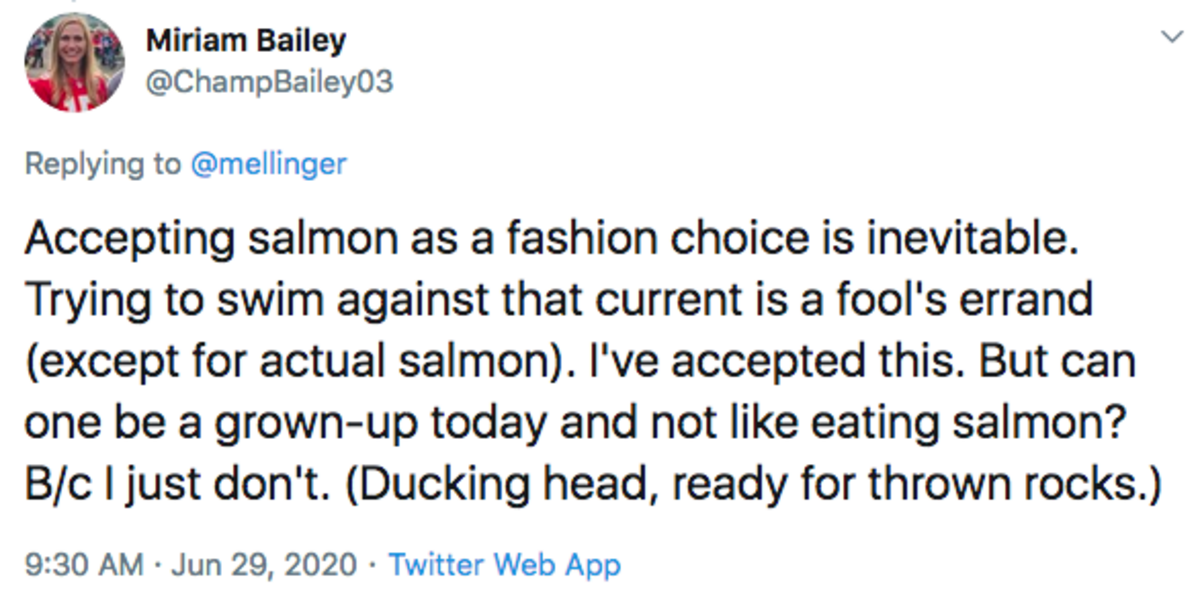
Free choice, my friend. I adore cheeseburgers, for instance, but understand why some might not have a taste for red meat. I drool at the idea of tacos, and nachos, but understand some might not like the taste combination or the mess or whatever.
Really, the only food I’ll get a little judgy about is pizza. There are just too many styles and too many topping combinations for you to tell me straight up that you don’t like pizza and for me to continue to think you are a logical and reasonable person.
Salmon? Totally. I get it. It can be fishy, oily, and sometimes the flavor isn’t there.
I would humbly suggest you try this, though:
Smother it in brown sugar, add some basic salmon seasoning, chop up some cilantro, and squeeze some lime over it. Cook on a plank at a low temperature — it’s GREAT on the smoker, but almost as good in the oven — until the internal temp hits 140.
If you still don’t like it, then salute. At least I tried.
This week, I’m particularly grateful for the bursts of time when our kids make each other (and, by extension, us) laugh like we’re at a comedy show. We ended up in the car a lot this past weekend, and maybe it’s because our 4-year-old is now in a booster seat (!), but they were killing me the entire time. These are the memories I’ll take with me.
This story was originally published June 30, 2020 at 5:00 AM.