
Mellinger Minutes: Sports’ new role, baseball’s blame, KU’s scare and more
Sports are not important. This cannot be argued. Whenever they return, they will not keep your family safe, they won’t raise your kids, they won’t pay your bills.
Sports are critically important. This cannot be argued. They are something like America’s last unifying force, our best memory-maker, a constant source of motivation and inspiration.
Both of the above paragraphs are true at different times. The trick is knowing the difference, and right now, even with live games in America paused (or perhaps worse, thanks baseball) we are in a moment for sports to shine.
Patrick Mahomes made the most significant social stand of any Kansas City athlete since the Monarchs when he appeared in a video along with other NFL stars.
The video was loaded with NFL talent — Tyrann Mathieu, Saquon Barkley, Michael Thomas, Odell Beckham, Deshaun Watson (who has also marched) and others.
But the weight of the message hits with Mahomes. It’s not a coincidence that the video was edited so that he’s the first one to say “Black Lives Matter.”
Mahomes is the game’s biggest star, and league’s face. It could be argued that no NFL player has ever had the juice that Mahomes has at this moment: wildly successful, relentlessly entertaining, good looking, whip smart, universally respected by teammates and the community, still just 24 years old.
Because of all that, and considering the scale and popularity of the NFL, it’s simply impossible for any other Kansas City athlete to have made a stand like this before. That includes Tom Watson, who stood against anti-semitism at a local country club in the 1980s.
The NFL talks a lot about family, and teamwork, and those talking points aren’t total lies, but they’re also far from total truths. Not all coaches are equal, not all players are equal. Mahomes has such an outsized influence that his presence on that video was necessary for it to hit home.
He’s in a difficult spot. He took some heat for not speaking out sooner, and then his initial statement drew more criticism. That’s just reality for someone with influence. Whatever he does will draw criticism in some form. He has to be comfortable with that. We’re seeing the beginning of that transformation.
One thing that’s been mostly unspoken is that Mahomes doing this in Kansas City is different than if he played in Seattle or Atlanta or Denver or some other parts of the country.
Kansas City straddles two red states, and those politics affected the response four years ago when Marcus Peters joined the protest began by Colin Kaepernick — the politics affected the reaction from fans, which in turn affected the team’s handling of the situation.
Peters was a different messenger. He is unapologetic. He does not code-switch. Notably, he never fully expressed what he wanted accomplished, or his reasons for raising his fist during the national anthem.
This is different now and, to be sure, Mahomes is riding a wave that did not exist for Peters or anyone else four years ago. That matters and should not be forgotten.
But football games are watched together by people who would otherwise never cross paths. Peters was easy for some to dismiss. Mahomes is impossible for anyone to dismiss.
He has built-in capital that no other player has. But it’s one thing to have the capital. It’s quite another to choose when and how to use it. Certainly here locally, Mahomes can reach an audience that nobody else can.
We live in a country where race usually dictates which churches we go to, and politics often determine where we get our news. The way we vote influences how we look at an infectious disease, for crying out loud.
Athletes in all sports appear more motivated than ever to speak out on social issues. They and the sports they play will undoubtedly lose some fans in the process, and they’d lose some if they didn’t.
But what other place than sports has such passionate followings on both sides of these cultural battlegrounds?
That’s the power sports have. That’s the power Mahomes has. We’re going to see more of that in the coming weeks and months.
We are in the beginning stages of what sure feels like a major shift for issues much more important than who wins a game. Athletes and the leagues they popularize are our country’s last truly mainstream experience, which gives them a unique power and voice in shaping whatever is on the other side.
This week’s reading recommendation is Henry Bushnell on how a “rogue” employee (and native Kansas Citian) forced the NFL into a Black Lives Matter stance, and the eating recommendation is the fire bird at Blue Koi.
If you haven’t already, please give our Mellinger Minutes For Your Ears podcast a try. Much appreciation for your time. We talked some baseball on the last episode, and took some highlights from a conversation with Peter Vermes, including that time he was the muscle behind Jiffy Lube’s top performing bay on the East Coast. Seriously.
If you have a question you’d like answered on the show, please call 816-234-4365 and leave your first name, where you’re calling from, and almost literally any question.
Please give me a follow on Twitter and Facebook and, as always, thanks for your help and thanks for reading.
OK, here’s the show, and fair warning: There’s a lot of complaining here but we pick up steam later.
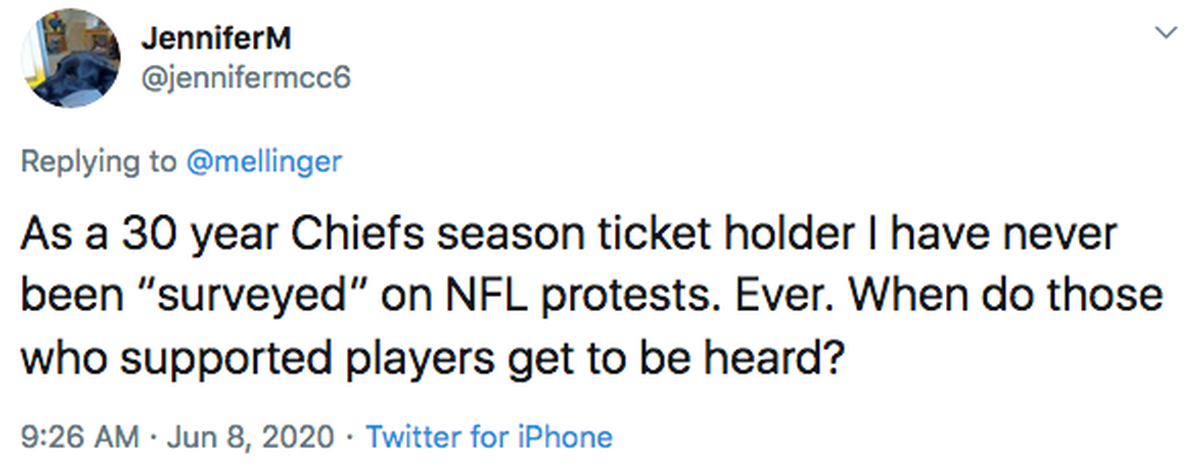
You can be heard now. You and anybody else who agrees or disagrees can speak out on social media or (more usefully, I would argue) write directly to the Chiefs. You might think those sorts of notes go straight into the ether, but I’ve been surprised at how much is read by actual humans.
This might be getting off track from what you’re asking here, but I hope the place we can get to is the place I was hoping we could get to four years ago:
That those who disagree with the method or even the sentiment behind the protest can at least listen, respectfully.
There’s never been a method of protest that everyone agrees on and, actually, that’s the point of protesting.
If a fan or teammate or anyone disagrees with any element of the protest, they should also recognize that nobody goes through the trouble without being genuinely moved.
I know this all might come across as naive, and maybe it is, but I hope we can all just listen to each other.
No rational person is in favor of police brutality, for instance. But the system we have isn’t fixing the problem, so we need to find a new way. We’re having a lot of uncomfortable conversations that have been put off for too long. It’s good that we’re doing it now.
But it means we’re going to have to get used to being uncomfortable.
There’s no other way we can get better.
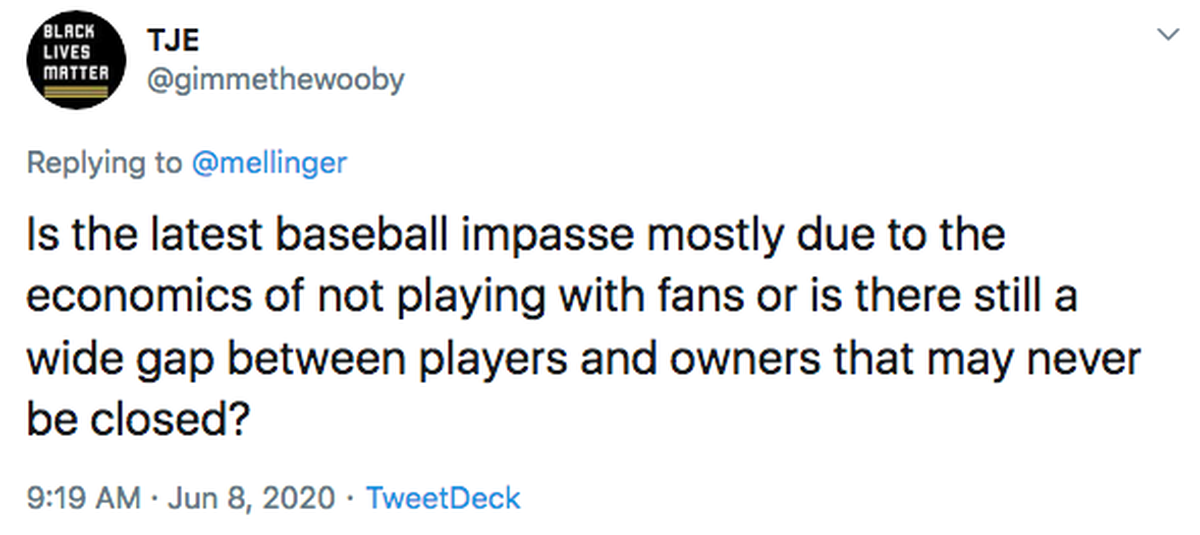
Both? Can it be both?
Because I think it’s both.
The original sin in all of this is the severe distrust between owners and players that dates back long before COVID-19.
With a better relationship, they could have navigated this more smoothly.
With so much mutual distaste, the whole thing becomes more difficult.
I’ve made this analogy before, but it’s the same as any other relationship. If you have a good relationship with your spouse, you’re going to handle a layoff or illness or major financial stress differently than if you were already fighting.
One of the frustrating parts of watching baseball’s string of self-inflicted wounds is that mutual ground exists.
If the owners have put themselves in a situation where losing half a season has them in such deep financial stress after years of record revenues then, well, first they should be embarrassed.
But after they’re done being embarrassed they could ask the players for further paycuts now with the promise of making the players whole later. I know there are other complications, but what about something like this:
An 82-game season with, say, 75 percent of pro rata salaries with the remaining 25 percent to be paid within 12 months.
The owners’ most recent proposal does not have the promise of the players being made whole, which is (at least to me) a reasonable thing to ask for the people taking on the risk.
Players give a little, owners give a little, and we all get baseball.
Why can’t this happen?
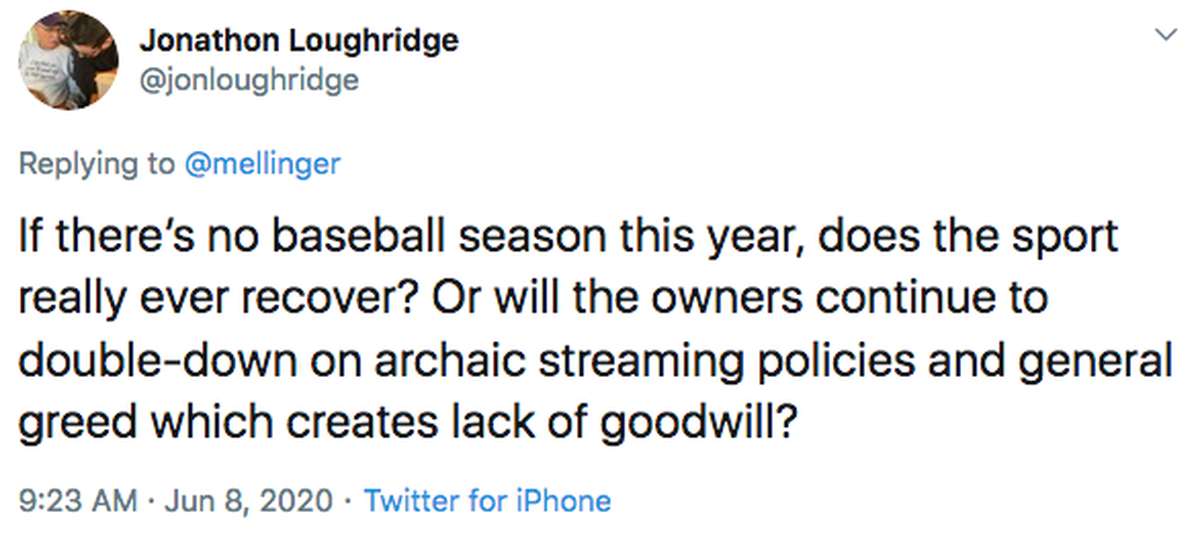
There’s an old saying from people in the game that goes like this: You know baseball is the best sport because it’s survived the idiots who run it.
That’s being tested right now.
My tendency is to say that baseball is so baked into American sports that it’ll survive. I want that to be true. I hope it’s true.
I think it’s true?
But there’s no question we’re going backward right now. It took more than 10 years for Major League Baseball to get back to its average attendance before the 1994 strike. That’s the best comparison we have at the moment, but I’m worried that we have some extenuating circumstances that make our current situation worse.
For one, attendance has dropped — slightly, but still — every year since 2012. Average attendance at MLB games has been under 1994’s average every year since 2008.
So, that’s one worry: that baseball is entering this round of self-destruction on shakier ground than in 1994.
Here’s another: There’s more competition. MLS is growing, the NBA has long since passed MLB in popularity, particularly with young fans. It’s never been easier to find entertainment, and never been easier to create new habits.
These are broad strokes, and maybe you’ll disagree, but in 1994 the strike was met largely with anger.
Right now, the current mess is met largely with sadness.
That’s the wrong kind of trend line, and it’s a shame that the men trusted with shaping baseball’s future instead seem intent on destroying it.
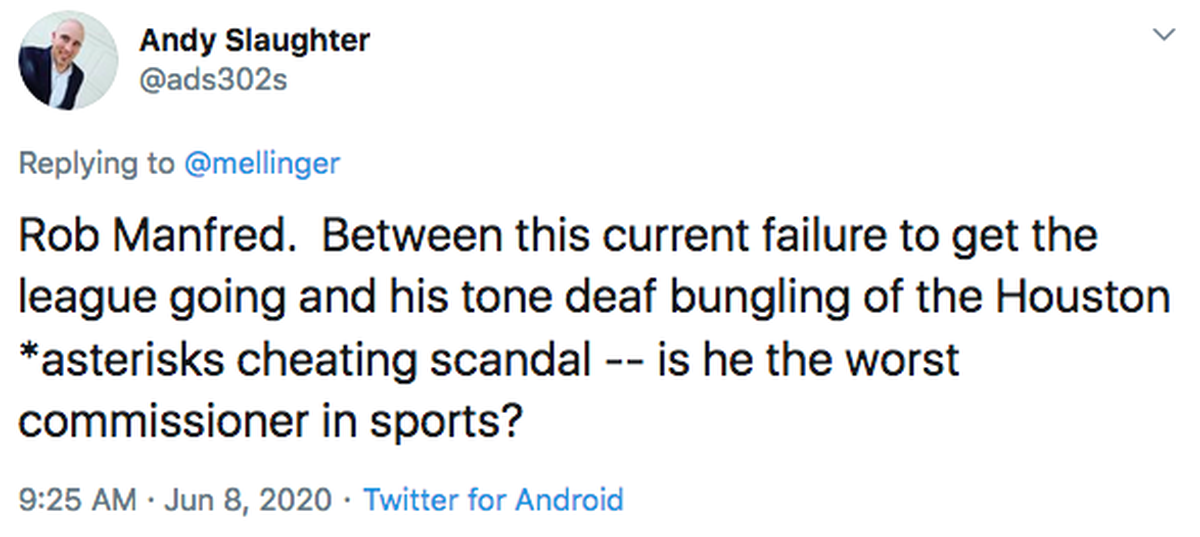
The worst part about Manfred’s role in this is that this is the opposite of how he got the job.
Manfred made his reputation as the guy on the owners’ side who could get a deal done with players. He is now reforming that reputation into the polar opposite.
Some in baseball who I respect and who know Manfred well say he cares deeply about his legacy, so I have to believe he doesn’t want to be the first commissioner of any sport since (when?) to lose an entire season. But beyond that, I’m not sure of the reasons for hope.
It’s easy to wag a finger at everyone and blame them all, but Manfred and union leader Tony Clark deserve an outsized portion of the blame.
Manfred has allowed the notion that he is against players, not just in the naturally adversarial world of working through baseball’s financial structure, but through subtle but significant ways like public perception.
He used to be the guy who might make a decision the players wouldn’t like but would have the respect to give them a heads up first. Now, you’re seeing leaks obviously made to put the players in the worst light possible.
Clark wears his share of it, too. The difference in negotiating chops under his leadership compared to Michael Weiner’s is hard to miss. Clark got deals done, but the ground he ceded in the process has grown the players’ distrust and distaste for owners.
Look:
There’s a certain deal you make as a fan. At first, you don’t even realize you made the deal. That’s how they get you.
But the deal is you understand it’s a business, and that your love for your sport or team is making lots of people rich, and in exchange they provide you with that sport and team and allow you to believe in a sort of purity.
That belief can be tested, like when your NFL team can’t fit someone under the cap, or your baseball team trades a star in a salary dump. You can usually talk yourself around that, that it’s part of the game, or part of a broader strategy.
But that belief is exposed as naive in times like this, and there’s nothing any business can do worse than to make its customers feel like suckers.
That’s what happening right now.
That’s what baseball is doing to itself.
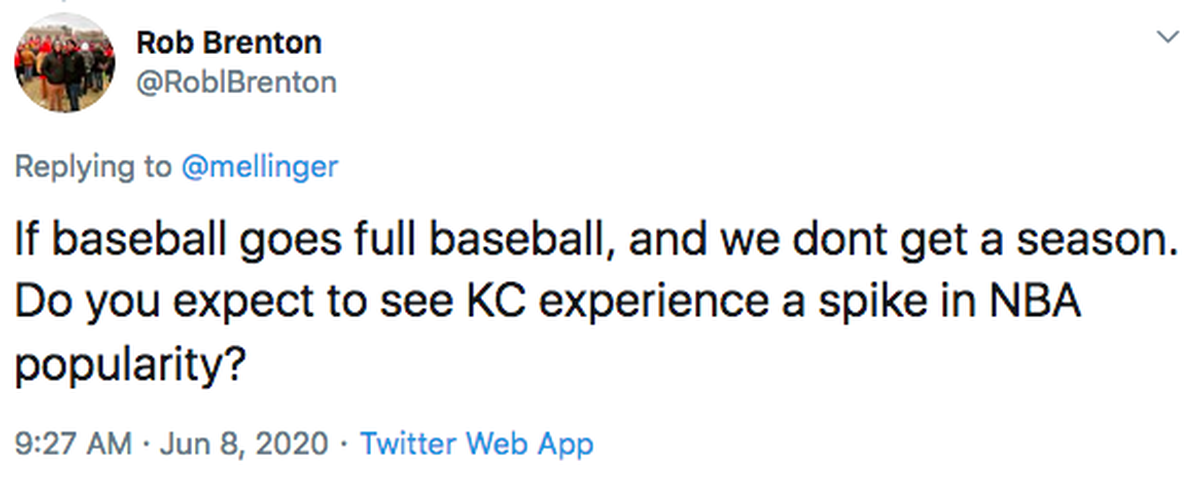
Maybe a little? I wouldn’t expect there to be a strong correlation there.
If anything, I’d think that soccer has the most to gain. MLS has been growing anyway and Sporting KC’s season is the one that most directly overlaps the Royals’. In the summers, the competition for sports entertainment in Kansas City is between baseball and soccer.
It’s already true that kids and young adults were drifting more toward soccer. Parents can sometimes be the gatekeepers for what their children are exposed to, and if MLB pisses off the (last?) generation that grew up with baseball as a top two or three sport in America then tell me what happens in the future.
This is the frustration from those of us who love baseball, right?
It’s like the sport is operating with this antiquated thinking that they have some ordained right to fans’ time and money.
This is such a dangerous game because it’s simply never been easier to find new stuff to do, and Americans have never been more incentivized to create new habits.
If baseball somehow operated cohesively and had a plan in place to return by July 4, it still would have lost some of its fans. Now, it also would’ve had first crack at new fans, and an unprecedented opportunity to grow. But it would’ve lost some fans, through no fault of its own, who simply found new things to do.
Bike shops are doing heavy business, for instance. Tee times can be hard to find. Trails are full. RV parks are packed. Last weekend, we rented a boat for an afternoon and had a blast. I doubt we’d have done that in normal times. But now we’re going to do it again.
Baseball doesn’t have to worry about people like me. There are many of us who will scream and complain and criticize, but we’ll turn the TV on at 7:10 on a weeknight and we’ll be at the ballpark as a family at least a few times every summer.
But no sport thrives on its hardcore fans alone.
You need to sell yourself to a broader audience, and baseball is doing the opposite. It’s a great help for other sports, and bike shops, and book stores, and Netflix.
But it’s a crappy thing baseball is doing to itself and the fans it’s supposed to serve.
OK, let’s move on. Good thoughts!
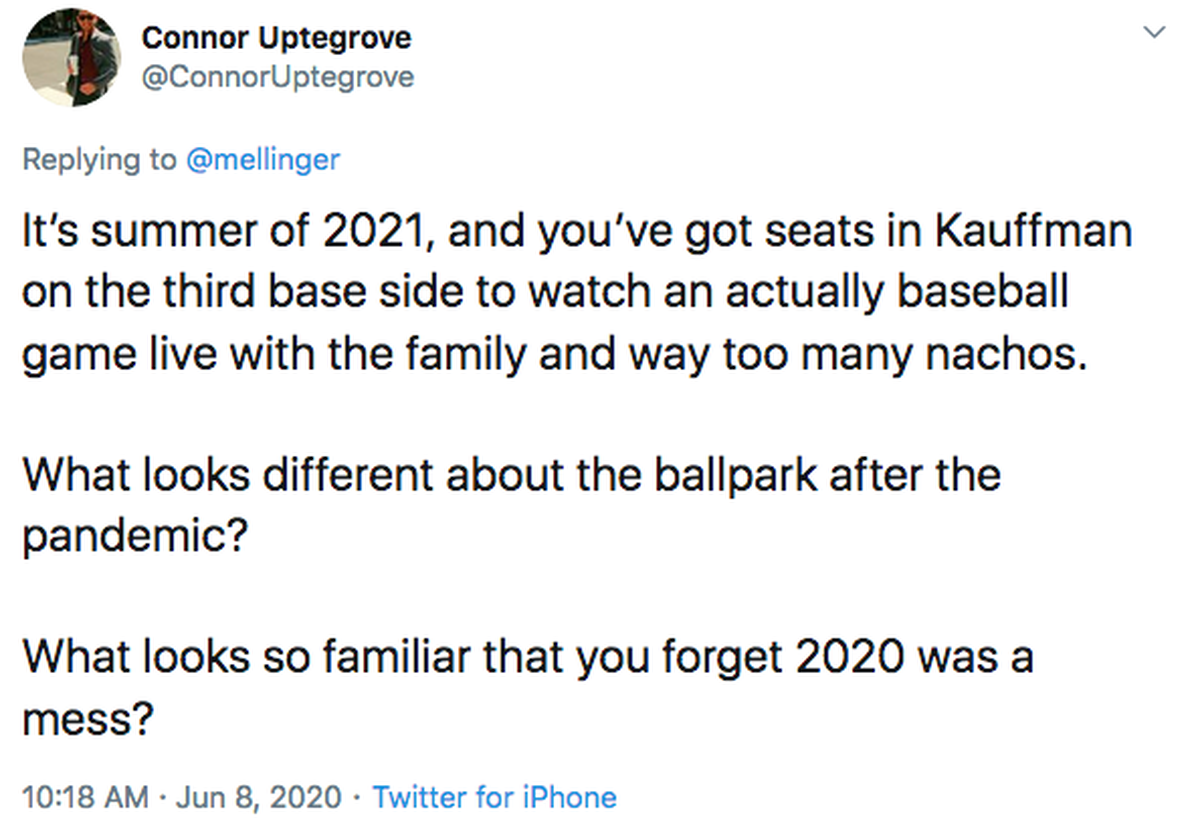
Let’s go!
I need to know if there’s a vaccine first, but since we’re thinking good thoughts right now let’s say there’s a vaccine.
There’s fewer fans. That’s probably inevitable, even without baseball leadership doing its current clown show. Again, some people will have created new habits. Others, even with a vaccine, will be hesitant to join big crowds. That’s not going to disappear immediately with a vaccine.
Hand sanitizer will be everywhere, probably next to the napkin dispensers. All concession workers will probably have gloves, and those directly handling food will probably have masks.
I could see the food options being different, too. More bottles and cans, fewer fountain drinks. More prepackaged food. Something like that.
One more thing, and maybe you’ll have to pardon me, but it’s true: more hand washing in the men’s bathroom.
I’m not sure how open this secret is, but there can’t be many grosser public places than the men’s bathroom at a stadium. Pre-corona, you’d have a better chance calling a coin flip than you would that the guy next to you at the urinal would wash his hands ... and if you’re a man and reading this, you know I’m right.
I’m guessing that number rises a bit.
So, you know, maybe it’s not all bad?
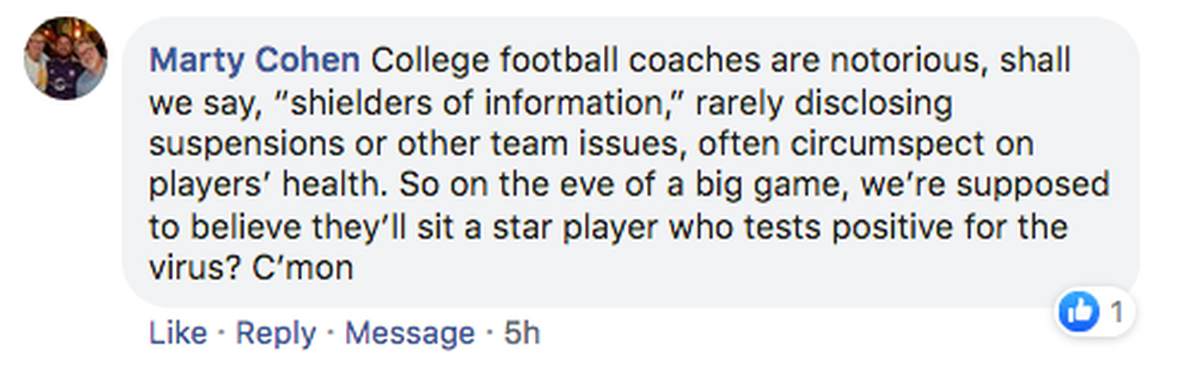
This is an actual thing that is being discussed in actual athletic departments. There is genuine concern that some schools will ignore positive tests.
Sports can be so dumb sometimes, and it’s hard to think of a better example: Many who love and make their living in college sports — already a multi-billion dollar industry built upon unpaid students — are concerned about losing a competitive advantage to a school forcing an athlete with a potentially deadly disease to play a sport that already carries significant health risks.
Whew. That’s a mouthful.
The truth is that people lie. They’ve always lied, and they’ll always lie. They lie for many reasons, but perhaps none more than self-interest.
Since we’re trying to stay positive here on the Minutes’ back nine, let me point out that it’s never been easier to get a message out.
College athletes have access to the Twitter, is what I’m saying, and it’s hard to imagine a school being able to keep that kind of secret.
I also want to emphasize a point I’ve made before: We’re all guessing. Nobody knows. Some people will use that confusion for their own benefit, but others will simply make well-intentioned mistakes.
Separating those groups will be hard, but I hope we can all offer some grace.
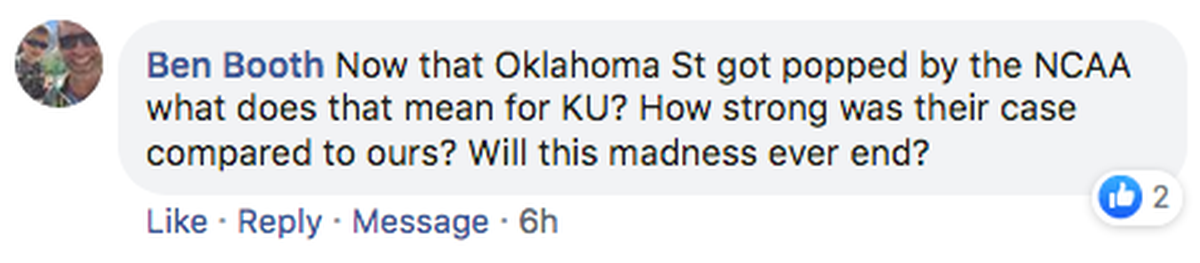
I can’t imagine that people in KU Athletics were sleeping well before Oklahoma State was given three years’ probation and a one-year postseason ban for *one* Level I violation.
But they sure aren’t sleeping great now.
Kansas is being accused of (*checks notes*) FIVE (5) Level I violations.
Now, the particulars of the cases are different. A former Oklahoma State assistant coach was sentenced to three months in prison for accepting money to steer players to certain agents and financial advisors.
Kansas is being accused of, essentially, benefiting from Adidas’ payments and other efforts to steer recruits to Lawrence.
I would argue that a coach violating trust in a player is worse than a shoe company throwing money at a recruit, but rules are rules, and Kansas is being accused of breaking a whole mess of ‘em.
The truth is I’m not sure the punishments (which OSU is appealing) change anything for KU.
People there have long believed the NCAA is out for blood, so if anything this is just confirmation of what they already felt.
There’s a showdown coming. I’m not sure how KU and the NCAA can both get out of this with their dignity.
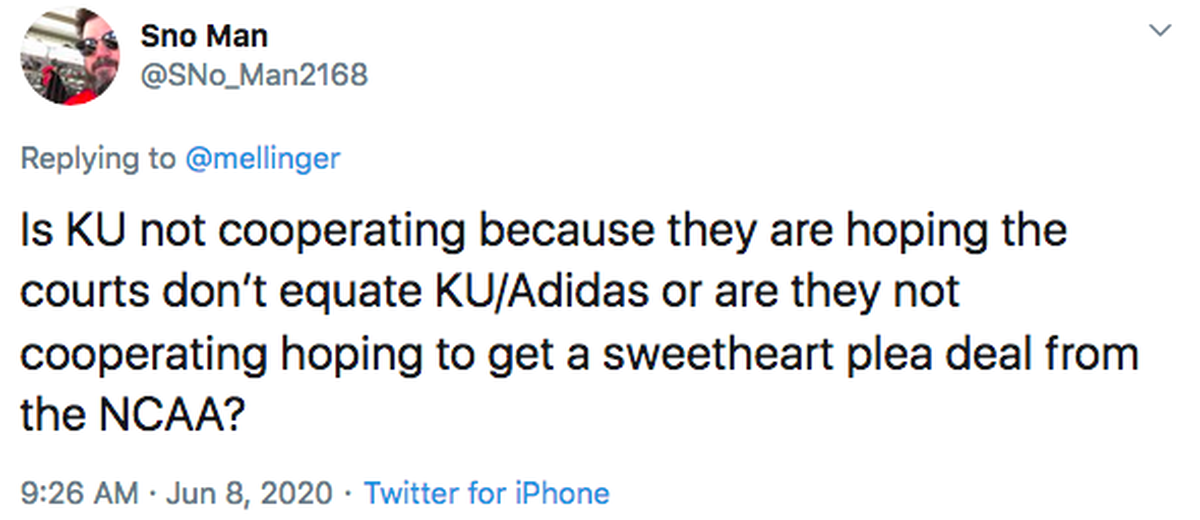
Every conversation I’ve had with people in and around KU leads me to believe that the people there are fighting like this because they genuinely believes they’re on the right side.
We can all have opinions here. Mine happens to be that nothing made public so far doesn’t sound like standard operating procedure in college basketball, that it’s absurd to label a sponsor a booster because the very act of becoming a sponsor means you have partnered with a program, that if Adidas is officially labeled as a booster then college sports is about to be comprehensively rocked by unintended consequences, and that the rules being broken are dishonest and outdated.
I believe all of that and also this: The NCAA has set the rules and would not be operating like this if it wasn’t sure it had the goods.
But all of that is immaterial to your question.
I’m not sure anyone has ever strong-armed the NCAA into a sweetheart plea deal, so I can’t imagine that’s the play.
One potential benefit for KU of the case turning so personal is that it has been recommended to the NCAA’s Independent Accountability Resolutions Process. This is a new mechanism, so we don’t have a lot of track record, but the idea behind the IARP was to have people with no direct ties to the NCAA making judgments.
Maybe that helps?
Who knows.
But escaping five Level I violations with anything less than scholarship reductions, a postseason ban and perhaps a long-term suspension for Bill Self would be a major win for KU.
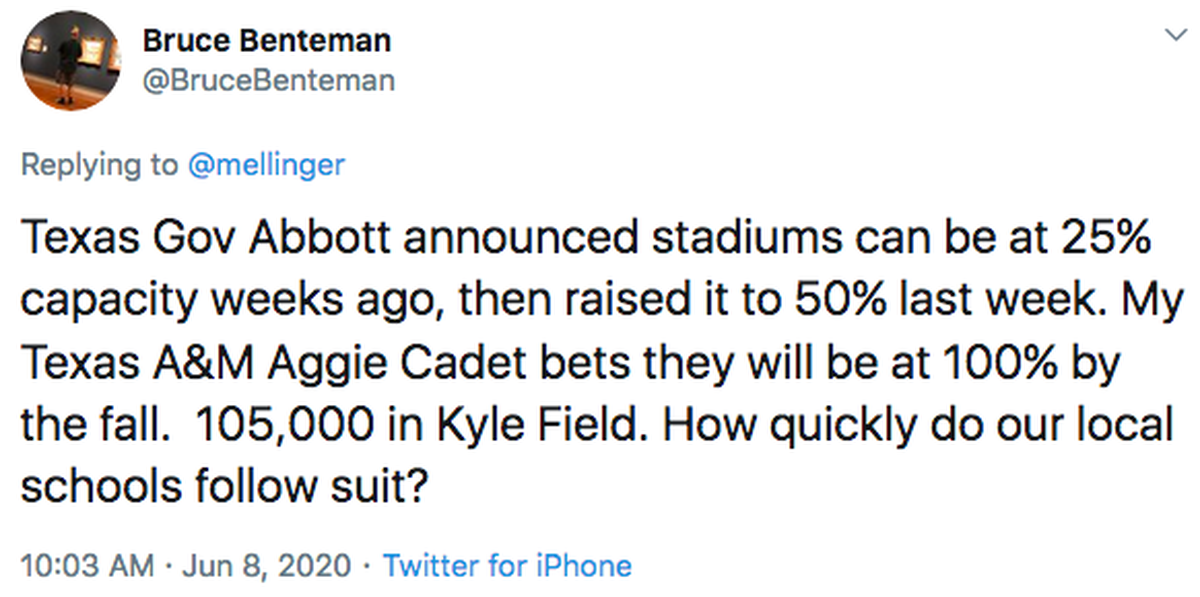
This is part of what I mean by everybody is guessing.
Think about this: three months ago, we were all living normal lives. So how could anyone be confident what the world will look like when football season is here?
Would it shock you if there’s a massive second wave coming from businesses opening and protests and just a general fatigue from people on guidelines?
Would it shock you if the evidence from Italy that the virus is losing potency and more slices of good news, like asymptomatic carriers being less of a threat than previously believed, means we see progress?
Who could be shocked by either of those outcomes?
I do think we’re a ways from seeing 105,000 people in a football stadium, but at this point nothing short of a literal alien landing at the White House to drop off 330 million COVID-19 vaccine doses would shock me.
Along those lines, I hope we all try to remember that there are few, if any, definitive answers. If a health expert or politician or business is wrong about one thing, it doesn’t necessarily mean incompetence or bad intentions. They could just have been wrong about one thing.
If a restaurant is open, we’re not obligated to go and, in turn, if our neighbor goes to that restaurant it doesn’t mean he or she thinks the virus is a myth. We’re all trying to get through the best way we can.
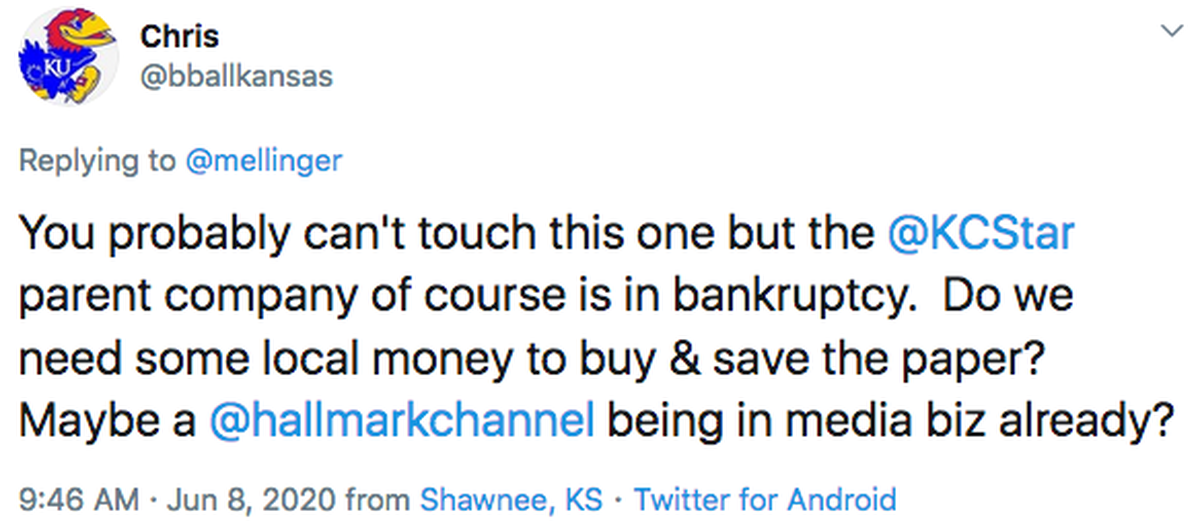
Your guess on making media companies work financially is at least as good as mine.
The dream scenario for any newspaper is what’s happened with the Minneapolis Star-Tribune and L.A. Times and Washington Post and a handful of others — a billionaire who believes in journalism takes over out of a civic motivation.
That’s just the truth.
Digital subscriptions are important, too, yes. It’s the clearest path forward, for a lot of reasons, including that media outlets centered on subscriptions have a different incentive than those centered on page views.
I believe deeply in journalism, obviously. And when I say that I’m talking far less about what I do and more about what my teammates in news do. They look out for us. They help expose corruption and push for positive change.
Journalism and “the media” are often conflated so wildly that it’s easy sometimes to think cable news stars are the same as local journalists. We all get lumped into the same dirty barrel, and none of us are better for the experience.
I hope true journalism lasts forever and, further, believe we’d be a significantly worse country without it.
But I also believe it’s up to us to make sure we’re worth your time. I’ve always believed journalists in general and newspapers in particular have been plainly terrible at telling their own stories, so that’s part of it, but another part is doing honest work that builds trust and connection with our audience.
We can’t just ask for your time and money, is what I’m saying . We have to make sure we’re worth it. I hope I do my part.
This week, I’m particularly grateful for this specific giggle our 4-year-old makes when he goes downhill on his bike. It’s like this high-pitched YA-HOOOO!!!! and it is the happiest noise I can imagine.
This story was originally published June 9, 2020 at 5:00 AM.