
Mellinger Minutes: There’s sports stuff here. Even some positive! But first, real life
We will get to sports. Promise. Swear. Cross my heart. All of that. We’ll get to sports.
But not here at the top.
We’ve failed. All of us. You. Me. Us. We all have a part in this. Is that uncomfortable? Good.
My grade school was once vandalized. Someone spray-painted the playground with swastikas and “KKK” and the like. This was more than 30 years ago, but I still remember the hushed tones from adults. I didn’t know it then but can see now they felt shame. And confusion. They didn’t know how to talk to us kids about it.
The janitor was black. I don’t remember his name, but I remember he had a big smile and joked with us often. I must’ve been 8 or 10 at the time, not old enough to understand what was going on, but old enough to cry when he had to be the one to clean up that graffiti.
I remember my mom’s message: That’s a terrible thing that happened. The world is not perfect. But it’s a lot better than it was when I was your age, and when you’re my age it’ll be even better.
She grew up in the 1960s. She had to believe that. But was she right?
Sometimes I think so. I’m a sportswriter, so I think about sports when my mom said those words: The NFL had never had a black head coach. Many in the league believed black athletes should not be quarterbacks. Stereotypes ran through all sports.
We’re better now. Unmistakably. We have more diversity of experience at high levels of virtually all sports. Black head coaches. Black athletics directors. When the Chiefs drafted Patrick Mahomes, I did not realize he would be the Chiefs’ first black starting quarterback* until someone pointed it out.
* Warren Moon started one game for the Chiefs in 2000 — the last of 208 he played in a Hall of Fame career — but was never QB1.
Even then, I didn’t see it as much of a story. That’s progress, right?
But in so many other ways we’re no better than 30 years ago. The NFL has had to demand teams to even consider black coaches, and then increase those demands after years of not enough change.
More to the point, even with more opportunities for minorities it’s hard to find evidence that racism has diminished. Dave Chappelle had a bit about the different forms of racism, and I’m not talking about that old-school, burn-a-cross-in-a-yard stuff.
I’m talking about perceptions, and comforts, and feeling like it’s us against them — no matter your “us” or your “them.”
We still live in largely segregated neighborhoods, attend largely segregated churches, and send our kids to schools that often don’t reflect our communities.
Which, look, we can’t do a lot about that. At least not in the moment.
But I’ve been thinking a lot lately about what we can do, specifically in light of how we often live among people who look like us. And we can reach out. We can talk. We can ask questions. We can have the kinds of conversations we’ve resisted for so long because they’re uncomfortable.
Mostly, we can try to empathize. We can try to see things from the other person’s perspective. That doesn’t mean that a white guy like me can know what it feels like to be black and pulled over, but it means I can try. I can reach out, see how a friend is managing, and let them know I appreciate them. Let them know I’m thinking of them.
It’s not much, but it’s better than nothing. We can be human, together. That would be different, at least.
OK, on with the show.
This week’s reading recommendation is Robert Klemko on Royce White’s role around the Minneapolis protests, and the eating recommendation is the pastor at El Matador.
If you haven’t already, please give our Mellinger Minutes For Your Ears podcast a try. Much appreciation for your time. We talked a lot of Chiefs on the last episode, and had a conversation with Pat Mahomes.
If you have a question you’d like answered on the show, please call 816-234-4365 and leave your first name, where you’re calling from, and almost literally any question.
Please give me a follow on Twitter and Facebook and, as always, thanks for your help and thanks for reading.
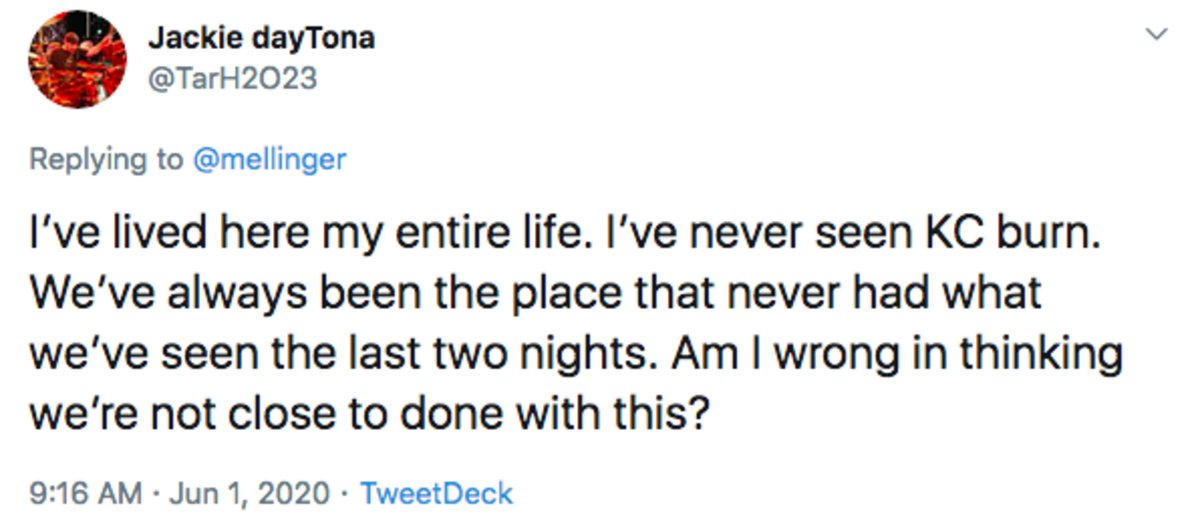
I don’t think so. I hope you’re wrong. I hope I’m wrong. But I don’t think so.
And that’s probably how it has to be.
There is no joy without pain, and there can be no broad improvements without uncomfortable conversations and ugly moments. That’s the system we’ve made for ourselves, better or worse.
I wish this didn’t have to happen. We all wish that. It would be great if there was nothing to protest. It would be great if we had a few bad cops — every profession has some who aren’t up to the job — but they were quickly condemned and dealt with.
It would be great if black people — black men, specifically — did not have so much evidence that they are not valued or respected the way they deserve.
Failing all of that, it would be great if the solution was tidy and quick. If the videos hit and the reaction was swift and unanimous: bad cops punished, good cops speaking out, all of us trusting that we were getting better.
But that’s not reality.
The reality, way too often, is that we all dig into preconceived notions, which means we don’t grow, we don’t consider new ideas, and we further close off the world.
I hope this isn’t coming off preachy. I don’t have anything figured out. I’ve been guilty.
There’s no side on this that has a monopoly on empathy. I know it’s popular to decry what’s become known as “both sides-ing” sensitive issues like this, but I hope we can at least find a middle ground between that and shouting without listening.
We can all get better. I hope we do. At least then we’d have something positive come from all of this.
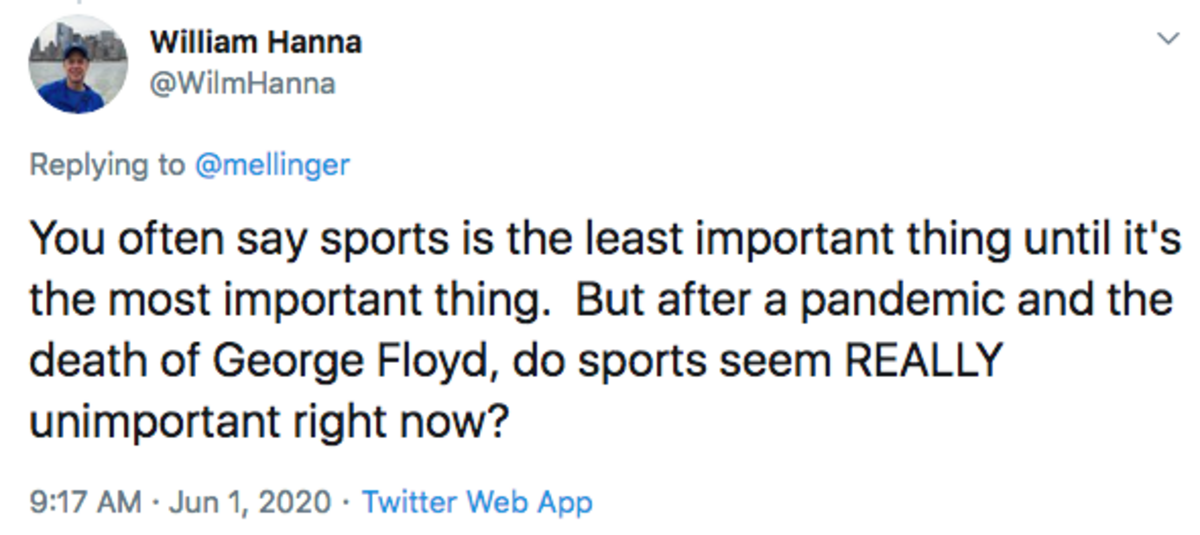
Well, you know, this is exactly where I’m coming from.
Sports don’t matter a drop when the streets are full of cops, protesters and tear gas.
But sports matter a ton when they give us voices. They matter a ton when a white man from North Dakota can have a reach of 1 million people and talk about institutional racism.
The most important thing in the world right now is not when baseball will return, or how the NFL will manage testing once practice and games resume.
But I also can’t help but think about how good it’ll be for all of us when we have games again. I can’t help but think of the power sports hold as a unifier, and that we miss that now as much as ever.
I also can’t help but think that when games do return they’ll almost certainly be played in empty stadiums, which unfortunately would mute some of the power.
Speaking of power, it’s interesting to see who’s using it. Teams and universities release statements. The University of Minnesota severed most ties with the Minneapolis police department. The sports writer Rob Parker was critical of black quarterbacks not being more outspoken right now, and I understand and obviously respect his perspective, but I see it a little differently.
Now — and I’m not drawing cause and effect here — Patrick Mahomes made a statement on Twitter after Parker’s column posted.
But while Mahomes’ message of unity and empathy is positive, I don’t care so much about what he and other black quarterbacks like Russell Wilson or Lamar Jackson say.
I understand this might be naive, and we are in a time when nobody wants to be naive. But it’s worth noting that white athletes like Carson Wentz, Trevor Lawrence and others have spoken out.
If we think of getting the message to the people who most need to hear it, you could make the case that those voices are more productive right now. Black people and celebrities have been speaking out forever and it’s gotten nowhere.
They need our help. They need our voices to join.
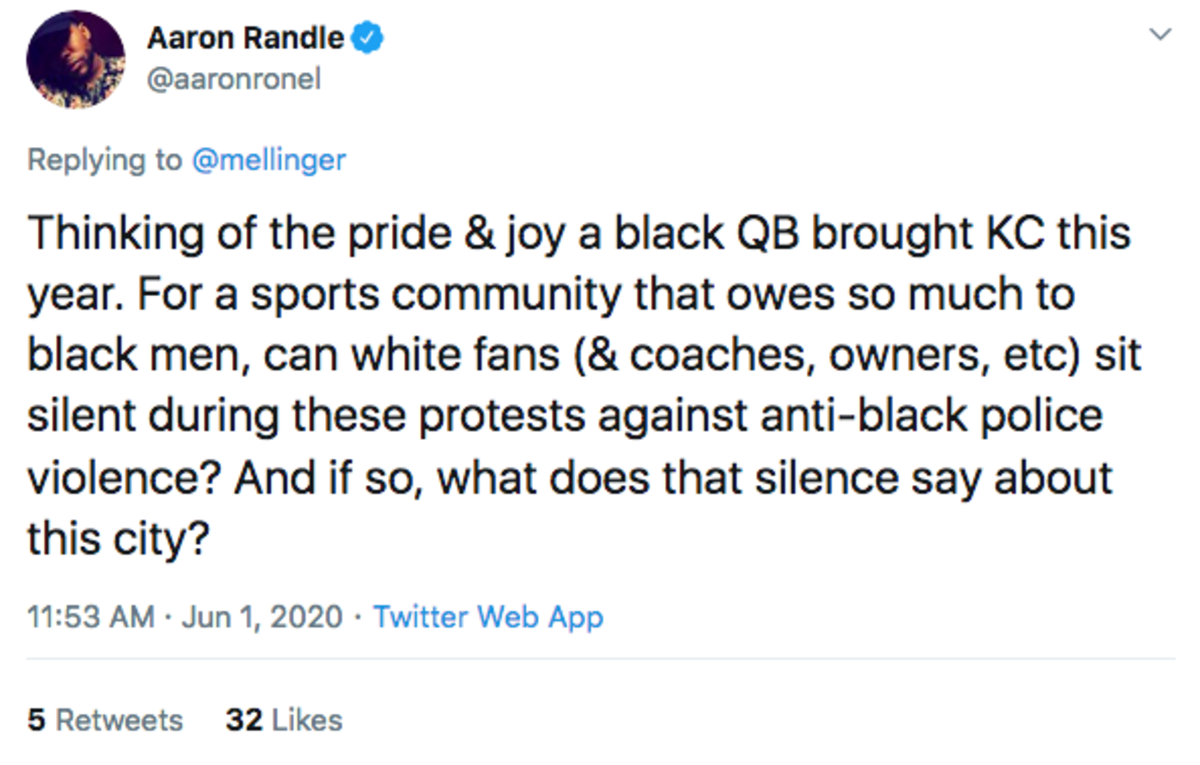
I hear you.
But that’s part of what I mean when I reference white athletes like Wentz and Lawrence. Travis Kelce could have a similar impact. Andy Reid. Dayton Moore. Bill Self. Gary Pinkel.
Also, in keeping with the theme of empathy, I’m not going to condemn someone for not speaking out. They could have a thousand reasons. Maybe they don’t have the words. Or the voice. Or the confidence.
Maybe they’re helping in other ways, like through volunteer work or spreading messages through friends instead of on social media.
But, to be honest, I don’t care all that much whether a black quarterback speaks out right now. I don’t care enormously about a white athlete, or a white fan, or anyone else we’re talking about.
I’d care if cops spoke out, though.
I’d care deeply about that.
I respect that they are in a difficult situation. Most cops are good. We should all respect the challenges in what they’re asked to do. There are few better assets for a community than a great cop.
But there are few worse forces than a bad cop, and just one can undo the good work of so many others.
A common theme in so many of these cases is that the cop involved in the incident that lights the fuse left clues that this is where it was headed. Those clues are too often covered up or excused, and I have to believe that trend could be reversed with a different culture.
You’ve heard the saying that all it takes for evil to triumph is for good men to do nothing, and what do we think would happen if the good cops — the vast majority — were more publicly frustrated at the bad cops besmirching their names?
This doesn’t have to be cops vs. protesters, or white cops vs. black men. This can be about the positive forces in police departments across this country demanding more accountability for those who abuse their power or otherwise show they aren’t up to the significant challenges, stresses and demands of being a police officer.
Now, I’m just a dumb sportswriter, but I assume that would lead into other conversations about whether we’re ready to pay cops more, or provide more funding for more extensive training and education. Maybe it’s a productive place to start.
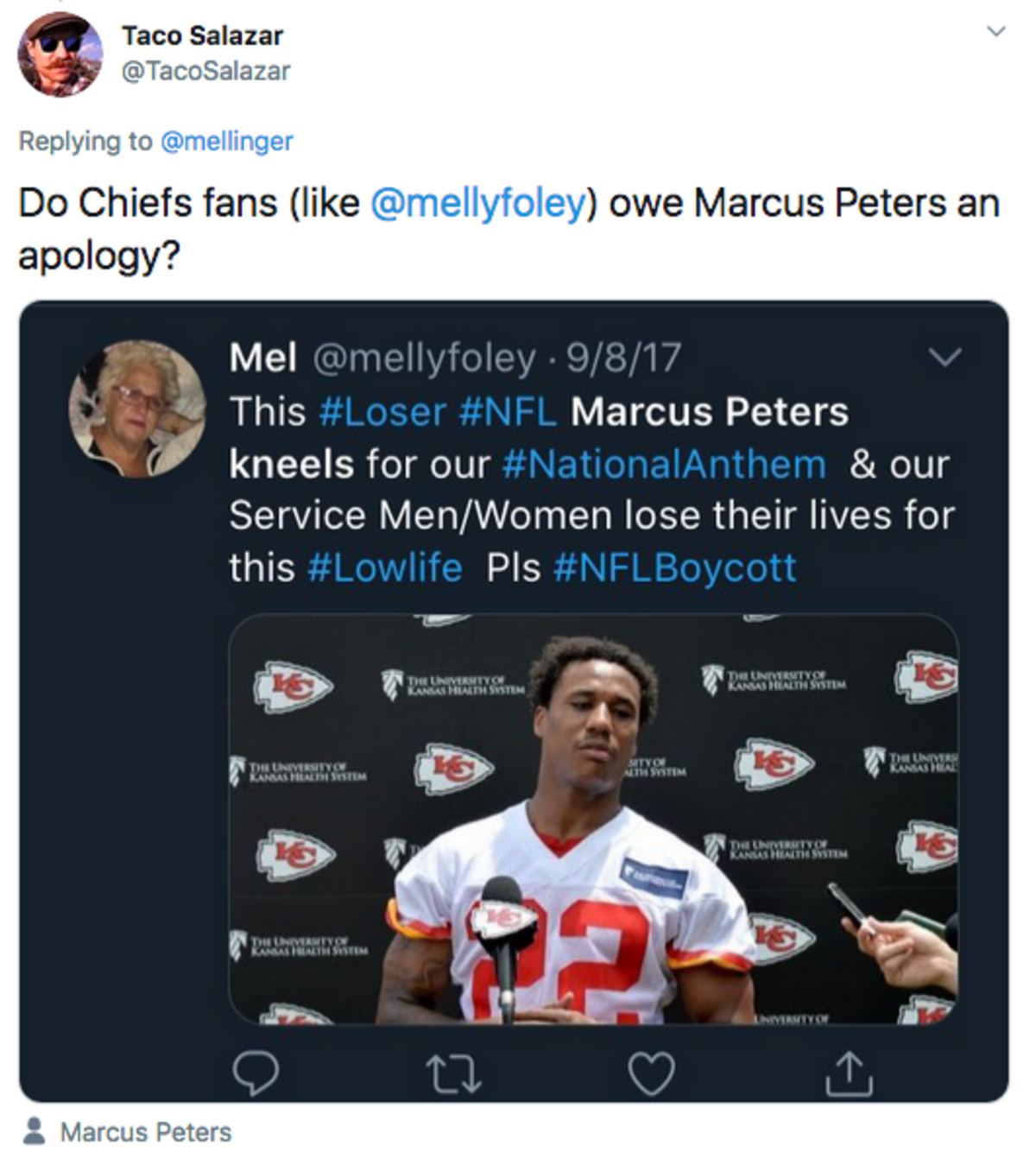
I guess, but I don’t really care about apologies or scorekeeping or anything else right now. That kind of thing encourages us all to further dig in, and continue to worry more about protecting preconceived notions than pursuing real improvement or better understanding.
But I’m glad you brought up the protest that began with Colin Kaepernick.
Because there’s a lot of talk right now about the property destruction and looting as the wrong way for protesters to make their point, and sure, we can all agree that it would be best to have these conversations peacefully.
But that’s been tried.
Kaepernick is the most famous example, taking counsel from an Army Green Beret on how to make his point without disrespecting the national anthem or flag.
The response: the president called him a son of a bitch, and the league’s owners essentially blackballed him.
So, a peaceful protest was wrong then, and a protest that has turned ugly in some places is wrong now.
It’s hard to know what the acceptable form of protest would be.
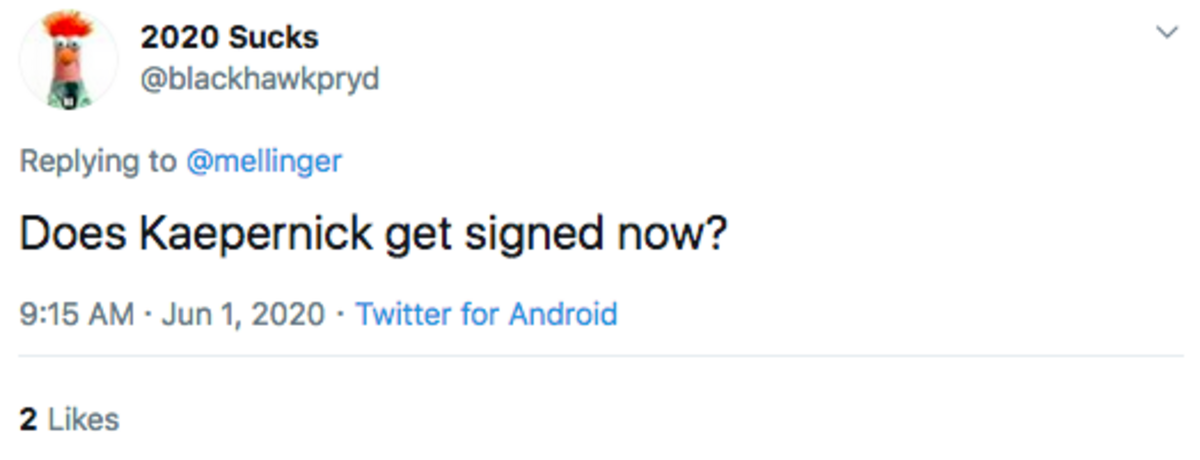
I doubt it. This may or may not be why you’re asking this question, but Joe Lockhart, the NFL’s VP of communications and government affairs from 2016-18, wrote a column for CNN, where he now works as a political analyst.
The column is interesting in a few ways, and I’d encourage you to read it.
He makes the point that Roger Goodell and others in the league office encouraged owners to sign Kaepernick, but that it was seen as bad for business.
Has that changed now?
The thought has come to me before about writing a column asking the Chiefs to sign Kaepernick. But when Alex Smith was the quarterback, I was swayed by the thought that there was too much emotional baggage involved.
Smith and Kaepernick maintained a positive relationship with the 49ers, even after Smith lost his job after suffering a concussion. But I could see why the Chiefs might worry that bringing Kaepernick in to again be Smith’s backup would be unnecessarily risky to bringing out Smith’s best.
Then, when they drafted Mahomes, it made sense to me that the backup should be older, someone who’s played in a lot of systems and played against a lot of defenses. Kaepernick has six years in the NFL. Chad Henne has 12. I get it.
So even with Clark Hunt repeatedly going on the record that he would support signing Kaepernick if Reid thought it best for the team, I can understand why it didn’t happen here.
But it should’ve happened somewhere by now.
It’s interesting that while the owners protected their singular business interests, keeping Kaepernick out of the league has only grown his profile, reach, and influence. His last snap was 3 1/2 years ago, but he’s still one of the world’s most discussed football players.
This isn’t how he’d have wanted it, but being left out of the NFL has in some ways amplified his voice and cause. What a sad statement.
Sports! And a positive sports story! What the heck man, let’s do it.
I’m going to write more about this later in the week, so please excuse me for keeping this (relatively) short.
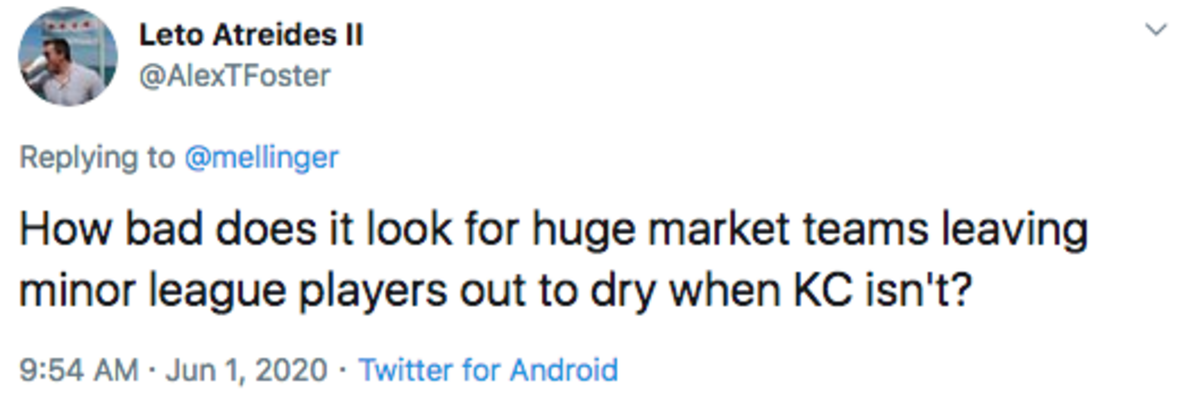
I had two immediate and separate and equally strong reactions to the Royals committing to not releasing or cutting pay for any minor-leaguers or club employees through the summer:
First, anything other than this would’ve been a rejection of how the Royals pulled themselves up from the industry’s punchline to the 2015 World Series champions. They have made the franchise about people, about support. Going back on that would’ve been a major departure and signaled a significant change in the organization’s identity.
Second, it is a comprehensive rejection of any other club — and there are MANY — that is cutting minor-leaguers, cutting their pay, and/or furloughing or laying off employees. John Sherman and his group were uniquely positioned here. Sherman’s ownership is the only one in baseball that hasn’t benefited from years of operations and growing franchise values*.
* The Marlins sold in 2017, the only other club to change hands since 2012.
They could have used that as justification to cut costs, and they would not have been completely full of (it).
Instead, they did the opposite, and every owner crying about decreasing revenues should know they’ve been exposed.
I have a lot more thoughts about this to share. But let me finish this today, and get with you tomorrow.
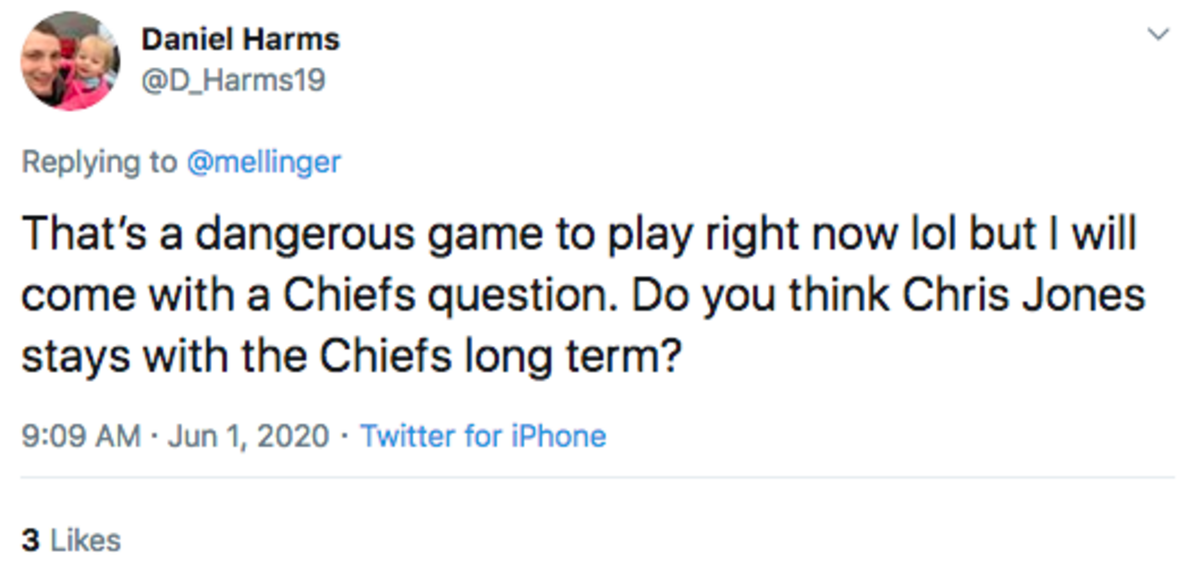
I do.
This might be a reference to Ian Rapoport’s report that Jones and the Chiefs have not talked contract in months, but that’s out there so let’s start here:
It’s not really news that talks aren’t happening, and wouldn’t be even if we weren’t in the middle of a global pandemic. There’s no immediate deadline.
But your question is still a good one.
My guess — and that’s all it is right now, is a guess — is that he will play for the Chiefs in 2020 and then be traded.
Other possibilities exist, of course. The Chiefs could trade him this summer, and they could reach a long-term deal.
But at the moment it seems the likeliest outcome is that he’ll be traded after this season. Two primary reasons:
1. Jones wants every last cent he’s earned.
2. The Chiefs’ best chance to give that to him was last summer.
What I believe is that the Chiefs value Jones, and want him here, but they already have one of the league’s tightest long-term cap situations and will soon give Mahomes the biggest contract in league history.
Travis Kelce will be up for a raise soon. Charvarius Ward won’t command Darius Slay money, but he’ll soon be due a huge raise from the $750,000 he’ll make this season. We could list more.
Many on both sides of contract negotiations believe the salary cap could go down in 2021 because of a drop in revenue created by the novel coronavirus, which would only put further complications in front of a team already light on space.
If the Chiefs were on a different stage of development they might be more inclined to trade Jones now, or earlier in the offseason.
They’d get less for him next year than they would now or before the draft, but trading one of your best players for a draft pick you can’t use until after the season would be a hell of a way to commit to another Super Bowl run.
Look, obviously I could be wrong. I do believe the Chiefs value Jones and genuinely want him long-term, and I do believe Jones enjoys playing for the Chiefs and wants to win more Super Bowls.
But football is a brutal game, and this could be Jones’ only chance to secure his family long-term, so you can see how business could get in the way of everyone’s hopes.
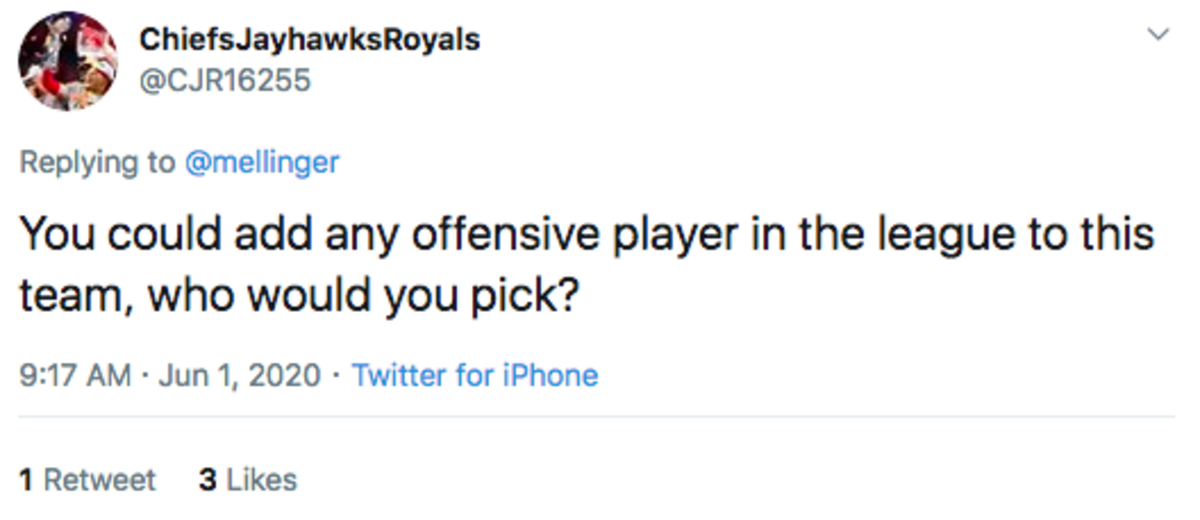
Tom Brady.
Kidding!
This may or may not be in response to the question we answered on the podcast about adding a player to the Chiefs. I went all defense there, so appreciate the distinction here about sticking with offense.
It’s tempting to say DeAndre Hopkins or Michael Thomas or Julio Jones, and that would be a BLAST to watch.
But to me the answer is Quenton Nelson, the mauling left guard from Indianapolis. Your answer could be Jason Kelce or Brandon Brooks or Zack Martin and we’re arguing the same point — the one thing the Chiefs’ offense is missing is a badass, grind-your-face-into-the-dirt interior lineman who can also pass protect.
This would give the Chiefs more options on short yardage, particularly on third and fourth downs, which would only open the pass even more.
I also feel obligated to point out that asking what the Chiefs offense could use is a little like asking how to improve the Tank 7*.
* The only answer is to make it in a bigger can, which damned if Boulevard didn’t already do.

Unpacking the failing relationship between players and owners would take more time than we have, even here.
There is blame on both sides, but more of that blame is on the players than most believe. That goes against my usual tendency to back players, and my reasons aren’t what you’d think so I hope this is articulated clearly.
The players got too comfortable. They lost ground in the 2012 CBA, and then lost even more in 2016, when union head Tony Clark — a very smart man, and a potentially strong leader — was mismatched against the collective bargaining chops of the commissioner’s office.
The players traded creature comforts like extra days off and better travel for steps they should’ve known approach a salary cap. They gained a better lifestyle in some ways, but sacrificed some financial ground and part of their principles.
It’s hard to get that back.
The players are understandably frustrated with the deal, but they must own the fact that they signed it. They are understandably distrustful of the owners, but they must understand that’s how adversarial business relationships work.
They can be mad that they’re losing in negotiations, but this is the game they’ve set up. Get better at it.
It’s worth noting that after the last round of CBA negotiations Clark and the union lawyered up with more skilled and experienced negotiators, and the hope is they work to a better place.
But in the meantime I just want to make the point that it’s not as simple as saying “greedy owners” or “whiny” ballplayers or whatever.
In most of human history, the distrust would be immaterial. Just part of life for two groups who come to a negotiation with vastly different life experiences and beliefs.
But we’re seeing the difference between how, for example, the NBA operates more collectively, like a partnership, and MLB’s culture.
The distrust can be benign in terms of work stoppages but has been amplified by our current state of confusion.
I’ve used this analogy before, but it’s like any relationship. If you and your spouse are strongly united, you will handle unpredictable stresses better and differently than if the new tension finds you already rocky.
I don’t want to oversimplify this. The NBA has had and will have their differences with players. Those relationships are far from perfect. But for reasons that are both in and out of leadership’s control, they’re in a much better place to navigate these new stresses than baseball.
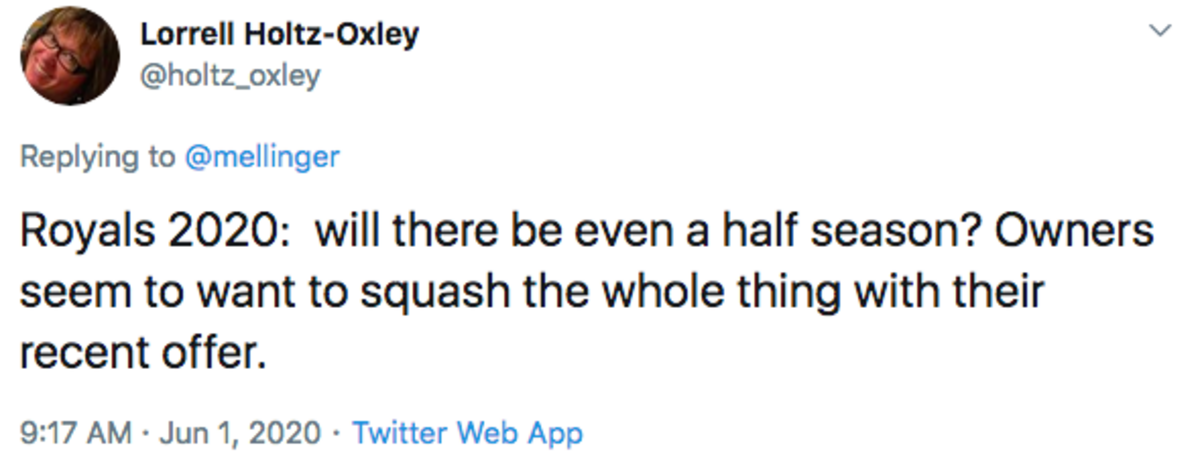
Well, OK, here’s one more thing I’ll write on later in the week.
The hope is yes, obviously. The hope is that baseball players who have spent their lives playing baseball and businessmen who’ve spent their fortunes or lives working in baseball can find some middle ground to quite literally save a season of baseball.
It would be dishonest to say organizing Major League Baseball games through a pandemic should be easy, but the motivation should be clear and the common ground easy to see.
The worry is that the fighting about schedule length and pay will distract from what should be the goal, which is solving the significant problems of health and safety.
This should have been seen as an opportunity. Baseball has long been losing younger fans, and here is a largely captive American audience so desperate for sports that we’re gambling on Wrestlemania and watching German soccer or NASCAR for the first time.
Baseball should have been unified in stepping that void, instead of giving potential customers reason to confirm their worst suspicions.
There is still time. This is not over. Leaders on both sides can save themselves. They’ve blown the chance to handle this with grace and unity, but they can still avoid the worst outcome.
And, well, at the risk of going too meta wouldn’t it be great if everything in 2020 could avoid the worst outcome?
This week, I’m particularly grateful for every relationship I have — personal and professional — in which each side can speak freely and get beyond the surface purpose of the interaction. I’m grateful for friends who really care, professional relationships that go deeper, and everywhere else that people go beyond the bare minimum. I hope to hold up my end of it, too.
This story was originally published June 2, 2020 at 5:00 AM.