
Mellinger Minutes: Live sports coming into focus, top 50 debates and good COVID habits
Real live American team sports are still weeks away at best, but we’re starting to get a better idea of what they’ll look like.
That’s not a reference to baseball playing in empty home ballparks, or MLS and the NBA relocating temporarily to Florida.
It’s a reference to the German soccer league Bundesliga restarting and the specifically fascinating golf exhibition over the weekend featuring Tiger Woods, Phil Mickelson, Peyton Manning and Tom Brady.
One theme that comes through in conversations with people in football and especially baseball: Sports will have to meet fans halfway.
Particularly in terms of empty stadiums and arenas, leagues are going to need to experiment. Fox added crowd noise for Bundesliga broadcasts this past weekend. The results were mixed. If you were watching casually, it probably felt more natural.
But if you watched more closely and saw games the week before, with players’ voices echoing off metal bleachers, you could feel the awkwardness involved. A goal is scored, and a beat and a half later the audio engineer hits the “GOAL SCORED” button and there’s ... a little more noise?
The golf match was terrific. All players were mic’d and could hear and have conversations with the broadcasters. This led to all kinds of delightfully manufactured discomfort, like Charles Barkley taunting Brady’s bad shots.
The match was exactly the right level of competitive. These are world-class athletes, so they wanted to win, but they also knew the grander purpose — raise money for charity, provide a few hours of entertainment, have a good time.
When our major sports leagues resume, presumably without fans in their stadiums, that balance will shift a little. We’ll need more players mic’d up, but it’s probably unrealistic to expect a pitcher and hitter to have a conversation during a plate appearance broadcast for everyone to hear.
But why can’t all umpires be mic’d? And managers? Or a colorful starting pitcher — Danny Duffy comes to mind — on an off-day providing insight and jokes? What if a guy could hit a home run, jog the bases, get dapped up by his teammates and then answer a question or two about what he saw?
Professional and major college sports can be stubborn. They can be disconnected. Increasingly in recent years — and maybe this is just my opinion, but it is my opinion — they’ve become a little arrogant. Revenues go up and up, emboldening certain policies that put short-term profits over the kind of fan accessibility that builds long-term loyalty.
My hope is that a silver lining could be that sports are spooked enough by declining revenue that they rethink some of how they operate. Allow their athletes’ personalities to show more. Make tangible steps to ensure tickets are accessible to middle- and lower-class families.
Focus more on the kind of entertainment that appeals to fans, and less on the kind of business decisions that are made in boardrooms.
That’s my hope, anyway. Of course, it could just as easily go the other way — revenues are down, so let’s grab every dollar we can short-term.
This week’s reading recommendation is Wright Thompson on Michael Jordan (pack a lunch) and the eating recommendation is the pizza at Martin City Brewing.
If you haven’t already, please give our Mellinger Minutes For Your Ears podcast a try. I appreciate you listening, and hope we’re worth it. The last episode — and we’ll talk more about this below — was an absolute blast and will be hard to top.
If you have a question you’d like answered on the show, please call 816-234-4365; leave your first name, where you’re calling from and almost literally any question.
Please give me a follow on Twitter and Facebook and, as always, thanks for your help and thanks for reading.
OK, here’s the show:
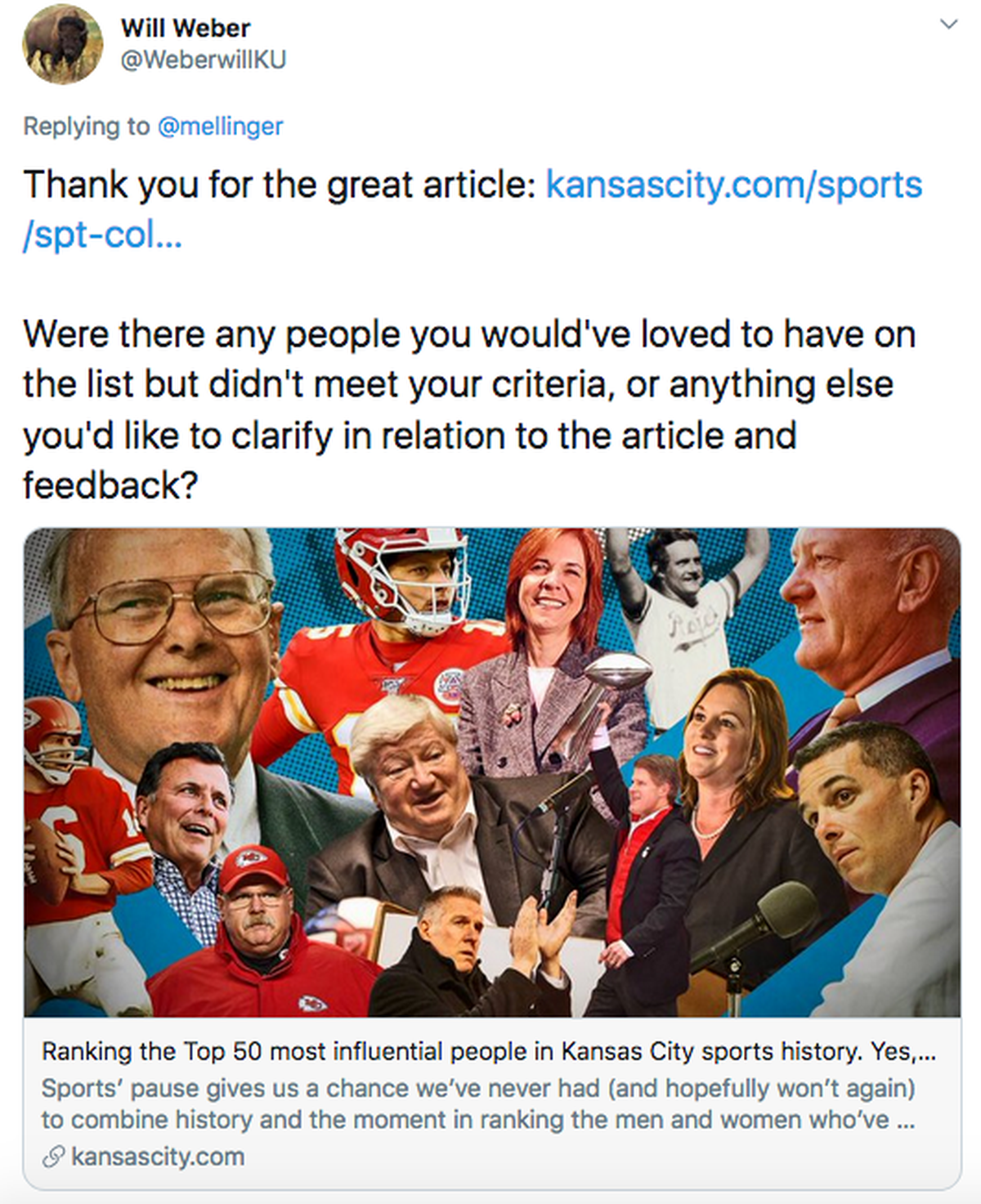
Thanks. I’d been working on that in various forms for about two months. Hopefully that came across.
The hardest thing about putting it together was my fault. I didn’t want the list to be the most influential right now, and I didn’t want it to be the most influential of all-time.
I wanted to combine the two.
I’m not sure I’ve seen a list like that, first of all, and with everything paused it seemed like the perfect time.
This doesn’t really fit into a headline all that well, but the idea was to rank the most influential people in making Kansas City sports what it is today.
That’s a distinction that perhaps only I care about, but to me it’s important.
That means Lamar Hunt is at the top of the list because without him the Chiefs wouldn’t exist. But it also means that Patrick Mahomes is near the top because when you consider the scale and popularity of the NFL it’s unlikely any Kansas City athlete has ever had as much influence locally and nationally as Mahomes does right now.
Some, like Buck O’Neil, I suspect will be on lists like this for decades. Others, like Tyrann Mathieu or Travis Kelce, might fall off when they’re done playing here.
Now, obviously you’re free to reject the criteria or even the thoughts according to the criteria and, actually, isn’t that part of the point of lists like this?
You asked about people I wish were on the list, and H. Roe Bartle is the first to come to mind. He was instrumental in the Chiefs coming here — they were going to leave Dallas but could’ve gone anywhere — and legend has it that the team name came from his personal nickname, “Chief.”
He was the last one off, actually, and was on every version of the list I had until the end, replaced by Joe McGuff, who had a legendary career and was critical in landing the Royals (thus maintaining Kansas City’s major-league status) after the A’s left.
Others who were on some versions of the list include Bernadette Wagner, John Schuerholz, Buck Buchanan, Walt Shublom and Fred Arbanas.
I’ve heard a lot of feedback. The vast majority is good-natured, even (or especially) in disagreement. Some calls for Kevin Harlan or Denny Matthews or Bill Grigsby to be on the list. I understand all of that, and respect the work of those and other broadcasters, but in the end I was swayed by the argument that a broadcaster’s influence only goes as far as the team allows.
One other challenge I didn’t fully think through before doing the list, and that I probably wouldn’t consider much if I was a casual reader looking at it: What to do with high school figures?
They don’t have the profile of people involved in major college or pro sports, obviously, but I’m swayed by the thought that nobody directly touches more Kansas Citians through sports than high school coaches.
That’s why Peter Vermes, Dayton Moore and Will Shields got extra credit. I ended up with four people whose impact came through high school sports: Evelyn Gates, Tony Severino, Bud Lathrop and Jack Bush. We could’ve easily also included Shublom or Al Davis or Terry English or Ann Fritz or others. At least in my mind, the coaches included are representative of so many others.
Once you settle on the 50, then the actual ranking is sort of like when a cooking recipe says “salt and pepper to taste.” Is Mahomes too high? Maybe. Is Tom Watson too low? Probably. Should Carl Peterson and Marty Schottenheimer be flipped? There’s a case to be made.
I tried to keep that balance of history and the moment in mind throughout, and in that way I like that the list includes Brett Veach and Carol Marinovich, Tyrann Mathieu and Don Motley, Whit Merrifield and Norm Stewart.
All I know is it was fun as hell to do, I learned a lot and I am grateful to everyone — including some who ended up on the list — who helped me through the process.
Oh, man. Off the top of my head:
10. Ali Farokhmanesh. That shot, man.
9. James Harrison. I’m still not sure whether that was a hold, but Harrison sold it.
8. Joe Axelson. He wasn’t the entire reason the Kings left, not even close. But he does make for a convenient fall guy.
7. Lin Elliott. Speaking of fall guys.
6. Tyus Edney. Let’s just move on.
5. Greg Robinson. Good gracious, man.
4. Sirr Parker. Woof.
3. Madison Bumgarner. If he were simply great, instead of transformative, the Royals would’ve won the 2014 World Series.
2. John Elway. Probably responsible for more curse words and more angry drinking in Kansas City than any other person in history.
1. COVID-19. Screw directly off.
It’s a good question, and one I haven’t really considered. Maybe this is old-school, but I tend to look at things with the Reporters Aren’t The Story kind of view. Joe McGuff made the list, but he was in the game for nearly a half century and is widely credited for a key role in landing the Royals after the A’s left.
I’ve always believed Kansas City’s collective self-esteem has lagged beyond its collective worth, and if the A’s left and were never replaced there’s no telling what that would’ve done.
I grew up reading Whitlock and Posnanski, and this probably sounds weird, but when I started at the Star I was more nervous to meet them than any athlete or coach or executive I’ve ever covered.
More to your point, I think, Whitlock and Posnanski mattered around town. They shaped opinions and they affected how teams sometimes operated.
Whitlock changed the tone of Kansas City sports coverage. He was so damn blunt. Posnanski changed how many in Kansas City saw sports. His writing was so damn beautiful.
Together, they made following sports here more interesting, more fun, more memorable. That’s a hell of an influence, you’re right.
If this list was done 20 years ago, you could make an argument for that tandem to be in the top 10. Neither has lived or written here in, what, a decade? So that’s a harder case to make, but the fact that we’re still talking about this all these years later is a testament to their talent, work and influence.
Baseball is in a really difficult spot, you guys.
The Arizona Plan died a quick death, so it’s particularly interesting that the NBA and MLS are both moving quickly toward restart plans that mirror what baseball rejected.
If the NBA and MLS get their seasons going while MLB stalls, or worse, with a plan to have games in home ballparks then, yes, that would be a very bad look.
Baseball is — to borrow a very baseball phrase — showing its ass here. The owners are strategically leaking specific parts of their proposal, prompting leaks and undisciplined criticism from the other side, with players and owners both allowing the perception that they care more about money than getting the games going again.
I keep coming back to this: The opportunity cost being paid is both intangible and enormous.
In the eyes of the fans the sport needs to attract most, baseball has an image problem that’s only growing worse. A cohesive and united response to a pandemic that’s wrecking lives could’ve boosted the sport’s brand and hastened its return.
Instead, our current reality is that Korean baseball highlights are leading SportsCenter while MLB officials debate which leaks will make the players look the worst.
For decades, people in the game have referenced a line about how you know baseball is the best sport because even the idiots in charge haven’t been able to ruin it yet.
It’s an exaggeration to prove a point, and baseball won’t be ruined no matter what happens (or doesn’t happen) this summer. But it will be a major hit if the sport’s awkward mechanics and pathetic infighting prevent or delay a season when fans are desperate to watch and new fans are so easily accessible.
They have to get going.
You might know that I’ve dropped some of my cynicism on this over the last year or so, in large part because of conversations with Jarrett Sutton and Corey Wacknov. They joined the podcast a month or so back and make an interesting case.
There are two ways that our current reality might produce a team in Kansas City.
The first is that some in the league believe that some owners are going to want out. Maybe they have other interests to concentrate on, maybe they don’t want to or don’t have a great plan to navigate the changes. Maybe they just need the cash.
However it happens, a sale would mean potential relocation, and Kansas City (along with other markets, most notably Seattle and Las Vegas) would be candidates.
The second way is that some believe the league could add teams. Expansion fees would likely be more than $1 billion each, which would mean more than $60 million for each owner. That’s some sweet action, and, just like with relocation, Kansas City would be among the expansion candidates.
I want to be clear: This is a longshot.
Nobody would bet even money on the NBA coming to Kansas City in the next three to five years.
But it is possible, at least. More possible than it was a year or two ago, anyway.
Maybe? There’s probably data that would prove this one way or the other, but I think some about Dick Vermeil’s time in Kansas City. The Chiefs used their first pick on an offensive player just once in those years (Larry Johnson).
Overall, 16 of 38 draft picks in Vermeil’s time with the Chiefs were spent on offensive players. I know the payroll was tilted toward offense in those years, but still.
Even now, with Andy Reid, the Chiefs have used their first pick on an offensive player four times, and defense three.
I’m not going to fall back on the ol’ Best Player Available thing, but it’s a matter of perspective.
You could argue that if all things are equal, the offensive player will have a better impact for an offensive coach because he’ll be put in a better position.
Or, you could argue that the defensive player would be the better use of resources because the offensive coach should be able to get production from slightly lesser talent.
One thing I really respect about the Chiefs the last few years is their insistence on keeping strengths strengths. That’s trading up for Mahomes, that’s adding speed with Mecole Hardman and that’s drafting running back Clyde Edwards-Helaire.
I’ve said this before, but as much as I thought they would’ve been better served overall going defensive back first, and then running back later, I respect the hell out of making defensive coordinators mutter curse words to themselves.
Well, a few things to mention here at the top.
First, I’m glad you liked it. I know it was very baseball nerdy, and that kind of thing isn’t for everyone, but it was one of my favorite interviews I’ve had on the job.
Second, I’m planning a column based on the interview this week, so I’ll be specific with this answer.
The column will likely focus on the actual conversation, about thought processes and surprises and confirmations and all that. Part of what you’re asking here is how the thing came together, and that’s what I’d like to address with this answer.
The idea started with something on The Athletic, actually. They’ve had various reporters in various parts of the country “draft” teams — Dodgers seasons, for instance, or Bill Self basketball players — and then debate on who did the best.
I did something similar with Terez on the Chiefs, where we drafted reasons the Chiefs won the Super Bowl.
I figured it would make a good podcast to do a Royals draft and broadcaster Ryan Lefebvre was nice enough to play along. But at some point in the conversation I realized I hadn’t made it clear enough that it would be a podcast, and I didn’t want to ask Ryan to do the whole thing over again, so I asked Dayton Moore if he would be willing to judge.
“I’ll do more than that,” he said. “I’ll treat this like I do all my baseball decisions.”
He then ran through the steps. Said he’d send the teams to his analytics department, consult with his scouts and then put it all together to make a decision. Everything except financials.
Honestly, I thought he was joking, so I said something about how if he was treating it like all his baseball decisions he’d ignore analytics and pick whichever team had Jeff Franceour.
Fortunately, Moore knew I was joking and insisted he was serious. And that’s how the whole thing came to be — a general manager, top pro scout and head of analytics offering nearly an hour of their time to some idiot sportswriter as an exercise in how they make baseball decisions together.
It was all fascinating. I particularly enjoyed Daniel Mack, assistant general manager for research and development, calling me out for leaning too hard on FanGraphs’ WAR and making the point that I should’ve moved Jorge Soler from DH to right field and then had Kendrys Morales as my DH.
Usually, I’m the one making the critiques.
I can’t thank them enough for their time. I’ve known Moore for nearly 15 years now, so I hope part of his willingness to go above and beyond on this is that he knows I’m genuinely interested and will be fair.
I also know it’s important to Moore that the public is engaged with baseball, now as much as ever, and he thought this would be a good way to pull back the curtain a little.
Also, even with he draft approaching fast, I suspect part of it came from something that all of us who love baseball can relate to — those guys miss the action and discussions that come from having live games.
It was an absolute thrill, particularly the interaction between the three. Moore and Watson come from traditional scouting backgrounds. The Royals’ openness to analytics came slower than many other organizations, but that relationship has advanced far beyond what most believe.
That might end up being the focus of the column this week, actually. I love my very weird job, you guys.
The plan all along was for the payroll to decrease as more roster spots go to pre-arb players.
There are significant differences between this rebuild and the last one, from potential roster construction to the financial rules in place across the sport. But, generally speaking, we’re at the 2010 point or so.
The Royals have less than $40 million committed to next season’s payroll, which includes nearly $30 million for Sal Perez and Danny Duffy. One trade and the Royals could get very lean, very quickly.
It’s worth noting that the payroll will almost certainly rise fast from there, as guys like Adalberto Mondesi, Jakob Junis, Hunter Dozier and Brad Keller go through arbitration.
But this is a little like when the Royals went from $77 million in 2010 to $44 million in 2011. That was the league’s lowest payroll, which prompted some #GlassIzCheep talk without understanding that it was a byproduct of a dozen or so rookies debuting.
If you’re a Royals fan you’re hoping that the next rookie class has a similar impact, and that as those players mature and the front office has a better idea of where the holes are they’ll be able to fill with the airport prices of free agency.
Two examples from the last round of rebuilding:
Duffy was the only one in a deep crop of pitchers to have a sustained big-league impact, which meant the 2015 team needed to supplement with trades (Wade Davis, Johnny Cueto) and free agents (Edinson Volquez, Chris Young).
Also, there was a time when Johnny Giavotella was the second baseman of the future. That never clicked, so the Royals spent big money on Omar Infante and, when that didn’t work, traded for Ben Zobrist.
These are the years where a team stocks up capital to be able to spend in those moments down the road.
I hate the shortened draft, and I’m quite certain the Royals hate it even more.
Greg Holland was taken in the 10th round, Whit Merrifield in the ninth and Brad Keller in the eighth. There are players like this all across the sport, on every roster. Rebuilding teams count on these players.
I wouldn’t worry about undrafted free agents clustering to better teams. Guys are going to go where they have the best chance. Primarily that means the best minor-league development systems and playing opportunities. The latter should benefit the Royals, and if the former doesn’t then they have much bigger problems than a shortened draft.

There’s obnoxious fans in every sport, and not just Marlins Man. Golf’s structure — fans close to the action, dead silence before a shot — allows a few to amplify, but they’re everywhere.
We are in total agreement about GET IN THE HOLE or YOU DA MAN or DILLY DILLY or any of the rest.
But as much as I’d endorse all of those catchphrases being banned, at this point I’d also love to watch a golf tournament where everyone was required to yell BABBA BOOEY after every shot.
You guys, I’d stand up and do the damn wave for nine innings if it meant I could watch a live Major League Baseball game in between.
So many. I’m going to write a little about this in the next few weeks, but Bo Jackson was so important in not just me falling in love with sports, but in precisely how I love sports, and what I love about them.
But if I’m understanding the spirit of your question, the most relatable game I can think of at the moment is when Northern Iowa beat Kansas in the 2010 NCAA Tournament.
I grew up a KU fan, raised by two KU fans. I went to Kansas, and even if what I do for a living had always prevented the kind of rooting interest you’d expect from a grad, that 2010 tournament was the first significant KU game I’d covered in this job.
Before that, I was on high schools and then baseball. I’d taken the column job at the beginning of March and straight away here’s a tournament where Kansas entered as a No. 1 seed.
I want to emphasize an earlier point, and one I’ve made in varying ways in other places. This job changes the way you see sports. Not better, not worse, just different. So I didn’t think any of this would be an issue (I actually enjoyed watching K-State more that season than KU), but the test comes in real-time.
So when Ali Farokhmanesh hit that shot, I remember thinking not about sadness or anger or whatever I’d have felt as a fan, but more about the adrenaline and focus that comes from needing to write about a major event on deadline.
It comes from an honest place, that’s all I can tell you. Mahomes is a gift.
I hope so. Like you say, it’s hard to know what will stick and what won’t, but Friday date nights have turned into Friday family move nights. The kids eat orange chicken, the parents get takeout sushi and we all share popcorn.
We go to parks more often than we used to and have started to pack up the bikes to go to various trails around town. I’m eating better and cooking more. More time in the yard. I wish I could say I’m reading more, but that would mean I’m lying to you.
I think about this stuff all the time. What habits have you developed and want to stick? This is something people in sports are worried about, by the way.
There’s the old line about absence making the heart grow fonder, but there’s also one that says out of sight, out of mind. Some of us want sports back desperately, but others have developed new habits, new interests, new hobbies.
Nobody’s right here, nobody’s wrong.
But sports are going to need to find a way to get back into the hearts and minds (and wallets) of fans. I don’t know if that’s with more accessible broadcasts, or cheaper seats, or bonus experiences for season ticket-holders. Maybe it’s a combination of those things along with some other stuff I’m not thinking of at the moment.
But life is never going back to exactly how it was. We’re evolving. We’re changing. It’s going to be up to sports to do the same.
This week, I’m particularly grateful that our older son is into collecting football and baseball cards. I shouldn’t do this, but I know it’s just human nature — it’s so cool to live an experience I cherished as a kid through my own kids.
This story was originally published May 26, 2020 at 5:00 AM.