
Mellinger Minutes: Alex Smith appreciation, Chiefs analysis, some baseball and more
Someday they’ll have an Alex Smith Appreciation Day at Arrowhead Stadium.
He’ll come back with his family, probably in a dark and tailored suit, and he’ll wave to fans and they will stand and cheer back. Highlights will play, including that comeback against the Chargers and the playoff win in Houston.
He’ll be remembered as the quarterback who helped build the Chiefs from their 2012 disaster to a regular AFC contender. He’ll be remembered as committed leader, universally respected, and for going beyond the job description in helping Patrick Mahomes prepare for the best two*-year start to a playing career in league history.
*And counting?
Mitch Holthus thinks it’ll be for a Ring of Honor ceremony. That’s a little rich for my blood, but now’s not the time for that debate, particularly as nobody would begrudge him the honor.
The appreciation was always going to happen, but ESPN’s Project 11 allowed the broader football world a window to see why.
Smith’s career is fascinating. The San Francisco 49ers made him the first pick in the draft before his 21st birthday. He was such a late bloomer that he played just one college game with the understanding that he would be an NFL player. He’s said that more media covered his first NFL workout than all but one of his college games.
The 49ers gave him a run of dysfunction. There was no direction there, little talent and a comical cycle of new playbooks and systems to learn. When they finally gave him support, he was the starting quarterback on a team that was a muffed punt away from the Super Bowl. The next year, the 49ers were in first place and he was leading the league in passer rating when he lost his job because of a concussion.
The team finished that season five years from winning the Super Bowl, with Smith going out of his way to support his replacement.
Andy Reid and the Chiefs gave him his best and most consistent opportunity. The Chiefs made more postseasons in his five seasons in Kansas City than they made in the previous 15.
He was again asked to mentor his more physically talented replacement. Smith did that beautifully, led the league in passer rating — playing with some “puck it” — and then was traded to Washington, where he was given a huge contract and handed the keys to a messy franchise.
Washington was 6-3 in his first season (after going 7-9 the year before) when Smith suffered a fluke and gruesome leg injury. Doctors talked about amputating the leg, and infection came on so hard he could’ve died.
Through it all, he has maintained an almost superhuman drive and focus. He has maintained perspective, taking inventory of everything he has. His injury has been described as something closer to that of a soldier, and when he met some at a military rehab center he described himself as “not worthy” of being in the same room.
He’ll turn 36 this week, but says he remains intent on playing quarterback again. He’s described the injury as “an opportunity.”
Smith was the No. 1 overall pick in an NFL Draft, and the irony is that it turned out he came with a limited ceiling. You could win a Super Bowl with him, but everything around him had to be perfect. NFL teams are rarely perfect.
But Smith’s place in football should only partially be defined by those limitations. His impact has come in attitude, in perseverance, in respect. He’s right — he has lived a damn good life. He’s made around $100 million and has a supportive wife and family.
He’s also been a dang good model for how to approach work and life. He’s been given reasons to fail, and found ways to succeed. That’s never been truer than it is now, with this injury, and it’s cool that the world is able to see how he’s dealt with it.
This week’s reading recommendation is Laurent Duvernay-Tardif (as told to Greg Bishop) on moving from the Super Bowl to working against COVID-19. The eating recommendation is basically anything from Tacos El Matador, which is delivering for $3.
If you haven’t already, please give our Mellinger Minutes For Your Ears podcast a try. The response and support has been great, the guests fun, and the most recent episode is the best one yet.
If you have a question you’d like answered, please call 816-234-4365 and leave your first name, where you’re calling from and whatever you want to talk about. Last week, we talked about everything from the Chiefs to how to mourn a loved one.
Also, if you know of a high school or college senior who should be in our senior appreciation series, please me know.
And if you know of someone deserving of a pair of Chiefs tickets for all the thankless work they’ve done in this fight against COVID-19, let us know about that, too.
Please give me follow on Twitter and Facebook and, as always, thanks for your help and thanks for reading.
OK, here’s the show:
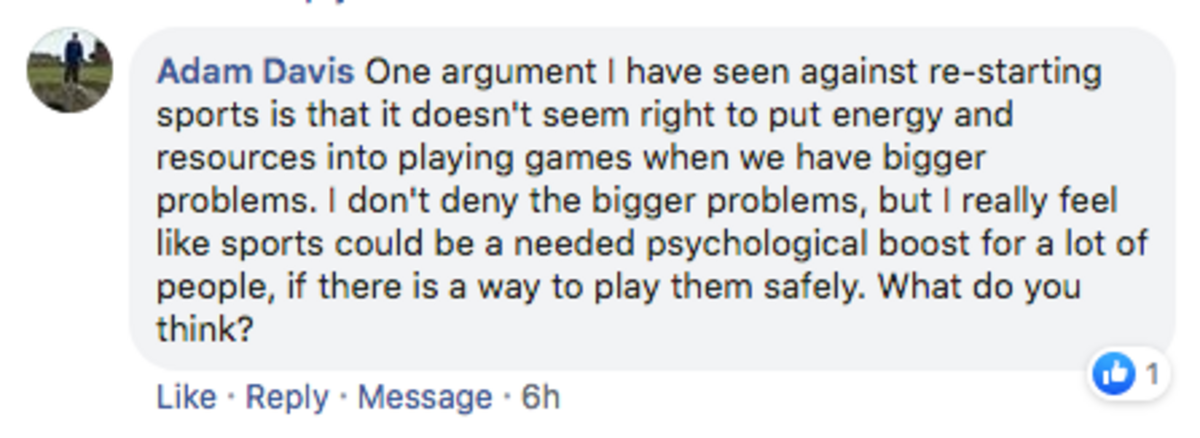
I agree 100 percent.
This existed long before anyone had heard of COVID-19 but the pandemic has been a fruitful opportunity for people who love made-up, straw man arguments.
Like, we’re all on the same side of wanting life to be normal again. Nobody is against that. We all might have different ideas on how to get there, but literally nobody is happy that people are dying from a disease without a cure or that we’re in different forms of lockdowns.
But you’ll still hear people argue that point.
And to your point, literally nobody thinks missing sports is the biggest problem in the world. Nobody. But you’ll hear people say dumb things, like, “sports shouldn’t be a priority.”
But what exactly are sports taking away?
The people talking and working and thinking of how to someday have sports again are not the same people working against the virus. Roger Goodell and Rob Manfred are not in a lab somewhere trying to create a vaccine.
And nobody would make the argument that sports should open without any safeguards, or any consideration to how to do it safely.
I don’t pretend to know everything about how to have games safely. I do have some ideas. I do believe it’s unrealistic to expect people to continue following strict lockdown guidelines for much longer. And I do believe it’s not just OK but responsible to start thinking about what the other side of this looks like.
The arguments on both extremes are silly and counterproductive: if you want sports to return, it doesn’t mean you think everyone’s grandmother should die. And if you want to be cautious, it doesn’t mean you want all small businesses to close and more people to lose jobs.
We can exist in this together, and challenge each other’s positions honestly.
My bias is obvious here. I miss sports desperately, and even beyond that the way I pay my mortgage and feed my family is dependent on sports.
So of course I want games back quickly, and based on that alone anyone is free to dismiss what I think about any of this.
But we’re a big country, filled with smart people, and if you believe we can’t have our health experts working against the virus and our sports experts preparing to return when the time is right then what are any of us doing here?
Sports’ return will be much more than a ballgame to watch, too. You mentioned the psychological boost, and I’m with you and agree but also believe there’s more to it than that.
Sports’ return will be a mile marker for the country. When we have the right combination of testing, treatments, and enough control over the spread that we’re able to have games again — even without fans, as NASCAR plans to do next weekend and the PGA plans next month — it will be a major victory for everyone fighting this thing.
If it also makes a lot of us happier, well, that’s a hell of a bonus too.
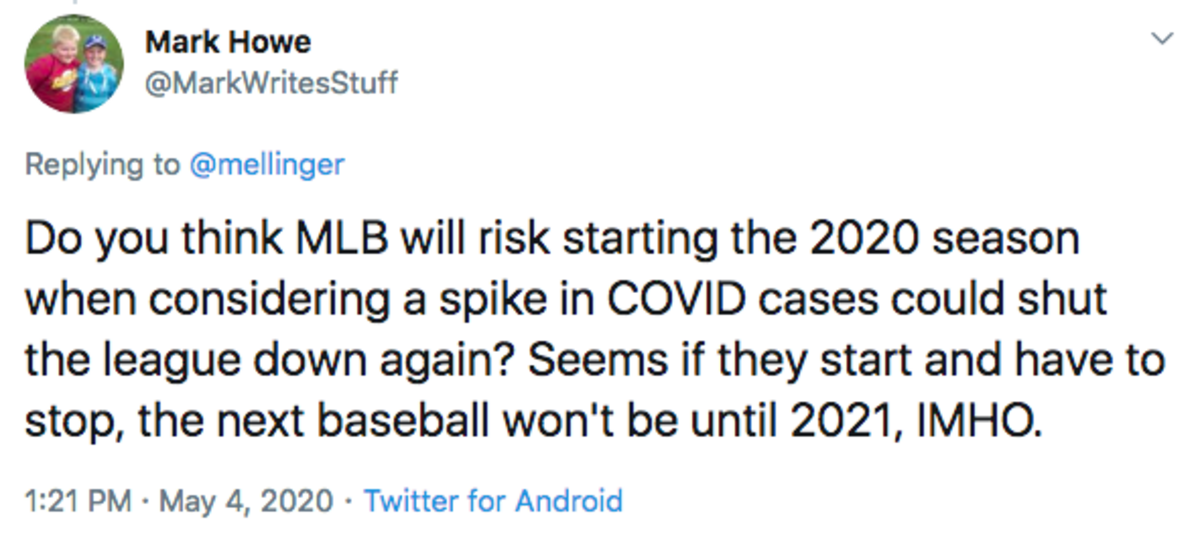
I don’t think it’s that simple. There is risk in doing anything before a vaccine is developed. The charge is to manage that risk. It’s a sliding scale.
We agree that starting and stopping would likely mean no more baseball until next year. But at what point does that risk become palatable?
There are no definitive answers available right now, to any of these questions. I haven’t read anything that makes me believe the spread is to the point that leagues can have any certainty.
The NFL will release its schedule, for instance, but remains working on contingencies. Major League Baseball can have a soft target of starting in June or July or August, but nobody is under the impression that they control the outcome here.
The virus is in charge, not humans.
So, just as an example, MLB could build one of its plans around a July 4 opening day. That’d be cool, right? It would make sense logistically and symbolically, and mean we’d have another month or so to make enough progress so that players could begin some form of spring training.
Maybe we can get there. But there are also indications that we won’t, so other plans have to be made.
Again: any business, including professional sports, will have to understand that re-opening without a vaccine will involve risk.
The trick is determining the right combination of lowered risk and high reward. That’s why we have health experts.
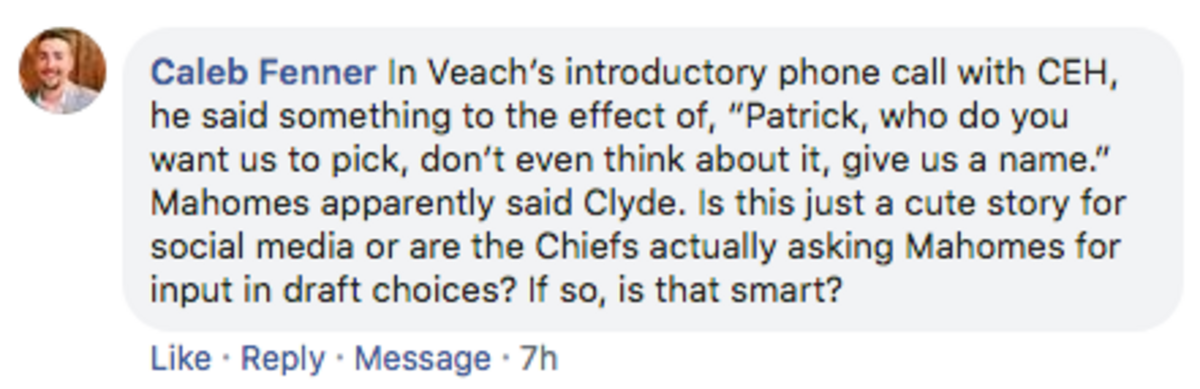
Yeah, I never wrote much about that anecdote because it was taken by some to mean something it doesn’t.
Brett Veach and his scouts are hard-working and conscientious professionals. Patrick Mahomes is a unicorn, but he’s not a scout. That’s not his job. He doesn’t make picks.
Veach and Mahomes have a particularly close relationship. Lots of mutual respect. Each side’s success is good for the other. Veach knows Mahomes is his greatest achievement, and Mahomes knows Veach believed in him first and put him in a position to succeed.
So, they talk a lot. And I have no doubt that the story is true, same as I have no doubt that Veach is not letting months of prepwork be overruled by his quarterback at the last minute.
It does make for a cool story, though, and gives Clyde Edwards-Helaire a nice platform in joining the team. He knows he’s wanted, not just by the front office and coaches but also the league’s best player. That’s a good start.
Sidenote: this does remind me of Zack Greinke, who thought of himself as something of a scout. He’d watch minor leaguers and even amateur prospects in his free time and share his opinions with the front office.
To me, it was one of the strongest pieces of evidence of how much Greinke loved baseball, even as his diagnosed social anxiety issues were sometimes misunderstood.
But, well, lets just say Zack’s scouting judgments were mixed.
Anyway, let’s talk more about the Chiefs.
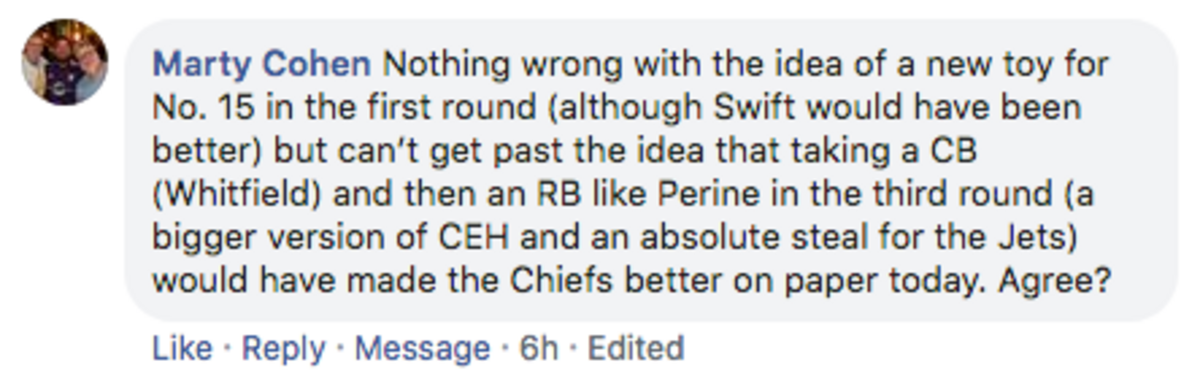
Without writing those columns again I’d summarize like this: I understand and am on board with what they like about Edwards-Helaire both individually and as a fit, but believe the better way to maximize value from the draft would’ve been exactly what you said there.
The main reason I’m including this question, though, is to preemptively announce that I’m sick of arguments that’ll be had about this pick once the season starts.
Every time he scores a touchdown, or makes a great play, it’ll be lol at anyone who couldn’t see this dude would thrive.
Every time Damien Williams scores, or the secondary gives up a pass, it’ll be so glad we used our first-round pick on empty calories so we could have this again!
I just want it on record here in May: all these arguments you’ll have during games can go kick rocks.
But, jeez, once I type that I immediately think, gawd it’ll be great to have dumb arguments like that again.
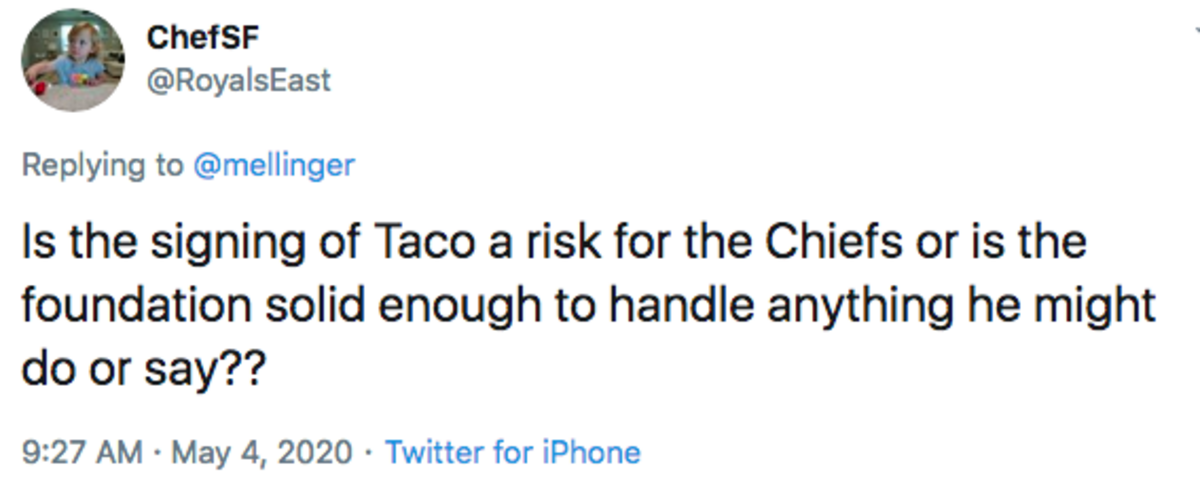
Taco Charlton is the awesomely named edge rusher who is now on his third team since being drafted in the first round by the Cowboys in 2017. Depending on who you believe and when you believe them, his time in Dallas went sideways because of a shoulder injury, bad attitude in practice, and concerns about how he carried himself away from the field.
It’s all pretty vague, but it’s also notable the Dolphins released him to save less than $2 million of cap space when he led them in sacks in just 10 games.
Honestly, it’s hard for me to see how this is a bad deal for the Chiefs.
The risk is minimal, both financially and in the locker room. Charlton and Frank Clark played together at Michigan, and remain close. Charlton needs the Chiefs a lot more than the Chiefs need him, and that leverage means everything.
Both sides know Charlton can be released quickly and painlessly, and Charlton knew that when he signed the deal. That means he has to believe he’s ready to work, and he has to know that if he burns a third bridge so quickly that other teams are going to have serious doubts about whether he can ever be productive.
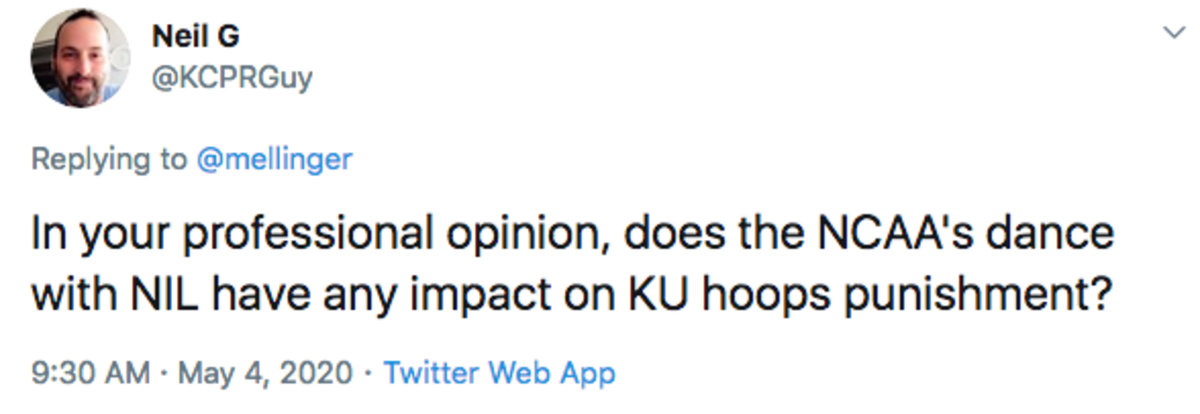
It does not.
The optics are changing, to be sure. The NCAA knows the public appetite for punishing these sorts of things is draining, and it knows that when the case and the NIL rules are set it may very well be true that KU’s punishment would be for violating rules that no longer exist.
But the rules did exist in real time, and that’s the important part of this.
I’m tempted to argue the other side, you know. These rules have been screaming to be updated for years, for decades, and it’s laughable that the FBI — THE *FBI* — spent so much time and money investigating something so small and victimless.
So if the NCAA does, even in some small way, adjust its punishment based on what I would call common sense then of course I’ll applaud.
But I can’t expect that.
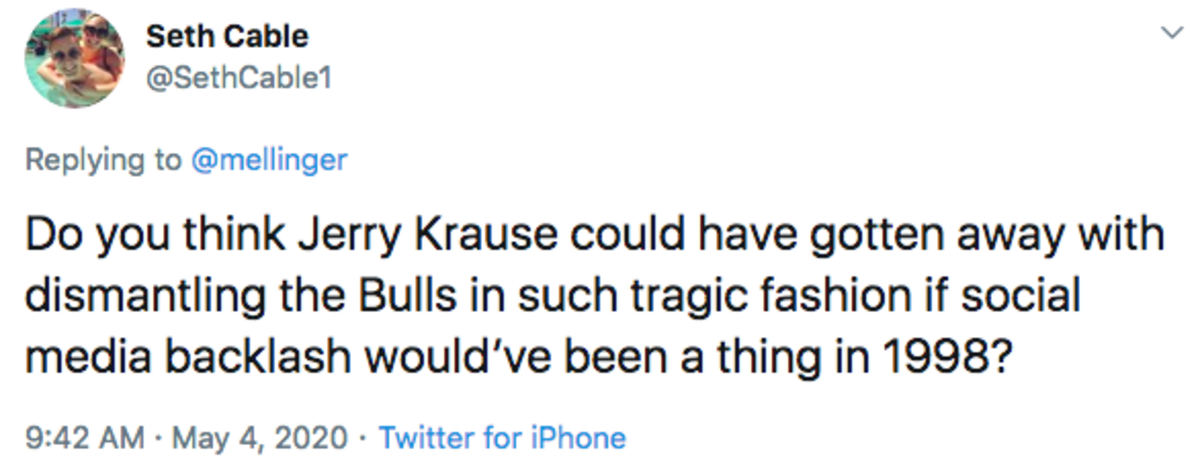
Full disclosure: I haven’t watched Sunday’s episodes yet.
But the Krause stuff is mind blowing, and on so many levels and in so many ways. It’s crazy to see how openly and freely the players disrespected him, and how public the rift between Krause and the players and coaches had become.
It’s also wild to me that the documentary has basically been open season on a man’s memory. He’s not around to defend himself, and Jerry Reinsdorf isn’t helping much.
That’s an underplayed part of all this, too. Why did Reinsdorf not step in? Why did he not keep those relationships from becoming so toxic? Maybe he tried, but at some point you need to be forceful, even if it means firing people you otherwise value.
Look, the show is wildly entertaining. It’s the best thing on TV right now.
But it’s also not a neutral view of history. Jordan’s production company is a partner, and he had veto power on who was interviewed and, presumably, the show’s content.
I say all this to point out that what we’re watching isn’t fair to Krause. It’s silly to pretend that he had nothing to do with the team’s success, and it’s weird to see such pettiness not only tolerated but celebrated.
So, if all of that was happening today I’m curious how it would’ve been publicly digested. Jordan is always going to win a popularity contest but there also would be more information about Krause and his contributions.
A great example is the line about players not winning championships. It’s a preposterous thing to say, but when Krause clarifies that he said players don’t win championships alone, well, you see the point. And nobody would argue that. It takes a collective.
But at least from my perspective, the biggest difference would be that Reinsdorf would’ve felt more pressure and urgency to keep those relationships from becoming destructive.
It’s hard to believe that would be tolerated today. And that’s where my mind keeps going, that Reinsdorf’s role in all of this would’ve had to be different.
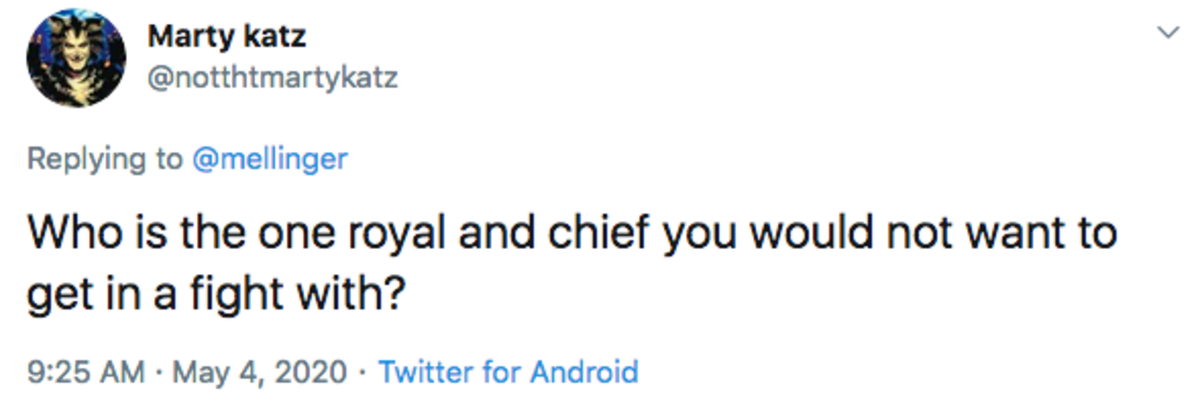
If we’re talking about current players, the answers are Alex Gordon and Frank Clark. I can explain.
Jorge Soler would probably be the most popular pick on the Royals, and an easy case can be made there. He’s stronger than Alex, bigger, and the idea of fist fighting the American League’s reigning home run champion is less than advisable.
But Gordon is made of nothing but skin, bones, muscle and broccoli. He has enough athleticism to chase you down and, crucially, is so laid back and deferential that if he got to the point of fighting I have to believe he would bring the strength of eight oxen.
Clark is a little more straightforward, though cases could also be made for Tanoh Kpassagnon, Eric Fisher, Darwin Thompson and others. Austin Reiter has the look of a man who would not stop fighting until he had literally tasted your flesh.
But it’s hard not to answer Clark here. He’s built like a heavyweight boxer and, actually, if he’d chosen that sport instead of football he probably could’ve been a star.
I’m at a Mason/Smith, and please let me explain.
I’m thrilled that the series is back on, both for football and men’s basketball. You would probably expect that out of a Kansas City-based sports columnist, but it’s also personal. Rivalries like that are what I grew up on as a sports fan.
I’m fairly certain I’ll be at all the scheduled games, and even if I had a real job I’d still go.
So that’s great! I should be at a Mangino/Pinkel!
But that would mean I’m extremely excited about watching a KU football game, and my friends, I’ve never lied to you and I’m not going to start now.
The same is true in men’s basketball. I can’t get excited to watch Mizzou right now.
This might just be a me problem, but there’s also a tinge of plain business decision here. The rivalry was killed by hurt egos and pettiness, and now it’s alive again because of capitalism, not history.
Even before COVID-19 college sports were on shaky ground with attendance and related revenue, and there is no surer way for KU football to sell extra tickets than to play Mizzou.
I’m obviously fine with that. These have always been businesses. But I can still be a little annoyed.
Now, if you tell me that KU can build up closer to Mizzou’s level in football and Mizzou can do the same improvements in basketball then we’re talking more like a Pinkel/Mangino/Norm/Self level of excitement.
No, I don’t. On a few levels.
First, I don’t think the numbers quite merited it. I understand the Gold Gloves, the All-Star games, the Silver Sluggers and being a central part of a world champion.
But he’s also topped out at 4.2 WAR in Baseball Reference’s calculation, and has 22.1 in his career. The average Hall of Fame catcher has a seven-year peak of 34.8 WAR, according to JAWS.
It doesn’t matter where you stand on metrics. Those things matter, and will only matter more when Perez’s career is over.
There was a time I believed it was possible, and wrote a column quoting George Brett making the case.
But even Brett’s public optimism was based on certain trends holding, most notably increased on-base and slugging percentages. He was also always going to have a difficult time staying at the position, and once (I’m not saying if here, but when) he moves to first base or designated hitter his value craters.
These Hall of Fame debates can be tricky, because simply having the kind of career that merits one means you’re talking about a damn good player. Perez will be a Royals Hall of Famer, of course, and he’ll have an interesting case for his number being retired someday. I believe his swing in the Wild Card game should be a statue.
But even before the injury he had some trends working against him in terms of baseball’s Hall of Fame.
A list? A list!
Let’s do a top 5 because, just being honest, nobody loves leftovers.
5. Mexican casserole. I realize I’m being specific here, but the definition can broaden to include enchiladas and even some burritos. The spices remain and sometimes even develop the second time through.
4. Pasta. But it has to be the right kind of pasta. Cheese helps, and red sauce is generally superior through the reheating process.
3. Ribs. The trick is you have to be patient. You can’t microwave these things, like some dolt. Use a toaster oven if you have one, or the regular oven if you don’t. Ten minutes or so at around 300 degrees. The same applies here to basically any barbecue.
2. Pizza. This is going to be controversial, not having pizza No. 1. I am prepared for your arrows, and ask only that you know I have a long and deep appreciation for leftover pizza — it’s quick, can be eaten cold or reheated, and except for the crust retains value for a few days.
1. Chili. The only item on this list that actually tastes better as a leftover, and that’s why it’s the GOAT.
Another list?
Another list!
Here’s where I show my work: I love all these places, but this list is different than if you’d asked my favorite restaurants. I love Prime Sushi, for instance, and Joe’s and Planet Sub and Minsky’s and the Peanut and a thousand places that would be nowhere near this list because we’re crushing them with takeout and delivery.
This list is about dining in.
10. Mildred’s. My favorite breakfast sandwich in the city.
9. Bichelmeyer. Maybe a weird inclusion, and you can get a street taco fix at a lot of places right now. But there’s something about going in that place on a Saturday afternoon that I really miss.
8. Succotash. My wife has converted me into more of a breakfast restaurant person, and this is probably my favorite.
7. Osteria Il Centro. I’ve never had anything other than a great experience there.
6. Gram & Dun. Dinner or a drink there on a nice summer night sounds amazing.
5. Le Fou Frog. Always fun, especially with a group. My wife and I went there the night we got engaged, too.
4. Westport Cafe. Maybe my favorite place in the city. The staff is so great.
3. Garozzo’s. I’ve probably celebrated more birthdays or special occasions there than any other restaurant in the city.
2. Rozzelle Court. This is probably cheating, but eating there would mean the museum is open, and other than the Kauffman Center the Nelson is where I feel stronger connection to my mom than anywhere else in town.
1. Kauffman Stadium. This is definitely cheating, but I would legit give up a pinky toe to have tatchos and a big Banquet on a nice night right now.
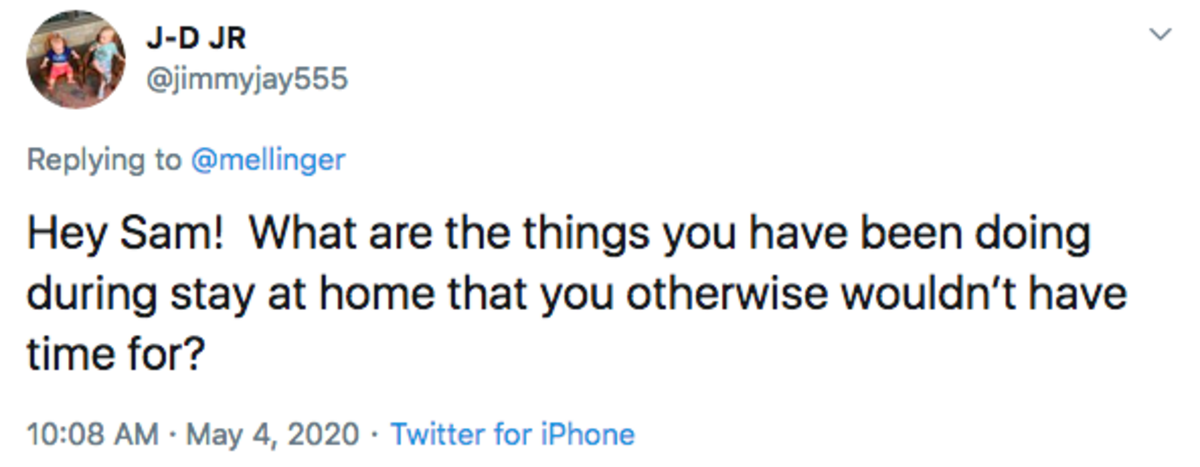
I hope I can say this without being obnoxious, but other than not traveling and not having Royals games to cover I’m not sure I have a lot more time, at least during the week.
The work is still there, even if it’s vastly different than before. This weekly timesuck is still doing about 6,000 words a pop, and taking up my Mondays. I’m still writing, still reading, still making phone calls. Our kids aren’t as self-sufficient as they’ll be in a few years.
Purely in terms of time, my schedule is more regular now, without games at night or on the weekends. That’s not the worst thing in the world.
So I’m probably like most parents. The biggest difference is more time with the kids. The two boys were signed up for a total of five teams, which I knew even at the time was too much. I was going to coach one of them, and help with a few others, and was looking forward to it.
But I also know at some point it would’ve felt like too much, that there would’ve been a Saturday where we just wanted to go to the park or hang out or ride bikes instead of put on a uniform for another organized sport.
So, being fully in charge of most of my weekends has been really cool. That’s a significant change. The other day, we loaded the car with bikes and baseballs and went to a park to ride and swing. Even in real time, I know days like that will be some of my favorites when I’m old and shrinking.
We’re sleeping more. All of us. Without school starting at 8, the mornings are on our terms. That’s nice. The other night, we let the kids stay up way too late but they slept past 10. It was amazing. There’s no way they’d have done that if they were still used to waking up early.
I’m in the yard more. With the weekends freer, I’m able to take another round with the edger, drop some more fertilizer, that kind of thing. The lawn usually looks like a goat track. At least right now, it looks pretty damn good.
I guess in general, there’s a slower pace that’s welcomed. Homeschooling — and I want to be clear that my wife does at least 99 percent of it — doesn’t have to start at 8. It can be 9, or 10, or really whenever. Being in control of little things like that is nice, and, actually, will be missed when we get normal back.
Hopefully this doesn’t need to be said but here goes anyway: this sucks, and the Internet doesn’t have room to list all the ways that it sucks. I also am plainly aware that I and my family have it good. None of us have been sick. We like each other. We like our house, and have easy access to parks.
Not everybody is able to navigate this crisis from such a position, and there is literally not one day that goes by I don’t think about that.
But I also believe a lot of life is making the most of what you have, and when this is all over I want to be proud of how I spent the time. So far, I think I am.
This week, I’m particularly grateful for a string of perfect weather. We’ve been able to play outside in comfort, eat dinner on the patio, and have a night cap or two by the fire. Lockdown would be a lot different in 100 degrees and humid.