
Harrowing tale, back in KC after Grand Princess trip: ‘Would you want me next door?’
The man’s name is not Mark, but that’s what he’s asked to be called for the purposes of this story. We’ll oblige.
He does not want his real name used for reasons that range from protecting his family to preventing his neighbors from panicking to a distaste for the idea that anyone would think he’s doing this for attention.
There may be a time that Mark will agree to use his real name. There is more to the story than he is sharing so far, and he has nothing but time to share it. The only reason he’s sharing this much is that the Kansas Department of Health and Environment held a news conference this week in which it was announced that he did not test positive for the novel COVID-19 coronavirus.
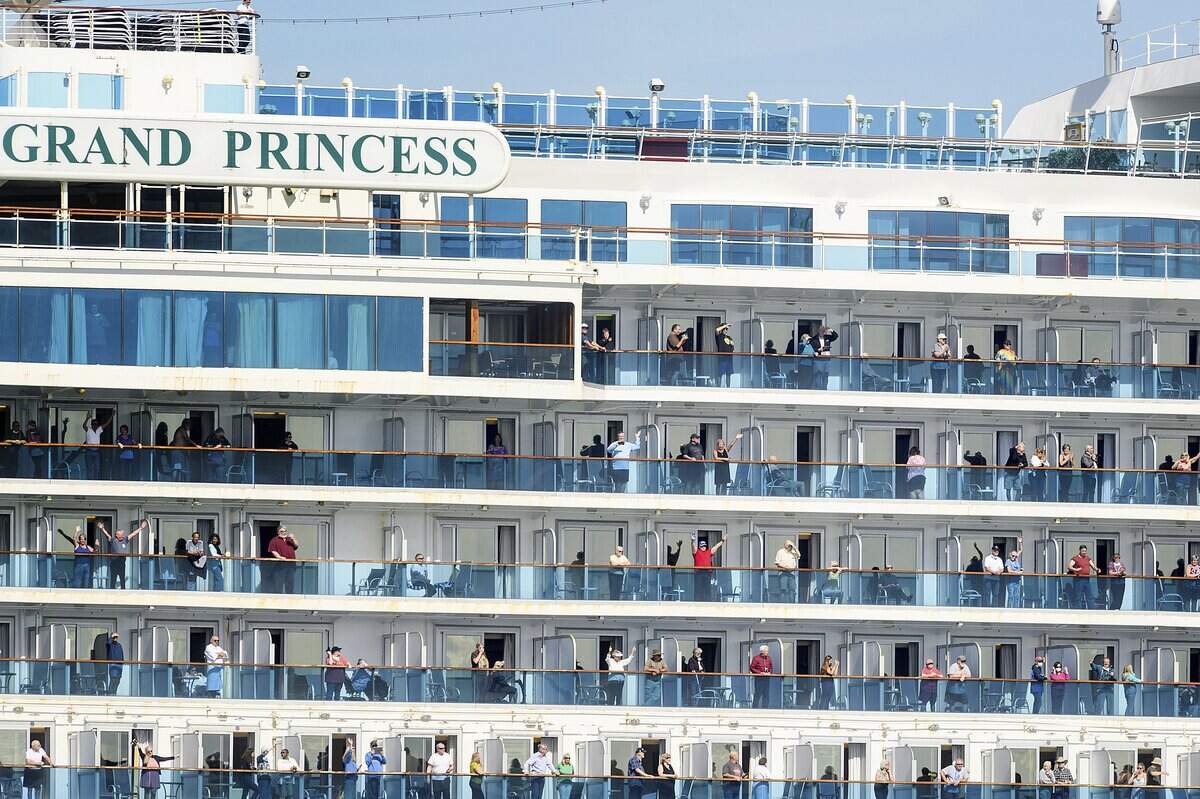
This is Mark’s surreal reality — he and his wife “Anne” (also not her real name) were on the Grand Princess cruise ship that dominated the news recently, weren’t tested until a day after leaving the ship, and are now quarantined at home in the Kansas City area.
Kansas City is where they heard their test results — not from a doctor, or through a phone call, but when KDHE secretary Lee Norman publicly announced that all 10 Kansans on the ship had tested negative.
“We assumed if we had (tested positive) that we’d be doing something different than we’re doing,” Mark said. “But it’s been an experience. There’s lots of mistakes, which is understandable. A thing of this magnitude, nobody can plan for it.”
You probably remember the Grand Princess, though it’s understandable if some details are dulled amid the constant spill of news these last few weeks. The ship was among the first places in which confirmed COVID-19 cases were reported, apparently a spillover from the trip that proceeded Mark and Anne’s.
Twenty-one of the ship’s passengers and crew tested positive. Everyone aboard was ordered to stay in their cabins. Vice President Mike Pence said all passengers and crew would be tested, but not enough tests existed for more than 2,000 people on the ship. At least six people in quarantine have since tested positive, and at least nine others have been hospitalized with symptoms.
In that way, Mark and Anne are lucky. The ship docked on March 9. Mark and Anne disembarked on March 12, then started a government-mandated quarantine the next day (Friday the 13th, as it happened).
After some fits and stops, they slept in their own beds for the first time this week. Not all of that cruise’s passengers are home yet and, according to various news reports, some have still not been tested.
“I’m referring to it as ‘you guys,’” Mark said. “But we’re getting more information from you guys from reading the Internet than anything else.”
Everyone on the ship has had a different experience, with a different story to tell. This story is Mark’s and Anne’s, and it’s full of frustrations. The ship’s restaurants did not close immediately after the first positive test aboard. Crew members did not change gloves often enough. Very little information was shared, even as passengers could see and hear helicopters flying overhead.
Lastly, and this one really sticks with Mark — passengers from California and Texas were given what he saw as preferential treatment.
“And, man, I’m sick to death for the people who were stuck in an inside cabin,” Mark said. “It was bad enough for us, but we had an ocean view and could see some of what was going on. Seven days in an inside cabin, man, our conversation right now would be very different.”
Mark and Anne, like all passengers, had to pass through a screening tent after walking off the ship in Oakland. They were asked about various symptoms and had their temperatures taken. They passed those exams, then rode a bus to the tarmac at the Oakland airport. They boarded a plain white commuter jet and had been given the impression they were headed to San Antonio.
Instead, they landed in San Diego. That’s where they were swabbed for the first time. The U.S. Department of Health and Human Services had arranged another flight for them the next day. They were told to be ready by 8 a.m., but various delays turned that into 2 p.m.
The plane carried 10 passengers from Kansas, around 15 from Nebraska and maybe 25 from Minnesota. They landed in Omaha first and, after a short delay when the plane lost power, flew on to Kansas City. Minnesota would be the last stop.
Upon landing, all passengers had to sign paperwork in which they promised to continue their quarantine. Mark and Anne then boarded a van, which took them to their car. A Kansas Highway Patrolman followed them home.
They are required to stay there until March 26 but plan to continue the quarantine a little longer, to account for the potential contact they had in transit.
“That sounds like I’m patting myself on the back, but I’m not,” Mark said. “My daughter just said, ‘I’m not touching you guys.’”
They had some stored-up frozen food at home anyway, and their daughter is making weekly grocery runs now. Rules are rules, and she’s particularly cautious with young kids, so the process is similar to what home delivery agencies are adopting. Mark described it as “dump and run.”
The food is placed on the porch, the doorbell is rung, and then they distance.
“She stops to see us through the glass door,” Mark said. “So that’s kind of emotional. Drops the groceries there, talks to us a little bit, and that’s it.”
Mark refers to their ordeal as “the trip from hell” but notes with dark humor that at least it was free. Princess refunded their fares and offered all passengers a free trip in the future. It’s a nice enough gesture, but Mark doesn’t expect they’ll use it or to ever travel to California again.
He turned 65 during this quarantine, which means he became eligible for Medicare in the midst of what will be remembered as one of the most infamous cruise trips in American history. The couple is still processing the experience. The emotions, too, including the uncertainty about whether they should even be home right now.
“Getting us home is great, don’t get me wrong,” he said. “I know people we were leaving there in San Diego were jealous. But in the end, is it really the right thing to do? Sending us back into our communities? I don’t know.
“I mean, would you want me living next door to you right now?”