
There’s a voice missing from Kansas City’s World Cup story
Eric Wahl began the trek to his first in-person men’s World Cup match from the familiarity of Pioneer Square, a half-mile walk to Lumen Field in Seattle.
He’d traveled along the same route several times, maybe dozens, but never like this. The road was so packed that his feet disappeared along the pavement, obstructed from view by those leading and those lagging behind.
He had boarded a plane in Kansas City at 6 a.m. Friday, in Seattle by 8 a.m., and, truth be told, he was exhausted by nightfall. But he wanted to be present for someone who could not be.
His brother.
Grant Wahl, a prominent soccer writer and Shawnee Mission East High School graduate, died while covering the previous FIFA World Cup four years ago in Qatar. An autopsy later determined the cause of Grant’s shocking death, at just 49 years old, to be a ruptured ascending aortic aneurysm.
His absence is palpable in a hometown that secured the World Cup six months before his death, in a country whose soccer stories he so beautifully told and in a world that sometimes preferred he not dig where he always brought a journalistic shovel.
But his presence was palpable here, with Eric, on a half-mile jaunt in Seattle.
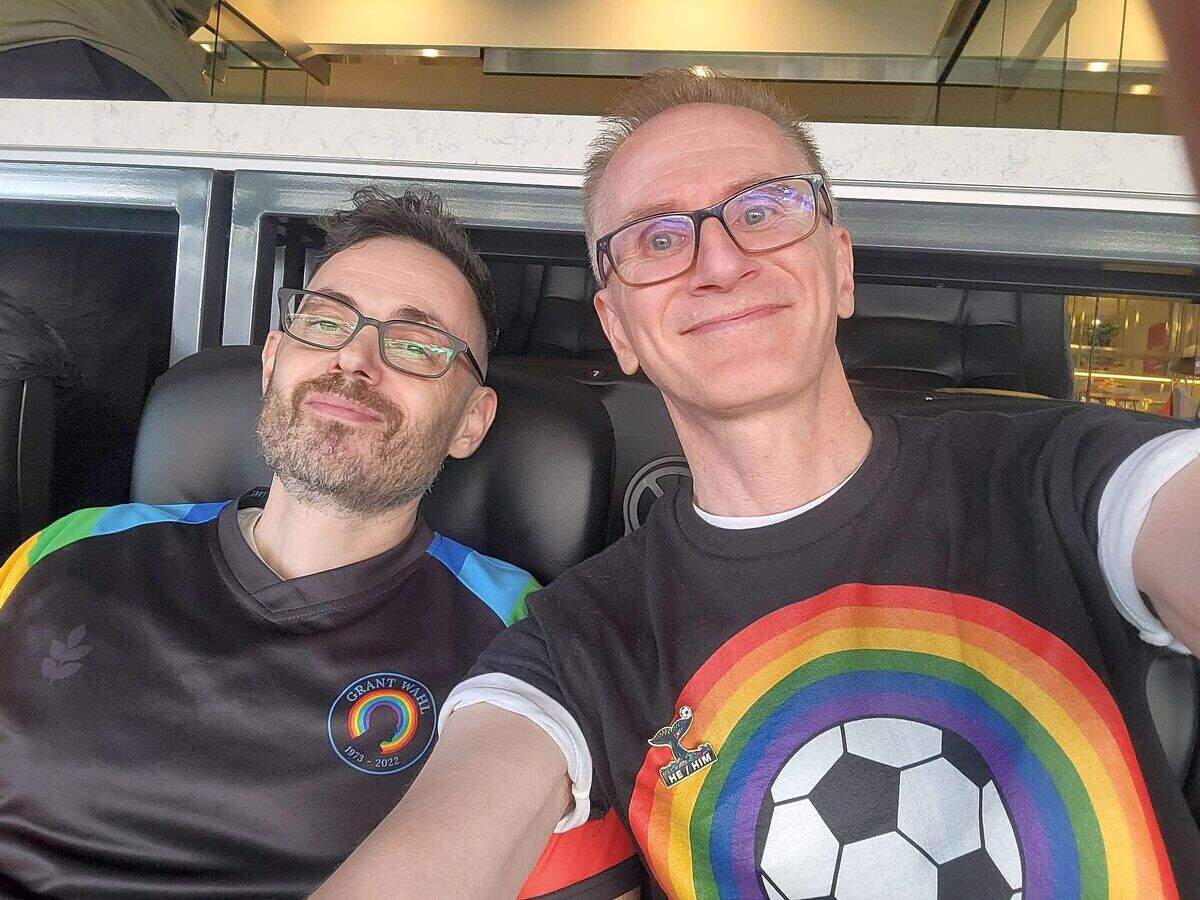
Eric attended Friday’s match in Seattle between Iran and Egypt, a Pride match, along with his ex-husband. He wore a Pride shirt there, a soccer ball enclosed by a rainbow — nearly identical to the shirt Grant wore just a few days before his death.
The attire had caused a stir in Qatar, a country that criminalizes gay relationships, and Grant was even briefly refused entry into the match. But the stir was part of the point, or at least a willing consequence.
Dressed in a version of the same shirt — which he’d actually urged Grant to think twice about wearing in Qatar — Eric didn’t encounter pushback in Seattle but something contrasting. He was surrounded by Iranian flags, Egyptian fans donning King Tutankhamun headdresses and people who had made entire outfits out of their nation’s colors — all mixed among Pride flags.
This, he reflected, is why Grant wore the shirt.
“Those kinds of experiences in what feel like shared jubilation — that was always the bedrock of why Grant wanted to right about sports in the first place,” Eric said. “It was how we can transcend our differences through sport.
“All the things I’ve heard from Grant, I now have this experience, too. In that sense, it made me feel closer to Grant.”
In the days after Grant’s death, Eric shared tales of his life. Those memories prevail, but so does his influence.
In Seattle.
In Kansas City.
The vibes have been terrific in the city he once called home — in the city he ironically needed to leave in order to cover the sport. At long last, it returned to his town at its pinnacle.
As he spoke, Eric sat in his home office, overlooking the Fan Fest in downtown Kansas City. It’s funny talking to him about his match experience Friday, because while he’s a huge soccer fan, it took him 20 minutes before he even mentioned the game.
You know, I pointed out, that’s how Grant shared his stories with the world.
“Exactly,” he said.
Grant would have loved telling the story of Curaçao earning its first-ever World Cup point with a draw against Ecuador at Arrowhead Stadium, Eric figures, perhaps even more than a hat trick for Lionel Messi just days earlier — but he just might have been the journalist who could talk his way into dinner with Messi at a Kansas City BBQ joint.
Or, more likely, he would have been tackling the national topics that have been the undercurrent of so many World Cups, this one not among the exceptions.
The World Cup was a vehicle Grant used to drive conversations about topics bigger than sports yet woven into their very fabric. The brothers bonded over the game, but in his work, Grant so frequently provided a microphone for the voices a powerful organization would rather hush. Days before his death, he wrote once more about migrant workers and human rights violations in Qatar.
That’s what we remember.
His brother remembers everything.
Over the weekend, Eric drove past the Seattle home Grant and his wife, Celine, used to occupy. He drives past their childhood home in Mission occasionally, too. The last time he saw it, a Pride flag waved from the house. He needs to hear that backstory.
Eric regularly sees the memories, or ghosts, as he refers to them.
In Mission, two black rectangles are staked into the ground. They are inconspicuous to most, but deeply meaningful to at least one.
As a kid, Grant was an Eagle scout, and essentially built a historical trail after discovering pioneer grave sites. He worked with a metalsmith to make metal stakes, with a local sign-making company to attach signs to the metal and with a local printing company to make pamphlets to correspond to what he’d found.
Over time, the signs fell out of their holsters. But the black rectangles remain staked into the ground today.
As traffic races past them every day at 40 miles per hour, Eric drives by there every week or so, easing on his accelerator to better study them.
There are reminders of moments in time.
This World Cup has offered reminders of a feeling.
“I just feel Grant so much during this World Cup — in a way that I thought was going to make me more sad than it has,” Eric said. “I don’t feel sad. I feel proud.”
He wants to chase that feeling again. He plans to attend future World Cups.
He already has a shirt picked out.