
KC voters rejected downtown baseball once. The Royals need to remember why
AI-generated summary reviewed by our newsroom.
- Council pledged up to $600 million and no new public vote will be required.
- Ordinance identifies Washington Square Park and lets the city manager negotiate.
- Council wants community benefits agreements, greater transparency before final approval.
The back-and-forth discussion spanned a dozen minutes before 11 of 13 city council members metaphorically raised their hands, pledging up to $600 million to the Kansas City Royals for a downtown baseball stadium.
The overwhelming vote represented a major step forward in a conversation that has frequently stepped sideways, or even backwards.
Their overwhelming vote, anyway.
There won’t be a public vote required to earmark the $600 million contribution to the Royals — rather, there won’t be another one, we should say, because Jackson County residents turned aside an April 2024 proposal that would have shifted the Royals downtown.
This project is different from the failed Crossroads District proposal vote two years ago — in its funding mechanism, amount and reach, in its literal location and perhaps most notably in the fact its stadium footprint does not include displacing local businesses.
But that brings us to the element of this process that still needs to be different.
The next steps.
The Royals haven’t publicly committed to the project — which identifies Washington Square Park near Crown Center as the stadium location — though they’ve more than hinted that it mirrors their preference. Two team presidents sat inside the council chambers as the ordinance passed, more than a gesture of appreciation. For now, the ordinance grants the city manager the authority to negotiate a term sheet, lease and development agreement with the Royals.
But if Washington Square Park is indeed where this turbulent half-decade ride concludes, the Royals would need to remember why it was a turbulent ride.
This entire conversation might have concluded two years ago if the voters whose support the Royals required hadn’t viewed the details as a combination of absent, confusing or shifting. Did Kansas City altogether turn its nose up to downtown baseball two years ago, or did it reject a half-baked plan that rushed to the finish line without breaking the tape?
The lack of a county- or city-wide vote now should not absolve them from authoring a more transparent, detailed and community-first project. It should only reinforce that responsibility. That’s if the team jumps at the Washington Square Park project. The city will first look to obtain a “yes” from the Royals.
We would all then hope for answers to a lot more questions over the ensuing weeks and months — from both the team and a city that would still owe its residents full financial details, term sheets, a lease and a replacement for the park and its memorial that will be axed.
The Royals cannot merely suggest downtown baseball will revitalize, energize or augment the city. They would have to prove exactly how — because studies have refuted the idea that a stadium’s presence alone is an economic driver.
How would they connect their development to the rest of the city? How — and how much — would they invest of their own money? How would they embrace a community benefits agreement?
A potentially important, or at least clarifying, amendment was added to the ordinance Thursday — that any potential development and community benefits agreements (CBAs) will have to come back to the city council. So while the Royals haven’t made their final decision, there are agreements that would still require public discussion and local government approval, too.
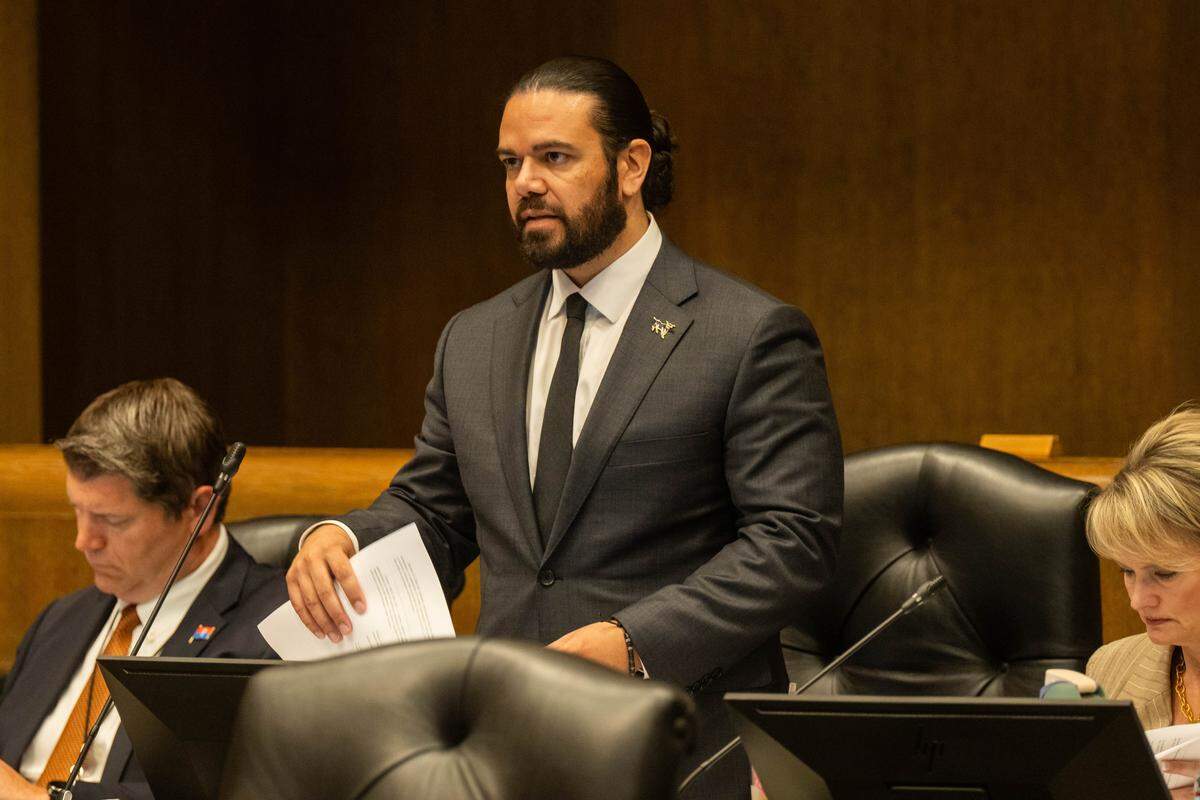
Johnathan Duncan, councilman for the Sixth District, proposed the addition. I asked what he’d like to see included in a potential CBA, and this part of the conversation ought to sound familiar to two years ago:
• If the ancillary development includes a hotel, as the Royals have proposed in past location renderings, he wants it to provide those workers a living wage and the right to organize a union. The same rights would go for other ancillary development, such as retail and restaurant employees.
• If it includes apartment complexes or other housing, Duncan is insisting those contain substantial affordability requirements within them.
Experts of community benefits agreements also advocate for other items, including minority and women business enterprise goals.
As of Thursday, the Royals might have just been gifted an opportunity to fulfill their original vision, though they’re still seeking significant state contribution and potentially county contribution. But they’ve also been gifted an opportunity for a public perception reset.
It’s not yet clear how far-reaching they would pursue a surrounding ballpark district in a space that at first glance is tight. But no matter what is built, they would need to bring a couple of things they failed to deliver two years ago:
Details.
Public clarity.
“They have to be more transparent,” Eric Bunch, councilman for the Fourth District told me afterward. “It’s paramount.”
Duncan, who voted in favor the ordinance, said he’d spoken to five neighborhood meetings in the past eight days.
“Every single one of those meetings, they have asked for more transparency,” Duncan told me. “People want to know what’s going on. They want to know how their tax dollars are being spent, and they want a clearly-identified public benefit for the use of those tax dollars.
“I think it’s incumbent on the Royals to provide that, and I think part of that includes what is (the) vision for this downtown ballpark and any ancillary development around it, and how are we going to see that public benefit come to fruition in that vision?”
Two years ago, the voters held them to that standard.
The council now holds that responsibility — and they should hold them to that same standard.
The chambers Thursday were jam-packed, with progressive advocacy groups who were vocal inside the room and grew even louder outside its doors after the council’s collective decision. Dressed in red T-shirts, they held signs showing the results of the failed Jackson County-wide vote in 2024.

That isn’t the only resistance.
It was just three weeks ago that Royals owner John Sherman revealed a team-issued survey last fall showed the majority of their fans preferred they stay at Kauffman Stadium — their home for more than a half-century — rather than move at all.
The Royals might not need to win a public vote this time to relocate downtown.
But they should still feel the need to win over the public’s support.