
Why the Chiefs signing Kenneth Walker could signal a big offensive scheme change
AI-generated summary reviewed by our newsroom.
- Chiefs signed Kenneth Walker to fix a run game that ranked among the league's worst.
- Walker's under-center success implies KC should reduce RPOs and adjust scheme.
- Team committed three years/$45M, marking big financial commitment to run game.
Half an hour into the NFL’s quote-unquote legal tampering window, the Chiefs reeled in the biggest fish of their free agency plans.
A running back.
They will pay darn near top-of-the-market money for now-former Seattle running back Kenneth Walker, a month removed from his Super Bowl MVP honor, locking up a position you’d rather not be allocating darn near top-of-the-market resources to acquire.
Why?
That’s a multi-year explanation disguised as the expedience of the half-hour rush that came Monday.
The Chiefs had to do something after employing just about the worst run game in football last year, other than Kareem Hunt’s short-yardage success — they were dead last in explosive yards from their backfield, and they ranked bottom-five in missed-tackle rate and yards after contact.
They were backed into a corner to find a way to make defenses respect their run game, which might just be the best way to fully unlock Patrick Mahomes and their passing game. Actually, to be clear, they backed themselves into that corner because of what they did over the last two years — or, rather, what they failed to do. They should have addressed the position in the middle of last year’s draft, a class flush with running back talent.
Alas, as a flurry of NFL signings unfold this week, it will provide yet another reminder that free agency is not the ideal time to solve major problems, because you never find major discounts.
That’s how the Chiefs arrived here.
But where are they going now?
That’s the most intriguing question after they gave Walker a contract that will pay him up to $15 million annually, behind only Saquon Barkley and Christian McCaffrey. Price aside — and the initial few hundred words of this column didn’t exactly put price aside — Walker clearly has some things the Chiefs did not.
He’s explosive in the running game. And he can make people miss.
Walker, clocked as the third-fastest back in the league on average, was sixth in the NFL with 33 carries of 10-plus yards a year ago. The entire Chiefs backfield totaled 23. Walker, 25, forced 61 missed tackles, per PFF data. The entire Chiefs backfield forced just 49. Walker ranked fourth in missed-tackle rate, and Isiah Pacheco was 51 of 52 qualified rushers.
He’s different.
But the next step for the Chiefs is to ask themselves a question that has already come up multiple times inside their building:
Why is he different?
It’s the talent. But it’s the scheme, too.
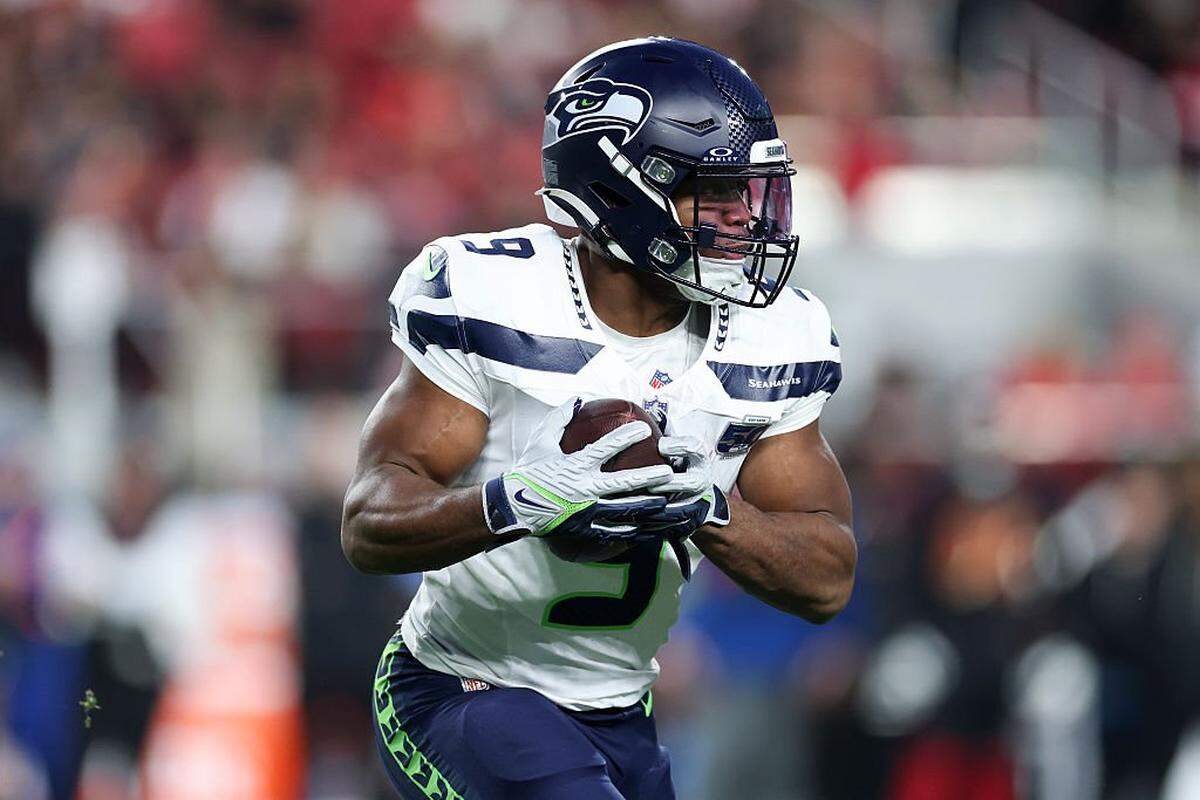
A three-year contract changes the former. The Chiefs just signaled a willingness to change the latter.
In 2025, the Seahawks certainly had a desire to run the ball more frequently than the Chiefs did. But they also had a desire to run it differently.
Walker carried the ball 172 times on under-center formations, per data from Sports Info Solutions. Kareem Hunt led the Chiefs in under-center rushes. His total: 72.
And among those team-leading 72 carries on under-center formations, 20 of them came on third- or fourth-and-short. And nine more were goal-to-go spots. The situation, not the scheme, dictated 40.3% of Hunt’s team-leading total, in other words.
Walker, by contrast, carried the ball on under-center designs 171 times on first and second downs alone, more than three times the amount of any Chiefs running back.
The Seahawks did it by preference, not strictly by circumstance, and it became their most successful option. Walker ranked fourth in the NFL in points earned from under-center rushes, per SIS data.
The Chiefs didn’t have anyone in the top-30 in that stat.
They hardly tried.
They instead used RPO (run-pass option) calls as their primary method for running the ball. Hunt and Pacheco combined for 125 carries derived from RPOs — the most among any duo in the league. They both ranked in the top-eight in RPO attempts.
Walker had 14 carries for 20 yards on RPO play calls.
That’s it.
The Chiefs are changing who will be running the football — and, ideally, how they’re running the football.
Or at least they better, if they want to take advantage of the skill-set of the player who will cost them $45 million over the next three years. (You don’t spend $45 million without knowing what has made the player great.)
It would make far less sense to ask Walker to completely change what’s made him successful than it would for the Chiefs to change something that has driven so little of their success.
Walker spends more time in the backfield than literally any other running back in football, per Next Gen Stats. He isn’t exactly a straight downhill runner, averaging 3.19 seconds to cross the line of scrimmage, highest in the NGS decade-long era.
He’s different than what the Chiefs employed a year ago.
The Chiefs needed a different talent. But they also need a modification to the running scheme.
They just took care of the former.
The latter awaits.
This story was originally published March 9, 2026 at 3:06 PM.