
The K-State football job ought to be attractive. Let’s remember the reason why
AI-generated summary reviewed by our newsroom.
- Chris Klieman succeeded Bill Snyder, led K-State seven seasons and improved the program.
- Klieman preserved Snyder’s culture, introduced his own identity and sustained the program.
- Athletic director Gene Taylor said he’ll start a national search as he faces pivotal hire
In a black suit and purple tie, Chris Klieman opened his Kansas State tenure with a typical mention of appreciation for the opportunity before him.
But just 70 seconds into an introductory speech, he turned to his right, looked down to the front row and acknowledged the real job he had just accepted.
“Coach Snyder,” he said, “you’re a legend and you’re an icon. You are Kansas State football.”
Yes, that was the task — he was replacing that guy.
Klieman would spend the ensuing seven college football seasons driving down a highway named for his predecessor, passing by a statue of his predecessor outside the stadium and coaching in a venue named for his predecessor.
And on the other end of it? He’s leaving that program better than he found it.
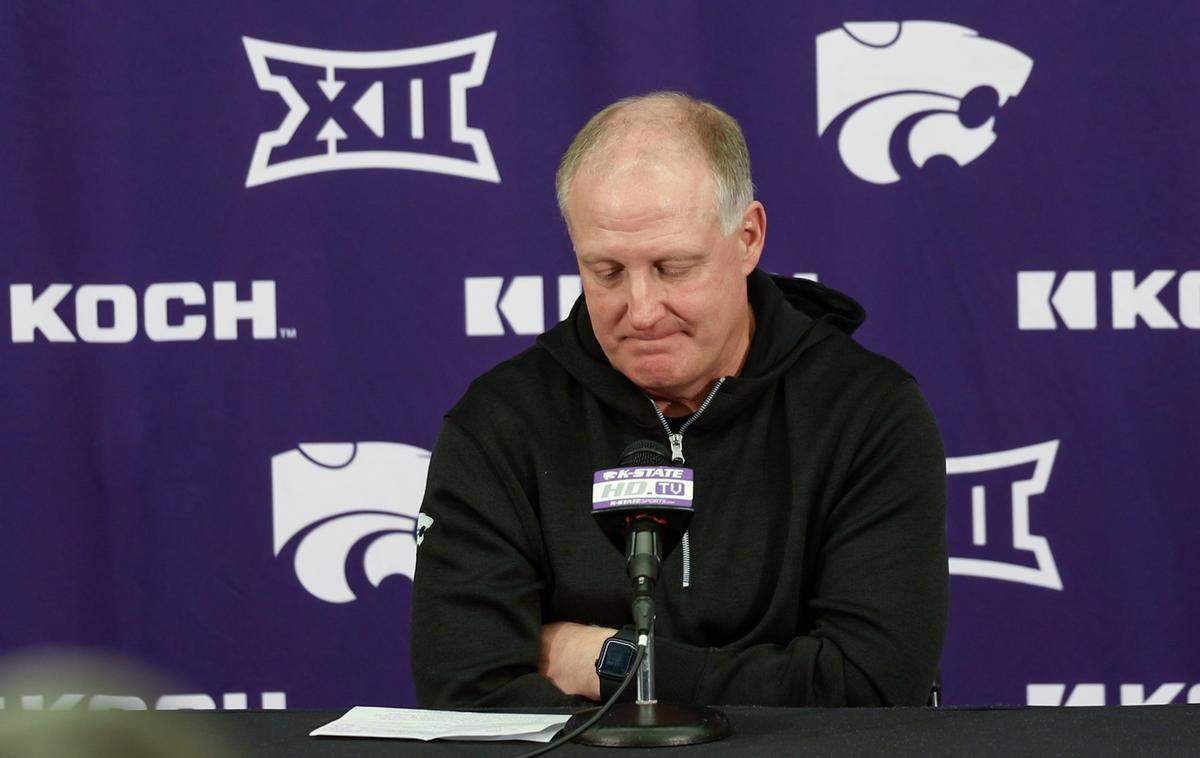
Seven years later, nearly to the day, Klieman returned to the podium as the subject of another major change. He is retiring from coaching, leaving the profession behind at age 58 for what K-State athletics director Gene Taylor called family reasons and the changing landscape of the industry.
Taylor said he has not “talked to anybody at all yet” about replacing Klieman, though the obvious link has been and will be former Wildcats quarterback Collin Klein, the Texas A&M offensive coordinator.
Klein, 36, has never been a head coach, but he is a fast up-and-comer whose offense is not only Big 12-proven but SEC-proven. It will be difficult to find a qualified coach more familiar with the program than someone who quarterbacked the team to a conference title in a Heisman Trophy-finalist season and later returned as its offensive coordinator.
There are more than a few signs, in other words, that point toward Klein being the right hire at the right moment, though more time will prove the validity of that belief.
But time already has proven the validity of another:
Chris Klieman was the right hire.
Klein would be a popular choice as his replacement, if not an obvious one. But whatever you thought of Klieman stepping to that podium seven years ago in his purple tie, there is one thing it was most certainly not.
Obvious.
“People thought I was nuts,” Taylor recalled, “because I hired my drinking buddy from Fargo, North Dakota.”
They plucked him from the Football Championship Subdivision (FCS), a job that seven years later might feel closer to a different profession altogether than the one he vacated Wednesday. He wasn’t just unproven at this level. He was altogether inexperienced in it, and, turns out, stepping into an environment so few knew.
And he won.
“I took this job with little to no Power-4 experience,” he said Wednesday, without taking questions, “but I had a guy who believed in me.”
It would be too simple to say Klein might just fall into Kansas State’s lap as the next man up, because that overlooks the foundation that needs to be in place in order to make a gig attractive in the first place.
But here’s the point: Klieman is a major reason for that foundation. And he is therefore a major reason for that attraction.
It wasn’t apparent that Kansas State could consistently win without Bill Snyder, because, well, they hadn’t consistently won without Bill Snyder. They tried it once, and after a three-year hiatus they asked him to return and resurrect it all over again.
“Everybody said,” Klieman recalled of following Snyder, “’Don’t want to do that.’”
K-State needed someone to stabilize the program.
They got more than that.
This is quite evidently a program that was built by Snyder. But as the highway and stadium names endure, it is now a program that accomplished what it might not have otherwise a decade earlier.
It has survived his departure.
That is a significant step for its long-term health, and Klieman guided that stride. The disappointment of this season — and there ought to be plenty — is not nearly enough to wash away the 2022 Big 12 championship, the school’s first in a decade and its first absent Snyder since 1934.

Klieman’s legacy will not be based on one year, because the program’s long-term health is dependent on more than one trophy. It will be his consistency: The Wildcats were ranked at some point in every year of his seven-year tenure. They won at least nine games in three straight seasons and at least eight games in four straight. They are headed to a bowl for the sixth time in his seven seasons.
The appeal of the job vacancy in Manhattan today, in 2025, mirrors the success of the man who held it for the last seven years — during the most turbulent time the sport has experienced.
Klein is building the resume of a man who has options and could soon have more of them. Klieman ensured Kansas State stayed a pretty darn good one.
In a news conference confirming his own departure, Klieman called the man he succeeded the greatest coach in the history of college football. There would be some debate on that, to be sure, but it’s quite obvious Snyder is the best coach in K-State history.
Taylor warned him of that years ago, in a conversation in Fargo as they discussed the job. It was a risk he felt necessary to mention, but Klieman had just succeeded a coaching legend at North Dakota State who’d won three national titles.
Klieman followed by winning four of the next five.
The risk wasn’t one-sided, though. The K-State part of the decision was met with skepticism.
“He not only built on Coach Snyder’s culture — he put his own mark on it,” Taylor said. “I think he’s done it with class and dignity — and won.”
“A lot of people didn’t think an FCS guy could do (it).”
He did. Consistently.
That sets up the future.
In a profession that demands the best possible answer to one question — what’s next? — let’s not forget the reason for what’s yet possible.