
Sporting KC’s sticking with Vermes, but owners say they’re not scared to make a change
A glass door swings open, an avenue to the office of Sporting Kansas City principal owner Mike Illig. He sits alongside a conference table, flanked by team president and CEO Jake Reid.
This is not my first visit to the space, but it is a markedly different visit. One past meeting touted the pursuit of a star player, another a facility that’s a cornerstone of the organization.
This hourlong conversation — literally all of it — delves into what has gone wrong with Sporting for the past 15 months, and whether that examination could necessitate a significant change. As of late, Sporting’s ownership group has sat inside this very room or others like it, asking themselves that same question.
How did they get here? It was only only five years ago, after all, that MLS commissioner Don Garber walked into a new state-of-the-art training facility and referred to Sporting as “very much a model” for the entire league. The man in charge of the wins and losses in Kansas City — the one whose future Sporting owners have discussed more than they ever cared to — owns some major responsibility for that label.
Yet today, with one win, seven losses and three draws, Sporting KC occupies last place in the Western Conference, same as it has for several weeks now, same as it did for much of last season. In the team’s most recent home game, a 2-0 loss to Montreal, the frustration became not simply implied but visible and audible. Fans booed the players off the field. Twice. They chanted for manager Peter Vermes’ job. Over and over again.
“It is embarrassing,” Illig said. “I’m embarrassed.
“But I’m sympathetic to our own situation for why we’re in this hole.”
That last part came with an explanation repeated throughout the hour, one you’ve undoubtedly heard before. But I know why you’re here, so let’s talk about it.
Vermes.
His future.
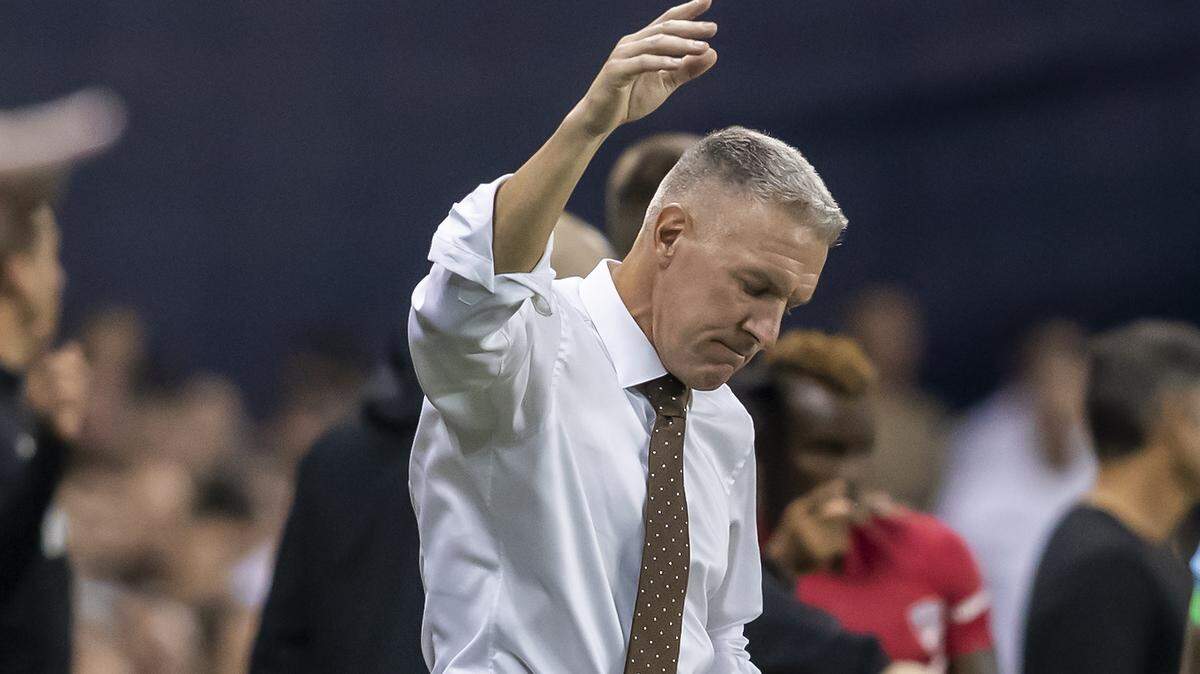
Sporting KC is not firing Vermes, but a date should be applied to that sentence, because ownership has considered a coaching change, and that consideration is not a thing of the past but rather put aside for the moment.
Ultimately, internal discussions incorporating wide-ranging analytics have led to the same landing spot — they’d like to see Vermes guide a team absent the injuries to star players. And then evaluate the full picture.
If you’ve come here before, you already know what I think of the injury situation. But first the full initial response from Illig:
“I agree with all of the fans’ frustration, and it’s unbelievably exhausting to keep talking about injuries,” he said. “That frustration is only going to grow, and at some point someone’s got to be in the crosshairs. But if the guy’s actually really frickin’ good at his job, and he doesn’t have the tools in his toolbox, that’s not a fair evaluation.”
While the statistics do supply some merit — there is a history of this team, led by this coach, producing results with the full complement of the roster — that reasoning runs counter to the past notion that Sporting KC was a club bigger than one or two players. I’ve pointed that out in past writing, though when I pointed it out to Illig, he noted that striker Alan Pulido’s $8 million transfer fee and midfielder Gadi Kinda’s $4 million fee dwarf what the club has paid on all of its other transfers combined. Not all absences are created equally, in other words.
Point taken.
But even so, if those two absences supply a valid excuse for not being at the top of the standings, they don’t warrant being at the very bottom. It would be an oversight to think that injuries are the only culprit in the record. At the very least, we can factually say that Sporting has not responded well to its situation. That’s why they’re here. And that’s why we’re here, having an uncomfortable conversation.
But what’s most relevant now is that excuse is gone, with Pulido and Gadi back in the lineup as of last weekend. And therefore, yes, that places in the crosshairs those who continue to use injuries as a rationale. The evaluation must change considerably.
Nobody involved, at least nobody to whom I’ve spoken, disagrees with that. Not Vermes. And certainly not Illig.
“This is a results-oriented business. The results are not up to standard,” Illig said. “But we know why that is. And in the event Peter demonstrates he cannot deliver results with a full toolbox, we have no problem making a change there. And he knows that.”
We’re going to delve deeper into that, but let’s take a step back and recognize the uniqueness of what Illig said.
One of the owners of a professional sports team is publicizing that a coach is essentially on the hot seat. Those are my words and my phrasing, but it’s not my assumption.
The longest-tenured manager in Major League Soccer is coaching under a scrutiny he’s never before experienced, particularly now that he’s managing with a full deck again. While that’s often the case in sports, it’s quite infrequent that the world knows about it.
That’s not news to him.
“We’ve had some tough conversations about the trials and tribulations of where we are,” Illig said. “He’s been the driver of those conversations, like, ‘Listen, I know it’s not good enough. You gotta do what you gotta do, but I’m not giving up.”
The response: “OK, we’re not (giving up), either,” Illig said.
Don’t mistake that for tolerance. The stretch has not only tested ownership patience but worn it nearly thin, injuries or not.
Sporting is 12-23-10 over the past two seasons. The record is abysmal. You don’t need me to tell you that.
But Vermes isn’t a coach whose resume is strictly the struggles of the past 15 months. He is a coach who has delivered four trophies (one MLS Cup, three U.S. Open Cups) and guided the club to eight consecutive playoff appearances ... and then struggled over the past 15 months. That often seems to be lost in the conversation, and lost in the “Vermes Out” chants. But I digress. Or then again, maybe I don’t.
The point is if the leash seems long, well, he’s earned one. Let’s not compare it to the Chicago Fire canning their coach after less than two seasons.
Sporting’s task is to address whether the guy who has been the right man in the past, which should be without debate, is the right man for the future, which has been debated within their own walls. The track record is enough to buy some time, but not eternity.
They want that answer to be yes, by the way. It’s not as though ownership is waiting on him to fail. The decision to stick with Vermes derives from the hope, and the belief, that he is capable of steering the ship north.
It’s a fine line between hope and belief, isn’t it? That belief comes from that aforementioned track record — but maybe too from the hope it would follow the most optimal outcome.
The truth is an in-season change would not be immediately fruitful, other than perhaps being emblematic of a point Illig wants to illustrate: that the ownership group has not altered its standard. (It’s harder to illustrate that point when the guy currently buried in the hole is the guy you’re hoping can dig you out of it — just months after you signed him to a five-year contract extension).
It would be as drastic a change as any team in MLS could make to move on from Vermes, given the multitude of roles he occupies. But it does prompt the question of whether he — or anyone — should occupy so many jobs as the league continues to balloon in size.
A yearlong tailspin has poured water through the cracks of old concrete, illuminating the dangers of putting so much on the shoulders of a single person. Sporting splits its operation under two CEOs — Reid on the business side, Vermes on the technical side. And for Vermes, that includes a receipt of responsibilities like player identification and acquisition, managing the team, overseeing the academy and the second team, and on and on and on.
The escape hatch, if it were to ever come to that, can be found at the end of a maze.
“So, ultimately, are we willing to walk in terms of Peter and making a change there? Would we? Well, if it gets to the point where he has a full toolbox and we’re not delivering results, we have to, right?” Illig said. “But knowing that we’re going to have reset on the whole strategy that we’ve got thousands and thousands of pages of playbook and documents on how to go to a different direction.
“Because right now, that all sits in one head.”
Illig said he has not spoken to Vermes about taking away only some of his responsibilities.
For years, Sporting owners met in the same office in a quiet Kansas suburb, outlining paths toward the future, knowing they didn’t have to worry about who would be in charge of implementing those plans on the technical side. In a later comment, Illig estimated it would require maybe three years to recoil the whole thing and start fresh. But that’s by Sporting’s own design.
Illig said other ownership groups have told him in the past they are envious of Sporting’s position, given their own disconnect and constant disagreement between technical directors and head coaches.
That all works when things are going well. But couldn’t some disagreement and debate be healthy at a time like this?
“Sure, absolutely,” Illig replied. “It can be.”
Recently, he did seek other opinions: Those of the players.
Illig said he spoke to several privately, unscheduled, and asked them about Vermes.
“They’re adamant that it’s not about the guy who’s at the helm,” Illig said.
And the players are still confident in him?
“Hell, yeah,” Illig said, emphasizing that twice for effect. “That’s one thing I have to make sure of, right? If Peter’s lost the team, it doesn’t matter. If they’re not going to show up for the guy, then what the hell is the point of keeping him?”
Albeit less tersely, that’s the question driving the current state too. It’s the answer that reverts back to the top of the conversation.
Sporting KC is 13-3-4 in the regular season with Pulido and Kinda in the starting lineup. The team averages better than 2 goals per game.
Both are back. In their first regular season start together in a year and a half, Sporting beat top-of-the-table Seattle, and on the road, no less. Was it an aberration, or is it proof that the injuries were all that’s to blame?
Everyone involved would prefer the latter.
But some need it to be.
In a very real way, every coach or manager in professional sports is fighting to keep his or her job. It’s just always been assumed with Sporting the guy in charge has won his fight.
Vermes has called his roster not just a good group but a great one. This evaluation, in that case, would happen to coincide with the metrics of his choosing, would it not?
We closed like this: What does ownership want to see over the remainder of the season to keep everyone in place?
“It’s going to sound simple, but results,” Illig said, before pointing at a screen in front of him, showing Johnny Russell and Daniel Salloi celebrating a goal. “That face right there — seeing guys have fun, enjoying themselves out there.
“And getting results.”