
Eyeing playoff return, KC Royals are all-in on No. 1 prospect Bobby Witt. Is he ready?
The first pitch zipped past him, and 20 seconds later, the next. On a sunny March afternoon in Surprise, Arizona, Bobby Witt Jr. left the bat resting on his shoulder.
For the moment.
The top-ranked prospect in baseball is not an imposing figure in the box — think more Whit Merrifield than Salvador Perez — but don’t let that fool you. This is the man who, at times last season, became the talk of a Major League Baseball clubhouse he had yet to enter. Whose spring training home runs spark tweets from Patrick Mahomes. Who can make or break a farm system and return the Kansas City Royals to a playoff contender sooner rather than later.
Members of the Royals organization will insist their success this season pivots on other controllable features, but candidly, manager Mike Matheny cannot recall greater anticipation for a player’s big-league arrival, which will come Thursday at Kauffman Stadium. And Matheny, mind you, played on a team in St. Louis that welcomed the debut of Albert Pujols.
So on the third pitch of the at-bat, Witt finally launched his swing, torquing the barrel of the bat into the baseball before it ricocheted backward into the netting. A fan nearby, forgetting the covering in place to protect spectators from foul balls, braced for impact. Witt was behind in the count, 1-2.
He has played this game for as long as he can remember, and as the son of a now-retired 16-year MLB veteran, he’s known for just as long that he would someday be like his dad. The path here has been a smooth ride — so smooth that the Royals have spent more time this spring analyzing how to best mentally prepare Witt for failure because, darn it, at some point, he’s going to fail. He has to.
Yet this cannot fail. The Royals need a 21-year-old infielder to be great as much as they expect him to be. And they do expect it. A day earlier, a teammate pondered when asked to identify Witt’s best trait.
“Physically, he’s got every tool in the book,” Merrifield said. “What can’t he do?”
The at-bat in Surprise, one of Witt’s first of the spring, would span seven pitches. After the sixth, Matheny turned to a group of players and coaches nearby.
“This,” he said, “is probably going to get hit hard.”

Austin Pruitt, a 32-year-old pitcher for the Oakland Athletics, had baited Witt into a check-swing two pitches earlier, so on his seventh offering, Pruitt tried to sneak a fastball over the inner half of the plate. It stayed in the zone too long. So did Witt’s bat. That’s what so many are learning to love about his swing: It might be quick, but the barrel hovers over the zone longer than most.
It did here. Witt crushed a baseball into a flight that reached the feet of the scoreboard beyond the fence in left centerfield.
After a quick jog around the bases, he disappeared into the dugout, removed his helmet and approached a few teammates. Immediately, he began to replay what he’d just experienced.
Not the home run. The pitches preceding it.
“The spin of the ball,” he began, before embarking on a thesis about how the action of a pitch and the potential strategy of the man throwing it telegraphed what might be coming. This has become the norm with Witt, the undercurrent of conversations in the clubhouse.

“What is he, 21?” infielder Nicky Lopez asked, before receiving confirmation that Witt does not turn 22 until June. “I mean, when I was 21, I was just trying to see the ball and hit the ball.
“The conversations with Bobby are a little more advanced.”
The Royals were buoyed by their farm system once before, and not too long ago, really. The arrival of Alex Gordon, Eric Hosmer and Mike Moustakas — all top-10 prospects — preceded their World Series runs in 2014 and 2015. Correlation and causation.
Witt, however, is a different story. He is not just one of the guys.
He is the guy.
The great anticipation
Two years after purchasing the Royals, John Sherman is recognized around town a little more often than he used to be. These days, his conversations with fellow Kansas Citians — while shopping in grocery stores or eating dinner in restaurants — have shifted from his general plans for the team to a more specific topic.
When is Bobby Witt Jr. going to come up?
“I always say that’s above my pay grade,” Sherman jokes, deferring that verdict to team president Dayton Moore and general manager J.J. Picollo.
After Witt tore up the minor leagues last summer, Moore hears that question more frequently than any other. On airplanes. In hotel lobbies. Even in conversations with his family. His son, Robert, is a second baseman at the University of Arkansas, an MLB Draft prospect himself, but when he talks to his dad, he can’t help but ask about the 21-year-old Witt.
Is he going to make the team?
“I can’t tell you that,” Dayton will say.
“Let me just tell you,” Robert once replied, “if he doesn’t make the team, you should be fired.”
Dayton laughs as he shares the story, same as Robert did when he made the quip.
But there’s a connection there. Witt and Robert shared a baseball field together. That connection, actually, prompted some of the early attraction between team and player.

Robert Moore, who is nearly two years younger than Witt, played in a handful of the same showcase tournaments as Witt, albeit in different age groups. One weekend, Dayton Moore traveled to Florida to see his son play, but he couldn’t help but stick around to watch the 15-year-old who had been anointed the best freshman in the country.
And you think you’ve been waiting awhile to see Bobby Witt in a big-league uniform.
When the Royals open their season Thursday against Cleveland, Witt will start his career at third base, and the rest of the baseball world will begin to learn what Moore discovered six years ago: Witt has a chance to change every element of a baseball game.
He has a compact swing that generates power to all fields. (A couple of years after Moore watched him, he would win the high school home run derby preceding an All-Star Game.) His quick hands and feet make him an asset in the field and on the bases. His speed, in fact, has surprised some already in Arizona.
And he has room to grow.
What can’t he do? Well, as of now, he appears to be a player with few holes in his game. After a rare slump in the minor leagues last year — more on that later — he learned to cut down on his swing-and-misses and was named the minor league player of the year. He nearly had a 30-30 — 30 homers and 30 steals in the same season — but a rainout swiped away one of his stolen bases, and he fell one short.
By mid-summer last year, Royals players in the bigs were on their phones during flights across the country, checking to see how that kid in the minors was doing. They all have their favorite moments — a catch he made on a popup, his first-to-third gliding speed, that home run he hit that didn’t count.
“Bobby’s highlights seem to be popular,” Merrifield said.
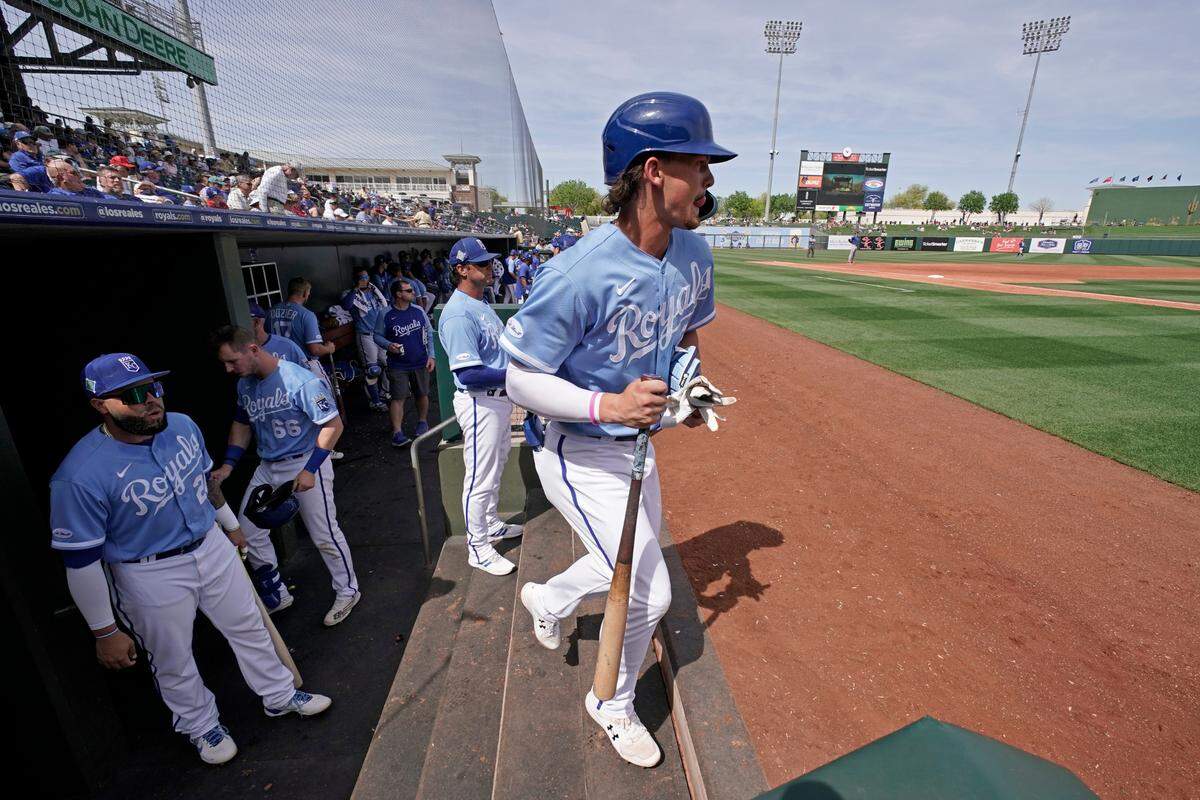
Witt has hit at every level — youth, high school, the club’s alternate training site during the COVID-shortened 2020 season and throughout his ascension in the minor leagues — except the one in which he’s about to embark. But that’s merely because he hasn’t yet had that opportunity. And now, very soon, he will.
The Next Big Thing in Kansas City is the Next Big Thing in baseball, shouldering his way into the sport’s youth movement. His arrival as a major-leaguer is among the most anticipated in the city’s history because it’s among the most anticipated inside the organization. There was not a night last summer that Moore put his head on his pillow without knowing how Witt had performed that day.
Asked last week if he receives more inquiries about Witt than any player in, well, ever, Matheny interrupted before the question was finished: “Yep.”
The Royals have surged back to possessing the fifth-best-ranked farm system in baseball, but one student is clearly at the head of the class. Moustakas and Hosmer essentially came up together, joining Lorenzo Cain and Alcides Escobar. Witt will arrive on his own this week, the spotlight brighter and its shine narrowed to one subject.
The Royals have not had this in their history, not really anyway. Gordon, then the highest-ranked prospect in the organization’s history at No. 2, debuted under the hope he’d be the next George Brett. The Royals, though, were not yet built to win.
They believe they are now.
Although they finished 74-88 a year ago, they were 38-35 after the All-Star break. They return the key pieces of their lineup and added Zack Greinke atop the rotation.
What they aren’t saying publicly: The No. 1 prospect needs to be part of the reason why they’re better. The Royals might like their lineup, but it does not come together without Witt’s bat.
“That’s something you celebrate as an organization — you’ve got the kind of talent that people recognize as unique,” Matheny said. “But does that automatically translate? The answer is no. Can some of that become a distraction? The answer is yes. So how do we guard him and continue to put him places we think he can be successful?
“In general, I think he’s primed to handle all of this. But it’s a lot. And it’s going to continue to be a lot.”
Which leaves us with this: Is he ready?
A lesson in failure
The greatest player to wear a Royals uniform stood adjacent to a practice field at Surprise Stadium last week and talked about failure. And not just in that sense that even good hitters fail seven times out of 10.
Actual failure.
George Brett hit .125 as a 20-year-old in 1973 and a year later was hitting .242 at the All-Star break.
In his own words, he stunk.
“It hits you hard,” Brett said.
Why? For Brett, this was a first.
He had never struggled in the minor leagues — an All-Star on every team for which he played. Now, for the first time, he doubted he belonged. As he drove to the park, he’d flip on the radio and hope the sportscaster didn’t list a tough starting pitcher for the opposition. On those days, he was an out before he even stepped to the plate.

“Everybody in this league struggles. Everybody. I learned that the hard way,” Brett said. “Bobby Witt, I think he’s going to be very successful his first year, but he’s going to struggle at some point. I think he’s got the makeup and the mentality to handle it, and we’re going to find out — because I don’t know if he’s ever struggled before.”
It’s a topic that comes up often among members of the Royals’ coaching staff. There are no certainties in this sport other than slumps. They will happen. Gordon and Moustakas, two of the best prospects the franchise had seen, returned to the minor leagues after enduring prolonged slumps in the big leagues.
How will Witt handle his first slump? His second?
“That’s a great question — it’s something we talk about. Years past, I was always concerned about the guy who’d had nothing but success all the way up,” Matheny said. “He’s going to get his lunch handed to him at some point. Every great player — you just mentioned George Brett — has had those periods where the game just handed them their lunch. You have to experience it at some point.”
The circumstances of their respective arrivals in the major leagues — Brett’s in 1973, Witt’s looming this week — are far from identical. Brett spent his teenage years playing the top competition in Southern California. He hoped he was ready.
Witt spent his playing the best competition in the country — and beyond. He knows he’s ready, Brett believes, even if he’s got a hell of a poker face about it. Witt played in showcase after showcase throughout high school. Travel ball before that.
He represented Team USA in the COPABE Pan-American championship. Took MVP honors after hitting for the cycle in the championship game. The father of M.J. Melendez, another intriguing Royals prospect, coached that Team USA squad.

“I talked to my dad as soon as we drafted (Witt), and what he was most impressed with was the way he had handled himself when things didn’t always go his way,” Melendez said. “He’s the same guy.”
And Witt’s journey to the majors hasn’t been completely unscathed, he will remind you. The Royals seriously considered putting him on their Opening Day roster a year ago before electing to keep him in the minors.
Recently, in a conversation with his father, Witt admitted that disappointment temporarily changed him. He tried to hit a home run on every swing. In a year in which he would be named the best player across all of the minor leagues, he initially struggled.
“He was trying to do way too much,” Witt Sr. said. “I think he finally realized that just going out and being himself was going to be good enough. He didn’t need to be someone else.”
The younger Witt took notes at the conclusion of that slump and stored them away for future use. He hopes he’ll never need them. But he knows that’s unlikely.
“I feel like you learn so much from failure,” he said. “You build off failure. Once you experience that, you don’t want to ever do it again.”
A lifetime of preparation
One afternoon during his senior season of high school at Colleyville Heritage in Texas, Witt walked from the on-deck circle to the batter’s box at rival Grapevine with a chant hovering over each step.
Over-rated!
Clap-clap, clap-clap-clap.
Over-rated!
By then, Witt had been dubbed a consensus top-5 pick in the upcoming draft and potentially the first overall selection. The Royals sent a representative to every game that year, making obvious their plans for the No. 2 overall pick.
The chants pre-dated and yet outlasted all of that. As a freshman, Witt was labeled the best player in his class by Perfect Game. Even earlier, he felt the spotlight of a father who pitched 16 years in the majors. Why wasn’t Witt Junior a better pitcher?
The attention he gets now, in other words, is more typical than unusual. It just comes at a different level. He knows that. The Royals do, too. As Moore put it, Witt is just going to have experience the big leagues for himself, the ups and the downs.
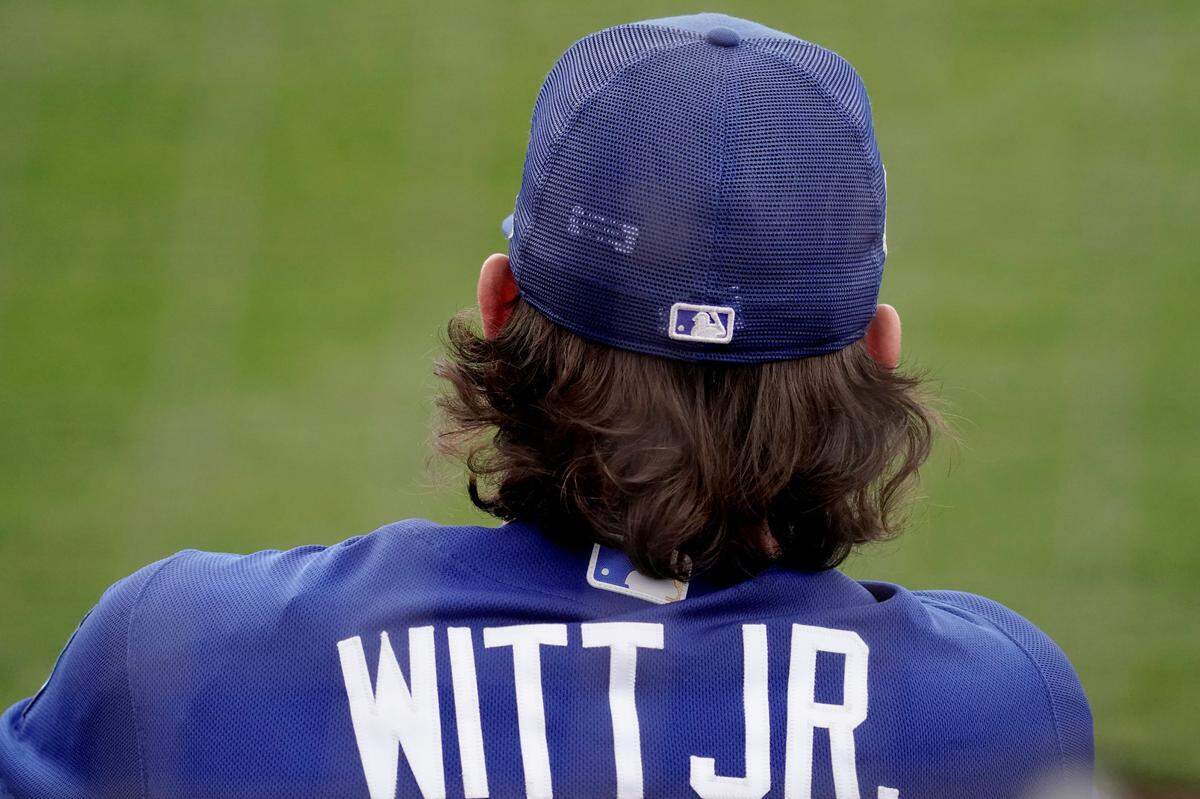
When it comes to Bobby Witt, there is much known. And there is still so much to find out. Much that can only be revealed once you put him in the fire. He seems as well-equipped as anyone to succeed, but the past can only provide so much preparation.
That doesn’t make it irrelevant.
Early in that at-bat at Grapevine, as the chants continued, Witt blasted a baseball over the left centerfield fence. You could hear the gasp from the crowd upon contact. His father stood and watched. As a player, Witt Sr. pitched with a certain intensity — an “amped-up guy,” he called himself.
His son is more laid back. He tends to take things in stride. It’s one of the reasons why he’s quickly endeared himself to teammates inside the Royals’ clubhouse. He’s not the guy coming to take everyone’s job. He’s a guy who can help them win.
“To be 21 years old and have the emotional maturity that you need to play this game is rare,” Merrifield said.
On this occasion, after it became clear the ball would leave the park, Witt reacted as he did to any of the 25 home runs he belted during his final two years of high school. He put his head down and jogged around the bases, displaying no more emotion than a casual high-five for the third base coach.
He reacted as though he expected the home run. As though he had hit one before.
As though there will be others.
How does top prospect Bobby Witt Jr. best fit into the Kansas City Royals’ lineup?
SportsBeat Live: Talking Witt, Whit and everything Kansas City Royals, watch now
This story was originally published April 7, 2022 at 5:00 AM.