
Peter Vermes’ connection to Hungarian soccer about more than signings, family stories
Commanding the respect of Sporting Kansas City coach Peter Vermes is a notable achievement. Hungarian soccer did that to him long ago.
The son of parents who fled the Soviet-occupied Eastern European nation during the Hungarian Revolution in 1956, Vermes heard tales from his father, Michael, who’d played for Budapest Honvéd FC. Many featured an immortalized, God-like figure and his dad’s teammate, Ferenc Puskás.
Widely considered an all-time great, Puskás was a magician of a forward who scored 514 goals in 530 appearances from 1943-66 for Honvéd and Spanish giant Real Madrid. Hungary’s national stadium is named after him, as is FIFA’s annual Puskás Award, bestowed annually to the player who scores the “most beautiful” goal.
One year, Puskás visited Philadelphia — near New Jersey, where the Vermes family lived at the time — on a U.S. meet-and-greet tour. Peter spoke fondly of the visit during a podcast last year. Peter had read about Puskás but dismissed his dad’s tales as overblown or exaggerated.
“Supposedly, Puskás was coming there,” Peter said on the podcast. “Me and my brothers are (sarcastically) like, ‘Ah, yeah, let’s see if this is real.’ My dad told us when he was a player that he had a nickname: They used to call him ‘The Crow,’ because he was kind of like the scavenger. (My father) was a hard player; he was always really fit and that was the nickname he had.”
Puskás was sitting at a restaurant table in Philadelphia, eating dinner and meeting people, when the Vermes family — Michael, Peter, his brothers — walked in. From about 15 feet away, Peter recalls, Puskás recognized his dad.
“He called my dad by his nickname,” Peter said, “which blew us all away, because we thought he was giving us good stories.”
Peter had often trained with Honvéd’s academy when his family returned to Hungary for visits. But his ties to Hungarian soccer are even more amplified now. Vermes has a copy of a Puskás autobiography on his desk, still follows the country’s domestic leagues and — perhaps most importantly to Sporting KC supporters — has plucked some good players from his family’s homeland.
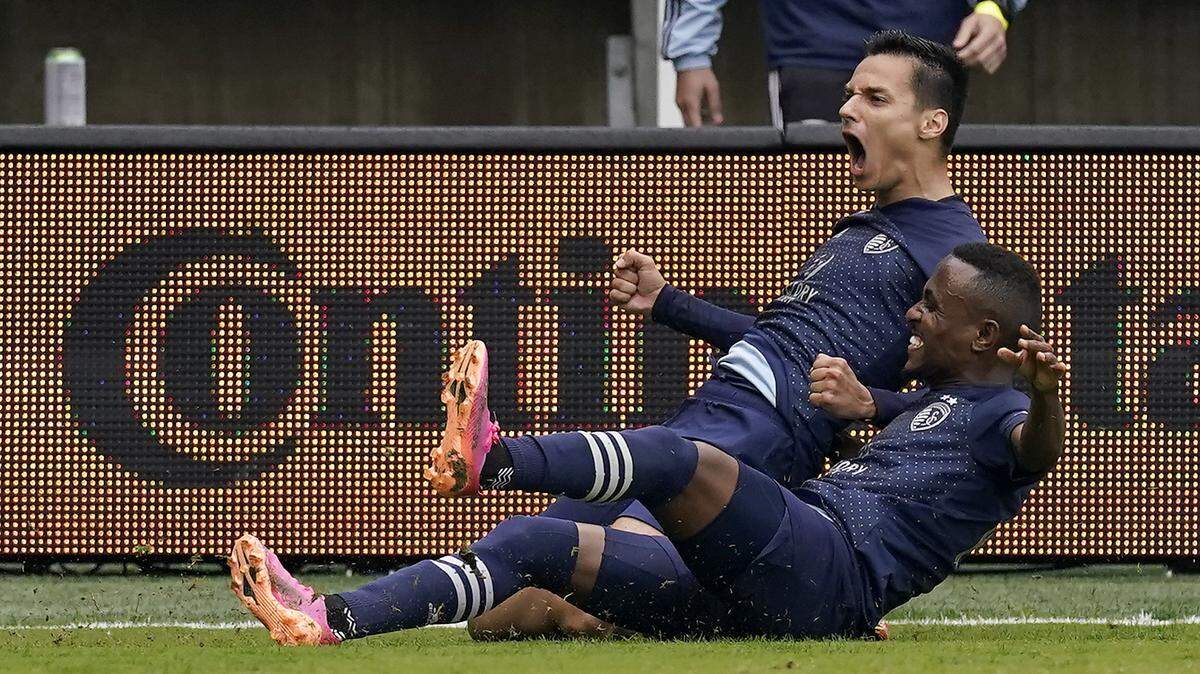
Start with winger Daniel Sallói, who’s enjoying a career resurgence this season with four goals and three assists in 10 games. Before him came Krisztián Németh, a poaching striker who scored 29 goals for SKC in two stints here (2015, 2018-19. Defender Botond Baráth, who made 21 SKC appearances in 2019-20, deserves a mention, too.
Vermes noted that “the ethnicity is never going to supersede the quality of the player.” But the Sporting coach who doubles as sporting director has unique control over the club’s transfer strategy. And sometimes the process leads him to his ancestral roots.
“Of course, because of my background, there’s a connection from that point of view,” Vermes said. “But in the end, I want good players for my club. ... I continue to always monitor with our scouting department that area of the world, and it always comes down to the same thing, and that is, ‘Does that player fit the way we want to play? Does he have the mentality that we need within our team to be able to play?’”
Detail-oriented scouting requires connections, especially when scouting abroad. So when Vermes sought to mine Hungary’s top division for players, he reached out to some old friends for guidance.
Istvan Urbanyi, a former teammate with Győr in the late 1980s, was managing the Maldives national team in 2013 when for familial reasons he shifted to coaching in the U.S. Urbanyi reached out to Vermes, his “best and only kind of opportunity” in America, and the meeting that followed produced a coaching job with the Sporting Academy.
Urbanyi quickly learned the status quo at Sporting: Vermes has a vision with his roster, and when all the cogs turn as they should, success ensues. It’s why Vermes is the longest-tenured coach in MLS and a MLS Cup winner.
What he does works.
“I think you see how Peter is building his system step-by-step,” Urbanyi said. “Everything is planned, organized and detailed ... (In MLS) it’s a short-term, mid-term, long-term financial plan. (It’s) more and more competitive. You have to win, you have to make the playoffs, you have to deal with the busy schedule, and so many things ... it’s amazing, for example, how Peter is handling all these aspects. Building a team, not only a starting 11, but a whole club.”
Urbanyi, who through last season coached with SKC affiliate Kaw Valley FC, helped Vermes acquire Sallói.
With cooperation from Salloi’s dad, Urbanyi brought Daniel to the U.S. to play for the academy while he attended Blue Valley Northwest High for a year in 2014. When Salloi’s return to the Hungarian league fell through, Vermes signed him as a homegrown player in 2016. That’s worked out well, too.
The structures of the MLS system — and structure Vermes provides locally in KC — have been big for Sallói. But the winger also credited Vermes for simply giving Hungarians a chance, and believing in them.
“I think he notices talents in Hungarian soccer,” Sallói said. “It’s a big opportunity for players from Hungary to go to MLS and play here. They can do well and then get to bigger leagues as well and go back to Europe. ... I think it’s great. And obviously, Peter is a big part of it. He’s the one who started this whole thing.”
Vermes wasn’t the first MLS coach to bring Hungarian players to the league. Urbanyi played a year with the San Jose Clash in 1997. But Vermes popularized it.
Striker Nemanja Nikolić played three seasons with the Chicago Fire (2017-19) and won the MLS Golden Boot in his first. FC Dallas’ Szabolcs Schön is a highly regarded 20-year-old winger who spent three years bouncing around the Hungarian first and second divisions. And recent Philadelphia Union signing Daniel Gazdag — Urbanyi played a role in his transfer from Honvéd as then-sporting director — played 175 times for the Hungarian club by age 25.
All three were named to Hungary’s 26-man squad for UEFA Euro 2020.
“It’s just like in the NFL. They always say it’s a copycat league, right?” Vermes said. “Somebody’s doing something, it’s working, then also everybody starts transitioning to that. It’s the same thing in our league. Somebody goes and gets a player from, let’s say, Argentina. Next thing you know, everybody’s mining in Argentina. It’s just kind of that idea. And I think when you see that players from certain areas of the world are working, you start to go there.”
As someone who played in both Hungary and the U.S. and coached under Vermes, Urbanyi still thinks Sporting is the gold standard for how MLS clubs welcome Hungarian players.
Nonetheless, Vermes has said many talented Hungarian players are often stereotypically labeled as complainers, potentially dinging their transfer potential. In the podcast, Vermes notes that with Hungarian players, he drills into them that not only do they have a responsibility as international players to be respectful, but also have a responsibility to represent “yourself and your nationality in the most respectful way,” because it may determine whether or not another Hungarian gets an opportunity in MLS.
The environment in which these players land is of paramount importance. The welcoming atmosphere that Sporting KC and many other MLS clubs provide, Urbanyi said, stands in stark contrast to his own playing days in Europe, when teammates wouldn’t so much as talk to him for “six months to a year.” Trust is earned more quickly here in the U.S., Urbanyi said.
But it’s one thing to do it, and another to do it well. Sporting has built a road map for integrating Hungarian players.
“Sometimes, there’s incredible ego that goes along with (Hungarian) players,” Vermes said. “It’s what actually gets them to be successful, too.
“Sometimes, it can be something that’s in the way a little bit. ... But when they get themselves into the world of being team-oriented and working toward that, you usually find individual success from that. It’s very hard the other way around.”
This story was originally published June 22, 2021 at 10:46 AM with the headline "Peter Vermes’ connection to Hungarian soccer about more than signings, family stories."