
How three Sporting KC ‘homegrowns’ highlight distinctly divergent pathways to same goal
Taking a 3-0 lead in the championship game of the National League Boys Disney Showcase, Jon Parry’s Sporting KC Academy U-14 team was cruising.
To that point, the opposition — South Carolina FC — wasn’t putting up much of a fight. But one South Carolina player, in the center of the field, stood out.
“He had an edge to him,” Parry recalled. “Most people would probably say he’s a head case, he’s nuts on the field, but he had an edge to him.”
Sporting KC’s academy team went on to win 5-2, with the player who stood out scoring one goal and contributing on the other.
“Holy cow, this kid’s got something,” Parry, Sporting KC’s academy director, thought to himself.
Parry had heard of Grayson Barber, but after seeing him in action he knew he had to get Barber to visit the SKC academy. Six years later, Barber signed a professional homegrown contract with Sporting KC at age 20. He was one of three homegrowns to sign with the club on Jan. 20, alongside 18-year-old Brooks Thompson and 16-year-old Ozzie Cisneros.
Sporting KC coach Peter Vermes chalks the trio’s ascension up to a system called the pro player pathway.
It’s a technique of development that has been refined by Vermes and his staff to produce 16 homegrown players since the academy was established in 2007.
But the signings of those three homegrowns showed how diverse the path can be. Barber left the Sporting KC Academy, opting to play in college. Brooks joined the Sporting KC Academy before quickly moving up to the club’s USL affiliate, Sporting Kansas City II, while Cisneros signs a pro contract straight out of the academy.
“All three players have had different paths within our pro player pathway,” Vermes said. “The path is different for every player, but at the end of the day, they’re all afforded the same opportunity.”
Leaving home
When he was 10, Cisneros traveled nearly three hours along Intersate 29 — each way — for practices with the SKC Academy. An Omaha native, Cisneros was first spotted through the club’s Midwest scouting network.
“Ozzie, being the special player that he is, he came into the academy at 10 years old, playing with the U-12 team,” said Rumba Munthali, Sporting KC’s U-17 and U-19 head coach.
Even at a young age, Cisneros’ talent was apparent. But commuting from Omaha to KC on a regular basis — taking away time from school and hanging out with friends — wasn’t a viable longterm option.
So at age 13, still in middle school, he bid family and friends farewell and moved to Kansas City to live with a host family.
“It was tough for me and my family,” he said recently. “It was a big decision, but we decided it was the best decision for me. And yeah, it was tough. I get homesick every once in a while. I just miss my family, my mom’s cooking.”
Cisneros wasn’t the first player to make such a move and he certainly won’t be the last. Barber and Thompson also lived with host families.
The club now has a director of player care, Betsy Maxfield, who oversees the process of integrating players with host families. Before Maxfield, that job fell to Parry, who oversaw the moves of Barber and Sporting KC defender Jaylin Lindsey.
“In year one of that,” Parry said, “I’m going and doing the home visit, and the first year I went where Jaylin and Grayson lived at this house together.
“I go in, and they have a dog, and the dog’s sitting there. I’m petting the dog and the damn thing jumps up and almost bit me in the face. I walked out of there and was thinking to myself, ‘What the hell am I doing? I’m a soccer coach and I’m at a host family and I’m almost getting bit by a dog.’”
Building one of the most successful soccer academies in the country has had its challenges. But the payoff is when a player like Cisneros develops and thrives at a young age. By the time he was 15, Cisneros was playing for the U-19 academy team; he’s also made appearances with the U.S. U-15 Boys’ National Team.
Munthali describes Cisneros as a blend of current Sporting midfielders Gianluca Busio, Felipe Guttierez and Roger Espinoza.
“He can switch the ball as Busio does and connect other players — he can make the final pass,” Munthali said. “But then he can get stuck in and work really hard defensively for his team.”
And Cisneros’ quick rise probably wouldn’t have been possible without Sporting KC’s pro player pathway. The system ensure that every academy team — from the first team to the U-12s — plays the same way and learns the same information.
“It definitely makes me feel a little more comfortable,” Cisneros said. “It’s pretty much stuff that I already know, and I just try to perfect it, really.”
The normal pathway
Thompson knows the efficacy of the pro player pathway as well as anyone.
He came to the Sporting KC Academy in summer 2018 after spending two years at Florida’s famous IMG Academy. He immediately slotted into the U-19 team, producing four clean sheets in 12 games in 2018-19, and became the youngest signing in Sporting KC II history at age 16.
Standing at 6-foot-4 with plenty of athleticism, Brooks always seemed destined to succeed. Peter Mellor, Thompsons’ former coach and a former Burnley, Fulham and Portsmouth goalkeeper, said Thompson reminds him of a young Tim Howard — Howard made 121 appearances for the U.S. National Team from 2002-17.
Those who’ve observed Thompson’s journey on SKC’s pro player pathway say it allowed him to realize his potential.
“In 2017, we started the initiative, at least on the goalkeeping side, of just trying to rebuild things,” said SKC goalkeepers coach Alec Dufty. “We obviously had Timmy (Melia) and felt like we were in a decent place, but we knew we had to go out and find some young kids and try to build up from the bottom a little bit.”
Vermes likes his goalkeepers to help play the ball out of the back and use their feet. So that’s how academy keepers as young as 12 are taught to play.
“I’d definitely say I’ve progressed quite a bit with my feet being in this system,” Thompson said. “It’s a demand, for sure. And I’ve definitely progressed quite a bit from when I came out here from Florida. I’d say that’s the area I’ve probably improved in the most, just because of the demand and the role of a goalkeeper in this team.”
The club often integrates its goalkeepers with outfield players during possession drills so the former become more comfortable with having the ball at their feet under pressure. After just nine months spent in the academy, Thompson signed a deal with SKC II in March 2019, making his debut four months later against Hartford Athletic.
He sustained a back injury via overuse not long after and missed about four months. So it wasn’t until 2020 that Thompson really made his mark.
Typically, players from the first team who aren’t seeing many minutes are sent down to play for SKC II. But because of the COVID-19 pandemic, movement between the clubs was restricted. This meant that with 2020 first-team goalkeepers Jon Pulskamp and Richard Sanchez unable to move to SKC II, Thompson served as the team’s primary goalkeeper.
“It was on Brooks, and he responded very, very well,” Dufty said. “To go to places like Indy and Louisville and St. Louis and these teams that are really good, with men on their team, and to see him play the way he did was really positive for us.”
Thompson finished the shortened 2020 USL season with a 1.17 goals-against average and 26 saves in six games. His save total was the highest among teenage goalkeepers in the league.
Dufty expects Thompson to spend more time with SKC II in 2021, another advantage of the pro player pathway. Although he’ll train with the first team, being loaned down to the B-team will provide more game minutes. Parry expects Thompson’s path to be the norm going forward — guys will progress from the academy to the B-team, and then to the first team.
But there are still more paths to follow, too.
The college route
Barber, like Parry, remembers well the game in which he was discovered by Sporting KC at Disney.
“They went up early and they celebrated and it really got me riled up,” Barber recalled.
That edge that captured Parry’s interest? It reminded him a little bit of Vermes as a player. And it highlights another facet that Sporting KC scouts take into consideration: personality.
“We also talk about four different components: technically, tactically, physically and the mental side,” Parry said. “And so I think all of them are extremely important, but at the end of the day, the one that separates players is the mental side of the game.
“Whether they make it, whether they persevere through the daily ins and outs of being a professional player.”
Barber ticked all of those boxes, so it was disappointing for Parry when Barber left the academy ahead of his senior year of high school.
“It was tough,” Barber said. “At that time, being away from my family for so long, I wanted to be back home. But Sporting had brought me here and put a lot into me — you don’t want to just get up and leave.”
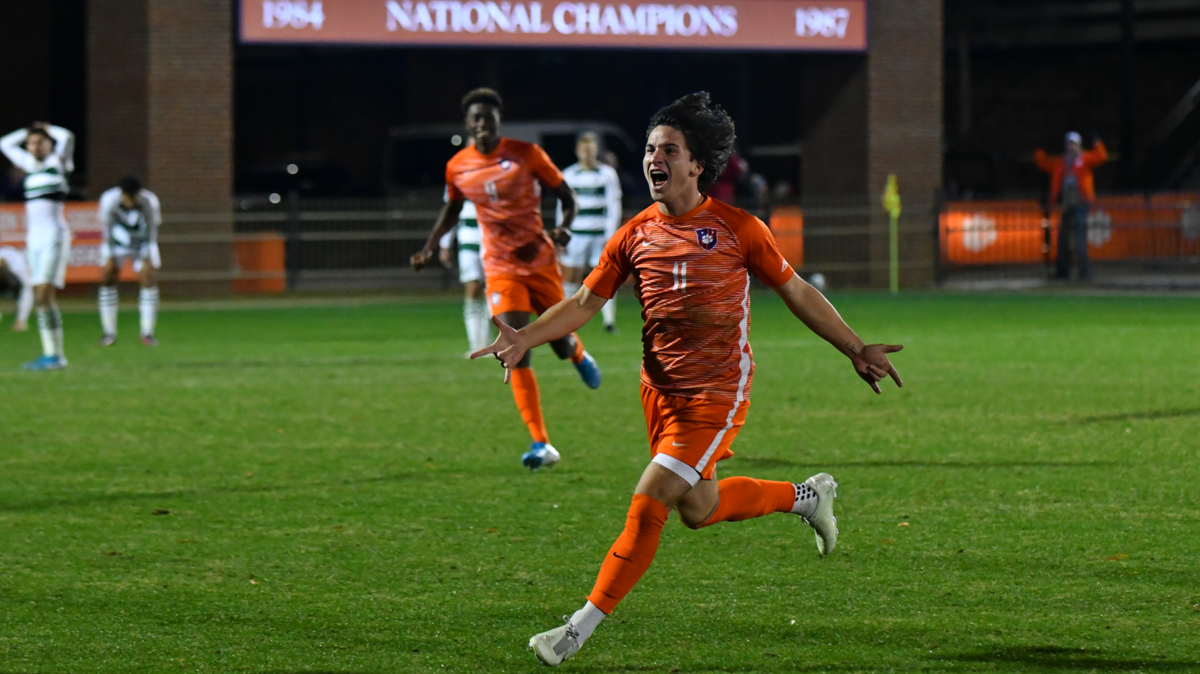
Barber was set to play college soccer at Clemson, and although he was leaving behind the Sporting KC Academy, he didn’t leave behind what he’d learned while there.
During his time with the club team in South Carolina, he was “the guy,” the player who made everything happen, who was involved in nearly every goal and had to put his team on his shoulders.
But at Sporting? That wouldn’t fly.
“It takes a second to get used to, but it’s nice,” Barber said. “Because when you’re the guy, it’s kind of like everything is focused on you. But being in the academy, having so many other good players around you ... It makes playing in a system, not just doing whatever you want, but playing to a position and sticking there, makes it way easier to do that.”
Barber returned to South Carolina a different player, more knowledgeable about his role in the midfield. Sporting KC begins teaching players positional roles, their role in the game, at the U-15 level.
With the knowledge he’d learned at Sporting, Barber went on to pull the strings in the midfield of arguably the best college team in the nation in 2020. He amassed 13 goals and 18 assists in 49 appearances for Clemson, leading the Tigers to the 2019 NCAA Tournament quarterfinals and the 2020 ACC championship.
Sporting KC kept track of Barber. The club currently has MLS homegrown rights to 35 players.
Although not in constant contact, the club likes to keep an eye on the collegiate players it has homegrown rights on — that figure currently stands at 35.
“I think our coaches do a good job of keeping in touch with them,” Parry said. “If it’s not a COVID year, we’re bringing those guys back in and they’re training with us.”
Uncertain whether a return to Sporting KC was in the cards, Barber was preparing to enter the MLS SuperDraft. Once Parry reconnected with him, the decision to return to KC was an easy one.
“Coming back here, multiple homegrowns on the roster that I’ve already played (with), and just coming back to a familiar place,” Barber said, “is what I feel would be more comfortable transitioning into like a pro career.”
Of the Barber-Thompson-Cisneros trio, Barber is arguably the most likely to make an immediate impact. He was named to the 2017 United Soccer Coaches Youth Boys All-America Team during his final season with the Sporting Academy and led NCAA Division I in assists, with seven, in 2020.
If he’d entered the draft, he had the potential to be a top-10 pick.
“I think it shows that everybody’s pathway is different, and I watched a couple of his college games this year and he was arguably the best player on the field every time,” Parry said. “He’s more mature mentally. Physically he’s more mature. And so I think he’s really excited.”
This story was originally published January 30, 2021 at 2:21 PM with the headline "How three Sporting KC ‘homegrowns’ highlight distinctly divergent pathways to same goal."