
Kansas falconer’s trained peregrine hunts down mallard ducks
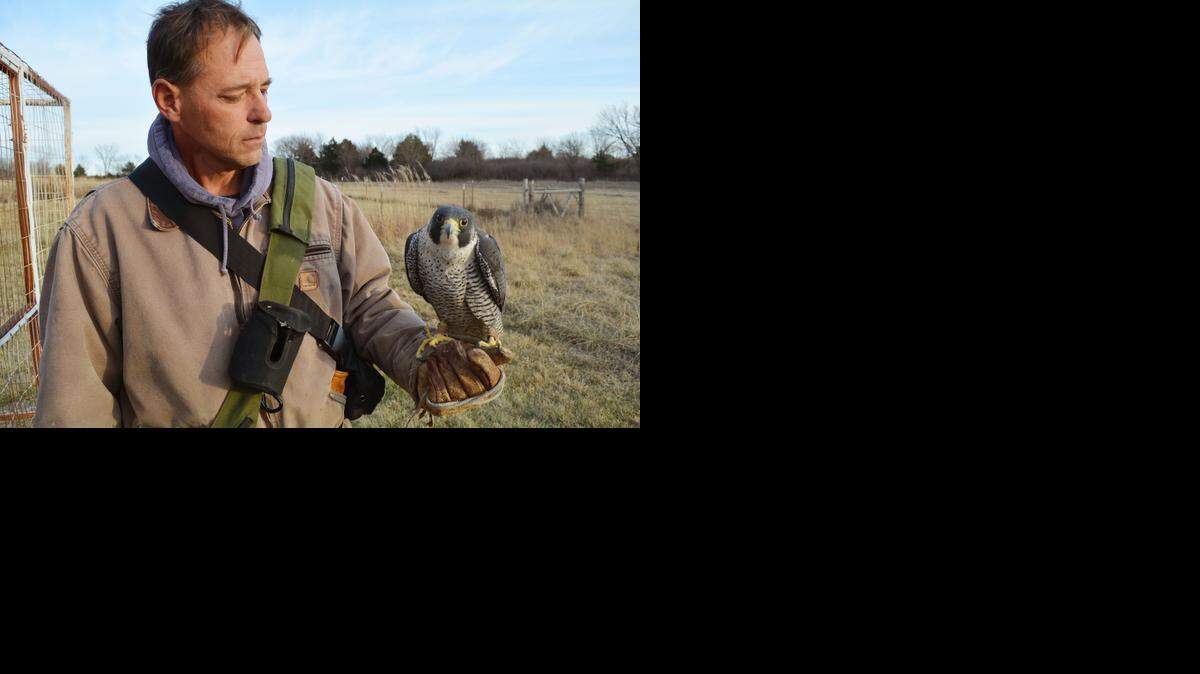
When Doug Burt goes duck hunting, he uses a much different weapon than most waterfowlers do.
Instead of a shotgun, he carries a trained peregrine falcon into the field.
“This is Cowboy,” Burt said as he stared at the falcon perched on his glove. “Birds his size — he only weighs 21 1/2 ounces — generally aren’t something that would intimidate many other birds. But after that first flush, they learn.
“Birds like him rule the sky.”
Moments later, Burt proved his point. As he approached a secluded farm pond, he removed the leather hood from Cowboy. Then he released the falcon and watched as the bird of prey quickly gained altitude.
Burt ran up the pond dam and clapped his hands, flushing the waterfowl that were resting on the frigid water. A flock of Canada geese exploded off the surface, honking loudly as they left. Cowboy continued to circle, ignoring that first wave.
But when smaller mallard ducks later flushed, the peregrine falcon sprang into action. He picked out one fleeing greenhead and performed a death dive on his target. He hit the duck at full speed, knocking it off its flight path. Then he hit it again and rode it to the ground.
Burt rushed over to retrieve the mallard and Cowboy was rewarded with a piece of meat.
“Cowboy is a very good athlete,” said Burt, 49, who lives in Council Grove. “He’s extraordinary. There aren’t a lot of terciel (male) peregrines that can take mallards regularly.
“He definitely knows what he’s doing when he’s up there flying.”
One thing is certain: Not many birds can outfly Cowboy when he’s on the hunt. Peregrines are capable of stooping (a falconer’s term for diving) at speeds of 200 miles per hour. That makes them the fastest-flying bird, according to wildlife biologists.
“You’re watching a small falcon do what God made it to do — hunt,” Burt said.
As a licensed master falconer, Burt is well-aware of what raptors can do. He has flown eight birds of prey in the 20 years he has been involved in falconry. In the past, he often followed a routine, trapping a red-tail hawk in the fall, training them and hunting with them for one season, then releasing them back into the wild.
He has trained raptors to hunt everything from rabbits to pheasants to waterfowl. His favorite? A goshawk, which will hunt “both fur and feather,” he said.
It’s a partnership, he said. “The bird knows by repetition that I am going to provide meat for him. They’re opportunistic. They learn to trust me. That’s why they don’t just fly off when they are released.”
When Cowboy rides a mallard to the ground, Burt rushes over to help. When the hunt is unsuccessful, he swings a lure —in this case, a leather silhouette of a bird — over his head to call Cowboy back in.
Burt grew up as a traditional duck hunter. Living in Nebraska, he would use his shotgun to take mallards on the Platte River.
But his mind kept drifting back to a book he read when he was 14; a book that heralded the wonder of birds of prey.
That’s when he decided to get into falconry. He started off by taking a required apprenticeship for two years, passing a written test and getting the proper permits.
He still remembers the first red-tailed hawk he worked with.
“The first year I had a redtail, we got three rabbits and I was one happy young man,” he said.
But few of the birds of prey Burt has owned could measure up to Cowboy. He purchased the bird from a raptor breeding facility in Montana. By the time Burt got Cowboy, he understood the concepts of hunting. Burt took it from there.
This is the third season Burt has hunted with the peregrine falcon and the birds has proven to be an excellent hunter. Cowboy took 13 wild ducks the first season, 25 the second. This year, the erratic weather has hampered the hunters and they have teamed to take only nine ducks.
“We are out hunting every day of the season that the weather allows,” Burt said. “If we’re lucky, we’ll take a duck.
“But it still takes everything going just right. The impact falconry has on wildlife populations is microscopic.
“For me, it’s just a great way to hunt. I don’t even take my shotgun out anymore. I would much rather watch Cowboy get the duck.”
To reach outdoors editor Brent Frazee, call 816-234-4319 or send email to bfrazee@kcstar.com.
That’s what speed do
OK, we’re coining a phrase by Jarrod Dyson of the Royals. But you get the idea. In the bird world, there are species that are known as speedsters. Here are a few:
▪ The peregrine falcon is regarded as the fastest bird, if you look at its diving speed. When hunting, it climbs to lofty heights, then dives on its prey at speeds of 200 miles per hour, studies have shown.
▪ The great snipe is the fastest migratory bird. In one study, it traveled from Sweden to Africa non-stop at a speed reaching 60 miles per hour.
▪ The TravelAlmanac.com recognizes the spine-tailed swift as the fastest level flier. It has reached speeds of 106 miles per hour in short flights.
▪ The fastest flight of a waterfowl species ever recorded was by a red-breasted merganser that attained a peak air speed of 100 miles per hour when it was trying to avoid an airplane. That broke the former record of 72 miles per hour by a canvasback.
▪ Most waterfowl fly at speeds of 40 to 60 miles per hour, according to Ducks Unlimited, a national waterfowl organization.
▪ Pheasants fly at speeds of 27 to 38 miles per hour when cruising, but can reach speeds up to 56 miles per hour when being chased.
▪ Another popular gamebird species, the bobwhite quail, flies at 20 to 40 miles per hour, according to studies.
This story was originally published January 2, 2015 at 8:39 PM.