
Hunters enthusiastically greet another duck season on northern Missouri wetlands
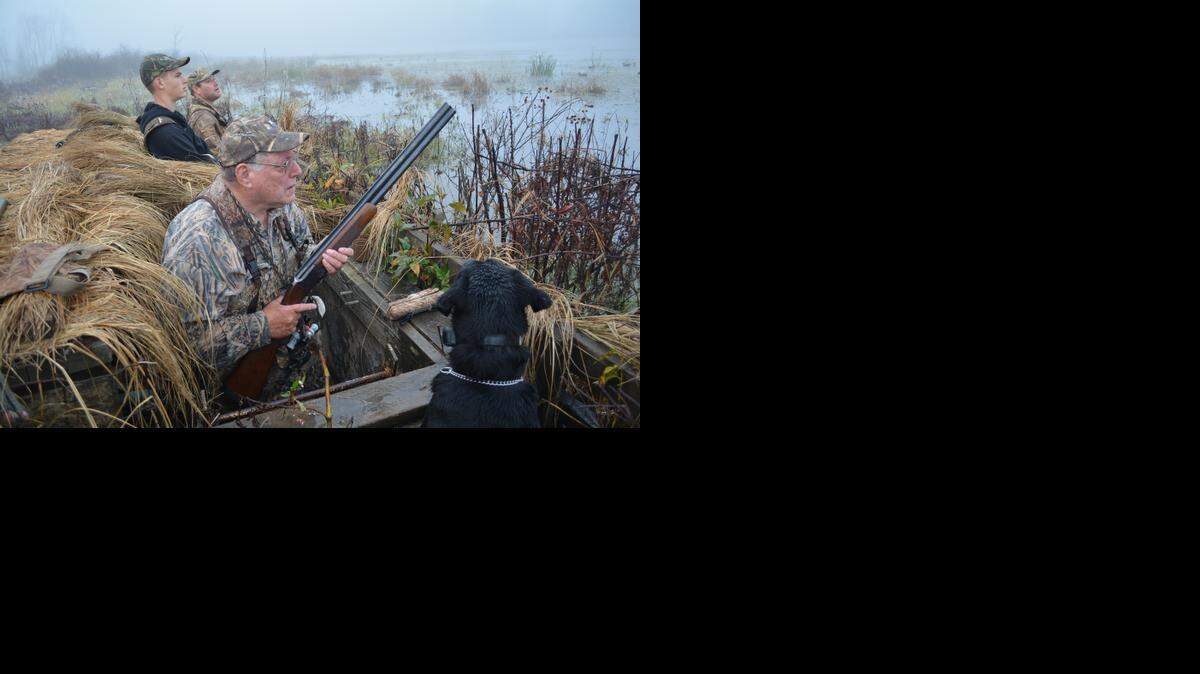
Sitting in a blind at the edge of his private wetland, Jeff Churan welcomed a new duck season with a statement that sums up his passion for waterfowl hunting.
“I’ve always said that there are only two seasons — duck season and getting ready for duck season,” Churan said with a chuckle. “One’s too short and one’s too long.
“But the waiting is over now.”
You might think these duck openers would be routine for Churan by now. At age 73, he has been participating in them for more than 50 years.
And he has been opening the Missouri season at his duck camp, The Bottoms, since he bought the land in 1972. That adds up to a lot of shots, a lot of ducks and a lot of memories.
Still, Churan embraces every season with the enthusiasm of a kid. There’s something about duck hunting that will do that to a man, he’ll tell you.
“For me, it has become a way of life,” said Churan, a former member of the Missouri Conservation Commission. “When I’m not duck hunting, I’m thinking about it.”
Sitting alongside his son John and his 16-year-old grandson Luke, he greeted the 2014 duck season in a thick fog. As his black Lab, Max, constantly scanned the gray sky for signs of movement, the retriever suddenly became alert.
Seconds later, a squadron of wood ducks came barreling out of the fog and swept down on the decoys. The hunters fired, two ducks tumbled to the marsh and the 2014 hunt was on.
“Well, here’s to another duck season,” Churan said as Max bounded through the water to make a retrieve. “I hope I have many more of them left.”
As the dog brought the last duck to the blind, Churan reached over and patted his companion.
“Good boy, Max,” he said. “You saw those ducks, didn’t you?”
Moments later, there was another group of wood ducks. And then a few widgeons. By the time the fog started to lift and the clock had turned to 10 a.m., the ducks stopped flying. But not before Churan and his family had taken five ducks.
No, it wasn’t the best hunting trip they had ever enjoyed at their marshes east of Chillicothe. But it certainly wasn’t the worst, either.
With the mild weather delaying the duck migration this fall, the nearby Fountain Grove Conservation Area and the Swan Lake National Wildlife Refuge weren’t reporting many waterfowl using their marshes. That cast an air of uncertainty on Saturday’s North Zone opener.
But that mattered little to Churan. This was the day he had waited for. In his world, shooting limits no longer determines success. Instead, getting together with family and friends and talking about past hunts, spending the night at the clubhouse, fixing steaks or fried walleyes, and hunting from the same blinds as he always has are far more important.
Churan has a deep appreciation for the heritage of Missouri waterfowl hunting. He was one of 13 authors, most of them past waterfowl biologists for the Missouri Department of Conservation, who joined to write the recently released book, “Waterfowl Hunting and Wetland Conservation in Missouri: A Model of Collaboration.”
Among the duck clubs that were featured was Churan’s The Bottoms Duck Camp. Located in the Grand River bottoms, it has a rich history.
Visit the clubhouse, and you’ll see rows and row of old duck decoys on display. But not your ordinary decoys. They are half decoys, featuring the duck’s rear ends.
“We wanted something that would be fitting of the name of our duck camp, The Bottoms,” Churan said with a laugh. “I have the world’s best collection of duck-butt decoys.”
Churan started off partnering with friends to buy pieces of the bottom land, then assumed sole ownership in 1972. Today, the 1,200 acres he owns are considered one of the prime waterfowl attractors in northern Missouri.
Part of the land is a working farm, in row crops. The other part is an impressive wetland, fed by a network of wells.
Churan takes pride in the fact that it is now a family-centered duck camp. He delights in telling people that three generations of his family now hunt ducks there. His sons, John and Greg, both hunt, and three grandsons, Riley, Luke and and Jake, are also avid waterfowlers. Luke’s twin sister, Lily, also is in love with the family duck camp.
“We’ve made a lot of good memories here,” John said. “I was practically brought up at this place.
“Duck hunting has always been a big part of my life, so I guess I’m following my dad’s example.”
To reach outdoors editor Brent Frazee, call 816-234-4319 or send email to bfrazee@kcstar.com.
Missouri: a place for waterfowl
Missouri has a rich history when it comes to waterfowl hunting and management.
Dozens of private duck clubs, combined with wetlands managed by the Missouri Department of Conservation and national wildlife refuges, dot the landscape with attractive spots for thousands of ducks and geese to rest on their fall and spring migrations.
▪ The Department of Conservation today manages 15 conservation areas intensively for ducks. That accounts for 82,000 acres of wetlands. And that doesn’t include conservation areas that have occasional wetlands depending on precipitation.
▪ The Fountain Grove Conservation Area was the first of the state-managed wetlands areas. It was constructed in 1947. More recently, wetlands such as the Four Rivers and Grand Pass conservation areas opened and now are among the state’s largest waterfowl attractors.
▪ National wildlife refuges go even further back than the state areas. Squaw Creek was the first to open, in 1935. Swan Lake wasn’t far behind, getting started in 1937. Both are known as prime rest stops for migrating geese. Squaw Creek attracts snow geese, while Swan Lake once was known for its large concentrations of Canadas, though that has changed in recent years. Both refuges draw large concentrations of ducks when conditions are right.
| Brent Frazee, bfrazee@kcstar.com