
Retaliating in today’s NFL no simple task, but sometimes it must be done
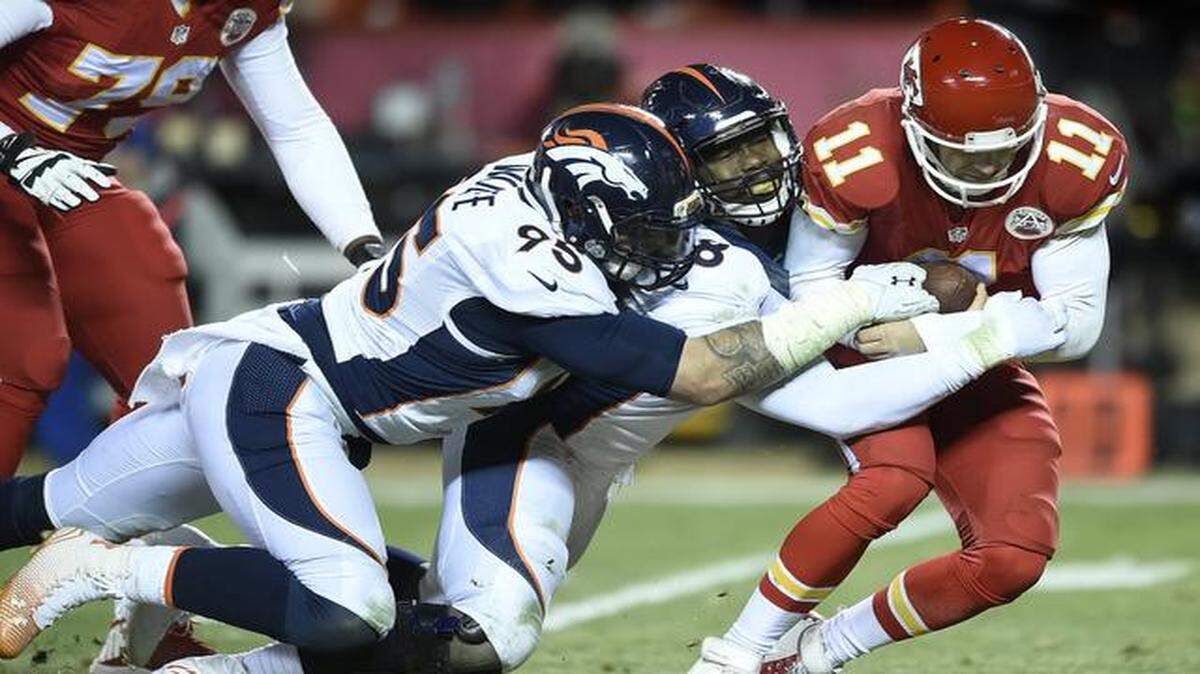
Moments after watching his quarterback get speared in the back well after releasing the ball, Chiefs fullback Anthony Sherman crouched in his stance, ready to pounce.
This was Sunday, during the fourth quarter of the Chiefs’ 29-16 loss to the Broncos. And although they trailed by 16 points, the Chiefs were still in the game.
When the ball was snapped on the next play, Sherman made a beeline toward the player who’d made the late hit — linebacker Von Miller — and delivered a hard chip-block as Alex Smith threw a touchdown pass to Jamaal Charles.
In a way, it was the perfect response to a late hit: The Chiefs put points on the scoreboard. But was that enough?
By all accounts, Sherman’s block was the Chiefs’ only retaliation toward Miller. But at least one other player — tight end Travis Kelce — thought Miller’s hit on Smith was a cheap shot. Kelce made an obscene gesture with his hand after the play, later explaining that it was directed toward the Broncos’ linebacker.
Chiefs coach Andy Reid called Kelce’s gesture an “immature act,” but Kelce wasn’t alone in his belief that Miller’s hit crossed the line. When asked later how teammates should respond to such plays, cornerback Chris Owens broke into a mischievous grin.
“Like responding to cheap shots? Like how (Miller) hit Alex Smith?” Owens said.
Chiefs linebacker Tamba Hali, who heard through the grapevine that Miller’s hit might’ve been in retaliation for a shot he gave Manning in the second quarter, agreed.
“I think people were trying to say I hit Peyton late,” Hali said. “(Miller’s) was blatant. One (second), two (seconds), then he hit him.
“But mine was on time. If (Manning) would have stopped, I would have got (the sack).”
While Hali’s contact with Manning was the Chiefs’ only official quarterback hit on Sunday, it’s worth noting that defensive end Kevin Vickerson put a decent lick on Manning a few plays before Miller’s hit on Smith: Manning tripped on a running play, and Vickerson dove on him to keep him from getting up. The result was a five-yard loss.
Regardless of whether either play spurred Miller’s late hit, the Chiefs were clearly incensed.
And rightfully so, said former defensive tackle Bill Maas.
“You don’t let anybody do that to you,” Maas said.
A 10-year pro who spent nine years with the Chiefs, Maas played from 1984 to 1992 in an NFL that was more physical than today’s pass-happy environment.
“When somebody spears your quarterback, you make sure you set the tone, that’s for sure,” Maas said. “And whatever that’s gonna be — pulling him off your guy, getting in his grill — you’re letting him know that’s not acceptable.”
Maas made it clear that “getting in a guy’s grill” was really just the start of what might happen to an opponent during the eye-for-an-eye era.
“The only way you get away with retaliation is by looking for an opportunity to take care of that, whether it be an interception or (in) a pile,” Maas says. “You keep it in the back of your head, and as soon as something happens, you want to find him with his head turned. And that’s when you go out and get after somebody.”
But getting retribution right away, Maas said, could often be tricky. Officials might be watching. That’s when words became a weapon.
“If (an offensive lineman) didn’t like something you did, they’d say, ‘Watch your knees, watch the high-low,’” Maas said. “I don’t know if that still goes on or not.”
If it does, today’s Chiefs players aren’t admitting it.
Maas knows for sure that at least one old-school means of retribution — spitting in a guy’s face — has fallen by the wayside.
“It’s changed,” Maas says. “You not only have to coach guys about playing the game, you have to coach them about what to say and mouthing words, because it (the camera) catches you so quick,” Maas says. “It was so common to get up in somebody’s face back then, and the lowest form of disrespect you can give them is to spit in their face. It was prevalent, and cameras didn’t catch that stuff. Now, they catch everything.”
But current players agree that they don’t forget a cheap shot.
“It’s something you store in the back of your mind,” Chiefs tight end Anthony Fasano said.
Fasano, a nine-year veteran, was with the Cowboys in 2006 when teammate Andre Gurode became the victim of one of the dirtiest plays in league history: Tennessee defensive tackle Albert Haynesworth’s infamous face-stomp.
That play was so vicious, Fasano said, that Gurode’s fellow linemen definitely found a way to retaliate.
“That’s probably the worst on-field thing we got mad about,” Fasano says. “I didn’t particularly have a chance to work an inside lineman, but I’m sure our guys did something that game. I do remember that.”
Fasano said the challenge is toeing the line between defending one another other and not hurting the team. As Maas said, it’s hard to get away with much.
“Everyone’s got a camera on them,” Fasano said, “and they’ll hit you in the wallet. You’ve just got to keep the integrity of the game (in mind).”
This is particularly true of a play such as Miller’s, which didn’t come close to approaching the cheapness that Haynesworth’s reached.
“It can’t be that way — you can’t get vengeance,” Fasano said. “It’s not really what the game’s about. Potentially, you start doing that and you hurt your team. Not to mention what the NFL will do to you.”
Another factor — the score — made it difficult for the Chiefs to return Miller’s hit in kind on Sunday. On the very next play, that touchdown pass from Smith to Charles cut the Chiefs’ deficit to 10 points, 26-16, with about 12 minutes left. Had they successfully converted the resulting two-point conversion, it would’ve been a one-score game.
Not exactly prime time for revenge — even after Denver increased its lead to 13 with a field goal on its next drive.
“Usually, in those situations, we respond well,” said Chiefs right tackle Donald Stephenson, who yielded two sacks to Miller but also landed a nasty block after the whistle on Lerentee McCray late in the game. “We come back out and play well. But (Sunday) was tough … mostly guys are worried about getting the win.
“When somebody does something like that, you obviously want to retaliate. But you’ve just got to be smart and do it between the whistles.”
Hali agreed, then brought up another interesting point. Sometimes, he said, retaliation isn’t just on the players.
“Our coaches can fix that,” Hali said. “You come in games sometimes, and coaches can say, ‘Hey, we’re gonna double this guy — get this guy.’ It’s all a game-planning thing. We can’t take it in our hands.”
On Sunday, the Chiefs’ coaching staff was clearly more concerned with helping their players fight their way back into the game. In lieu of a zone-running play, which could have allowed the Chiefs to double Miller within the rules, all 15 of the Chiefs’ remaining plays were passes.
Reid said that it’s important for players to “keep playing” after a cheap shot. He, too, stressed the importance of not doing anything to hurt the team, like drawing a penalty.
Arizona coach Bruce Arians, Reid’s counterpart this weekend, agreed.
“It’s not like baseball, (where) you throw it at a guy and get thrown out of a game (and) all you get is a ball,” Arians said. “In football, a 15-yard penalty or an ejection, you don’t have that many guys to play with. You try to fix it the right way on the field in a very legal, physical manner.”
Ultimately, though, revenge is a case-by-case matter.
“You have to stand up for yourself — you don’t want to sit around and think everybody can come in and punk you,” Arizona quarterback Drew Stanton said. “I would say, from our standpoint, that wouldn’t happen, and we saw that a little bit with some of the guys that we had last week in our game. Towards the end of the game (against Atlanta), there was some stuff that transpired ... but guys also walked away. It’s one of those things that you have to try to be the bigger man.”
The Chiefs did that on Sunday. They say Miller doesn’t have a reputation as a dirty guy — he might’ve gotten more than a hard chip-block if he did. And Smith remains confident that his teammates have his back.
“Certainly, we’ve got a lot of guys that take a lot of pride in playing with the guy next to him and defending that,” Smith said. “But it’s a big game — a division game — and certainly with where we were at, you’re trying to get back in it. So for us, we talk a lot about, yeah, you want to do it in the confines of the whistles and going out there within the play. Dominate, and that’s where you do it.”
Owens, who has gotten into a handful of scuffles since training camp and isn’t afraid to mix it up, notes that there’s some room for, ahem, interpretation when it comes to retaliating.
“We play football, so if you get in the heat of battle, you may throw a punch or take a punch,” Owens said. “You try to keep it in perspective and respect the refs; sometimes, refs give us some leniency. As long as you don’t do it blatantly, and try to punch a guy 20 seconds after the whistle, I think you’ll be alright.”
And as Maas and Fasano said, players tend to have a long memory.
“You earn respect by what you do on the field,” Owens said. “We’re not boxers; we’re not really trying to fight. But sometimes it happens that way. It doesn’t need to happen that way, but it does. It’s a gladiator sport.”
To reach Terez A. Paylor, call 816-234-4489 or send email to tpaylor@kcstar.com. Follow him on Twitter at @TerezPaylor.
This story was originally published December 4, 2014 at 9:58 PM.