
Chiefs are planting a flag, and hoping to give girls their own football jersey
Sheila Sickau has lived her dream of playing in a professional football league, and now working for an NFL franchise. The dream that motivates her these days is for others. She can’t wait for the day a story flashes on her screen about a star player who started in the Chiefs flag football program, won a state high school championship in Kansas or Missouri and earned a football scholarship to a local university.
“Then play in a pro league and in the Olympics,” Sickau said. “It all begins with that first step of competing, and girls wearing a football jersey of their own.”
The Chiefs and Sickau are playing a major role in creating that opportunity. Sickau is the Chiefs’ senior marketing manager of football development and is overseeing the organization’s push to sanction flag football in Kansas, giving it state championship status with the Kansas State High School Activities Association.
The KSHSAA’s 73-member board of directors will vote on the issue April 23, with a majority needed to pass. The vote at the organization’s headquarters in Topeka is open to the public.
Chiefs officials were out in full force Thursday morning at Hy-Vee stores in Kansas, handing out “Let Her Play” flags to bring awareness to the vote.
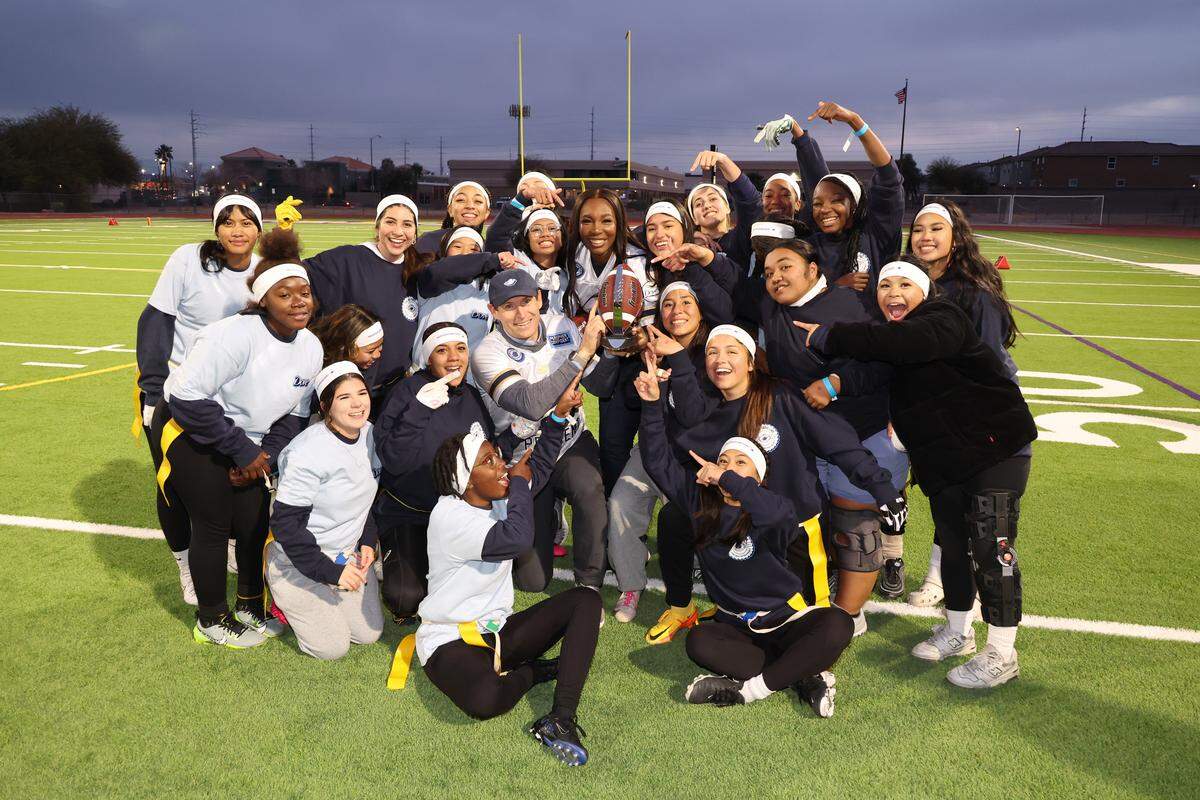
They’ve been playing in high school at the club level. Last fall, 29 Kansas schools offered girls flag football, mostly around Kansas City and Wichita.
In Missouri, girls flag football is recognized as an emerging sport. Two weeks ago, the Blue Springs School District announced it will add flag football and boys volleyball as spring sports starting in March 2027.
In Kansas, flag football would be a fall sport. It’s usually a 7-on-7 competition but can be 5-on-5. Teams typically have 20-30 participants, and sanctioning would mean — besides staging state playoffs and a championship — assigning officials and schools providing uniforms and equipment.
The Chiefs, along with the NFL, Nike and other sponsors, have been helping with costs in both states. The Chiefs have also helped with finding and preparing fields — 80 by 40 yards for this sport — and the organization envisions payoff in the short and long term.
“We know how important the next generation of fans is to Chiefs Kingdom and how important it is to find new ways to engage these fans,” said Lara Krug, team executive vice president and chief media and marketing officer. “So many of these fans are young women.”
According to Quantumrun, the female audience has grown to 47% of the NFL’s fan base, and female viewership grew by 9% in 2024.
Flag football, growing at the college level, has been popular in the NAIA. Sickau was an assistant coach on Ottawa University’s 2021 national championship team and the next year won a league championship while playing with the Kansas City Glory, a women’s professional league team.
The NCAA added flag football as an emerging sport in January, and last month Nebraska hired Liz Sowers from Ottawa as its first head coach. The Cornhuskers will launch their first season in 2028, and the Big 12 has become the first major conference to explore adding flag football as an officially sponsored sport that year.
That’s also when flag football will be a medal sport for women and men in the Olympics in Los Angeles.
The NFL has also announced a partnership with TMRW Sports to create and operate professional flag football leagues for both women and men, with teams associated with existing franchises. Chiefs president Mark Donovan recently told the Olathe Chamber of Commerce a pro team could be part of the franchise’s new team headquarters and practice facility there.
“Without making any promises, the Kansas City Chiefs will be heavily involved in ... a Chiefs version of professional flag football,” Donovan said.
The immediate focus is at the high school level in Kansas.
Mark Lentz, assistant executive director of the KSHSAA, doesn’t know how the vote will turn out. But he reminds the board that a “yes” vote doesn’t mean a school has to sponsor the sport. But a “no” vote prevents sanctioning for all schools.
“I tell people we have soccer, but not every school plays soccer,” Lentz said.
The Chiefs have heard concerns about flag football pulling athletes from other sports, but their research tells them that about half of participants in Kansas are playing a sport for the first time.
“I don’t think people are saying ‘no’ to flag football,” Sickau said. “There are issues with funding, facilities, space, and we’ve been trying to come with ways to reduce those barriers.”