Security zone, encampment clearing: How New Orleans is preparing for the Super Bowl
When a city hosts a big event, it’s common civic practice to sink some resources into spiffing the place up — to steer visitors toward your good angles and apply a little concealer to the bags under your eyes.
Kansas City did this in 2012, when it bulldozed a couple dozen old houses near Kauffman Stadium ahead of hosting Major League Baseball’s All-Star Game. And KC is already prepping for the World Cup, which arrives next year, by making sure the streetcar extension is up and running, accelerating development on the riverfront, renovating Arrowhead, and joining a group of other host cities in seeking $625 million in federal funding for security.
It’s much the same here in New Orleans ahead of next week’s Super Bowl. In some ways, it’s less of an undertaking. New Orleans is a city that is used to hosting things: This is its 11th time hosting a Super Bowl, and it welcomes huge international crowds annually for Mardi Gras and Jazz Fest.
But the preparations have taken on additional weight after a terrorist drove a truck down Bourbon Street in the early morning hours of New Year’s Day and opened fire, killing 14 people and injuring dozens more.
How is the city preparing for the avalanche of football fans — 100,000, by some estimates — arriving next week? Here’s what we know.
Security measures
The New Year’s Day attack was made possible, in part, by the fact that several bollards — squat steel columns that prevent cars from accessing streets — had been removed for maintenance, allowing the suspect to pull onto a French Quarter street filled with late-night revelers.
New Orleans officials have said that an improved bollard system will be installed come Super Bowl weekend. It will include “archers” — street barricades that are similar to bollards, but heavier-duty and more portable.
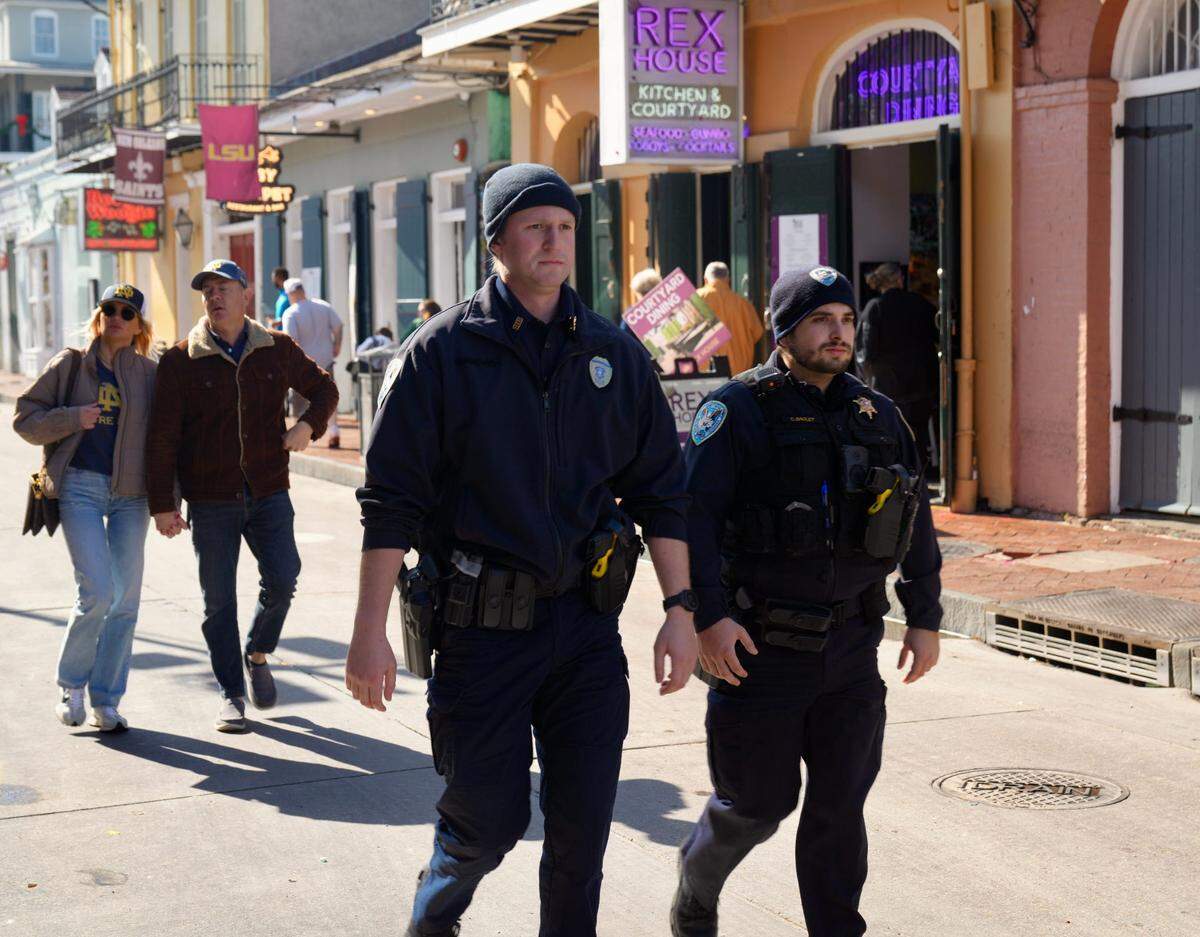
NFL chief security officer Cathy Lanier said in a press conference Wednesday that “thousands” of state, federal and local law enforcement officers will be deployed over Super Bowl weekend. Many will be concentrated in crowds and on rooftops in the French Quarter and the Warehouse District, the neighborhoods closest to the Superdome.
“The biggest thing that you’ll see that’s different (following the January attack) is just a lot more visible law enforcement presence and a hardened security perimeter,” Lanier said.
Eric DeLaune, a Homeland Security special agent leading federal coordination for Super Bowl LIX, told ESPN earlier this month that the overall goal is for visitors to be unable to “walk a city block in downtown New Orleans without at least encountering one law enforcement official.”
The city also hosted a training session, “Prepared & Protected: Security Strategies for Hospitality Professionals,” aimed at helping hospitality workers “identify and assess suspicious activity, as well as providing strategies for reporting their observations.”
“Attendees will learn how to recognize and report potential terrorist threats, understand the motives behind terrorist actions, and familiarize themselves with the various stages of the terrorist planning cycle,” according to a city release announcing the session.
Gov. Jeff Landry announced Wednesday that an “enhanced security zone” on Bourbon Street will be in effect between Feb. 5 and Feb. 10. It will “encompass the seven blocks from Canal Street to St. Ann Street and the two blocks between Dauphine Street and Royal Street,” NOLA.com reported, and include checkpoints, bag searches and a ban on coolers.
Lanier said Wednesday that there have been no credible threats in New Orleans since the January attack.
“We feel pretty good,” she said.
Beautification
Mayor LaToya Cantrell recently announced the Love Your City initiative, which invites residents to clean up various neighborhoods throughout New Orleans.
Volunteers are meeting this weekend in Central City, Treme, Hollygrove, Algiers, Rosedale, and the 7th Ward to spruce up streets and parks in advance of the Super Bowl.
New Orleans has also spent $2.1 million to build a food truck hub near the Super Dome.
The Earhart Food Truck Plaza, located on a concrete lot under the Pontchartrain Expressway, is set to open in time for the Super Bowl. It will feature eight food truck vendors, benches and other seating, and murals commissioned by the Arts Council painted along the highway underpass.
“Our food truck proprietors have made this location special to the City of New Orleans,” Cantrell said in a news release. “I am excited about what this project will do for our small businesses and our city as a whole.”
NOLA’S unhoused
Across from the new Earhart Food Truck Plaza is a former homeless encampment that Gov. Jeff Landry ordered to be cleared ahead of a three-night run of Taylor Swift’s Eras Tour in October.
Following the New Year’s Day attack, Landry issued an executive order directing state officials to clear more encampments in advance of Super Bowl and Mardi Gras crowds.
“It is in the best interest of every citizen’s safety and security to give the unhoused humane and safe shelter as we begin to welcome the world to the city of New Orleans,” Landry said in a statement.
Many of the homeless have been relocated to a temporary shelter near Gentilly, an industrial neighborhood far from the city core. Others have been sent out of state.
The plan, which will cost the state at least $11 million, has generated some controversy.
“I think it shows that we would accept a lot of harm to unhoused people as the price to pay so they’re not visible during these big events,” Angela Owczarek with New Orleans Homeless and Houseless Advocacy, Research and Rights Monitoring (NOHHARM) told The New York Times earlier this month.
The Star’s Mike Hendricks contributed to this report.
This story was originally published January 31, 2025 at 5:00 AM.
CORRECTION: This story previous misstated how many times New Orleans has hosted a Super Bowl. It has been updated.