
Eric Bieniemy’s approach to Chiefs’ offense mirrors his head-on approach to life
Eric Bieniemy bounces between position groups at Chiefs practice like he did during his years as an undersized but rugged running back. He’s here, then there, then way over there.
Even as the Chiefs’ offense coordinator, Bieniemy seeks contact, only in a different way. He pulls running back Spencer Ware aside for a demonstration, pats the shoulder pad of wide receiver Demarcus Robinson after a nice catch and goes face to face with quarterback Patrick Mahomes.
But something was missing as Bieniemy worked the practice field recently. One of the team’s most vocal coaches, the man who oversaw the running backs during his first five seasons with the Chiefs, well, his voice on this day was barely perceptible.
“Listen closer,” Chiefs coach Andy Reid said. “He’s just not in one spot anymore.”
Mahomes replacing Alex Smith is unquestionably is the biggest change to the Chiefs’ offense headed into 2018, but expectations also accompany the new coordinator of the offense.
Bieniemy follows Matt Nagy, who after two seasons in the role with the Chiefs now heads the Chicago Bears.
Doug Pederson was in that office before Nagy, and in his second season as the Philadelphia Eagles’ head coach won the Super Bowl.
The fast track has been established. But Bieniemy can’t think about his next job before he’s even coached a single regular-season game in this job.
“That’s not my focus,” Bieniemy said. “It can’t be.”
Whether it was dealing with racism as a student at Colorado, where he was a star, or squeezing every drop out of a nine-year NFL career, entering a coaching career, or raising a child with a disability, the task at hand gets Bieniemy’s full attention, and he faces it like he played: unafraid of contact.
“He’ll be honest with you,” Reid said. “He’s not going to play games. He’ll shoot you straight.”
The inspiration
Eric Bieniemy III, the older of Mia and Eric’s two children, is 23, has cerebral palsy, lives at home and is confined to a wheelchair.
“He runs the house,” Bieniemy said with a laugh. “And he will continue to run the house.”
Career moves have been made with Eric III in mind. When Bieniemy considered leaving his first coaching job at Colorado to become a running backs coach at UCLA in 2003, part of the pitch was the Bruins’ offer of assistance from the school’s Orthopaedic Hospital Center for Cerebral Palsy.
Bieniemy said proudly earlier this month that his son recently graduated from high school, and the family is looking into adult care options.
“He’s the heart and soul and the nucleus of our family,”Bieniemy said. “He’s the one who makes us go. When he’s feeling good, we’re feeling good. And when he’s not, we’re down. It gives you a whole different perspective on things, on what’s important.”
More coaching opportunities came Bieniemy’s way, and up the ladder he climbed. After three years at UCLA, he became the running backs coach for the Minnesota Vikings, and living near the Mayo Clinic in Rochester, Minn., was a factor in his decision.
In Minnesota, Bieniemy was the first position coach for Adrian Peterson and helped the former Oklahoma star to rookie- and player-of-the-year seasons.
Along the way, a Bieniemy network was forming. The Vikings’ head coach then was Brad Childress, who has served as a quarterbacks coach and offensive coordinator under Reid in Philadelphia.
Bieniemy spent his final NFL season with the Eagles in 1999, Reid’s first year there, and then served an internship with the team.
“We go back even further,” Bieniemy said.
Bieniemy was a star Colorado running back when Reid served as Missouri’s offensive line coach from 1989-91. That stretch includes the Buffaloes’ national championship team of 1990, a season Mizzou fans remember largely for the Fifth Down Game.
Colorado received an extra down on a frantic, final-second touchdown drive. Without the error, the Buffaloes probably don’t win at Columbia or share that season’s national title with Georgia Tech.
“I tell (Reid) there were really only four opportunities, because we spiked it once,” Bieniemy says with a smile.
Asked about the game, Reid said, “I have a hard time with that one.”
Networking
Bieniemy might not be with the Chiefs if his previous job had worked out.
He returned to Colorado in 2011 to join Jon Embree as offensive coordinator. Bieniemy was a finalist for the head coaching job. When it went to Embree, finances were arranged to make it worthwhile for Bieniemy to come back to Boulder.
As a player, Bieniemy enjoyed a marvelous career as a 5-foot-6 dynamo who finishing second in the nation in rushing and third in the Heisman Trophy race as a senior.
“The most competitive guy I’d ever been around,” former Colorado coach Bill McCartney said. “Three days into practice, when he was a freshman, we’re looking at each other as coaches and asking, ‘What do we have here?’ ”
What Colorado had was an excellent athlete, but also one who wasn’t always happy at the mostly all-white campus. Bieniemy was born in New Orleans and grew up in a mixed-race neighborhood in Southern California.
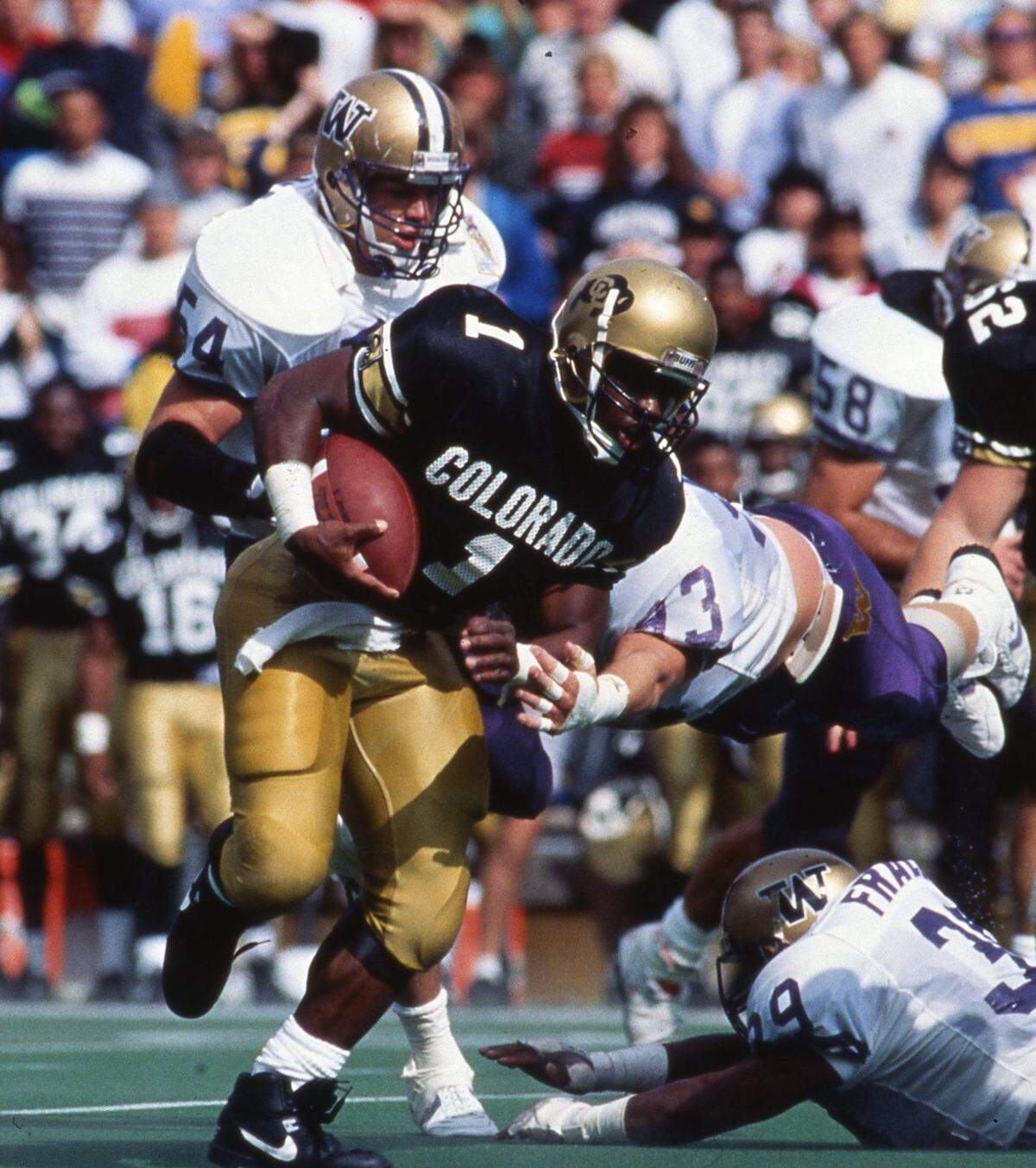
Getting called the N-word at a campus bar led to an altercation and an arrest. Bieniemy received a suspended sentence and was ordered to perform community service. There also was a DUI in 2001 during his first coaching stint at Colorado.
“I wouldn’t change any of my experience there, even with some of the negative stuff that took place,” Bieniemy said. “It helped shape me as a person and helped me grow. You learn from your mistakes.”
Even ones on the field. After two seasons and four victories, Embree was fired. That same year also was the final one for Romeo Crennel in Kansas City and Reid in Philadelphia.
The Chiefs hired Reid, who then hired Childress and Bieniemy. In his new stable of running backs, Bieniemy oversaw Jamaal Charles, who under his new position coach turned in an All-Pro season.
“You think about it, a lot of things had to happen for me to end up where I did,” Bieniemy said. “But I’m glad I’m here.”
Different perspective
Unlike Pederson and Nagy, who were quarterbacks, Bieniemy comes to the job from a rushing-game background.
Reid sees Bieniemy using that to his advantage in certain areas, like protections. From lining up where he did as a player and having coached running backs, Bieniemy knows blocking schemes.
“He’s an expert on all the protections, no matter whose eyes you’re looking through — whether it’s the offensive line, running backs, quarterbacks,” Reid said. “Helping Patrick with that at a young age is invaluable.
“And, I feel like he has a pretty good feel of the offense.”
Play-calling responsibility will remain with Reid, as it has with acouple of exceptions throughout his Chiefs tenure.
Bieniemy’s task is to help shape an offense dotted with playmaking talent, such as tight end Travis Kelce, wide receivers Tyreek Hill and Sammy Watkins and running back Kareem Hunt — and an experienced offensive line — and accelerate the learning curve for Mahomes in his first year as a starter.
No more screaming, however. Bieniemy said he’ll remain a toned-down version of himself in his new position.
“As excited as I am to be doing this, you can’t get too high or too low,” Bieniemy said. “My job is to step back and look the big picture, evaluating and making sure we’re getting the most out of all of our players.
“It’s not always easy, but I have to be even keel about this.”