
New player-tracking software gets rave reviews from baseball obsessives
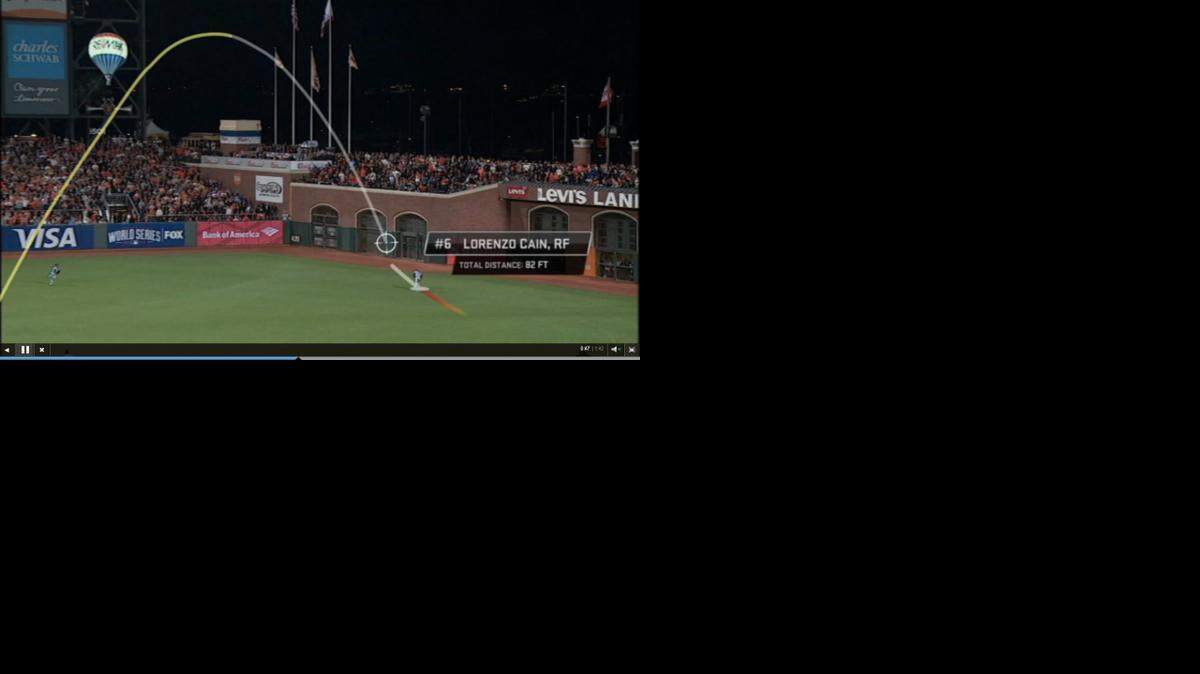
The latest innovation for baseball’s legion of stat nerds was rolled out for League Championship Series play this October and Statcast already is drawing rave reviews.
Statcast is the brainchild ChyronHego — a company based in Melville, N.Y., which manufactures the camera array — and TrackMan, which developed a radarlike software for precision tracking of player movement relative to the ball.
“My first impression is it’s been awesome,” said Shawmut Design and Construction project executive Eric Geisler, who oversaw the installation in Kansas City, Baltimore, San Francisco and St. Louis. “It adds a whole new dimension to the game.”
Shawmut also installed the camera systems and networks for baseball’s expanded replay system, which went into effect for the 2014 season, and it currently deploying enhanced Wi-Fi systems in the league’s stadiums.
The Statcast system is akin to the wildly popular Pitchf/x, which tracks pitch velocity as well as each dip and dart of every pitch delivered during the major league season.
“Each camera has three eyes on it that are monitoring the field,” Geisler said. “They basically map the field and measure the whole thing. Those cameras have to be placed so they have a clear view. … The eyes are scanning the field continuously and can recognize the ball when there’s a hit and recognize where the player started.”
Geisler said each camera has three lens stacked on top of each other that are synchronized. An array throughout the stadium creates something of a video/radar account of the game action.
Among the first videos to emerge from the ALCS was Royals center fielder Lorenzo Cain’s diving grab to rob J.J. Hardy on a tailing liner to the right-center field gap during game two at Camden Yards.
Based on Statcast’s images, Cain reacted to Hardy’s hit in 0.24 seconds and covered 82 feet in 3.65 seconds, reaching a top speed of 21.2 mph with a near-perfect route efficiency of 99.7 percent, which compares his actual route to the optimal route.
Such data, especially over the course of a season, will revolutionize the way defensive statistics — and things like base running — are measured and compared.
“It will be great for breaking down and analyzing players, but also for the teams themselves to analyze once the data set is big enough,” Geisler said.
Statcast could be available in all 30 stadiums at some point in 2015, providing unprecedented and unparalleled information about America’s pastime.
Shawmut was mobilized to prepare for installation of Statcast’s infrastructure in all of the playoff parks, a process that began roughly a week before the Wild Card round commenced.
“They didn’t know obviously who would be in the ALCS and NLCS, so we had to get all that infrastructure done before those games started,” Geisler said. “We were tracking all the baseball games — no pun intended — to see which cities needed staffing first.”
Geisler said there are only currently only four sets of cameras available in the United States, which is why installation was limited to the League Championship Series sites.
The Royals did Shawmut a big favor by sweeping the Angels in the AL Division Series.
“Definitely,” Geisler said. “That was one of the first ones to go in … (but) the overall goal is to get this throughout the league.”
To reach Tod Palmer, call 816-234-4389 or send email to tpalmer@kcstar.com. Follow him on Twitter: @todpalmer.
More Statcast links from the Royals’ playoff run:
▪ Curious about the route efficiency or release times on the Nori Aoki-Omar Infante-Salvador Perez relay that cut down Buster Posey at home during the first inning of the World Series’ first game?
▪ Remember Perez’s terrific play on Gregor Blanco’s eighth-inning bunt in game three of the World Series? It’s broken down into easily digestible bites by Statcast:
▪ The Royals’ three-time Gold Glove left fielder, Alex Gordon, made a spectacular catch on Hardy’s drive to the wall leading off the fifth inning in game four of the ALCS.
▪ Cain saved at least two runs Sunday when he ran down a drive by Hunter Pence into the right-field gap at AT&T Park in San Francisco during game five of the World Series: