
San Francisco’s scenic AT&T Park can be tough on outfielders
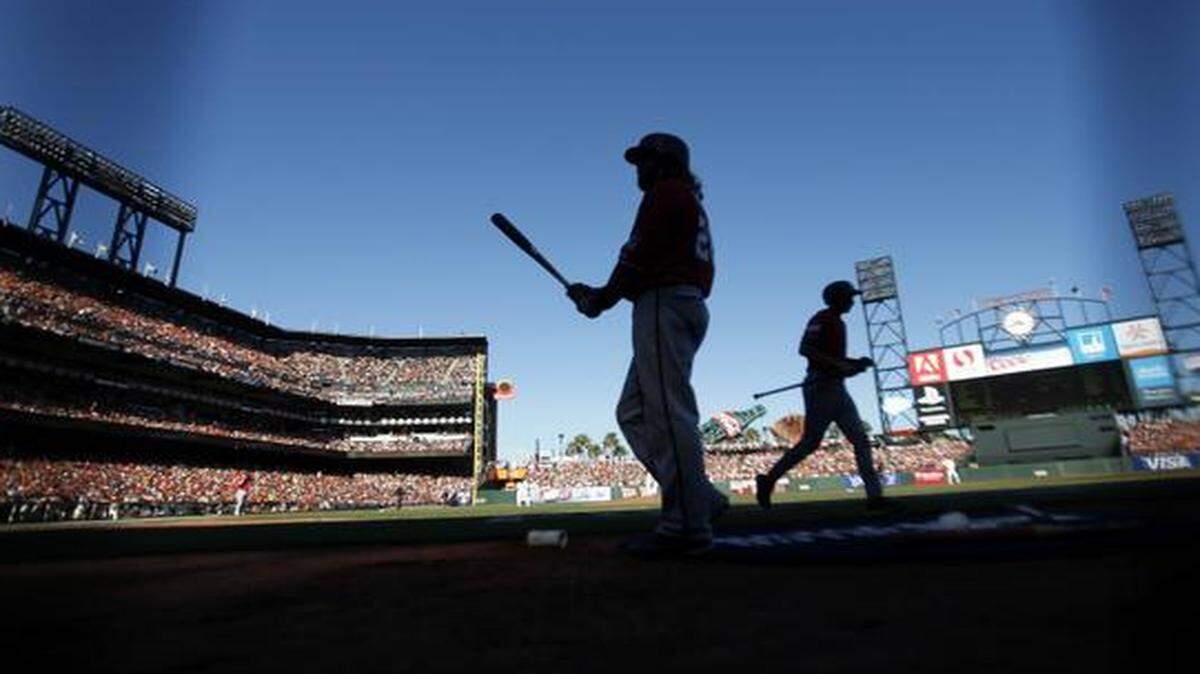
The sidewalk that separates AT&T Park from the edge of the China Basin Channel is just 27 feet wide, a narrow pathway that bisects one landmark from another. If you stand here, just beyond the right-field wall, you can look out toward San Francisco Bay as the wind rustles up against the flag poles and brick pillars that defend the waterfront known as McCovey Cove.
If you turn left, you can look back toward the playing field, to the hulking Bay Bridge rising above the left-field bleacher seats. Now fix your eyes on the right-field wall, 25 feet high and made of brick, a jutting mix of hard angles and possibilities.
Nearly 20 years ago, when a Kansas City man named Joe Spear was enlisted to design the new home ballpark for the San Francisco Giants, he found himself at Coors Field in Denver, touring the ballpark with Peter Magowan, then the managing partner of the Giants. Spear, a veteran of the sports architecture business, expected they would do the usual routine of sorting through ideas for suites and sight lines.
But for nearly three hours that day in Colorado, Magowan and Spear walked around the playing field. Magowan, Spear recalls, kept thinking up all these crazy ideas for angles in the outfield wall.
“He was completely focused on how the game would be played,” says Spear, now in his 31st year with Kansas City-based design firm Populous.
Here in San Francisco on Friday night, the Royals will learn all about the magic of AT&T Park when game three of the World Series convenes in the China Basin.
“The balls go all over the place,” Royals center fielder Lorenzo Cain said Thursday, standing in the visitor’s clubhouse following an afternoon workout inside the stadium. “You definitely have to be on your toes.”
For most of the Royals, this is their first chance to play at AT&T Park, the Giants’ home since 2000 and the park that has served as the franchise’s main stage during runs to the World Series championship in 2010 and 2012.
But to understand what could happen here Friday, it’s best to speak with the Kansas City man who, at least in part, is responsible for the stadium that has grown into an iconic Bay Area attraction in just 15 years.
Start with the brick wall in right field. The fun begins at the right-field foul pole, which sits just 309 feet from home plate. The reddish-brown wall then slants out along the edge of the cove, extending to 365 in right field before another odd inward angle gives way to a 421-foot chasm in right-center, a feature reminiscent of the Giants’ old home at the Polo Grounds in New York.
This would be enough to raise any outfielder’s stress level, but Spear had one more idea. The city of San Francisco was adamant that the port walk behind the right-field wall remain open to the public during Giants’ games. So Spear’s team suggested that the wall be constructed in an arched style, so people walking along the bay could peer into the stadium. The idea left the right-field wall as a combination of hard brick and chain fence inside the arches.
“It’s definitely tough,” Cain said. “I definitely will admit that, with the brick and then the chain-link fence and the angles out there. It’s tough. So you’ve got to be on your toes and be ready for anything.”
During Thursday’s workout, Cain and the Royals’ outfielders huddled with outfield instructor Rusty Kuntz in right field for the first two groups of batting practice. Together, they worked on reading the bounces off the wall. As Cain worked on his reads, he noticed something under his feet. Even the surface on the warning track was a little bit different.
“Like beach sand,” he said.
Cain, who will likely start in center field, has grown accustomed to moving to right field late in games, giving way for Jarrod Dyson in center. Right fielder Nori Aoki, who has started all 10 playoff games, has often been adventurous — though successful — during the last three weeks. With fly-ball pitchers Jeremy Guthrie and Jason Vargas scheduled to pitch games three and four, Yost said he would consider different setups in the outfield.
On Thursday afternoon in San Francisco, joggers breezed through the port walk while the Royals hit batting practice. Out in right field, a sign keeps track of the number of balls the Giants splash into McCovey Cove, named for San Francisco legend Willie McCovey. For now, it says “68.”
Out in McCovey Cove, a tugboat draped with Giants flags kept watch over a still bay. A solitary kayaker paddled up to the shoreline. On Friday night, the cove will be jammed, alive with action as the World Series returns to this site for the third time in five years.
In 2010, the Giants won both games here against the Texas Rangers. Two years ago, they did the same against the Detroit Tigers. The Giants, of course, hope the magic continues.
Back in Kansas City, Spear prepared to watch the Royals play a World Series game in the park he once conceived. In the early days of the project, he says, there was discussion about whether the ballpark should open up to the city skyline instead of the bay. In the end, the waterfront won out, and the limited real estate in the 13-acre site necessitated some creativity in right field.
Nearly two decades later, Spear is glad it did.
“You can look at the water for hours,” Spear says. “At least I can.”
To reach Rustin Dodd, call 816-234-4937 or send email to rdodd@kcstar.com. Follow him on Twitter: @rustindodd.
This story was originally published October 23, 2014 at 11:23 PM.