How the Kansas City Royals are using data analytics to develop their pitching staff
Kansas City Royals pitcher Michael Wacha stared intently at his target. There was intensity in his eyes, but his face was as expressionless as stone.
He shook his head. Then he furrowed his brow and twirled his glove, his fingers gripping the baseball tightly.
Wacha began his windup, stepping forcefully toward home plate before flinging the ball 60 feet, 6 inches. The pitch sliced through the Arizona air and slammed into the catcher’s mitt.
A loud pop of ball finding leather followed. Its reverberation caught the Royals’ attention. Wacha, who had just finished his delivery, nodded in agreement.
A job well done. And one captured on state-of-the-art camera equipment.
“The technology wasn’t really around when I first got called up,” Wacha said. “I think it’s a great tool for pitchers.”
The Royals have tracked Wacha’s velocity, spin rate, angle movement and overall pitch trajectory this spring. High-definition cameras provide a 3D look at his hand placement, pitching grips and the rotational axis of the baseball.
So what is this advanced technology? The Royals are among numerous Major League Baseball teams diving ever deeper into data analytics.
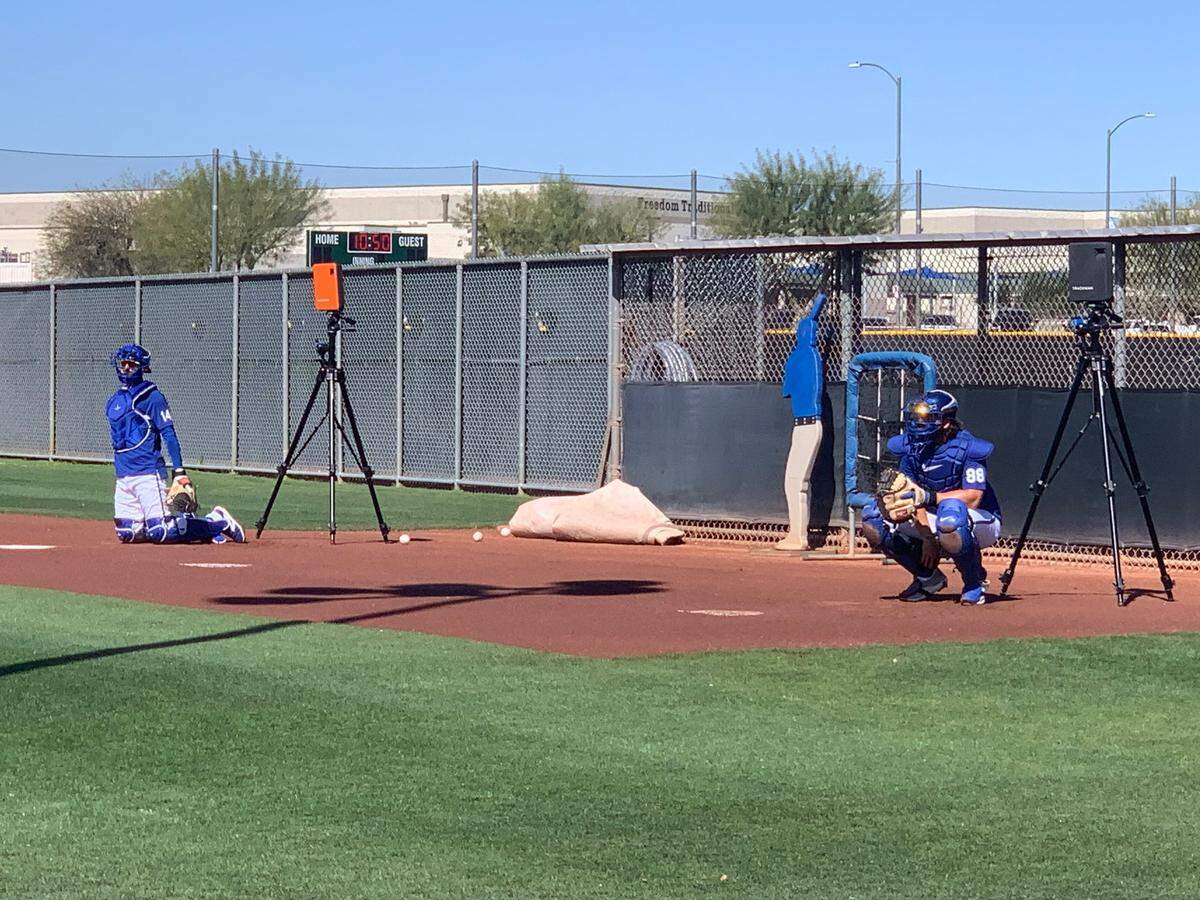
The Royals use two major digital instruments to help their pitchers at spring training: the TrackMan system and Edgertronic cameras. Both products provide real-time data that can be interpreted instantly.
That’s a stark change from Wacha’s early years in pro ball. He made his major-league debut in 2013 and remembers a time when there was no such technology.
When he was coming up, teams more or less had just one way of analyzing a fastball:
Did the batter hit it?
“We used to call it the invisible fastball,” Wacha said. “Guys would throw the fastball right down the middle and they would get swings and misses on it in the low 90s. We were like, ‘How is he doing that?’
“Now we know the guy has good carry on his fastball. It (today’s technology) actually perceives that it’s rising in the (strike) zone. It’s cool looking back on it now and seeing that’s the reason why those pitches worked.”
Pitching today is all about numbers. And Wacha, 32, has made that turn in the past couple of years. Today, he and other Royals pitchers ask questions like, How much horizontal break can I get on my slider? ... or, What’s the best grip for creating vertical depth on my sinker?
“Innovation is the data part — that’s just a tool, to help the players be the best version of themselves,” Royals pitching coach Brian Sweeney said.
The Royals have invested in their research and development team this offseason. Sweeney works in lockstep with multiple video coordinators, who compile data from each workout session and spring training game.
All pitchers’ data gets uploaded into a daily profile. Those profiles are then sent to Sweeney in an email. Each morning, Sweeney goes through the numbers and communicates with each of his pitchers.
The Royals call this “After Action Review,” and it’s intended to highlight in detail a previous pitching session.
“We talk about how it looked and we think about, ‘What’s the next steps to getting better?’” Sweeney said.
The TrackMan and Edgertronic cameras play vital roles in those discussions.
TrackMan technology has been prevalent in golf for years. For baseball, it’s a radar system that tracks the flight of a ball in motion. TrackMan uses Doppler technology to gather real-time data, which teams utilize in multiple ways.
The device can typically be identified as an orange box situated on a tripod behind the catcher. Major-league stadiums also feature the TrackMan during games.
“We have a bullpen report that shows (a pitcher), ‘This is what you did and this is what it looks like ...’” Sweeney said. “We have a tool at our disposal that is able to help us and help make the guys better.”
The Edgertronic camera offers a different radar metric. It operates in slow-motion to show a clear picture of how the baseball is coming out of a pitcher’s hand. An Edgertronic camera can shoot upward of 1,000 frames per second.
The Royals usually set up an Edgertronic device behind their pitchers. Once in place, it enables a zoomed-in view of the pitches being thrown.
Together, the Edgertronic and TrackMan can help pitchers learn more about their arsenal.
“It’s just a slow-mo and you are seeing how their fingers interact and put force in the baseball,” Sweeney said. “It’s really cool.”
The Royals also use traditional cameras to gather various snapshots of player performance. Wide-zoom lenses can depict mechanical adjustments and ball placement.
Some Royals players have experience using the Rapsodo camera system. The Royals don’t currently utilize Raspodo, but it, too, can help pitchers visualize their spin rate and spin efficiency.
“I really took interest in that and kind of consider it a way to improve myself and optimize what I have on the pitching front,” veteran Royals pitcher Kris Bubic said. “I wouldn’t consider myself the most athletic guy in this clubhouse. I’m not pumping upper 90s to 100 (mph).
“So for me, if I can use the data to optimize my arsenal and mechanics the best I can, I am going to do that.”
Bubic first became interested in data analytics around 2019 while he was playing for the High-A Wilmington Blue Rocks of the Carolina League. The Blue Rocks utilized the Rapsodo and Edgertronic cameras to help younger pitchers like Bubic improve.
Bubic tinkered with different pitching grips. He also researched how other pitchers laid out their respective arsenals. That season, Bubic was 7-4 with a 2.30 ERA in 17 starts.
The Royals promoted him up through their farm system. Now recovering from Tommy John surgery, he is expected to make his return sometime this summer.
“I think pitchers are always looking for ways to improve as fast as they can,” Bubic said.
A few Royals confessed to being at least somewhat skeptical of the advanced camera technology.
Newcomer Seth Lugo, for instance, said that early in his career he’d relied on a more old-school approach: working with his pitching coaches to adjust his game plan based on the batter he was facing. He focused on controlling his body movements in order to increase his velocity or extend his breaking pitches.
Lugo said he tried the TrackMan system when he arrived for big-league camp with the New York Mets in 2016. The technology was fairly new then, but Lugo said it showed that he was altering his arm slot when throwing fastballs or curveballs.
Lugo said he was advised to throw both pitches differently. So he threw a bullpen session and worked on that adjustment. But then, he said, he threw more curveballs in his next workout and strained a pronator muscle in his forearm.
The injury derailed his start to the 2016 season.
“I think when it (new technology) was first coming out, it was a little dangerous because pitching coaches and pitchers didn’t know how to use it to make the proper adjustments,” Lugo said. “(They were) strictly trying to match up a couple of numbers, which is probably bad for your arm.”
Lugo has since regained confidence in data analytics, noting the technology has improved in recent years. He became a full-time starter last season with the San Diego Padres and relied on data as he posted a 3.57 ERA in 26 starts. He joined the Royals this offseason.
“Now, I think there is better understanding,” he said. “There is more handling of the arm slot and more data of how the pitch is coming out of your hand.”
Perhaps, but reliever Nick Anderson prefers to trust his instincts and leave the data for his coaches to decipher.
“I don’t really use that stuff,” he said. “I’m a little more old school in that sense. Every once in a while, I might take a peek at it. For the most part, I don’t really use that.”
Last season, Anderson recorded a 3.06 ERA in 35 1/3 innings with the Atlanta Braves. He prefers to pitch batter to batter, making adjustments as needed based on what he and his catcher are seeing.
“I feel like the more you don’t worry about that, you just go compete and throw your stuff,” Anderson said. “Some days you just don’t have it. I feel like if you are always kind of looking at it and comparing results, the next time you don’t have it, it’s like, ‘Oh, crap, what am I going to do?’
“It can turn into a mental thing. I think for me, it’s less to worry about in that aspect. It’s kind of just throw the ball. How it comes out is how it comes out.”
The Royals are being as innovative as they can, and that will show up in the dugout. Major League Baseball allows the use of iPads during games, so pitchers are able to see right away how they performed against certain hitters.
“It’s simple, concise, actionable data,” Sweeney said, “so that they can sit down, have a drink of water and get ready to go out and compete again.”
The Royals will get a truer gauge of their pitching depth this summer. For now, some of the organization’s pitchers — Cole Ragans, James McArthur and Alec Marsh, for example — seem to be taking noticeable steps forward.
“It’s very impressive how they are able to see everything,” said another Royals pitching prospect, Jonathan Bowlan. “It definitely does help when you are trying to develop pitches, pitch shape and everything else like that.”
This story was originally published March 11, 2024 at 6:00 AM.