Why the MLB lockout puts spring training start in doubt for Kansas City Royals
The Kansas City Royals should be reporting to the sunshine and warm weather of Arizona next week to begin spring training drills in preparation for the upcoming Major League Baseball season.
Instead, the players remain locked out by the league’s owners and the only immediate certainty is that minor-league camp will begin next week (minor-league players not on their clubs’ respective 40-man rosters are not subject to the lockout).
Major-league camps will not start on time if the lockout continues. Depending on how long the start of spring training gets delayed, if it is delayed, the March 31 start to the regular season could also get pushed back.
How did the impasse between owners and players drag on for this long and what issues have them at odds?
Here’s an overview of how spring training has been put in doubt.
A quiet winter for MLB
The owners implemented a lockout of the players on Dec. 2, immediately after the latest Collective Bargaining Agreement (agreed upon in 2016) expired.
The decision to lock out the players also froze many of the typical operations and transactions fans commonly associate with the winter months, such as free-agent signings, contract extensions, trades, arbitration hearings and the Rule 5 Draft.
The lockout also prohibits players on 40-man rosters from working out, training and rehabbing at team facilities. They’re also not allowed to have contact with any team officials, including coaches and the front office.
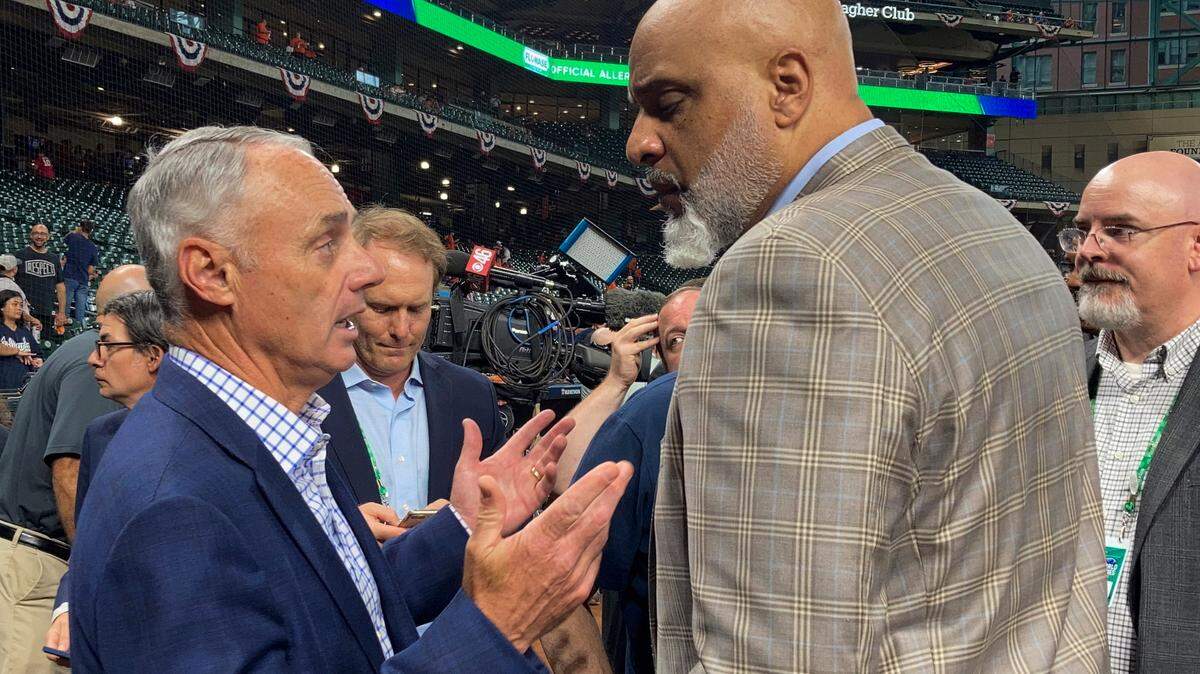
After the owners imposed the lockout, MLB Commissioner Rob Manfred wrote in “A letter to baseball fans” posted to MLB.com, “To be clear: this hard but important step does not necessarily mean games will be cancelled. In fact, we are taking this step now because it accelerates the urgency for an agreement with as much runway as possible to avoid doing damage to the 2022 season.”
The sides didn’t hold their first bargaining session until Jan. 13.
Players CBA concerns
MLB players have identified several aspects of their most recent agreement that they feel need to be addressed, including:
Tanking: Players contend that too often teams have “tanked” or went into a season without the intention of being competitive and exploiting the current system to save money instead of spending it on payroll to field the best teams possible. They want to adjust the penalties and/or incentives for teams to spend to make their teams annually competitive.
Luxury tax: Players contend that owners have used the competitive balance tax or “luxury tax” threshold as a default salary cap or artificial limit on payrolls. Last season, payrolls reached their lowest level in a full-length season since 2015. MLB had produced record revenues prior to the pandemic-shortened season in 2020.
Salary arbitration eligibility/service time manipulation: Players want to alter the rules that allow clubs to unilaterally decide salaries for players during their first three seasons in the majors. The current exception to that rule is the “Super Two” group or the top 22% of players (in terms of service time) entering their third season in the majors. That group reaches salary arbitration a year earlier than their peers.
By keeping players in the minors even after they’re ready to contribute daily in the majors, teams can keep them from reaching that Super Two designation and thereby gain another year of team control before a player reaches salary arbitration.
Free agency: Players argue that by the time players reach free agency, after six years of MLB service time, they’re often at an age where clubs don’t want to offer larger contracts. Their proposals have reportedly centered around the ideas of distributing more money to young players earlier in their careers and/or allowing players to reach free agency earlier than after six years of major-league service time.
According to the Associated Press, 1,145 of the 1,670 players on a major league roster last year earned under $1 million, while 771 earned less than $500,000 and 241 under $100,000. The 100 highest-paid players amassed 50.6% of earnings.
Owners and players frustrated by impasse
Last week, the MLB Players Association rejected the owners’ call for a federal mediator to step into the talks — seemingly a sign of the owners’ frustration with the progress of negotiations.
In a statement, the MLBPA said they were led to believe that a counterproposal would be coming from the owners when the owners instead called for mediation.
“The clearest path to a fair and timely agreement is to get back to the table,” the MLBPA statement read. “Players stand ready to negotiate.”
An MLB spokesperson reacted to the players declining mediation in comments to MLB.com, saying, “It is clear the most productive path forward would be the involvement of an impartial third party to help bridge gaps and facilitate an agreement.
“It is hard to understand why a party that wants to make an agreement would reject mediation from the federal agency specifically tasked with resolving these disputes, including many successes in professional sports.”
Major-league players, including All-Star pitcher and MLBPA executive committee member Max Scherzer, All-Star players Willson Contreras, Zack Britton, Mitch Haniger, Royals All-Star Whit Merrifield as well as Royals Brad Keller and Nicky Lopez, went to social media to profess their desire to resume bargaining.
In successive tweets last week, Scherzer wrote, “We don’t need mediation because what we are offering to MLB is fair for both sides:
“We want a system where threshold and penalties don’t function as caps, allows younger players to realize more of their market value, makes service time manipulation a thing of the past, and eliminate tanking as a winning strategy.”
Lopez’s Twitter post read, “We, the players, have been more than fair during this whole process. It’s time we get back to ‘bargaining’ and come up with a conclusion on the Bargaining Agreement. #AtTheTable”
On Thursday, MLB and the players agreed to resume negotiations Saturday after an 11-day break, according to The Associated Press.
“I am an optimist and I believe we will have an agreement in time to play our regular schedule,” Manfred said Thursday after a three-day owners’ meeting, according to the AP. “I see missing games as a disastrous outcome for this industry and we’re committed to making an agreement in an effort to avoid that.”
This story was originally published February 10, 2022 at 9:15 AM.