Royals pouring ample resources into top prospects Asa Lacy, Bobby Witt Jr. this summer
Tantalizingly talented pitcher Asa Lacy and baby-faced hitting savant Bobby Witt Jr. have prompted the Kansas City Royals to think aggressively during the season of COVID-19, but the organization remains a long way from reckless with its top farmhands.
Witt, 20, had an impressive showing during spring training 2.0 with the big-league club, and the Royals added Lacy to the pool of players who are working out at their alternate training site in Kansas City, Kan., this summer — T-Bones Stadium.
Manager Mike Matheny acknowledged that he’s keeping tabs on the pair’s progress, though they’re continuing to work toward the future, and not the present. Lacy was just drafted by the Royals No. 4 overall in June.
“I know they’re going to go slow. There’s no push right now,” Matheny said. “Actually, when I’m calling and talking about what’s going on at the secondary site, it’s all about who might be the next guy to come here and help us. I think we all realize that Asa has just got to get his feet under him. He’ll get the repetitions.”
The key phrases there: “no push,” and, get his “feet under him.” In other words, Lacy does not figure into the major-league club’s immediate plans.
That might throw a bucket of cold water on Royals followers who are already fired up about potentially seeing the two top farmhands in the big leagues soon, but assistant general manager/player performance J.J. Picollo and the Royals’ player development staff for now are content to be shaping these key pieces of the Royals’ next contending iteration in relative seclusion.
Fall ball
Baseball America reported last week that MLB might allow teams to add as many as 15 players to the groups working out at the clubs’ alternate training sites to allow for full, daily intrasquad scrimmages.
Currently, with the prominent numbers of pitchers on those player-pool rosters, there usually aren’t enough position players to field two defensive lineups.
Adding to the alternate-site player pools would allow for a natural transition into an expanded Fall League for minor-leaguers who couldn’t play a season this year. All minor-league seasons were called off this summer because of the pandemic.
Ideally, each MLB club would field a fall club made up entirely of its own prospects instead of each fall team featuring a roster with spots split evenly between several MLB clubs.
The expanded fall league could start in mid-September of early October and continue into November.
If some version of the plan is approved by MLB, it would guide how the Royals proceed with their top prospects heading into the following season.
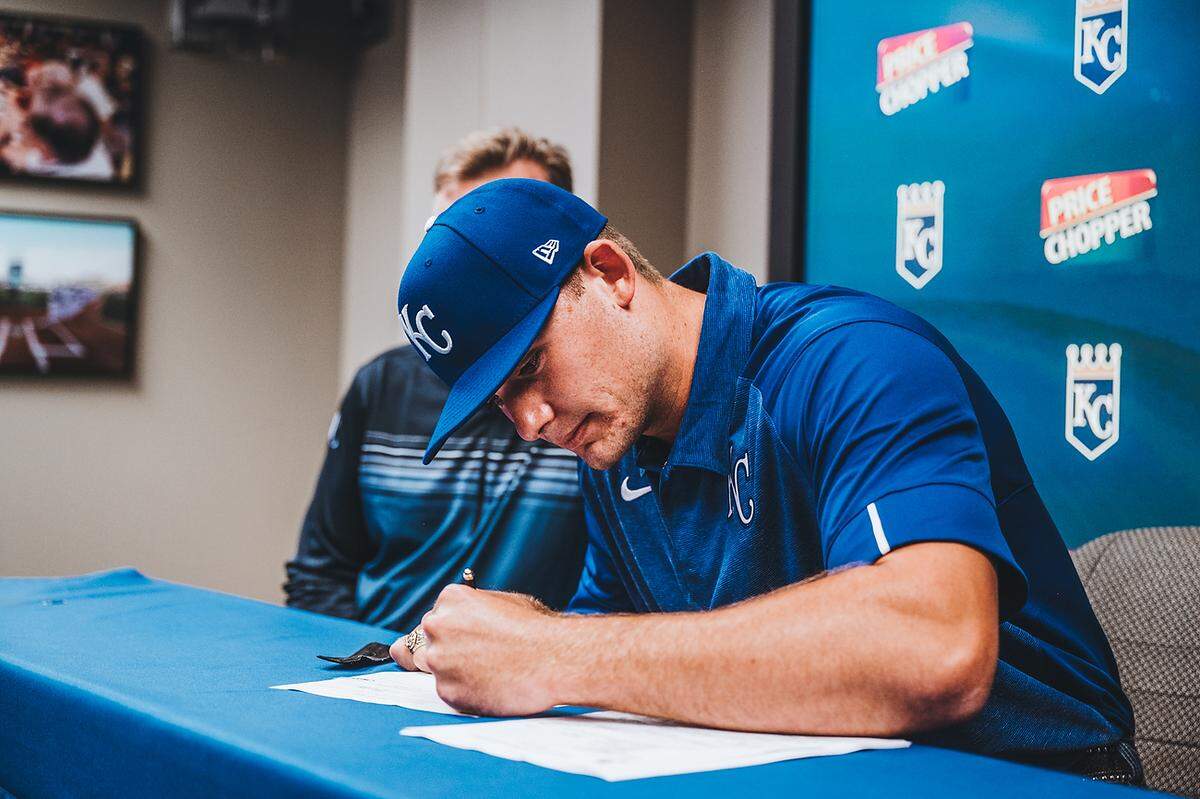
Asa Lacy
When the Royals originally set their 60-player pool for spring training 2.0 in Kansas City, they had clear intentions of bringing in several young pitchers, such as Lacy, Carlos Hernandez and Ofreidy Gomez, after the MLB season had started and they were able to sort out their depth. All three were recently added to the player pool.
The No. 4 overall pick in this year’s draft, Lacy shows traits of a potential future big-league ace. Baseball America and MLBPipeline.com have each ranked him the top pitching prospect in the Royals’ farm system and the No. 2 prospect regardless of position, behind Witt.
For now, the Royals will move deliberately with Lacy, who pitched just 24 innings in his pandemic-shortened junior season at Texas A&M and arrived at the alternate site just a week ago.
“The thought with Asa was we can get him into this alternate site, bring him along a little bit more slowly,” Picollo said. “There’s no need to get him up to give innings. He’ll go on an innings progression. By the time we get to the middle of September, end of October, if there is a fall league he’s ready to go into that league and pitch for a certain amount of time.”
The Royals staff has just started learning more about Lacy. He threw a few bullpen session and was scheduled to pitch a live batting practice session early this week. But the message from director of pitching performance Paul Gibson is that Lacy should simply be himself, do what he does and let the staff gain familiarity with him, his delivery and his pitches.
“I think in a traditional setting, we wouldn’t even be discussing Asa Lacy coming up the year he was drafted,” Picollo said. “Just because we’re at this alternate site and it’s the only thing going, I think people want to interpret that as, ‘The Royals must think he’s going to help us this year.’ It’s not that we don’t think he has that ability, it’s just the necessity of it — and let’s also say he will not have pitched in a professional game. These scrimmages over here are very much that — they’re just scrimmages.
“That would be a real difficult decision to make, and I don’t want to speak for Dayton (Moore), but I think the purpose of him being here is more development than it is as a potential addition to our major-league team this season.”
There’s no innings target for Lacy right now. The immediate goal will be to get him adjusted to a consistent routine of pitching every five days after being on a once-per-week college schedule at A&M.
Bobby Witt Jr.
Witt’s intrasquad performances during spring training 2.0 made it easy to forget he has played fewer than 40 professional games — all at the Rookie League level, at that. Witt posted an OPS of 1.219 in 25 plate appearances, per statistics kept by 610 Sports Radio’s Josh Vernier.
He’d been slated to begin the year at Low-A Lexington, but his aptitude and development forced the Royals to reassess their timeline. After all, he performed well against higher-level pitching than he would’ve faced in Low-A ball.
“I think what we’ve got to do is think a little more aggressively with him,” Picollo said. “I keep going back to this fall league, but if there’s a fall league, that will certainly help us evaluate what level he should start at next year.”
During camp, Witt faced a mixture of the Royals’ top prospects, current major-league pitchers and players with previous big-league experience.
There’s no set template for a young player’s progression. Mike Moustaksas spent his entire first season in the minors at Low-A. Eric Hosmer spent most of his first full season at Low-A (79 of 106 games) before advancing to High-A. Wil Myers moved from Low-A to High-A midway point through the season.
“What you want to do is you want to make sure a player is going to a level that he is challenged, but he also has a chance to experience success,” Picollo said. “If you move a guy prematurely, and he loses confidence, and he’s not ready for that level, then you run the risk of having to move a guy backwards. We don’t want to do that.
“As young as he is, if he’s handling a level well and it’s a month into it, then, OK, you move him up again. You want guys to be challenged. That’s the beauty of professional baseball in the minor leagues.”
It’s not hard to equate the pitching Witt is currently facing to Double-A or higher. And he continues to rise to the level of his competition.
“He’s doing it against upper-level pitching,” Picollo said. “Even since summer camp has ended, he has not shown any signs of let-up. It continues to be really impressive. It’s almost every day he does something that you go, ‘Wow.’ He handled this. He handled that.”
Picollo has raved about Witt’s ‘mature approach” at the plate, referring specifically to his pitch recognition and ability to hit with two strikes, which Picollo described as being “as good as I’ve ever seen with a young player.”
During the 2.0 camp at Kauffman Stadium, Witt played both shortstop and third base. That has continued at the club’s alternate site.
And that’s a versatility that could come into play if Witt continues to move quickly through the minors. As Picollo pointed out, former Atlanta Braves star Chipper Jones was drafted as a shortstop and played there initially in the minors. But Jones broke into the majors playing third and left field just so the Braves could get him into their big-league lineup.
“We are very intentionally playing him (Witt) at short and third base,” Picollo said.
“We’re doing a lot of work at third base. It’s really not an indication that we don’t think he can play short. It’s just, we’d just like to see him at both spots. We don’t know how quickly he’ll get to the major leagues. Being able to have the versatility to play other positions will help him fit on a major-league team sooner.”
This story was originally published August 19, 2020 at 11:06 AM.