Analysis: Royals’ pitching is better in 2020. Did Duffy start an organizational shift?
There’s something interesting going on with the 2020 Royals pitching staff under the surface, but to fully appreciate it, we need to look back.
The Royals, it turns out, have not had a pleasant recent history when it comes to throwing fastballs.
And because that’s the offering thrown roughly half the time in baseball ... that’s not a particularly enviable position to be in.
Here’s one look. Statcast’s all-encompassing “expected weighted on-base average against” gives a good view of the type of contact that opponents have been making against the Royals’ fastballs in recent years.
| xwOBA | MLB rank | |
| 2016 | .409 | 27 |
| 2017 | .374 | 25 |
| 2018 | .373 | 26 |
| 2019 | .386 | 27 |
| 2020 | .339 | 8 |
Here’s some context. Last season, a .409 xwOBA — what teams hit against the Royals’ fastballs in 2016 — would have been the ninth-ranked hitter in all of MLB. In other words, it would roughly be George Springer or J.D. Martinez at the plate whenever the Royals heaved a heater.
This year, though? The Royals have brought that number down to .339, which would have been 127th out of 250 qualified hitters. Now, when the Royals pitchers throw fastballs, it’s like facing 2019 Travis d’Arnaud or Brian Dozier.
And that’s quite the difference.
Though it’s only a small sample, it seems obvious that something has changed in 2020. And while the Royals do have some different personnel, many of their holdovers — we’ll get to this in a moment — have made the greatest improvements.
To start, though, I asked Royals manager Mike Matheny on Tuesday about his team’s fastball success and what he might attribute it to.
He mentioned a few things. He said it helps for pitchers to have good secondary pitches so they can take hitters off the fastball. He also mentioned his guys establishing the strike zone with down-and-away fastballs early in the count before “using the elevated fastball when we need it” — an emerging trend with the team that Royals Review’s David Lesky examined earlier this week.
Matheny also talked about his pitchers simply throwing well now while not afraid to challenge their team’s defense. That leads to confidence with the pitch, and an ability to feel like one doesn’t always have to throw it with perfect location.
This all appears that it could be part of the one-year change. The team elevating fastballs especially — KC has the ninth-best xwOBA against on those pitches, according to Statcast — could be part of a few incremental steps that are making drastic improvements. Another shift, as Lesky also mentioned, could be throwing fewer fastballs, which potentially would make them play up as well.
It seems to me there’s something else that could be going on here, though, based on a pattern that has played out across nearly all of the team’s pitchers.
The Royals have almost all changed their position on the mound ... while doing so in the same way.
Perhaps the best way to show this is through starter Danny Duffy. Take a look at his plant foot on the rubber over four different points in his career.
The site Brooks Baseball indicates Duffy has moved his horizontal release location more than two feet over the course of his career, as he’s changed his starting point from the extreme first-base side of the rubber to a more neutral position lately.
One of Duffy’s biggest shifts came between starts in August and September last year, as he moved a half-foot toward the third base side on the advice of pitching coach Cal Eldred and then-bullpen coach Vance Wilson, he told MLB.com’s Jeffrey Flanagan. And though Duffy told Flanagan the switch was made to help his changeup ... one has to wonder if it’s not impacting his fastball as well.
Duffy has moved even farther to have his release point be over the center of the rubber in 2020, and he’s not alone in that regard.
Via Statcast, here’s the location of the horizontal release point for current Royals’ pitchers on their fastballs in both 2019 and 2020. Negative numbers are toward the third-base side, while positive are toward first base.
| 2019 release point | 2020 release point | 2020 change in release point toward center of rubber (in feet) | |
| Duffy | 1.55 | 0.64 | 0.91 |
| Junis | -2.11 | -1.23 | 0.88 |
| Staumont | -1.32 | -0.75 | 0.57 |
| Newberry | -1.87 | -1.43 | 0.44 |
| Zimmer | -0.88 | -0.44 | 0.44 |
| Speier | 1.91 | 1.52 | 0.39 |
| Sparkman | -1.81 | -1.49 | 0.32 |
| McCarthy | -1.76 | -1.55 | 0.21 |
| Barlow | -1.58 | -1.40 | 0.18 |
| Kennedy | -2.48 | -2.42 | 0.06 |
| Keller | -1.59 | -1.58 | 0.01 |
Some are more drastic than others, but on the list above, all 11 Royals pitchers have had their horizontal release points move closer to the center of the rubber.
While that could be a coincidence, it’d be a crazy one. Perhaps instead, we might hypothesize, it could be some sort of change in organizational philosophy.
Notice also this doesn’t automatically mean a pitcher is moving to the middle of the rubber. Notice Jakob Junis is second on the list above? Here’s how he’s changed since last year.
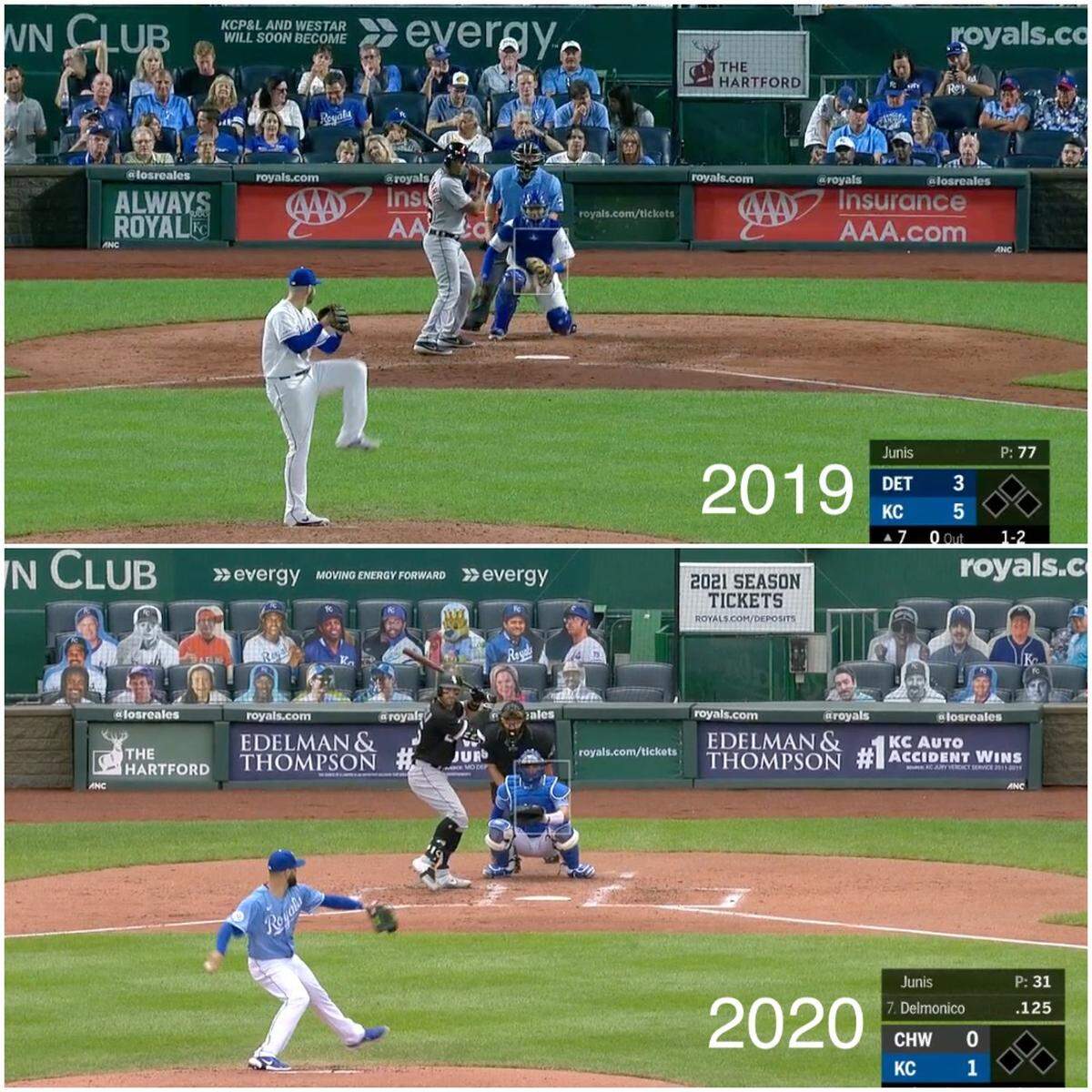
By moving farther left on the mound (from our vantage point), he’s ensuring his release point is closer to the middle. This seems to be the change that almost all Royals pitchers are doing regardless of what it takes to get there.
Junis spoke about his shift Wednesday, acknowledging that he had moved on the mound while also saying he planned to move back a little closer to the middle of the rubber in his next start to help out his slider. He said being on the left side of the rubber had aided his fastball, though.
“I have a tendency to kind of fly open with my shoulder a little bit,” Junis said. “Even though I’ll feel like I’m driving towards that outside corner for 95% of my delivery, that last 5% I pull off sometimes, and that’s what makes me miss that outside corner. Getting on the left side of the rubber and having that more direct path definitely helped with that more consistently, I think.”
Matheny also spoke Tuesday about how a pitcher’s starting position on the rubber could potentially help with locating an outside fastball.
“We firmly believe in that down-and-away pitch,” Matheny said. “Making that pitch is is kind of one of those hallmarks of good pitching. And where can you set yourself up to where your foundation and then your stride leads you to be able to hit that pitch on a consistent basis?”
Could this be helping the Royals’ fastball “stuff” as well? We talked a couple weeks ago about how Trevor Rosenthal — another Royal who has moved his release point eight inches toward the center of the rubber — has gained life on his fastball with his altered delivery.
And though different pitches are bound to bring different results, here’s a look at the xwOBAs on the Royals’ fastballs this year, compared to 2019.
| 2019 fastball xwOBA against | 2020 fastball xwOBA against | 2020 change in release point toward center of rubber (in feet) | |
| Duffy | .378 | .244 | 0.91 |
| Junis | .430 | .322 | 0.88 |
| Staumont | .419 | .344 | 0.57 |
| Newberry | .528 | .509 | 0.44 |
| Zimmer | .460 | .187 | 0.44 |
| Speier | .363 | .358 | 0.39 |
| Sparkman | .380 | .260 | 0.32 |
| McCarthy | .315 | .505 | 0.21 |
| Barlow | .359 | .437 | 0.18 |
| Kennedy | .293 | .285 | 0.06 |
| Keller | .371 | .284 | 0.01 |
As you’d expect, lots of Royals are seeing fastball improvements so far. And though correlation does not equal causation, we see some of the top fastball improvers — coincidence or not — are the ones who have moved themselves most toward a centered release point.
Duffy, Junis, Josh Staumont and Kyle Zimmer stand out most. While Staumont and Zimmer have both been known for their big fastballs in the past, they’re actually getting results from those pitches more often this year, with Zimmer doing that despite an average velocity that’s decreased more than 2 mph.
It’s too early — and too small of a sample — to say anything definitive yet about whether the Royals have found something here when it comes to release point.
What can’t be argued is that they’re getting results.
While succeeding — so far — in this particular game of inches.
This story was originally published August 12, 2020 at 1:51 PM.