
Baseball has a different look since the Royals last were in the playoffs
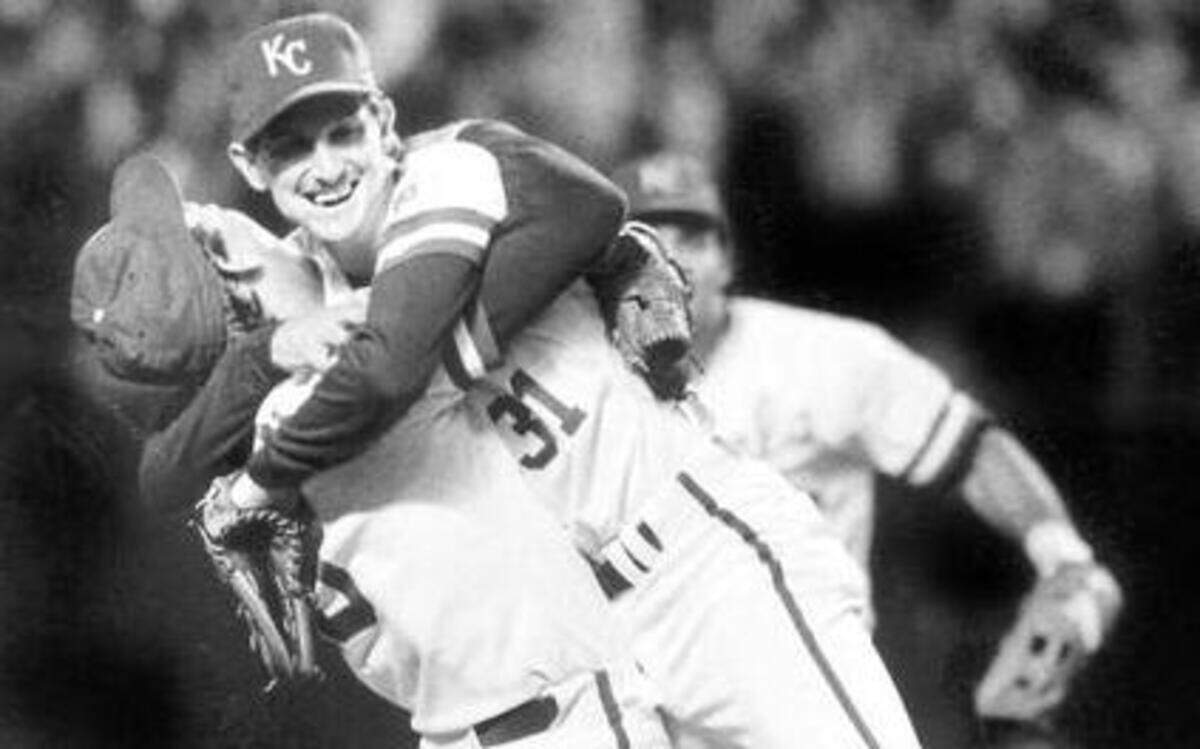
The quartet of Cardinals players surrounded umpire Don Denkinger, incredulous.
Denkinger had ruled Jorge Orta safe at first base in game six of the 1985 World Series in one of the signature moments of the Fall Classic.
That memory is not rekindled to tarnish the Royals’ last championship, nor poke at Cardinals fans. In that particular moment one can see just how baseball has changed since the Royals were last in the playoffs.
That game was played at Royals Stadium. Now it’s called Kauffman Stadium.
The playing surface was artificial. Now it’s grass.
There were 41,628 fans at that game. Kauffman Stadium now has a seating capacity of 37,903.
Look at the gaggle of Cardinals around Denkinger, and you’ll see catcher Darrell Porter wearing his cap instead of a protective helmet. That’s illegal these days.
But the landscape of baseball has been altered in the last 29 years.
The Royals extended the 1985 World Series by winning game five at Busch Stadium. That building no longer exists. In the American League Championship Series, the Royals won two games at Exhibition Stadium in Toronto, the Blue Jays’ stadium. That, too, has been erased from existence.
In fact, 24 of the current 30 stadiums in Major League Baseball were built after 1985. One of the old stadiums — Wrigley Field — has since installed lights.
The new ballparks include Tropicana Field in St. Petersburg, Fla.; Marlins Park in Miami; Chase Field in Phoenix; and Coors Field in Denver.
Those are home to the Rays, Marlins, Diamondbacks and Rockies, respectively. All four of those teams have been to the World Series, with Marlins and Diamondbacks winning the title.
The Royals qualified for the playoffs in 1985 by winning the American League Western Division. They are now in the AL Central. Baseball went from two to three divisions in 1994, adding a wild-card entry to the playoffs. That bumped the number of playoff teams from four to eight.
In 2012, a second wild-card team was added in each league, pushing the playoff entrants to 10.
The postseason, which was just two rounds in 1985, has doubled.
The Royals made their run to the playoffs in 1985 with a strong September. That included a rare five-game sweep of the Brewers. At that time, Milwaukee was in the American League and the Houston Astros were in the National League. Those clubs have swapped leagues.
That doesn’t mean the Royals were done playing Milwaukee. Interleague play started in 1997.
Even something as untouchable as the All-Star Game is different. After a tie in the 2002 Midsummer Classic, commissioner Bud Selig declared the winner of that game would be the league that played host to the World Series.
It’s a good thing for Royals fans that wasn’t the case in 1985, because the Cardinals would have had four games in the World Series.
Circling back to that moment in game six of the 1985 World Series, consider what might happen if we’re treated to another I-70 World Series.
Say the tables were turned and the Royals were nursing a 1-0 lead in the ninth inning of a game six. The Cardinals’ leadoff batter of the inning is called safe at first on a close play, even though he was out.
Umpires would then go to replay — another change in baseball’s landscape since 1985 — and could call out the Cardinals batter.
That undoubtedly would set Twitter ablaze.
To reach Pete Grathoff, call 816-234-4330 or send email to pgrathoff@kcstar.com. Follow him on Twitter: @pgrathoff.
Baseball’s playoff format changes
Major League Baseball’s playoff tournament is much different these days than it was when the Royals won the World Series in 1985.
▪ From 1969-93, there were four divisions, two in each league. The two American League divisions had seven teams each. The two National League divisions had six teams each. The regular-season division champions faced each other in a best-of-seven League Championship Series (best-of-five from 1969-84) to determine the AL and NL pennant winners. The AL and NL champions then played in the best-of-seven World Series, which alternated home field by league from season to season.
▪ Today, 10 of baseball’s 30 teams make the playoffs. Each league has 15 teams, three division winners and two wild cards.
The wild-card teams, which include the Royals this year, play one winner-take-all postseason game. The winner advances to face the team with the best record in the league in a best-of-five series. The other two division winners also play a best-of-five series. This is called the Division Series round.
The two Division Series winners in each league advance to a best-of-seven League Championship Series. Win that and it’s off to the World Series, which is still a best-of-seven format. The difference these days? The league that won the All-Star Game (this year it’s the American League) will play host to the World Series.
▪ In 1994-2011, baseball moved from two divisions to three in each league and added one wild-card playoff entrant in each league. The four playoff teams from each league advanced directly to the Division Series and played as they do today.
▪ Before 1969, there were no divisions in the AL and NL. The best team in each league after the regular season won the pennant and advanced directly to the World Series.
▪ Kauffman Stadium was called Royals Stadium and had artificial turf, not grass.
▪ ABC had the broadcast for game seven of the World Series with Al Michaels doing play-by-play and Tim McCarver doing color analysis. Kansas City Star sportswriter and editor Joe McGuff, who was instrumental in securing the expansion franchise that became the Royals, threw out the first pitch, and the Oak Ridge Boys sang the national anthem.
▪ Only six major-league ballparks from 1985 are still standing (from newest to oldest): Royals Stadium (1973), Oakland Coliseum (A’s, 1966), Anaheim Stadium (Angels, 1966), Dodger Stadium (1962), Wrigley Field (Cubs, 1914) and Fenway Park (Red Sox, 1912).
▪ There were no night games at Wrigley Field, which did not have lights installed until 1988.
▪ Catchers could wear just a ballcap instead of a protective helmet under their facemasks.
▪ There were 26 teams, 14 in the American League and 12 in the National. Interleague play did not exist until 1997.
▪ Two teams that have won the World Series, the Florida (now Miami) Marlins and the Arizona Diamondbacks, did not exist. The Marlins won in 1997 and 2003 as a wild-card team (another thing that didn’t exist in 1985) and the Diamondbacks won in 2001.
▪ 16 different teams have won the World Series since the Royals in 1985: The Yankees (five), Red Sox (three), Twins (two), Blue Jays (two), Marlins (two), Cardinals (two), Giants (two), Mets, Dodgers, A’s, Reds, Braves, Diamondbacks, Angels, White Sox and Phillies. There was no World Series in 1994.