
Kansas City’s lost generation of baseball fans to witness first playoff game
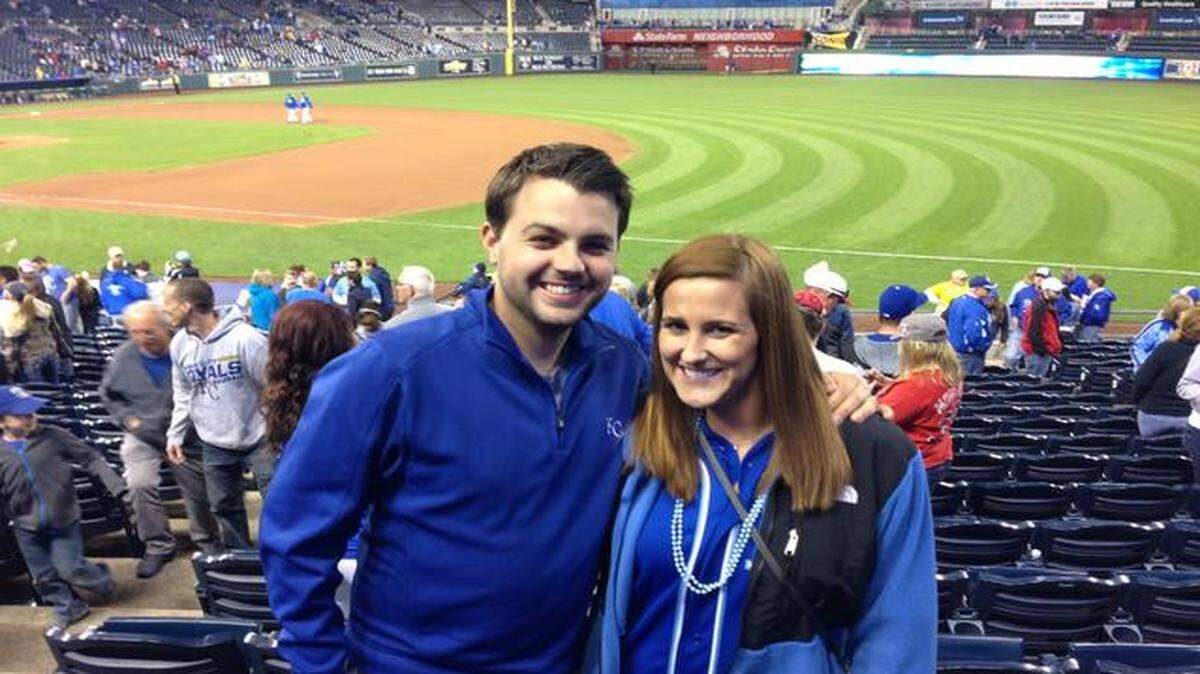
The lost children of Kansas City baseball, a generation of newborns once decked out in powder blue onesies and tiny George Brett jerseys, are all grown up now.
They are homeowners and entrepreneurs, lawyers and architects, college basketball coaches and high school history teachers. They are semi-truck drivers in the suburbs, and music writers in Brooklyn, and employees of Wells Fargo in Des Moines.
They are from both sides of the state line: children of both Kansas Citys, Independence and Shawnee, Overland Park and Lee’s Summit, Prairie Village and Brookside. Some left for college and never came back; others stayed behind to put down roots and raise a family.
Some have worked for U.S. senators on Capitol Hill; some have played in the World Cup; some work for the hometown newspaper. Some are like Garron Abernathy, a Kansas City kid who joined the Marine Corps and served two tours in Iraq. Some are like Jake Waxman, a 28-year-old resident physician at the Mayo Clinic.
And some are like Brad Mertel, a 29-year-old who was at game seven of the World Series on that October night in 1985. Mertel was just 2 months old, and his parents, Wayne and Cindy, dressed him in a white Royals jersey, long sleeves and an oversized blue hat. For most of the night — as the Royals closed out the St. Louis Cardinals for the first World Series title in franchise history — Wayne and Cindy looked for a cameraman, hoping their first son would show up on television.
Nearly three decades later, Mertel is one of the lucky ones, one of the lost children who can say he was there in the flesh — even if the photos are the only proof he has left.
“Obviously,” Mertel says. “I can’t remember anything,”
From the fall of 1985 to the final days of 1986, there were just fewer than 5 million babies born in the United States. A tiny fraction of those kids were born into Kansas City baseball, resigned to a life of hopeless fandom, errant cutoff throws and the longest postseason drought in North America.
It is an unusual club, of course, a generation of kids bonded by the rare combination of clustered birthdays and bad baseball. But in Kansas City, baseball can help explain a lot.
“We came to expect futility,” says Jonathan Lewis, 28, an Overland Park native who grew up to work for the Archdiocese of Washington, D.C. “Like a bad girlfriend you can’t quit.”
On Tuesday night, the Royals will play host to the Oakland A’s in the AL Wild Card Game, the first postseason game since that night in 1985. A generation of kids from Kansas City will witness playoff baseball for the first time. And perhaps this is the best place to start. That generation of babies in their onesies and Brett shirts?
Well, they are no longer kids.
Here is a story: A few years ago, a man named Derek Harshner took his girlfriend Mallory to a Royals game. It was a St. Patty’s themed night at the stadium, and the couple drank green beer, watched baseball and thought about the future.
Derek, born just months before the 1985 World Series, had grown up going to Kauffman Stadium. A million memories and a million losses. On a summer day in 1994, in the weeks before the strike, his mother bought him a Bob Hamelin-themed foam hammer.
“It’s probably the oldest souvenir I own,” Derek says.
So on that night three years ago, Derek and Mallory left the game and walked back toward the parking lot. Derek told her he loved her for the first time.
They’re married now, first child on the way, two trips to spring training in the memory bank.
A few weeks ago, they had a party to find out if their new baby would be a boy or girl. When they pulled a pink Royals onesie out of a box, they knew: It was a girl.
Somewhere along the way, as the lost seasons piled up, the wait for winning baseball stopped being about baseball.
After the 1994 strike and the busted youth movements, after the 100-loss seasons and the All-Stars who left town, the wait began to stand for something else. Something the spoke to the heart of a hometown.
If you grew up in Kansas City in the years after the 1985 World Series, you came to know certain things about your city. You knew that the suburbs were a cozy place to grow up, and that the Grandview Triangle meant traffic. You knew that downtown was somehow a functioning ghost town. You knew that Derrick Thomas was always coming off the edge, and Marcus Allen would gain that extra yard, and that, yes, you were wearing your Chiefs jersey to school on Friday.
You knew that the “Timber Wolf” at Worlds of Fun was the “No. 1 wooden roller coaster in the world,” and that Gates Bar-B-Q was here to help you, and that The Plaza would be always be alive on a cold, winter night.
And for a certain generation, you knew that summers meant losing baseball. For those born after 1985, it was a cruel annual reminder: No matter how great this city was — no matter the pride or family or history — you still lived in a small baseball market; a place where the bright stars wanted to leave and resources were scarce and nothing great ever seemed to happen.
“You almost become numb to the losing over time,” says Nathan Saverino, a St. Joseph native born April 23, 1986. “… that’s all you know.”
You know that Kevin Appier toiled here, pitching his guts out for mostly bad teams. You know that Mike Sweeney stayed here, hitting doubles while his back was wrecked. And you know that Johnny Damon, Jermaine Dye and Carlos Beltran left here, heading for bigger cities, winning rings and earning megadeals.
If you grew up in Kansas City, you probably felt it, too. Maybe I need to leave, too.
Keith Henry, 29, grew up in Liberty, then left the area for college in the mid-2000s. By that point, he says, the apathy had set in. The Royals would never be good, and that was fine. But then he came back. And something was different.
“As an adult I have an appreciation for the city,” Henry says, “the beauty, potential, attitude, culture (and ) grit … I root for the Royals because I want to witness success for the first time in my life, and because I want to see the city witness it as well.”
Here is a story: A few weeks ago, Caroline Findlay took her grandfather, Don Roberts, to the final Royals home game of the season. He’s 87, she says. Walks just fine. But she wheeled him to their seats all the same. Caroline was born Oct. 24, 1986, exactly one year after game five of the 1985 World Series.
When she was growing up on the Kansas side, Don would tell her stories about seeing Jackie Robinson and Satchel Paige. Now it’s Alex Gordon.
After high school at St. Theresa’s, Caroline left Kansas City. Lived in New York. Spent time in Korea. Heard the usual insults from Yankees fans. Eventually, she came back. She helps run a specialty food company now, and she spent the past few months watching nearly every Royals game with her grandpa.
“In a way, I want the Royals to do well for him,” Caroline says, “He’s waited 30 years for this.”
For so many years, the worst part was not the losing. A generation of baseball fans came to expect that. No, the worst part was something different, something harder to explain. It was something like irrelevancy — the idea that there might not be a reason to care.
So a lost generation found a way to cope. In the Armourdale neighborhood of KCK, the local kids would hit up police officers for Royals cards. In other years, you would go to Kauffman Stadium for a sundae in a mini helmet and a glimpse at the fountains. As the years went on, the memories became weirder and weirder.
You believed that Ricky Bottalico could be an answer in the bullpen, or that Angel Berroa was the next great shortstop. You believed that Jeremy Affeldt would stop getting blisters; that Jimmy Gobble was Tom Glavine; that Runelvys Hernandez could be an ace if he just stopped eating so much.
You studied the minor-league system, waiting on a wave of new talent, praying for a savior, hoping that somebody would finally break Steve Balboni’s ridiculous franchise record of 36 homers in a season. You went to games for the promotions, hoping the Royals would knock 12 hits, so you and some friends could snag a dozen Krispy Kreme doughnuts on the way home.
You would go see Zack Greinke pitch. Then you waited four days.
Or you did something like this. Before the 2006 season, a local kid named Derrick Krause — born just weeks after the ’85 series — bought season tickets after the Royals signed a group of free agents that included right-hander Scott Elarton, catcher Paul Bako and second baseman Mark Grudzielanek. He was encouraged, he says. The Royals really needed some pitching.
“I think this speaks to just how insane we are,” says Krause, who now lives in Sedalia, Mo. “… we were broke college students.”
For 29 years, a generation of baseball fans waited. And the kids grew up. Some went to college. Others started careers. Some moved home. Life kept burning along.
Imagine one generation, from one city, cascading across the world, still waiting on one baseball franchise. Now imagine a playoff berth. What will it feel like?
“There is something about Kansas City, where regardless of what happened in the past we always believe,” says Tom Brandt, a 28-year-old who now works at the U.S. Capitol. “When the Royals finally do make the playoffs and win, I know that moment will feel that much better — moments we've only been able to dream about.”
Here is a story: Remember Brad Mertel, the 2-month-old at game seven? He’s 29 now. Married a local girl named Stephanie. He’s the videoboard director for Sporting Kansas City.
A few weeks ago, he was at Kauffman Stadium for the final home series against the Tigers. Jeremy Guthrie was on the mound. The Royals were a week away from clinching a playoff spot. For the first time in years, Mertel found himself hanging on every pitch.
“I truly didn't know how to act during an important baseball game,” Mertel says.
A week later, as the Royals closed in on the playoffs, Mertel was thinking back over the last three decades. It’s been 29 years since his parents dressed him up in Royals gear and carried him into the last postseason game in Royals history. Finally, Brad and Stephanie are ready to do it again.
Their first son is due in November.
To reach Rustin Dodd, call 816-234-4937 or send email to rdodd@kcstar.com. Follow him on Twitter: @rustindodd.
This story was originally published September 29, 2014 at 8:08 PM.