
Eric Hosmer will never forget his memories with the Kansas City Royals: ‘It was epic’
Editor’s note: Lee Judge is a special contributor to The Star who has written about the team from a first-person and inside-the-clubhouse perspective for more than 10 years.
Eric Hosmer saw me, stuck out his hand and started one of those nine-part baseball handshakes that may or may not include hip bumps, a curtsey and a head-butt.
When I couldn’t make it past the standard “Caucasian guy selling you-life insurance” part of the shake, Hosmer started laughing and settled for a bro hug.
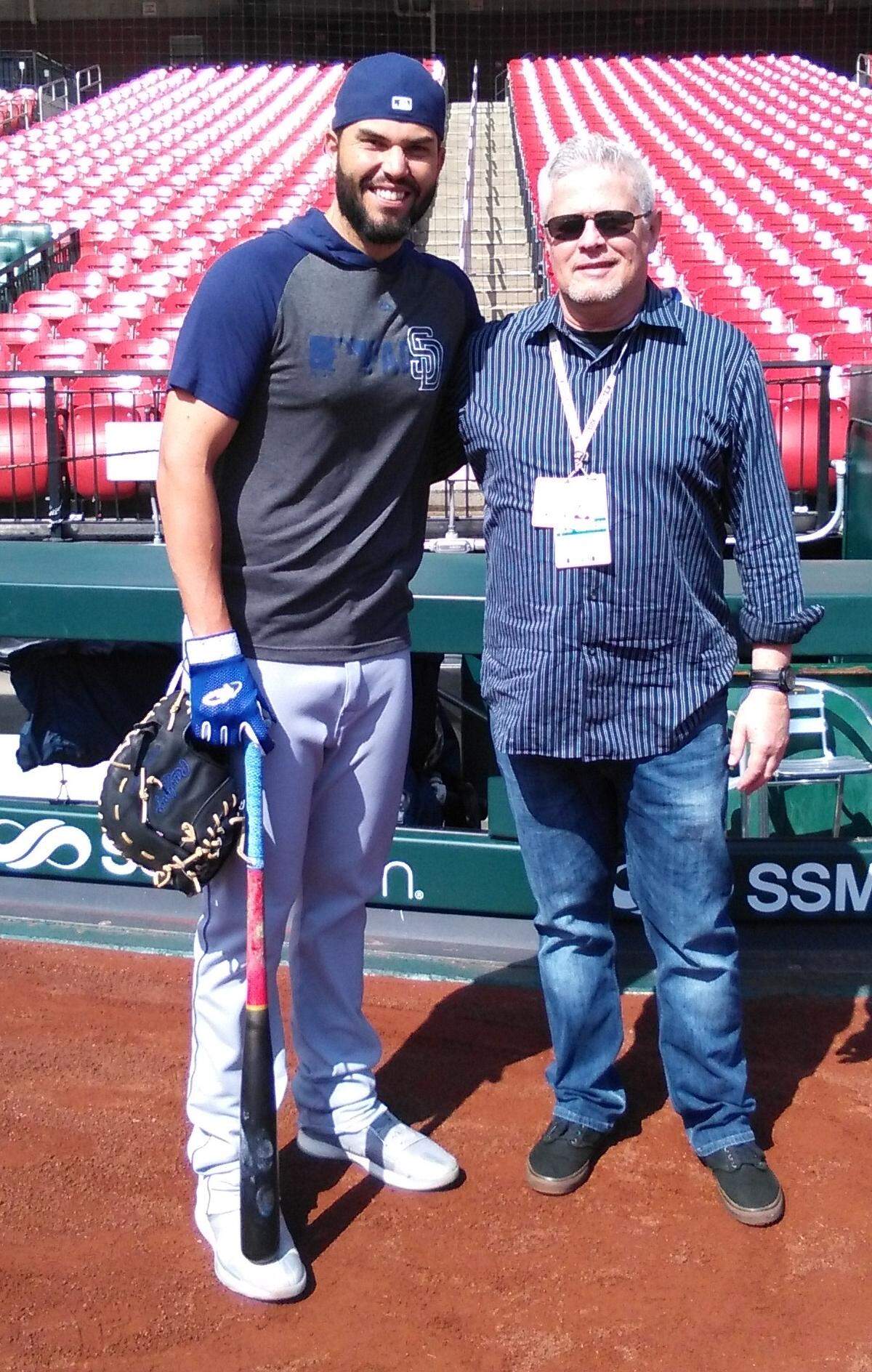
He then pulled up a couple of chairs and asked me to sit down and tell him everything that’s been happening in Kansas City since he left. Here, inside the visiting team’s clubhouse at Busch Stadium, where Hosmer’s San Diego Padres were in town to play a weekend series against the St. Louis Cardinals, one of the biggest stars in baseball was hungry for news from his adopted hometown.
From Kansas City, about the Royals.
I started by telling Hosmer that the 2019 Royals reminded me of KC’s 2011 team — the one to which he was called up from Omaha in May of that season.
The current edition of the Royals is struggling with its bullpen, I explained, but trying to get back to the speed-and-defense style of play they used to win two American League championships and one World Series.
When I first started covering the team in 2010, the Royals weren’t very good. But just one year later, Hosmer, Mike Moustakas, Alcides Escobar, Salvador Perez and Lorenzo Cain made their debuts, and things started to change. Suddenly, with Alex Gordon’s move out to left field, the Royals had six position players capable of winning a Gold Glove.
While everybody else was going cuckoo for Cocoa Puffs over home runs, the Royals were building a team based on speed, defense and relief pitching. And now they’re trying to do something similar in 2019. That doesn’t mean the current team will be able to duplicate the Class of 2011’s success, but you can see where the Royals are headed and how they intend to get there.
Hosmer nodded. He noted that KC general manager Dayton Moore has always been ahead of the curve.
The onetime toast of Kansas City said he wouldn’t bet against the Royals’ GM pulling another rabbit out of his hat.
On the Padres
When I asked about the Padres, the team with which Hosmer signed as a free agent in early 2018 for eight years and $144 million, Hosmer was upbeat. San Diego had a 66-96 record last year, but Hosmer said he’s seen what the Padres have in the pipeline and believes his current team will be a playoff contender in the near future.
Most baseball fans want instant gratification; most baseball players know Rome and World Series winners aren’t built in a day.
I asked about National League style of play and Hosmer said the most obvious difference is that the pitcher hits — no big revelation there. But then he pointed out that this mainly affects the guys at the bottom of the order; that’s where most of the pinch-hitting, pinch-running and bunting takes place.
The less obvious difference is that National League baseball demands good defense at the corner infield positions to handle those bunts. If the first and third basemen can’t handle bunts consistently, they’re going to see a lot of them.
I asked if the pitching was different in the NL, and Hosmer said, “Not all that much.”
I asked him why — if that was true — his average dropped off to .253 in 2018 after reaching a robust .318 in 2017, his final season in KC.
“Just a bad year,” he shrugged.
Hosmer believes he will get it going this season — he was hitting .263 after the weekend for the Padres, who were 6-4 after Sunday’s loss to the Cardinals — but didn’t offer any explanation for why that was so.
Those of us in the media have a hard time choking out the words: “I don’t know.” You could ask us why time travel is theoretically possible or how to perform the first step in open-heart surgery and we’d give it a shot.
So explaining why a guy who hit .318 the year before dropped to .253 the next season should be a snap … but it’s not. We like simple explanations that fit within the limitations of a story or sports-talk radio appearance, but in reality it’s seldom just one thing.
The players? Well, they know they can do everything right and still get bad results, so they don’t mind saying, “Hey, it’s baseball, some years just go that way,” and leaving it at that.
It was clear that Hosmer has put 2018 behind him and is focused on having a good year in 2019.
About pressure to perform
One of the theories we drag out at the drop of a hat (or a baseball) is that players who sign big contracts and then have bad years must have felt the pressure of justifying those big contracts.
But when I inflated that trial balloon and floated it past him, Hosmer shot it down.
He pointed out that whether a player’s got a multi-year contract or is hanging on by the skin of his teeth, there’s always pressure in the big leagues.
It can be “You just signed for a king’s ransom so perform” pressure, or, “If you don’t get a hit tonight you might get a free bus ticket to El-Paso” pressure, but big-league players always feel pressure of one kind or another.
Good point, and I wished I’d made it.
Playing in paradise
Assuming you don’t count earthquakes as climate, the weather in Southern California is awesome. And Hosmer said he wouldn’t mind if the Padres took a page out of the Chicago Cubs’ book and played nothing but day games.
But I then pointed out to Hosmer what longtime Royals coach Rusty Kuntz had once pointed out to me: The Chicago Cubs didn’t win jack squat until they started playing home games at night.
Day games mean nights off, and nights off mean hangovers, and hangovers mean you might not be ready to give 110 percent when 1:15 rolls around the next afternoon.
While it’s shocking to think professional athletes might ever darken a bar’s doorway, Hosmer laughed and conceded Rusty had a point.
These days, Hosmer has it made in the shade: He lives in one of the most gorgeous cities in the country, can walk from his condo to a beautiful ballpark he calls his workplace, plays for a team he believes will soon be a winner, and is signed through 2025 with a contract that made him a millionaire 144 times over.
What’s not to like? It’s the Garden of Eden without the snake.
But while Hosmer made it clear he’s happy where he is, he also made it clear that Kansas City, his former Royals teammates and the special relationship that team had with its fans still mean a lot to him.
Back in 2011, when that group of players first made it to Kansas City, it wasn’t unusual for a sparse crowd to show up to watch the Royals take batting practice while a much bigger crowd showed up to watch the visiting team — especially if the visiting team was the Red Sox or Yankees.
An observer without GPS could be forgiven for thinking the game was taking place in Boston or the Bronx, not Kansas City.
But as the Royals got better and better, the crowds that showed up to watch them take batting practice got bigger and bigger. One day in 2014 — before the Royals locked down a wild card spot and made the postseason for the first time since dinosaurs roamed the Earth — I was sitting in the Royals’ dugout watching Hosmer and his teammates take BP.
When the players left the field, the fans behind the dugout went nuts.
It was a sound I hadn’t heard before. Fans were literally screaming for the players they loved. The fans adored that team.
When Hosmer walked by that afternoon, I asked him: “When did you guys turn into the Beatles?” After giving it some thought, I’ve got a theory about that.
If your favorite team goes out and gets a high-priced free agent, you’re probably happy. But you might now feel a special bond with a multi-millionaire celebrity you don’t know and will probably never meet.
As those 2011 rookies grew up and became the best team in baseball, Royals fans were along for the ride every step of the way. That gave those fans a feeling of ownership: The Royals they watched come of age professionally weren’t just pro ballplayers; fans referred to them as “our boys.”
That doesn’t happen in every town with a winning team.
When I reminded Hosmer of the night he and his teammates celebrated beating the Angels in the 2014 ALDS with their fans in a Power & Light bar, and the players bought a round of drinks for the house, he grinned:
“It was epic,” he said.
How many baseball teams party with their fans?
A special time indeed
In most cities, if your team wins a playoff series, you know that a lot of the players are out celebrating afterward. But you also know you’re not invited.
In Kansas City, that Royals team partied with its fans and said, “You gave us your support and we appreciate it, so here’s a round on us.”
That doesn’t make those other cities or other teams bad; it just means that Royals team and this Midwest town had a special relationship.
Hosmer said he still wishes baseball economics allowed the core of baseball teams to stick together throughout their careers and firmly believes that if the core of that 2015 Royals team was still together, “We’d still be winning.”
During our conversation, Hosmer made it clear that he’s moved on. He loves playing in San Diego and loves his new team and teammates.
But he also made it clear that his time in Kansas City was something special — a time he’ll never forget and will always appreciate.
If you miss Hosmer, rest assured Hosmer misses you back.
This story was originally published April 8, 2019 at 1:46 PM.