
Overlooked again and again, Whit Merrifield became the Royals’ most consistent hitter
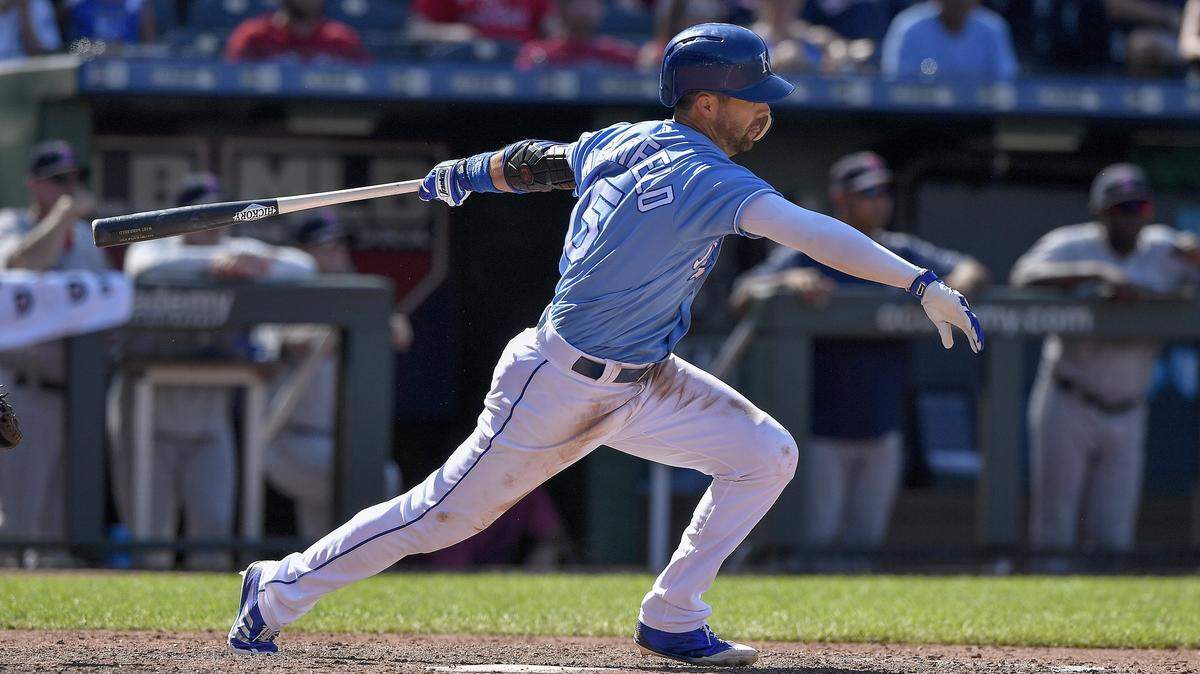
When Royals hitting coach Terry Bradshaw sees Whit Merrifield in one of his infrequent slumps, he doesn’t say much.
It’s not that Merrifield doesn’t welcome feedback from a man the Royals have employed as a hitting coach in some capacity since 2000. It’s not that Merrifield is immune to advice.
It’s that Merrifield, the Royals’ most consistent hitter in a season where the team has batted a collective .240 in its first 92 games, doesn’t need many reminders.
“When you look in that clubhouse, (which batter) has spent more time in the minor leagues than Whit Merrifield?” Bradshaw said this week at Target Field.
Most Royals fans already know Merrifield’s journey — overhauled diet, opening-day-roster exclusions and all. And if you don’t: He was passed over for a major-league promotion midway through 2015, left both unprotected and unselected in the Rule 5 draft that winter and deserted in Arizona at the end of spring training in 2016 despite batting .347 with nine extra-base hits in 49 Cactus League at-bats. When he finally earned his big-league call-up that May, he’d spent six summers toiling away in the minor leagues and learning to deal with disappointment.
Therein lies Bradshaw’s point: Few know Whit Merrifield better than Whit Merrifield.
“There’s going to be peaks and valleys to a season,” Merrifield said, “but the key to having a good season is managing those valleys and trying to ride out those peaks as long as you can.”
For most of the season, Merrifield has ridden out the peak. Even when surrounded by teammates who have fallen into prolonged ruts, Merrifield has remained steady. He’s only been held hitless in consecutive games twice this season: for both ends of a doubleheader on April 28 and for four games from May 20-23.
Put in context, Merrifield entered Friday hitting at a .302 clip that ranked third among all major-league second basemen with more than 280 plate appearances. He ranked in the top third in walk rate (9 percent) and weight runs created plus (121). His 41.1 percent hard-hit rate, as measured by Fangraphs, was third in the same group.
But this week, when catcher Salvador Perez was chosen as the Royals’ lone All-Star, Merrifield was slapped with a wave of disappointment again. He’d done enough to merit consideration, playing all the roles asked of him without faltering at the plate. But in a league dominated by the Astros’ Jose Altuve, the players’ second choice for the All-Star team was Yankees rookie second baseman Gleyber Torres, who went on the disabled list last week and was replaced on the AL roster by the Athletics’ Jed Lowrie.
After finding out Sunday he didn’t receive his first All-Star nod, Merrifield put together a career-best day and went 5 for 5 with two doubles against the Boston Red Sox.
“Anything I can use to motivate me,” he said, “I’m gonna use.”
It took time for Merrifield to internalize that lesson. Merrifield, a ninth-round draft pick out of South Carolina in 2010, was never the best prospect stashed on the Royals’ farm. He never made a Baseball America prospect list or received much attention after batting .340 and collecting 28 doubles and 11 stolen bases during his first foray into Class AAA ball in 2014. He was always on the fringes, valued most for the competent versatility that eventually made him a fixture in Kansas City in late April of 2017.
He never felt disrespected by the Royals, he said. In the middle of trying to win it all during the club’s first postseason run since 1985, Merrifield understood being excluded from the 40-man roster. He figured fate had to intervene for him to get a chance to break in.
The opportunity arose in the form of Alex Gordon’s groin strain in early July 2015, but Merrifield was passed over. In an interview published this week by Infield Chatter, Merrifield said Royals officials had originally chosen him to take Gordon’s spot and changed their minds at the last minute.
Merrifield’s season took a dive. Before the Class AAA All-Star game, he had batted .293 with 21 doubles, four triples, three home runs and 29 RBIs for the Omaha Storm Chasers. He batted just .220 with 11 extra-base hits in his final 50 games.
“I thought that was it,” Merrifield told The Star. “So I was thinking in my head what I was gonna do. I had a talk with my father that offseason and realized I’m gonna stick with it. That’s when I sort of reinvented myself, went on that crazy diet, put on a bunch of weight, became a lot stronger. (In) 2016 was when I started finding the player I am now.”
The Royals have overlooked him since, of course. They chose to keep Christian Colon as their utility man at the beginning of 2016; and they went with former top prospect Adalberto Mondesi, known then as Raul, as their opening day second baseman last season.
By then, Merrifield had crafted himself a mental edge. One that allowed him to block out the noise and let go of his grudges. One that allowed him to simultaneously use the slights as his motivation.
That’s how the Royals ended up with a hitter who doesn’t let the pressure of potentially losing a franchise-record number of games or being traded get to him. It’s how they ended up, almost by their own doing, with a player who knows his swing and comprehends his approach better than most playing in their second full season.
“I think it’s more about knowing who you are. That’s what got him here,” Bradshaw said. “He hit the ball to all fields. That’s what got him here. As a player, sometimes you get out of that element every now and then and you try to do a little too much more than what you’re capable.
“He’s been pretty solid and consistent the whole year.”
In Merrifield, the Royals have an All-Star caliber player who is fourth among baseball’s second basemen in on-base percentage (.373), sixth in WAR (2.6) and tied for most doubles (29). Merrifield also ranks 12th in the American League in batting average, 11th in OBP and eighth in batting average on balls in play (.335).
As the Royals weigh trading Merrifield, they must weigh whether or not they want to give up years of club control on a player who has thus far exhibited no signs of regressing as he ages. They must weigh if the return in a trade stacks up against a 29-year-old who could be a productive veteran presence for the crop of young players the Royals think will shepherd the franchise back into perennial contention.
Merrifield has heard the trade rumors and compartmentalized them. He’s also expressed desire to remain in Kansas City.
“The grass isn’t always greener on the other side,” said Merrifield, who, as would most players, approached the Royals about a long-term deal after winning the American League crown in stolen bases and batting .288 with 32 doubles and 19 homers in 145 games last year. “I’m comfortable here, I’ve had success here and I’d like to stay here.”
The Royals didn’t budge during the offseason; they might never. Merrifield, who will not become a free agent until after 2022, knows he can’t control their decision.
He just hopes he can change their mind. Again.
“If they keep me around, it shows that I’ve earned a belief in the front office and that I’ve earned the respect to stick around,” Merrifield said. “It’s a little motivation for me.”
This story was originally published July 13, 2018 at 6:20 PM.