
How Missouri Tigers running back Ahmad Hardy harnesses physics to break tackles
AI-generated summary reviewed by our newsroom.
- Hardy leads FBS in rushing and forces missed tackles with low pads and contact balance.
- He gains most yards after contact by keeping feet driving and planting.
- Stiff-arm and quick vector changes let Hardy convert contact into forward yards.
Every time I touch the ball, I think I’m going to score
In the UMass game, Ahmad Hardy made that comment sound less like bravado and more like routine. On his third touchdown that day, the Missouri Tigers running back sunk his pads at the goal line, met a defender squarely and kept driving — body angling forward, feet hammering — until the hit turned into a bounce and the bounce became six points.
Small strike zone. Forward lean. Contact balance. All the traits of an elite running back.
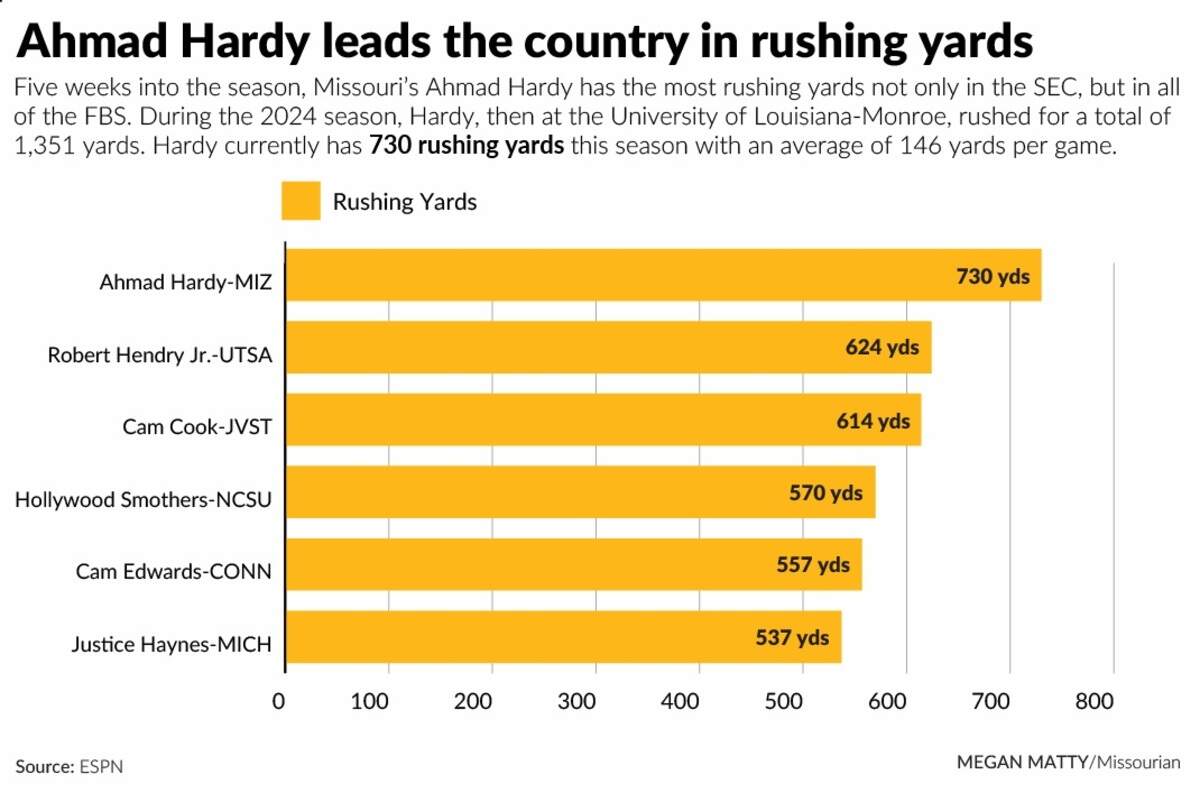
Through five games, Hardy leads FBS in rushing yards (730) and is tied for second in touchdowns (nine) on 104 carries. He also tops the nation in yards after contact (551) and missed tackles forced (46). Twenty-one of his carries have gone for 10 or more yards. His Pro Football Focus rushing grade — 92.1 — is the best in the FBS.
If the box score reads like spectacle, the explanation is simple: balance, leverage and what happens in the instant his cleats push back against the ground.
Tim Gay, the University of Nebraska physics professor who has studied football collisions for decades, puts it this way: Great backs run low and change speed fast. A lower center of mass makes them more stable at the moment of contact; coordination and musculature let them produce quick bursts that steal angles from tacklers. That combination makes them hard to finish.
Missouri coach Eli Drinkwitz has boiled it down all fall: Hardy keeps his lower body churning and doesn’t present a very big strike zone, making him nearly impossible to stop.
Run behind your pads — and don’t break stride On ESPN’s call of Missouri’s 42–6 Homecoming win over UMass, analyst Rene Ingoglia kept returning to one principle: contact balance.
To Ingoglia, it’s running behind your pads with a forward lean and a strong lower half. Hardy does it as a baseline, not just at the last second. Plenty of backs drop their pads when they expect contact and knock themselves out of rhythm. Hardy runs that way all the time, so glancing blows stay glancing.
“When Hardy takes a glancing blow, he bounces off and always finishes forward,” Ingoglia said.
The numbers match the tape. Of his 731 rushing yards, 551 have come after contact — roughly three-quarters of his production. By simple division, that’s about 5.3 yards after contact per carry. He’s forcing a miss roughly once every other attempt. And on 21 snaps, the run didn’t just survive contact; it exploded for a chunk gain.
Why the first hit often loses
It all starts with the ground. The runner who keeps his feet driving supplies force through his legs; the turf returns that force in the direction he chooses.
Arm tackles can’t match that power. That’s why a hit that arrives a shade high or from the side becomes a slide rather than a stop. And it’s why “falling forward” is more than a coaching cliché: The last force you put into the turf gives you the forward momentum that carries a play an extra half-yard or 2.
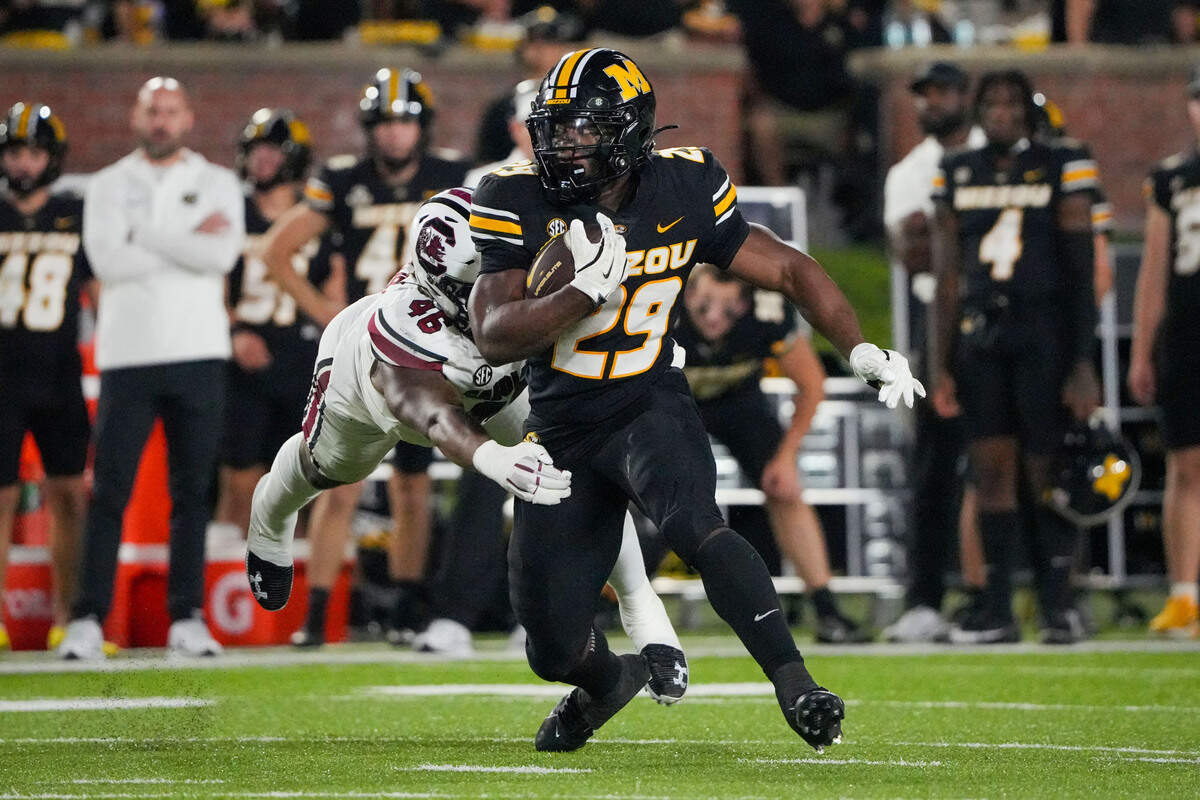
Gay’s version is blunt: “If you keep your feet moving, you’re the one applying force through the ground. Arms alone can’t match that.”
Add a stiff-arm, and the math tilts further.
“It keeps the defender from wrapping up,” Gay said. “If he can’t close space because your arm is rigid between you, he can’t secure the tackle.”
Hardy’s film checks those boxes. Given a choice between going around or through, he usually chooses through. He grew up watching Marshawn Lynch and now studies Derrick Henry and Saquon Barkley — big frames that run small.
Ingoglia, a former All-America back, adds a mindset layer: “There’s no rule the offensive player can’t deliver the blow. Lower pad level, deliver contact, finish forward. Over four quarters, that makes tacklers more tentative.”
The runner knows where he’s going
Even when a linebacker plays it right, the runner owns a baked-in advantage: He’s the only one who knows where he’s going and can accelerate into that lane first.
A well-timed plant shoves hundreds of pounds of force through the ankle into the turf; the ground pushes back in the new direction. If the defender isn’t anticipating that vector change, the runner wins the moment.
“A running back has the advantage that he knows where he wants to go,” Gay said, “and he can accelerate rapidly into the space he’s chosen.”
That’s how a stat like “missed tackles forced” turns into a fourth quarter that feels on tilt. One-on-one becomes a losing bet; numbers to the ball become mandatory. Late, defensive backs shoot low more often. Hardy’s base and stiff-arm turn many of those shots into misses.
What teammates see up close
Inside the building, the explanation starts up front.
“They get a great push,” Hardy said of Missouri’s line. “So I don’t have to make a lot of guys miss, but the guys I’m supposed to make miss, I try to make them miss.”
Right tackle Keagen Trost sees Hardy’s value most when the picture isn’t perfect. Fit up the blocks, and anyone can hit the hole; when the block frays and the back still drags a run into a positive gain, you know what you have.
“He’s the best running back that I’ve ever been on a team with,” Trost said.
The room mirrors the runner. Hardy and Jamal Roberts trade notes daily.
“We talk every day,” Hardy said. “We tell each other we’ll need each other in the fourth quarter.”
Physics, simplified
Strip away the buzzwords, and the through-line is simple.
Center of mass: A compact, forward posture makes toppling harder; glancing hits don’t generate enough torque.
Ground reaction: Live feet mean the back, not the tackler, supplies the bigger force at contact.
Direction change: A quick plant and burst into a new lane arrive before a larger defender can mirror them.
Finish: One deliberate, last push turns contact into forward yards.
Gay’s plain-English summary is even shorter: “The back who keeps his feet and chooses the vector wins.”
The stiff-arm, the spin and the lean are just tools that buy space and time for that choice.
The next test is always the biggest
Hardy has broken tackles his whole career, and the strike zone is small, but there is always a qualifier.
“We’ll find out this week,” Drinkwitz said.
Alabama started slow against the run and then clamped down against Vanderbilt. The SEC stacks NFL-sized bodies onto the same field of play, which is always governed by physics. That’s why teammates talk as much about mindset as mechanics.
“When they know we’re running it, we’ve just got to execute,” Hardy said.
When asked to finish the sentence “Ahmad Hardy breaks tackles because ...” Ingoglia reached for the word that sits between science and habit.
“Effort. He’s got all the other traits — balance, strength, lean — but effort lets him do what he does.”
Copyright 2025 Columbia Missourian