Why Mizzou isn’t having same success with transfers as other college basketball programs
Take a look up and down the men’s college basketball AP Top 25 or the latest NCAA Tournament projections and you’ll find plenty of teams filled with transfers.
Of course, Missouri (10-15, 4-8 SEC) isn’t one of them. It won’t make the cut for the NIT either.
Coming into the season, the Tigers only returned two players who had played consistent minutes — Kobe Brown and Javon Pickett — and brought in four transfers. But similar things can be said for schools like Texas Tech, Marquette, TCU and Iowa State. Though they were expected to be good this season all along, programs like Kentucky, Auburn and Texas are stacked with talent that started their careers elsewhere too.
So why has the transfer portal been so beneficial to some programs across the country but not Missouri?
Well, the simple answer is that Mizzou struck out on the portal, unable to find the impact pieces it was hoping for. If you look deeper though, it all lies in the defensive ability of the players Cuonzo Martin brought in and the group’s struggle to mesh as one unit on that side of the floor.
“The better we become as a defense, the better we’ll become as a team,” Martin said on Jan. 18. “This is probably my first time in coaching where I’ve had a team that really didn’t have a defensive DNA — because there’s so many new guys, so understanding we have to do this in order for us to be successful.”
Martin has never had this many transfers playing this much during his tenure in Columbia. Jarron “Boogie” Coleman (Ball State), Amari Davis (Green Bay), DaJuan Gordon (Kansas State) and Ronnie DeGray III (UMass) combine for slightly more than half of the team’s minutes per game at 107.1 minutes.
Martin, a defensive-minded coach who relies on toughness as one of his main points of emphasis, has also never had this bad of a defensive team during his time at Mizzou. The Tigers currently have a defensive efficiency of 102.0, which ranks 159th in the country, according to KenPom. A Martin-led team in Columbia has never finished with a defensive efficiency worse than 97.2 and 71st in the country.
For context, all of the schools mentioned at the start of this article are led by defenses that rank 40th in the country or better in the same metric.
“You come into something new and it’s not something that you’re accustomed to doing or used to doing,” Martin told The Star when asked about the challenge of integrating new players to his defensive style. “When you have a guy that comes in as a scorer, now all of sudden you’re asking him to play defense at a high level.
“... In basketball you’ve played on both sides of the floor, it’s just your willingness and your desire to give. So when a person struggles defensively, you can look at his mechanics, some may say the athleticism, but I think it’s more his desire to do it and his willingness to do it.”
Though Martin has shown a tendency to rely on high school talent over the portal in the past, this certainly isn’t the first time that Martin has brought transfers into his program and played them significant minutes. Kassius Robertson (2017-18), Mark Smith (2018-21) and Dru Smith (2019-21) are the three he relied on the most over his first four seasons leading the program.
Those three players did contribute their fair share offensively, but the real difference is that each was much better on the defensive end of the floor than any of the transfers Martin added this offseason.
Robertson and Mark Smith earned an “excellent” defensive rating from the Synergy analytics system in their first season playing for him, while Dru Smith was rated “very good.” Each of the trio was among or better than 81% of players nationally defensively, none giving up more than .739 points per possession. None allowed opposing players to shoot an adjusted field goal percentage higher than 39.2% against them either — the best was 33.3%.
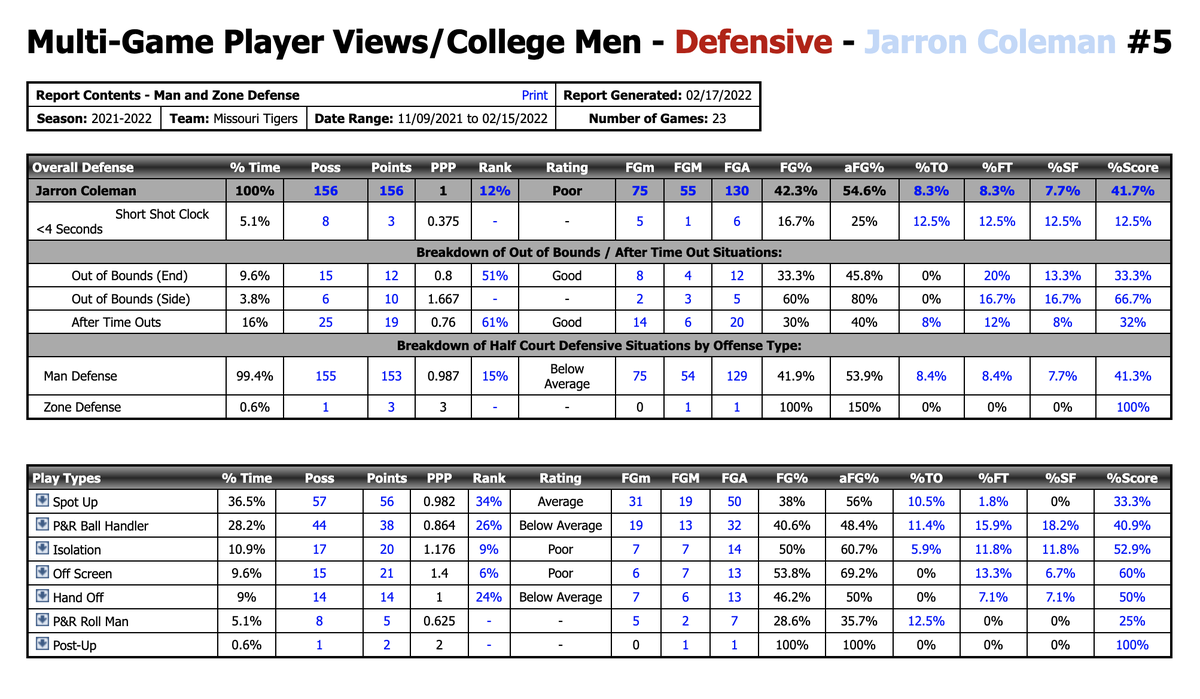
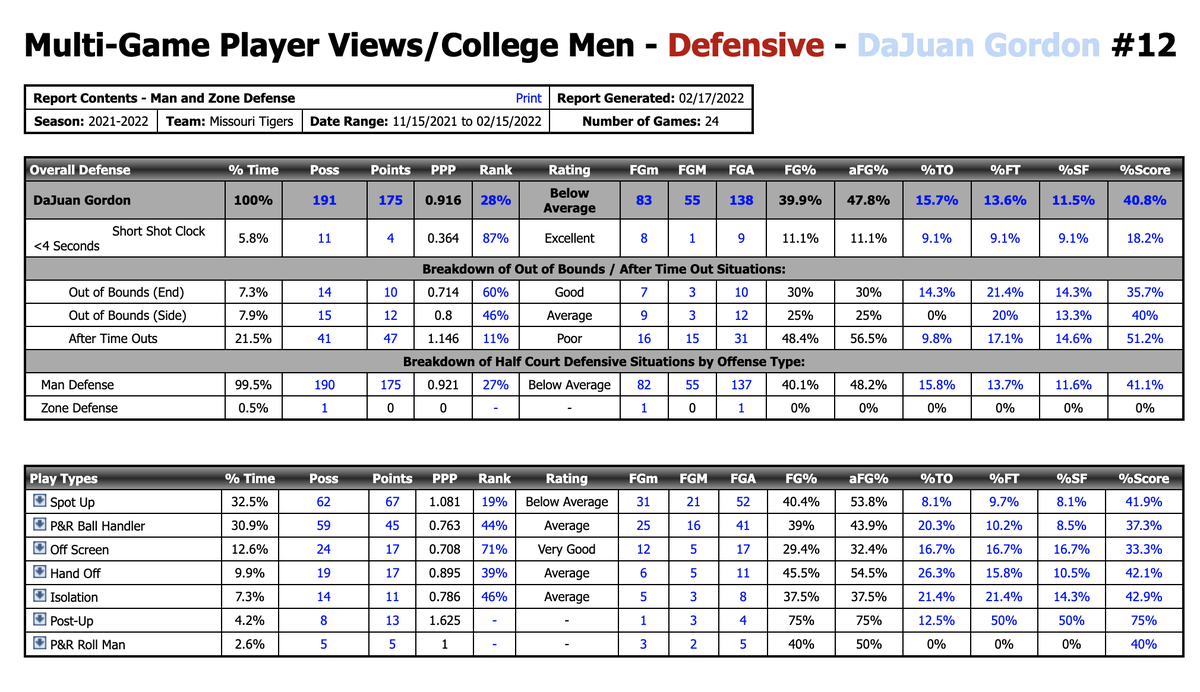
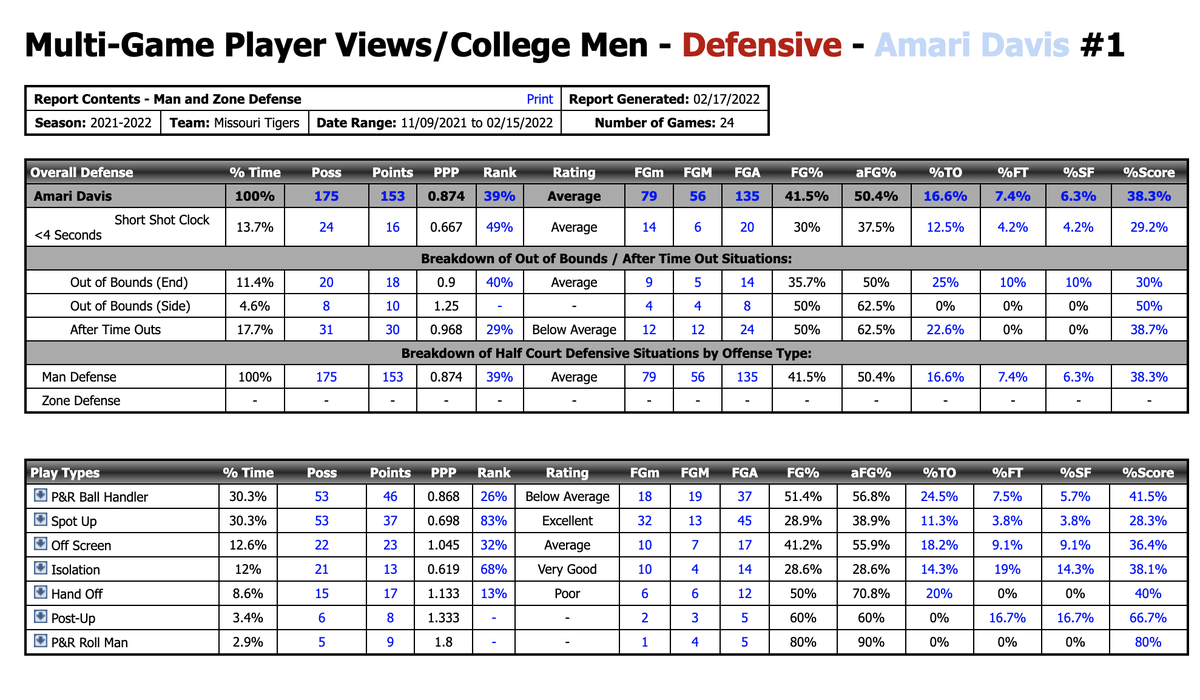
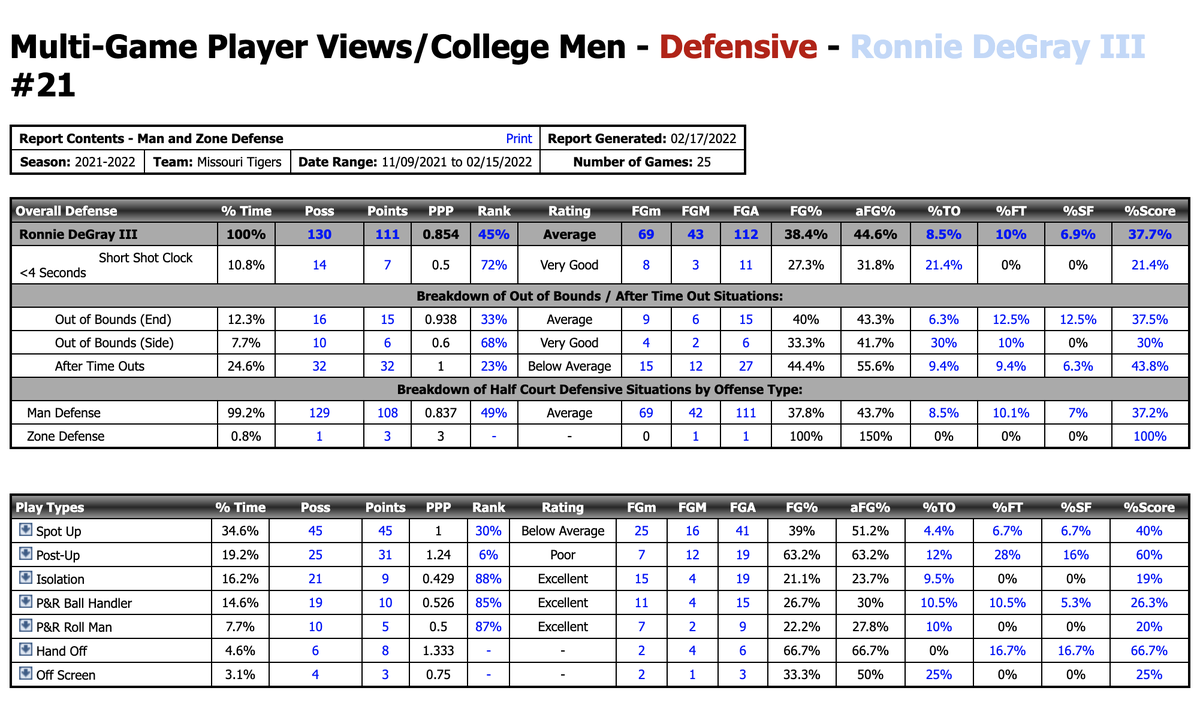
For comparison, none of the four MU transfers this season rank better than the 45th percentile of players or give up fewer than .854 points per possession. The best adjusted field goal percentage allowed by any of them is 44.6% — the worst is 54.6%. They range from being pegged as “average” defenders to “poor” by Synergy’s system.
Here’s a closer look at analytics for all four transfers, courtesy of Synergy.
Jarron “Boogie” Coleman
DaJuan Gordon
Amari Davis
Ronnie DeGray III
All four came from programs that were less than stellar defensively last season, so they aren’t necessarily used to playing with the effort Martin is used to on that end of the floor. Looking at KenPom’s defensive efficiency ratings for the 2020-21 season, Ball State (Coleman) was 167th, Kansas State (Gordon) was 100th, Green Bay (Davis) was 324th and UMass (DeGray) was 128th. It doesn’t help that the quartet hasn’t adjusted as well as Martin’s transfers have in the past.
This year’s Missouri squad — which features a large crop of freshmen as well — has improved its defensive effort from where it was at the beginning of the season. But the Tigers have still yet to play a consistent 40 minutes without significant defensive breakdowns. It’s the reason why they’ve lost four games in which they led by at least eight points, allowed conference opponents to get to the free-throw line 21.6 times per game on average and teams like Arkansas scored 1.226 points per possession on them Tuesday night.
“They’ve gotten so much better (defensively) from the start of nonconference play,” Martin said of the team’s defensive improvement, adding he believes they’ve been “a solid defensive team.”
“.... But they continue to grow together, they continue to be strong. There’s still areas to grow in.”
With six games left in the regular season entering Friday, it’s unclear how much more this team can actually boost its defense. It’s hard to expect much of a drastic improvement this late in the season. But we do know this: In a few weeks, the Missouri Tigers will be watching from home as other teams mired with offseason roster turnover compete in March Madness.
This story was originally published February 17, 2022 at 3:30 PM.