‘I just broke down’: How Mizzou’s Gary Pinkel found out he made college football hall
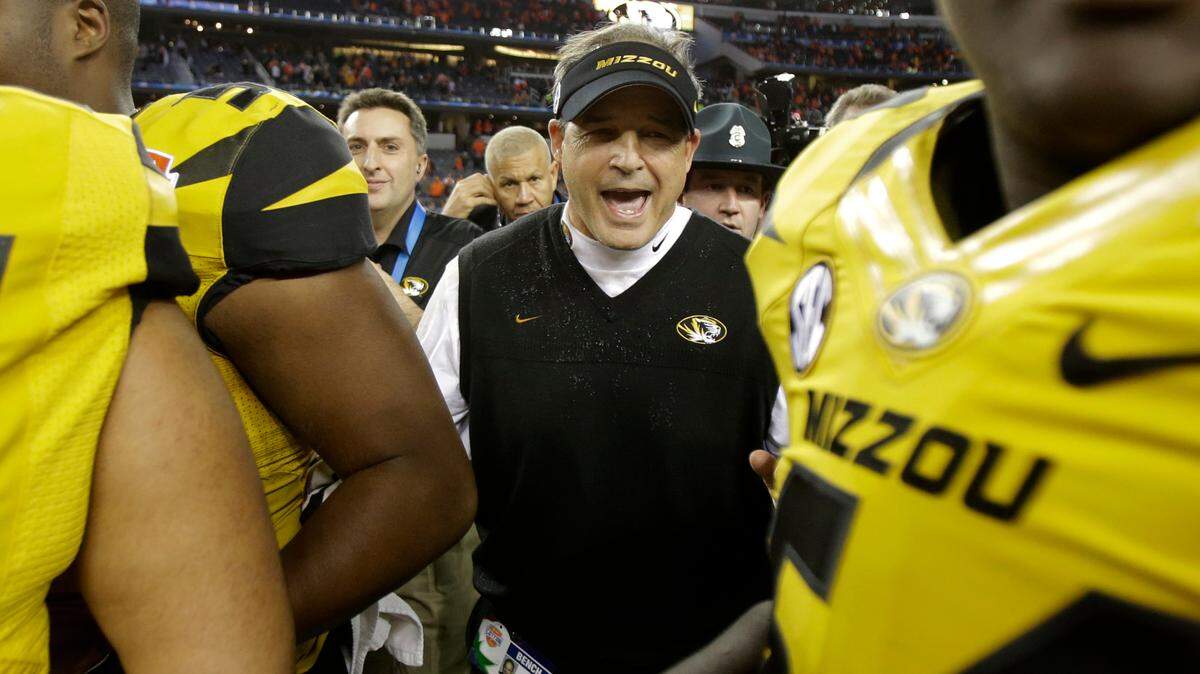
Gary Pinkel nearly forgot about the package sitting at his front door.
It was delivered sometime last Wednesday, but he left it out overnight. It wasn’t until after his workout the following morning that he finally remembered it was there and brought the box inside.
Upon peeling it open, Pinkel found a football with an envelope and card on top. He figured someone had sent it his way in hopes of getting an autograph returned.
But then he started reading the card.
A few lines later came the big reveal: he had been selected for the College Football Hall of Fame’s 2022 class. Welcome. You’re part of the team.
“I just broke down,” Pinkel said. “I’m just being honest with you, I was a wreck for a moment — in a positive way.”
In truth, Pinkel didn’t think he’d be invited into the hall. He wasn’t sure if he’d won enough titles or if his story resonated enough. So to find out he had been chosen — and in such a surprising fashion too — was an emotional experience. One he says he’ll never forget.
“I was just overwhelmed,” Pinkel said. “I just feel very blessed.”
Pinkel cemented his legacy as the career coaching victory leader at both the Toledo and Missouri football programs.
He started his head coaching career with the Rockets, leading the program from 1991-2000. He amassed a 73-37-2 record, including the 1995 Mid-American Conference championship and three other division titles.
Pinkel then coached Missouri from 2001-15, leading the Tigers to a 118-73 record, 10 winning seasons and five division titles in the Big 12 and SEC before stepping down from the profession when he was diagnosed with non-Hodgkin’s lymphoma.
“Certainly there’s no question the wins and losses speak for themselves,” said Mike Alden, who served as Missouri’s athletic director from from 1998-2015. “... But I think that if you take a look only at all the wins, you’re missing the picture of what built all that, and that’s why he deserves to be a Hall of Famer.”
Back in 2001, lots of people told Pinkel not to take the Missouri coaching job. The Tigers had produced just two winning seasons in nearly two decades.
“We inherited a program that had a lot of issues and problems over the years,” Pinkel said. “That all is part of it. And simply what you do is you start page one.”
Pinkel traces his success as a coach back to two things in particular. The first is his tutelage under Don James, whom he played for and coached under at Kent State (alongside Nick Saban) and then Washington. The second is building relationships and uniting people.
In reflecting on this accomplishment, Pinkel kept circling back to the other people who helped him get here. The players, assistant coaches, support staff and so many others that aided him in building the Mizzou program.
He was lucky enough to have a consistent staff on board for the first eight seasons, most notably offensive coordinator Dave Christensen and defensive coordinator Matt Eberflus, who joined him from Toledo.
“We operationally ran things in a very disciplined, organized way,” Pinkel said. “And it was also always about showing our players that you care. If you show them that you care, even if we’re going through tough times, eventually they’re going to trust you. And when you get that going, great things happen. And that’s what we did within a staff.”
Pinkel’s approach in building the Missouri program revolved around systems, something he picked up from James and also instilled at Toledo.
One system for player development: How do you make players stronger, faster, more mentally tough, etc. — to the point at which the seniors become extensions of assistant coaches. Another for organization: How do you practice and prepare. Another for academic responsibilities. And so on and so forth.
“It’s my job to make sure daily as I’m watching all these things happen that we correct things and we praise things,” Pinkel said. “We correct things and praise things every day. That’s what I did.”
He knows that probably sounds simple, but explains, “that is really hard to do at the end of the day.”
Missouri finished with a losing record in each of Pinkel’s first three seasons. Then in 2003, the Tigers went 8-5, eventually falling to Arkansas in the Independence Bowl. Though another losing season was in store before all the success started to come, it was that season that Alden felt things starting to shift.
“Because we could touch that and we could see it, right,” Alden said. “We make it to a bowl game, we start seeing this thing come forward. … and then knowing that there was a correction in 2004 and there was such a solid foundation that was going to build from there.”
Mizzou went 7-5 in 2005 and 8-5 in 2006, putting together back-to-back winning seasons and bowl appearances.
In 2007 came arguably the best year the program had ever seen. The Tigers went 12-2 and won the Cotton Bowl, in the process becoming the first team in program history to win that many games. They also climbed to the No. 1 ranking in the country after knocking off then-No. 2 Kansas, and Pinkel won Big 12 coach of the year.
In the eyes of many, Pinkel’s most shining accomplishment was guiding Missouri’s transition from the Big 12 to the SEC, a realignment the school wouldn’t have even been considered for if it weren’t for the program he’d already established.
The Tigers struggled at first, going 5-7 in 2012. There was a lot of noise at the time that they weren’t ready to make the jump, that they wouldn’t be able to have the same success.
“After that first season,” Pinkel said, “We needed to get things cranked up a little bit.”
Picked to finish sixth in the SEC East before the start of the 2013 season, Mizzou went on to win the division and compete in the SEC championship game in just its second year in the conference. The Tigers finished 12-2 with another Cotton Bowl victory and were ranked No. 5 in the final Associated Press poll.
Pinkel led the team to another division championship the following year, earning SEC coach of the year honors. Though Missouri once again lost in the title game, this time to Alabama, it finished with a win in the Citrus Bowl and an 11-3 record.
“I think that was the difference maker in getting over the hump,” Pinkel said. “People were accepting us and saying that we had a really good program.”
Pinkel took Missouri football to new heights, to a level of national respect and consistent success it hadn’t previously garnered. But perhaps what remains most special to Pinkel about his coaching career is exemplified in the reactions to the news of his induction. It’s in all the calls and texts from former players congratulating him and thanking him for the impact he made on their lives.
“Emotionally you become a wreck just looking at it,” Pinkel said. “That’s one of the great things about our profession, the relationship with players.”
This story was originally published January 11, 2022 at 7:02 PM.