
‘I think it’s very beneficial’: Mizzou’s Jim Sterk learns about NIL alongside athletes
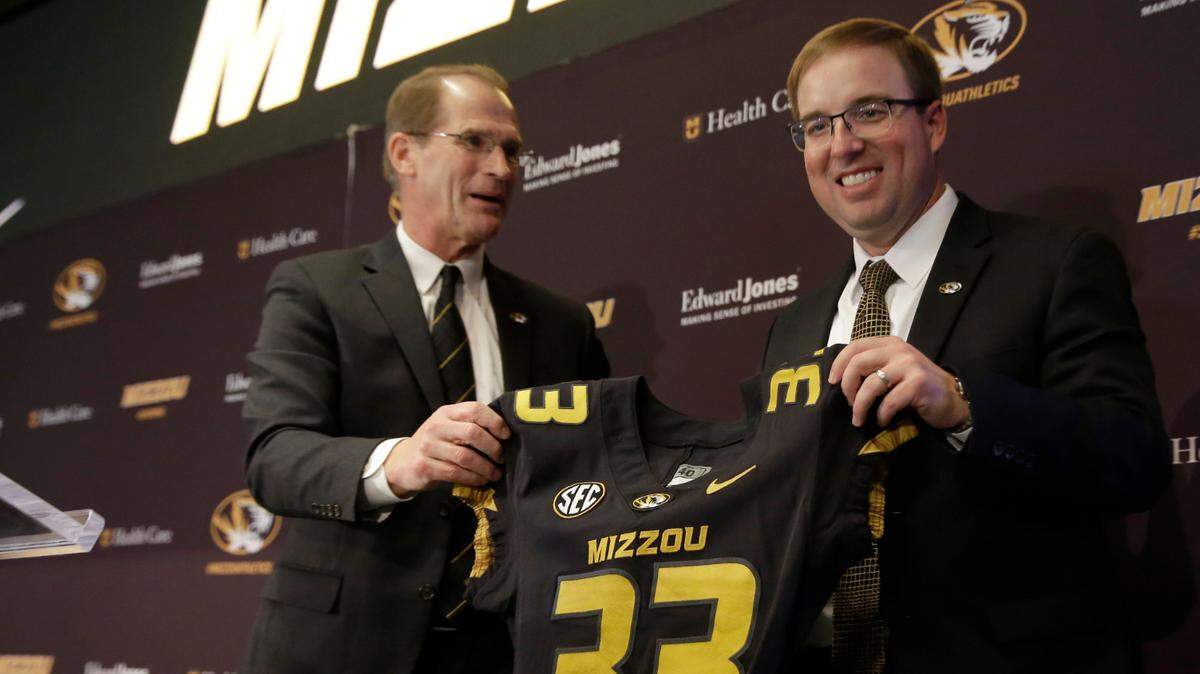
In just five years in charge as the University of Missouri’s athletic director, Jim Sterk has already been through two unprecedented eras.
Sterk is coming out of the first one: the COVID-19 pandemic and its gargantuan effect on college athletic revenues, of which Sterk said Thursday were down “$30 to 35 million” in Columbia. But as MU plans to return to full capacity for its athletic events this fall — of which Sterk noted new football ticket sales are up 150% since 2019 — and COVID’s wrath on college sports has seemed to subside, that’s when the second unprecedented era comes in.
Since the beginning of the month, the NCAA has allowed college athletes to benefit from their. name, image and likeness (NIL), a gigantic moment in the long-running debate of whether student-athletes can profit from their talent. While schools won’t be paying players beyond their scholarship and costs of attending school, NCAA athletes are now allowed to make money through endorsements.
There’s a lot to learn, Sterk said, for not just him but all involved.
“For a while, we were pandemic administrators,” Sterk said. “We want to be sport administrators, but (NIL) has changed it. It can’t consume us, it can’t consume the coaches. ... Right now, there’s no events or games going on, so it’s dominating thought and kids are thinking about it. But they’ll be the ones that are lifting and practicing and all, they have less time for that, and they’ll be focusing on their sport.
“I don’t think (NIL) will dominate. We want to get it to a manageable level. Obviously, the past week since July 1, it’s been really busy.”
No one is quite sure what the right moves are with NIL, and growth techniques are being attempted. Some, such as Missouri football’s Tyler Macon and Martez Manuel, have already created and are promoting brands using their popularity. Others have signed — often announced on paid social media posts — package deals through companies, like when several Missouri players joined YOKE Gaming (a service that allows fans to video chat and play video games with an athlete) on July 1.
Sterk remarked that he generally supports the idea of NIL, calling it “very beneficial” to college athletics, and helped the university set up a partnership with branding company Opendorse, which the department announced in November. Sterk wanted to build that connection early so that athletes had time to evaluate their options, while he also noted that there will be classes on taxes and entrepreneurship offered in the fall.
“It was important. That’s why we signed with Opendorse a while ago,” Sterk said about making sure the department knew early how to utilize NIL. “... I think our staff will continue to give weekly updates on questions and answers and things to avoid, so that our student-athletes are up to speed on what the latest is as far as opportunities, but also the pitfalls. Here’s what happened, and here are the issues. ... I think it’s going to be a never-ending, continuing education.”
A state NIL bill passed through Missouri’s legislature in May with bipartisan support and currently sits on Gov. Mike Parson’s desk waiting to be signed or vetoed. If signed — and Sterk noted Thursday he’s heard nothing to the contrary recently — the bill will go into effect Aug. 28.
Asked if he was concerned NIL may widen an already-present gap in college football between elite programs and those trying to do more with less, Sterk instead believed NIL has a chance to narrow it. There’s a “vacuum gap” to throw the Tigers into, he says, and that’s a conversation he’s had many times with second-year football coach Eliah Drinkwitz.
“I don’t think it widens the gap necessarily,” Sterk said. “I think there’s going to be opportunity across the nation with different teams. It puts things out in the open that you can see and allow. I think there’s going to be some student-athletes that are disappointed that they thought they were worth this ... (and) they may not be the next Patrick Mahomes and being able to get deals with everyone and high-level deals. So I think for us and Eli, as we looked at it ... how can we go ahead with this?”
Already, programs have began to come up with creative ideas in attempts to entice recruits. Sterk pointed out a tactic announced by a University of Miami booster offering Hurricanes football players $500-a-month contracts to promote a line of mixed martial arts gyms he owns, through social media and marketing appearances.
Whether a deal of that magnitude comes Missouri’s way soon is anyone’s guess in the money-driven world of college football, though it’s made more complicated in the Tigers’ case by the fact that the athletic department has already been garnering multi-million-dollar donations from boosters for the construction of an indoor football practice facility. A school spokesperson remarked that Oct. 17 is the target date to begin the project, located adjacent to the south end zone and expected to be completed by December 2022, with the facility coming at a cost of $33.4 million and funded entirely by private donations.
The NIL era, especially in its early days, may see the most creative athletic department — not necessarily the biggest or wealthiest — come out on top. Whether or not that gives Missouri an advantage is up to the decisions the department makes in the near future.
“Intercollegiate athletics and why I got into it in the first place is the educational side of things, and we’re going to continue to stress that,” Sterk said. “Our number one, as crazy and important as athletics is, and the competition and wins and losses and those things, it’s way more important for (student-athletes) to get their degree. We really need to stay focused on that, and that’s where our fundraising core has been of, raising money for scholarships. We need to continue to point that out.”