
Kansas’ football job faces stiff competition in coaching marketplace
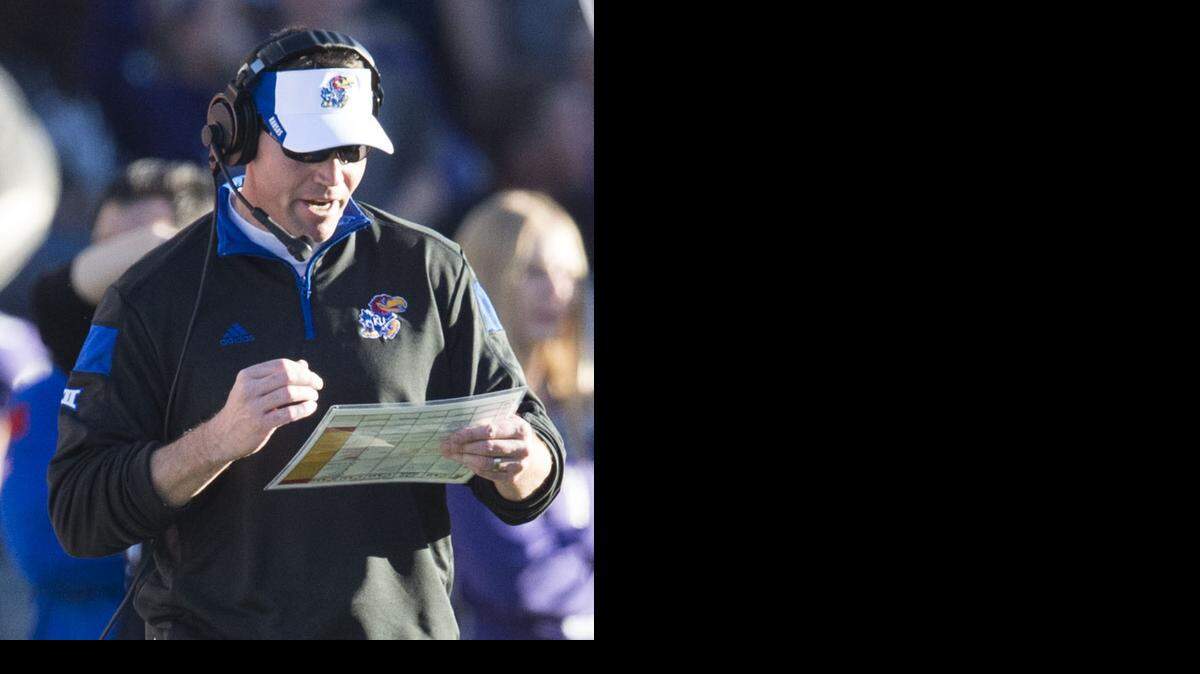
The locker rooms lacked air conditioning. There were no meeting rooms dedicated to football. The weight room, or what one might refer to as a weight room, was shared with the rest of the athletes on the University of Kansas campus.
When Glen Mason arrived at Kansas in 1988, leaving behind a coaching job at Kent State, he surveyed the landscape and came away with one prevailing thought:
We had better facilities at Kent State.
Mason, then a 37-year-old with two years of head coaching experience, had plenty of rational reasons to turn down a job at Kansas. The facilities were abysmal. The recruiting base, as it always has been, was questionable. The program had suffered through five losing seasons in six years.
But for Mason, the possible objections were trumped by one determining factor. Kansas was in the Big Eight, among the best conferences in college football. Kent State was not.
“There’s only so many big-time jobs,” Mason says now. “Those are awful hard to get. And if you can get one, and you bypass it, you may not get another chance.”
More than 25 years later, KU is in the market for another head coach — its fifth since Mason left for Minnesota in 1996. After firing Charlie Weis on Sept. 28, Kansas athletic director Sheahon Zenger has spent the last two months laying the groundwork for a search, compiling names and reaching out to potential candidates through consultant Chuck Neinas, the former Big 12 interim commissioner who was enlisted to help with the search.
According to a source familiar with the basics of the search procedure, KU will spend this week reaching out to possible candidates and zeroing in on a handful of top choices. For the moment, specific names are elusive.
Interim coach Clint Bowen is an official candidate, while other potential candidates have floated into the conversation. Memphis coach Justin Fuente is a hot commodity among many openings after leading the formerly woeful Tigers to a 9-3 record and an American Athletic Conference title. On Tuesday, though, the Memphis Commercial Appeal newspaper reported that Fuente was close to signing a new contract with Memphis. Georgia Southern coach Willie Fritz, a Kansas City native and former head coach at Central Missouri, is also drumming up interest after guiding his team to a Sun Belt title in the program’s first season in the Football Bowl Subdivision.
Other names — such as Minnesota coach Jerry Kill or Texas A&M wide receivers coach David Beaty — have ties to the area or the program, but to this point, Zenger has remained tight-lipped on concrete information.
But as the search continues — and Zenger attempts to find the right fit for Kansas football — a key question rises to the forefront, the same question that Mason had 26 years ago: How appealing is the Kansas job? Good enough to attract the right coach in a marketplace that includes openings at Nebraska, Florida and Michigan, as well as UNLV and Tulsa?
“These is upside potential there,” says Mason, now working in television after coaching at Minnesota during 1997-2006.
Oftentimes, to look at the KU football program is to see many different pictures. The KU athletic department has invested millions in facilities upgrades over the last decade, building the $33 million Anderson Family Football Complex, complete with a new weight room and two new practice fields adjacent to Memorial Stadium.
But the job certainly has its natural drawbacks. The program has bottomed out during six straight losing seasons. The in-state recruiting base is thin, further emaciated by the presence of a perennial top-25 program in Kansas State and traditional powers such as Oklahoma and Nebraska, who will swoop in and gobble up many of the state’s best recruits.
According to numbers tracked annually at the website NationalHSFootball.com, the state of Kansas produced an average of just 14.8 FBS signees during the last four-year recruiting cycle. The number does not include walk-ons who may have grown into contributing players, but when compared against nearby states, the talent pool is shallow. Missouri produced an average of 28 FBS signees from 2011 to 2014, while Oklahoma averaged 35.3 per year. Among states in the Big 12 footprint, only Iowa (8.8) and West Virginia (3) were worse at producing FBS players.
During the last two decades, Kansas has mined Texas for talent. But KU coaches also concede that the rise of Baylor and TCU, along with Texas A&M’s move to the Southeastern Conference, has ramped up the competition for Texas high school players.
“If you recruit the right guys in here,” KU receivers coach Eric Kiesau says, “you can have a positive, productive program.”
Those familiar with the KU program, though, point to other assets and appealing qualities. The last two Kansas coaches — Weis and Turner Gill — were paid handsomely, pulling in at least $2 million annually. And Zenger can point to recent success. While the glory was fleeting, Kansas was one of just 51 schools to appear in a Bowl Championship Series game from 1997 to 2014. The Jayhawks were one of 21 schools that made just one appearance, but a track record of some success can be critical.
One example: When Fuente, a Tulsa, Okla., native, took over a losing Memphis program in 2012, he cited the program’s recent success in the early 2000s as a primary factor.
More to the point, Mason says, Kansas is a Big 12 job, one of just 64 jobs in the so-called “power five” conferences. For every top assistant reluctant to stake their career on a tenuous rebuild at Kansas, there are five to 10 others waiting for an opportunity in the Big 12.
“I looked at it as a product,” Mason says. “Is this product sellable? What’s the campus like? What’s the school like? At Kansas, why can’t you sell it?”
To reach Rustin Dodd, call 816-234-4937 or send email to rdodd@kcstar.com. Follow him on Twitter: @rustindodd.
This story was originally published December 2, 2014 at 3:04 PM.