
Clint Bowen is face to face with his dream job at KU
The smooth wooden shelves are now bare and empty. The walls are spotless. The enormous office desk in the middle of the room is void of the usual trinkets. Zero photos or posters. No souvenirs or keepsakes. Only a couple stacks of papers and some cardboard boxes.
Clint Bowen is sitting at a table inside the Kansas head coach’s office at the Anderson Family Football Complex, the one that used to belong to Charlie Weis, the corner unit that overlooks the southwest corner of Memorial Stadium.
For the better part of two decades, Bowen has thought about sitting in this chair, guiding the football program he once played for, living a professional dream in his own hometown. But now he is here. And he is not quite ready to unpack.
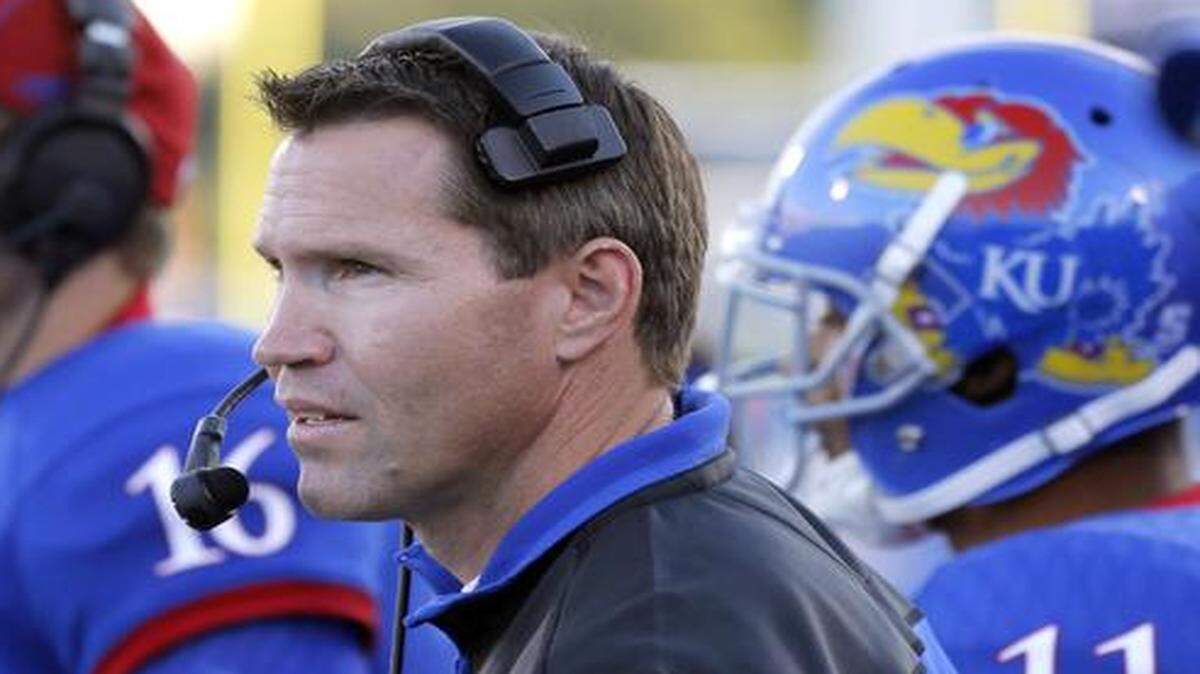
After replacing a fired Weis on Sept. 28, Bowen was given the interim head coaching title for the final nine weeks of the season. For Bowen, 42, it was an unofficial eight-game audition — a little more than two months to prove to KU’s brass that he is the guy to steer the program out of a four-year wasteland of record losing and fired head coaches.
“Clint’s ready,” says Dave Campo, the KU associate head coach who once coached the Dallas Cowboys.
“I would let my son play for Clint,” says Glen Mason, Bowen’s old coach at Kansas.
“He’s the people’s choice,” says Gene Wier, the legendary high school coach at Olathe North and a long-time friend of Bowen’s.
For the last five weeks, Bowen has focused on establishing a new identity for Kansas football, following the blueprint he learned while playing for Mason and serving as a defensive assistant under Mark Mangino during the 2000s. He uses words like toughness and innovation, focusing on the resources that Kansas has, not the ones that it lacks.
But for the moment, Bowen says, he is not much concerned with his own future. In the next six weeks, Kansas athletic director Sheahon Zenger will hire a full-time head coach. Bowen will be a candidate, Zenger says, and he’ll be a part of the new regime in one way or another.
But no matter what happens, no matter who is sitting in this office in December, Bowen will keep telling anybody that will listen: Kansas is a place where you can win.
“This really is a place that has all the resources to be successful,” Bowen says. “There’s a lot of excuses, and there’s excuses for every program across the nation. People always ask: ‘Can it be a basketball school and a football school?’ And my answer is, absolutely, yes.”
Here is a Clint Bowen story. In the fall of 1987, the Lawrence High football team headed west on Interstate 70 to face Manhattan High in the Kansas 6A championship game at KSU Stadium. Bowen was a sophomore that year, a developing piece in the Lawrence High football dynasty. His father, Charley Sr., had been a high school All-American for the Chesty Lions, and football was in the family blood.
Even then, there was something about strapping on the pads and playing under the lights for the local powerhouse. It was in those days, Bowen says, that he first started thinking about coaching football. Yes, a high school coach. That’s what Bowen wanted to be.
On that day in Manhattan, Lawrence High claimed another state championship. Bowen’s older brother, Charley Jr. — who would also go on to play at Kansas — was one of the Lions’ stars. Clint was Charley’s hard-nosed little brother, the kid who grew up working on a neighbor’s dairy farm for extra money.
Nearly 30 years later, this state championship story should probably be a footnote. Bowen would play in two more state championship games — winning one — and then head to Kansas as a walk-on defensive back. But on that day in 1987, there just happened to be a young assistant coach on the Manhattan High sideline.
His name was Sheahon Zenger, and he still remembers the Bowen boys beating Manhattan High that day.
“The Bowen name,” Zenger says now, “was definitely prevalent.”
The first week was the hardest.
In the days after Bowen took the interim job in late September, the questions kept ending up on his desk. What did he want to have for the pregame meal? What uniforms would Kansas wear? What pump-up video did he want to show the team?
Then there would be another media obligation. A news conference. A Big 12 teleconference. A nightly radio show.
For all the years Bowen had thought about being the head coach at Kansas, well, there are some things that must be learned on the fly.
“I just kept writing things down,” Bowen says.
Five weeks later, Bowen says, the routine has been simplified. He arrives early in the morning, finishing his administrative tasks before an 8 a.m. staff meeting. Then he stays late, working on his old defensive coordinator tasks.
“Late at night,” Bowen says, “that’s when I do all the defensive stuff.”
The Jayhawks are winless in four games since Bowen took over, losing competitive games against Oklahoma State and Texas Tech, and suffering a 60-14 blowout at Baylor last week. For some coaches, this might be discouraging. But for Bowen, he has been in this situation before. He was here for a turnaround under Mason in the early 1990s. He bore witness to a program renaissance under Mangino in the 2000s. If you understand the landscape, he says — the challenges, the recruiting territory, the history — you can start to piece the Kansas blueprint back together.
On a late October morning, Bowen drifted back to the offseason workouts under Mason in the early 1990s, when the program was in the midst of a wholesale culture change.
“I’ll hear coach Mason’s voice until the day I die,” Bowen says. “‘You got to be tough; you got to be tough.’”
In those days, the KU players would arrive in cotton sweats, running to the point of near collapse. If you survived those winter workouts, you could surely survive a season in the Big Eight. And Bowen was a natural survivor. A former walk-on, Bowen would help a rising Kansas program to the 1992 Aloha Bowl and then lead the team with 114 tackles as a senior in 1993. If you saw Bowen then, friends say, he always maintained a boyish quality, a Midwestern sensibility. It hid an inner fire.
“Don’t let the smile fool you,” Mason says now. “He was one of the toughest players I ever coached.”
Here is another Clint Bowen story. After finishing his football career at Kansas, Bowen set out to begin a career as a high school teacher and football coach. While finishing his degree in education, he found himself student teaching under Gene Wier at Olathe North.
Wier, one of the most accomplished high school coaches in Kansas City history, was in the midst of building a dynasty at Olathe North. But during one semester together, he saw something different in Bowen.
“You really want to do this for the next 50 years?” Wier asked.
Wier was curious. Why not give college coaching a shot?
“He was bright and young and energetic, and he needed to do that while he was still single,” Wier says now. “He could find out if that’s what he wanted to do or not.”
A short time later, Weir placed a call to Mason at Kansas. A few months, Bowen returned to KU as a graduate assistant.
If you listen to Clint Bowen talk about Kansas football for long enough, you’ll likely hear him use one word: innovative.
“We have to be creative,” Bowen says.
For Bowen, the idea of innovation comes in many forms. Kansas will never have the most talented players — especially on the offensive and defensive lines — so the coaches must employ schemes that give their players a chance. But to fully illustrate his point, Bowen tells a story about the 2007 Orange Bowl team.
The secondary he coached that year featured three players — Aqib Talib, Chris Harris and Darrell Stuckey — who would have long and productive NFL careers. But each player had his own story. Talib was an overlooked receiver from Texas who picked Kansas over Utah; Harris was an undersized recruit who picked KU over Tulsa; Stuckey was a high school quarterback from Kansas City, Kan.
“A kid might not look the prettiest,” Bowen says, “but he might be a pretty good football player. You got to find ways to look past what everyone else is seeing.
“You end up with an Orange Bowl secondary.”
Here is one more Clint Bowen story. Almost 10 years ago, the New York Giants called during the offseason asking if Bowen might be interested in a position at the NFL level. He thought it over for a few days. And then he said no.
A few colleagues told him he was an idiot. He was still in his 30s at that point. How could he turn down that opportunity? But Bowen had a different perspective. His wife, Kristie, was pregnant with a baby boy. His family — which now includes two young sons — was just getting settled. And Lawrence was home. It was where they met; it was where they put down roots; it was where Clint once told Kristie, on one of their first dates, that he would one day be the head football coach at Kansas.
“I see it different,” Bowen says. “I kind of have a purpose. I have a place that’s important (to) me.”
Now Bowen is sitting in the head coach’s office, the one with the empty shelves and bare walls. The Jayhawks play Iowa State on Saturday, and for at least four more weeks, Bowen will do his best to push the program forward. That much, he knows.
“Whether I’m a part of (the future) or not, it’s not really relevant,” Bowen says, “I go back to what coach Mason used to say: It’s about the team, the team, the team.
“You can win at this place. And you have everything you need to do it.”
To reach Rustin Dodd, call 816-234-4937 or send email to rdodd@kcstar.com. Follow him on Twitter: @rustindodd.
This story was originally published November 6, 2014 at 6:01 PM.