‘Talking that jibber-jabber’: How social media criticisms are fueling Kansas basketball
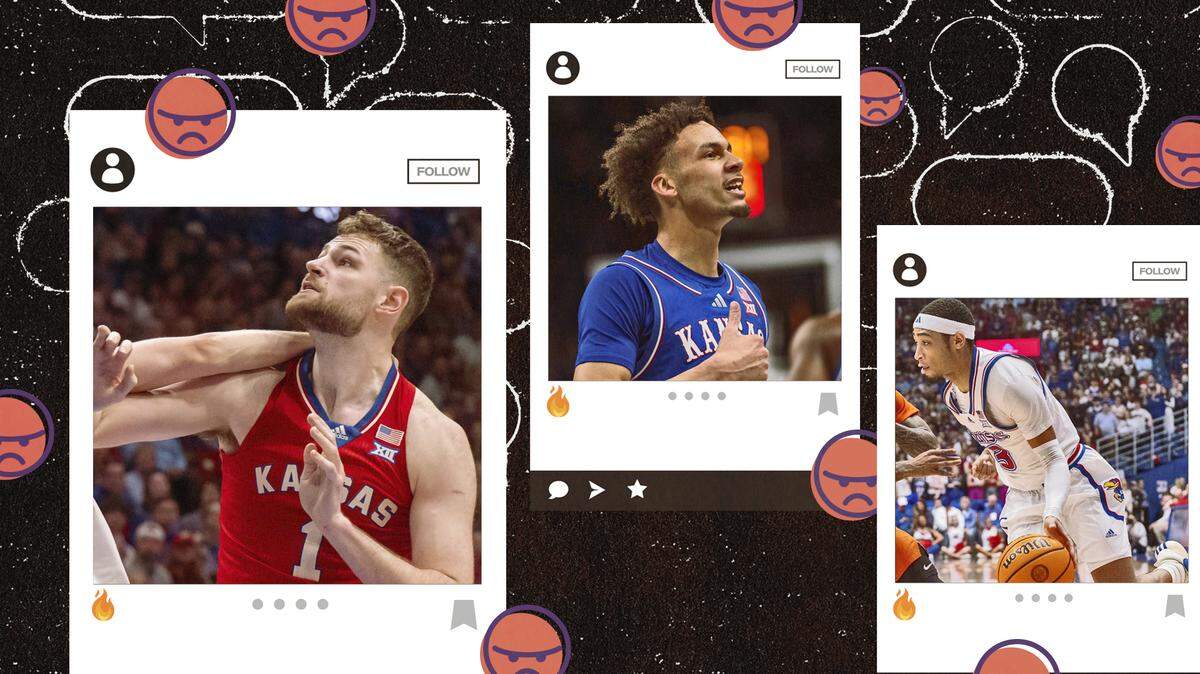
Kansas Jayhawks guard Dajuan Harris has a set of screenshots saved on his phone.
At first glance, the images seem harmless enough. Collectively, however, they offer a sobering glimpse into the social-media environment enveloping many high-level college athletes today.
If you’ve tweeted or posted about KU or Harris this season, there’s a good chance he’s seen it. Perhaps he even snapped a screenshot of it.
Doesn’t matter if the comment was positive or negative. KU’s sixth-year point guard has probably already shared it in various group chats with friends or family.
He recently offered up two such images — one depicting negative feedback, one something more complimentary — as examples.
.jpg "BeFunky-collage (11).jpg")
“I still look at social media because words don’t hurt me,” Harris said, phone in hand. “That’s how I grew up. My mom told me that words should never hurt you. Half of the people talking don’t know basketball anyway.
“So ... I just scroll and laugh at that stuff.”
A new season begins ...
There’s much on the line as the No. 7-seeded Jayhawks (21-12) prepare for Thursday’s first-round NCAA Tournament matchup against No. 10 Arkansas (20-13) in Providence, Rhode Island.
Ranked No. 1 before the season began, the Jayhawks have not lived up to expectations — their own, or those of most fans. In fact, this year marks the first time that KU has failed to gain at least a No. 4 NCAA Tournament seed since head coach Bill Self was hired in April 2003. No. 7 is the program’s lowest seeding since 2000, when the Jayhawks were a No. 8.
For Harris and his teammates, March Madness presents an opportunity for redemption after a season marred by a dozen losses. The starting point guard has a few nasty tweets from fans saved; they’d make for some nice cold-take zingers in the event KU defies the odds and makes a deep run. If nothing else, they’re extra motivation during this most crucial time of the season.
Harris isn’t the only Jayhawk who is keenly aware of what people are saying about him online. Several other players told The Star that most everyone on the team scrolls through X and Instagram regularly. It’s often the first thing they do on the bus ride home from road trips.
For better or worse, social media is here to stay. More than that, it’s deeply integrated into college sports as a means by which many players, teams and universities seek out connection with their followers.
Bottom line, no matter how KU performs this week (and potentially beyond), Harris knows he’ll hear about it online.
“I’ve been here for six years. I understand how it is,” he said. “I’ve seen how everybody changed up on different players. It doesn’t hurt me that the fans change up on you — they also support you a lot. So you’ve gotta thank them. They believe in us, and I hope they can continue to believe in us.
“There are some fake fans on social media, too. ... There are some out fans out there talking that jibber-jabber. Some stuff they might be right about and some stuff they aren’t.”
The story of this season’s KU men’s basketball team can’t be told without some underscoring of the role played by social media. To better understand that role, The Star spoke with multiple current and former KU players about their own social media experiences.
Social media and NIL
Jayhawks center Hunter Dickinson enjoys an elevated platform as one of the best players in the game competing for a program steeped in rich tradition.
He’s one of the most candid stars in the game today. Sometimes, by his own admission, to a fault.
Dickinson has built something of a brand around his abilities on the court and social media presence. He even announced his return to KU for another shot at a title on X (formerly Twitter) last summer.
When hoops analytics site EvanMiya tweeted a stat showing how Dickinson’s defense is better than some might think, the Kansas big man responded with a GIF of a white owl turning to stare directly at the camera.
That’s Dickinson’s fun and easygoing persona on social media, especially now, in the era of name, image and likeness in college athletics. But it wasn’t always this way for the 24-year-old native of Alexandria, Virginia.
“Nowadays, with NIL and stuff, you’ve got to kind of put yourself out there so you’re marketable to brands,” he said. “But also, what I think I struggled with at first was keeping the main thing the main thing: making sure that, if you play well enough, you’re going to attract marketing stuff regardless of how (many) followers you have and stuff like that.
“You’ve got to kind of put yourself out there at times, but never lose face. You’ve got to keep the main thing the main thing.”
Dickinson has spoken on multiple occasions about the added scrutiny that players shoulder when they’re getting paid. And he understands fans’ frustration when they under-perform.
He likened it to his own fandom for the Buffalo Bills. Dickinson admits that when his favorite NFL team loses, he gets upset ... but when they win, he “loves them again.”
“I’m a fan, too, at times,” he said. “I get it. I don’t blame them for feeling certain ways.”
Dickinson has seen a change in the tenor of social media chatter since the broadening legalization of sports gambling. Kansas legalized sports betting in August 2022; it became legal in Missouri in November.
Dickinson estimated that as many as 70% of the direct messages he receives — often laced with vitriol — would cease if prop bets for college players went away.
For his own part, Dickinson, a Catholic, said he gave up social media for Lent. And that has improved his overall focus.
Former KU star and current Toronto Raptors guard Gradey Dick shared similar thoughts about the impact that sports betting has had on the way fans interact with athletes. The Wichita native was a fan favorite in Lawrence and remains so in the NBA, largely owing to his approachable personality.
Dick’s social media acumen has a lot to do with that and is apparent in his many TikToks. Just don’t try to direct-message him.
“I don’t think I’ve opened my comments or opened my DMs since high school,” he said. “Sometimes I see the comments and it just makes me laugh. ... You could have your best game — like, I could have my best game in the NBA, most points, blah blah — and there’s always one person: Why couldn’t you get one more rebound? Go die.’
“So it’s like, ‘Bruh, what are you talking about.’ That stuff is just nuts. You could be winning. You could be successful. There’s always going to be someone saying something.”
Zeke Mayo’s experience
Social media took center stage in an ugly way earlier this month following KU’s loss to Texas Tech.
Guard Zeke Mayo tweeted out screenshots that appeared to come from his Instagram direct messages. In each of the four pieces Mayo shared, fans expressed various degrees of hate toward the Lawrence native.
It was awful sentiment: threats of violence, racist comments. Two messages wished for Mayo to die.
The reason? Mayo hadn’t played as well as hoped against the Red Raiders. He scored five points on 1-for-7 shooting, turning it over five times and missing shots he’d typically make.
In the wake of his posting what had been sent to him, Mayo found swift support from teammates, university officials and an overwhelming majority of Jayhawk fans on social media.
He told The Star recently that he wanted to raise awareness about how social media affects college athletes’ mental health, but discussing what happened remains difficult for him. He’s heartened to see other college players, such as Kansas State’s Coleman Hawkins, make public their own struggles with social media.
Mayo said he prays “for Hawkins and his family, because it’s no joke.” Like Mayo after the Texas Tech game, Hawkins at K-State has absorbed withering criticism that he failed to live up to expectations as a heralded transfer into the program.
“I mean, it’s extremely serious, especially with athletes,” Mayo said, “because we have such a high standard of playing at a high level because of NIL. And that’s not even a factor, honestly, to me personally. I just never really looked at it as, ‘We get paid, so we have to meet a specific standard.’
“We bust our ass every day to perform at the highest level that you can. It’s just tough to see people going through that, so I’m trying to raise awareness.”
‘A real point of emphasis’
Mayo said he relied on teammates, coaches, family and friends to help him restore his mental health after the abuse he received.
In recent years, the university has sought to prioritize mental health services for its students, including student-athletes in basketball and beyond. KU Athletics, through the University of Kansas Health System, says it has mental health resources at the ready.
“This notion of supporting student-athletes, obviously through physical wellness, but through mental wellness, has absolutely become a real point of emphasis,” said KU athletic director Travis Goff. “And that’s across college campuses. More and more of those services are being provided at a higher level.
“The notion of NIL and some degree of compensation, of sports wagering, the energy and emotional elements of that ... I think there’s been an evolution of that. And at times it feels like (the) stakes are higher than ever before.”
The school’s athletic department has an executive director of mental health services, a director of mental health services and an athletic counselor on staff, all of whom “support our student-athletes and teams and are readily available to them,” per KU Athletics.
The KU men’s basketball team even has an assigned mental health staffer on hand as part of a broader mental health initiative called “Beak the Stigma.” It’s aim: to support student-athletes in speaking comfortably and openly about their own mental health.
Bringing it into the light
Mayo harbors some lingering regret about going public with his experience after the Texas Tech game.
“I do for sure because a lot of people think I was looking for pity,” he said, “and they kind of called it soft a little bit. That just wasn’t the case. I kind of wanted to put that out there just for people to understand the stuff that we go through on a daily basis. ... (I’m) not looking for pity, not looking for empathy from others.”
Mayo deactivated his Instagram account last month after the Jayhawks lost to Houston in double-overtime. Like his teammate Dickinson, he said disconnecting a bit has helped his mental outlook.
“I just wanted to get away from that all,” Mayo said. “It’s a habit. As a teenager or young adult, you’re going to get on your phone after the game and see who’s messaging you. I just had to put that away for a little bit. It’s still deactivated right now. I’m gonna stick with that as long as possible.”
Mayo paused a moment before adding this:
“Social media is definitely something that can take over your mind, and it can get to you. So shutting it off has helped me a lot, for sure.”
All eyes on the Jayhawks
When it comes to social media, KU hoops coach Bill Self has at least one piece of advice for his players:
Don’t read into it too much.
Self’s reasoning is simple: Things said online can be true or semi-true, sure, but there are plenty of instances where a “fan” is just trying to bait a player.
“I think the best thing that players can do is don’t read the good,” Self said. “If you don’t read the good, you’re not having an inkling to read what’s not good.”
The coach knows that’s a difficult ask in 2025. Social media invariably has a hand in shaping how young players view themselves and the world. Self-confidence can rise, or fall, with a tweet.
Players competing for a blue-blood basketball school like Kansas are naturally cast under a brighter spotlight. The extra scrutiny is a blessing for some, such as former JUCO guard-turned-KU bench player David Coit.
“Obviously, the culture around Kansas is that the people love basketball,” he said. “It’s a lot of positives that come with it. I think there’s a lot more eyes on you. It’s a lot more pressure, but that’s what you want as a competitor. It’s a blessing to have people watching you, holding you accountable for what you do on the court.”
Coit remains a player on social media, too. But he doesn’t let negative feedback get him down.
“I’ve got a positive outlook on things,” he said. “I don’t let that sway me in any way. It isn’t going to make me feel better. It isn’t going to make me feel worse.”
Let the games begin
As March Madness commences, players across the country are seeing an uptick in all kinds of online chatter. About themselves, about their teams.
According to one recent NCAA study, eight of 10 abusive posts sent to college athletes on social media came during the NCAA Tournament. And ESPN reported not long ago that abuse by sports bettors is an increasingly common form of harassment.
Dickinson, the KU center, believes it’s best not to give the harassers any attention.
“A lot of them are made-up accounts with no followers and stuff like that,” he said. “You can’t really take that to heart. Everybody’s human, so they’re going to take it in different ways. I feel like if you don’t respect the person talking, don’t give them the time of day.
Harris, the Jayhawks’ longtime veteran point guard who will be done with college basketball once KU’s tourney run concludes, has one last piece of insight for eventual successors on the hardwood.
“To the young guys, it’s really just when you’re going through the toughest times, you’ve got to stay off the internet because people will DM you some stuff that could hurt you,” Harris said. “They probably won’t hurt you …
“Just stay off the internet because there’s some people out there that send some hateful messages. If you go hard, don’t let that stuff get to you. Then it shouldn’t matter at the end of the day, to be honest.”