Rock Chalk... but what actually is a Jayhawk? Everything to know about KU’s iconic mascot
Whenever the Kansas Jayhawks are on national TV we see social media and Google searches light up asking one question: What is a Jayhawk? To help the rest of the world out, we pulled together this primer on the KU mascot’s history and why Kansas fans love these birds so much.
What is a Jayhawk?
While the exact origin of the term “Jayhawk” is unknown, F.W. Blackmar, the first dean of the University of Kansas Graduate School, attempted to explain the mascot’s origin in a university radio program in 1926:
“The ‘Jayhawk’ is a myth. It has no historical use. It is neither beast, fish nor fowl,” he wrote.
The name is a combination of two real birds: the blue jay, a noisy bird known to rob nests, and the sparrow hawk, a stealthy hunter.
One of the earliest accounts of people being referred to as “jayhawkers” comes from the 1840s and describes a group of pioneers traveling across the Great Plains west to California to join the gold rush. Blackmar’s address notes that around the same time “jayhawking” became a general term referring to “marauding or plundering.”
A few years later, the Kansas Territory became a battleground to decide whether it would become a slave state or a free state. There was no compromise in sight by settlers on either side of the Kansas-Missouri border and so began the years of violent guerrilla conflict between the pro-slavery and abolitionist forces — now known as “Bleeding Kansas.”
Lawrence, where the University of Kansas was founded in 1865, was an abolitionist stronghold that quite literally rose from the ashes following a massacre and raid by William Quantrill’s soldiers in 1863. It was during the Bleeding Kansas period of the state’s history that some abolitionist forces began to be known as Jayhawkers. The abolitionist leader John Brown (who is famously depicted in a mural in the Kansas Capitol) was referred to in the Lawrence newspaper Herald of Freedom as an “old Jayhawk apostle.”
A few years later in 1886, the Jayhawk made its first official appearance in association with KU in the university’s Rock Chalk Chant. And when the Kansas football team first took the field in 1890, “it seemed only natural to call them Jayhawkers,” according to KU Athletics.
But what makes a Jayhawk? For that we turn back to Blackmar’s address:
“The ‘Jayhawk’ myth has become a spirit of progress and power. Gone has the spirit of robber birds; gone the reckless spirit of the law and disorder bands of the stress and storm period. Only the spirit of comradeship and the courageous fighting qualities to make and keep Kansas free, remain. The spirit of the modern Jayhawk is to make Kansas great and strong and noble in good deeds.”
Now, it’s a spirit all Kansans can get behind.
But what does a Jayhawk look like?
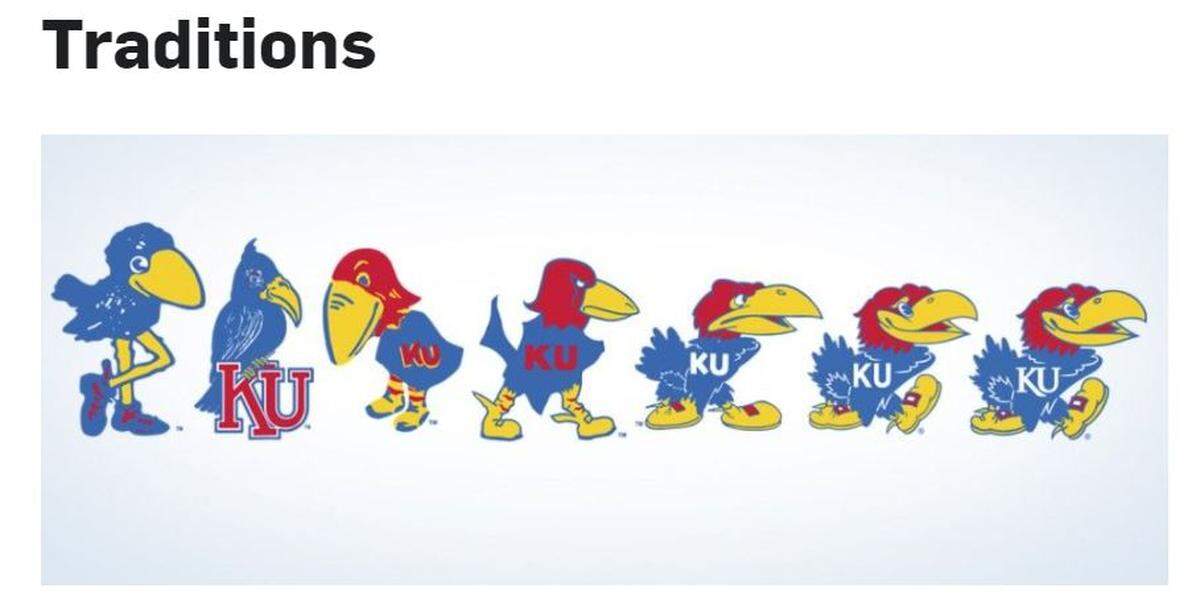
Henry Maloy, a cartoonist for the student newspaper The University Daily Kansan, is credited with drawing the first Jayhawk officially recognized by the university in 1912. The friendly illustration features a blue body, a large yellow beak, long stilt-like legs and most notably shoes (KU Athletics says that they are for kicking opponents).
There have been seven incarnations of the Jayhawk since its inception, each uniquely shaped by the era they represented:
- The 1920 Jayhawk is a more somber bird perched on a KU monogram.
- In 1923 the design by Jimmy O’Bryon and George Hollingbery extenuated the Jayhawk’s beak making it resemble a duck.
- Forrest O. Calvin’s drawing in 1929 gave the Jayhawk sharp talons above its shoes.
- The Jayhawk now known by some as the “War Hawk” was designed in 1941 by Gene “Yogi” Williams and featured opened eyes and beak, which gave the bird a more menacing appearance.
But it is the 1946 smiling Jayhawk designed by Harold D. Sandy that we know today.
What about Big Jay and Baby Jay?
The Jayhawk became more than an illustration in 1960 when the KU Alumni Association provided a mascot costume to the university. And so Big Jay was born. But he wouldn’t be alone for long. In 1971, Baby Jay (created by KU student Amy Hurst) was hatched out of a papier mâché egg at the 50-yard line during halftime of KU’s homecoming game against Kansas State.
However, Big Jay and Baby Jay are not father and daughter, nor siblings, nor in a romantic relationship. They are just birds having a good time. Big Jay is a proud, strutting athletic bird and Baby Jay is mischievous and childlike, but never mean, former mascots told the Lawrence Journal-World.
Becoming a KU hype bird is a big responsibility and students who join the Spirit Squad as the mascots take it seriously. The suits themselves are made to accommodate specific height requirements: Big Jay is between 6’1” and 6’5” and Baby Jay is between 4’11” and 5’1”.
While March Madness fans are used to seeing Big Jay and Baby Jay on the sidelines at basketball games, the mascots attend weddings, birthdays, charity events and more.
The Crimson and the Blue
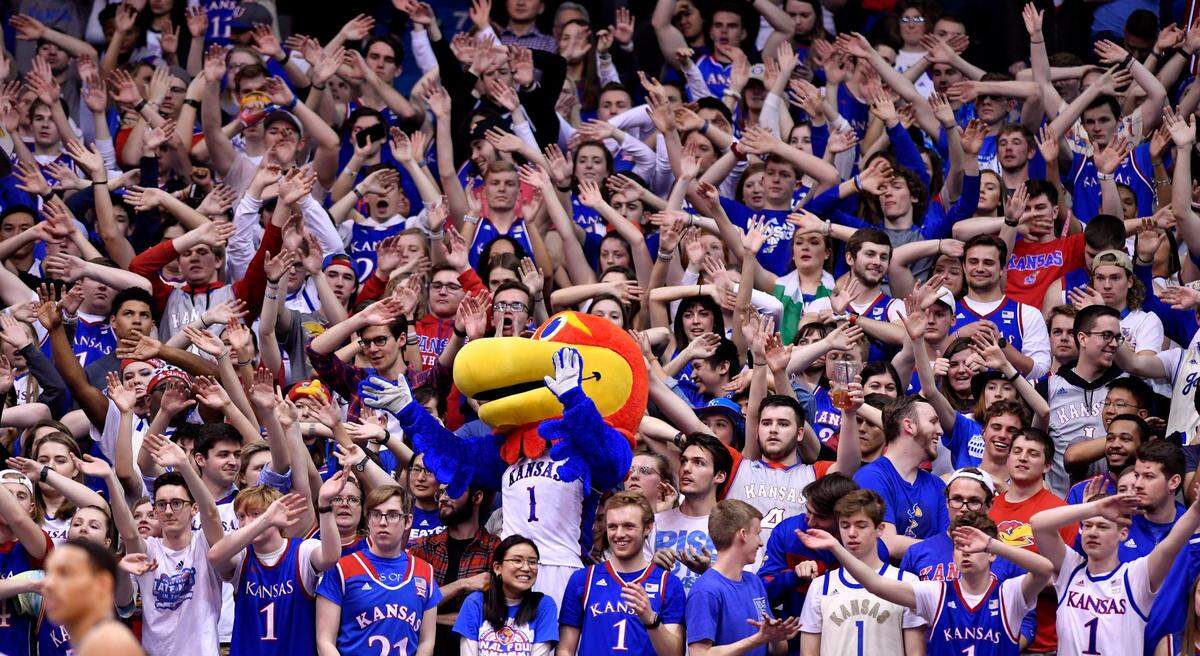
The iconic crimson and blue the Jayhawk fans sport today were not the first colors adopted by the university. From the 1870s through the mid-1890s, the official colors of the University of Kansas were actually sky blue and corn yellow. Some connect the color choice to the University of Michigan, which had also inspired KU’s Board of Regents charter.
In 1891 the university’s athletics board switched the uniform colors to crimson — some say that the change was made to have a color that showed fewer stains. Others say that it was chosen to reinforce the hope that the school could become the “Harvard of the West.” Some also connect the choice to prominent New York attorney and Harvard law graduate John J. McCook, who had donated money to fund the school’s first official athletic field.
Only a few years later in 1896 the athletic board had settled on crimson and blue to represent the university, but it was not without controversy.
One popular myth about the colors says that because the colors are the combined colors of Harvard and Yale, the addition of blue was designed to assuage the Yale alumni on KU’s faculty who had “endured a difficult time embracing the hues of their alma mater’s chief rival.”
And so to this day Jayhawks lift the chorus ever onward, crimson and the blue, as they sing “Hail to old KU.”
This story was originally published March 19, 2022 at 5:00 AM.