Why one of KU Jayhawks’ most encouraging plays was a 4-yard run vs. Coastal Carolina
Let’s start with the bad news for KU football: Its running game has not been good enough.
The Jayhawks transitioned to using “wide zone” as its base running game staple — the same scheme that helped Buffalo lead the nation in rush yards per carry under coach Lance Leipold last season — but there have been some severe growing pains.
“It needs to improve for sure,” KU offensive coordinator Andy Kotelnicki said of the wide zone Thursday.
“We’ve really struggled with the timing of that,” added Leipold earlier in the week, “and in the consistency of our guys working together.”
The numbers haven’t been pretty. KU is averaging 3.2 yards per rush, but even that is misleading; take away quarterback Jason Bean’s running total — most of which has come on scrambles and broken plays — and the Jayhawks’ four running backs have combined for 48 carries and 113 yards (2.4 per carry).
Some of the issues could have been anticipated, given the coaching staff only had August practices to teach the new system after Leipold’s late hiring in April. In the opener, for instance, KU’s offensive line had both communication and execution breakdowns, which led to KU’s two-yard-per-carry output against South Dakota.
So let’s get to the good news for KU: There are flashes, every once in a while, that the team is gaining on what it wants to become with wide zone.
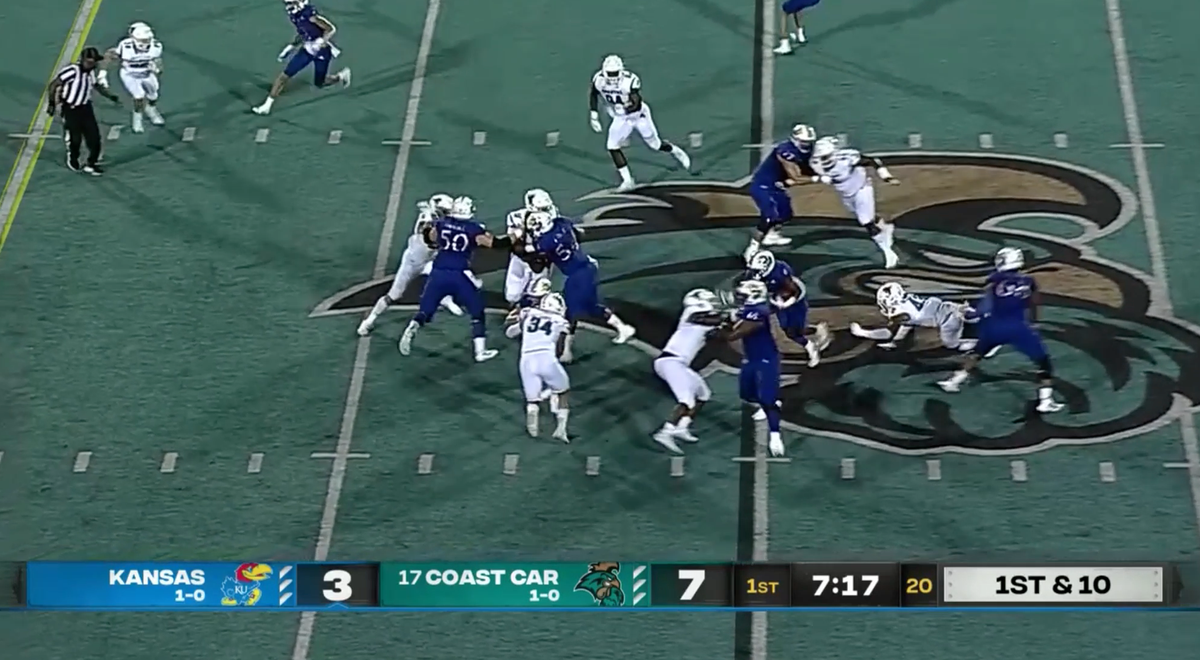
And perhaps the best example came midway through the first quarter of last week’s game against Coastal Carolina ... even though the final result was only a four-yard run.
What’s important to watch is KU’s offensive line working effectively in tandem. Left tackle Earl Bostick, for one, sticks his arm into a Coastal Carolina defensive lineman to give left guard Malik Clark time to catch up to him. Then Bostick peels off to block a separate linebacker. KU has two blocking two.
The same happens on the interior of KU’s line. Center Mike Novitsky punches his arm into Coastal Carolina’s nose tackle, getting him moving upfield while buying time for right guard Michael Ford to take over. Novitsky then seals off an interior linebacker, again giving KU two blockers on two defenders.
The image, for an instant, is how Buffalo gashed so many opponents in the run game last season. KU’s four blockers have their helmets between the defenders and ball-carrier, leaving a potential open lane for running back Devin Neal.
So why does the play only go for four yards? Again, it’s the result of small details that are often the difference between short gains and huge plays.
Typically, running backs are taught in wide zone to aim for the outside hip of where a tight end would line up on the play side of the field. If this is the case, Neal’s first steps appear to be too far toward the sideline, making things more difficult on his blockers.
Bostick is also just an instant late to get outside to peel off his block on the linebacker, who gets a hand on Neal’s thigh. Neal is unable to run through the contact, stumbling forward before slapping his hands together in disappointment after the play.
“I was just super-frustrated because I saw (the hole) in the game,” Neal said, “And then I was even more frustrated when I came back to film and I saw how open it was.”
To be clear, KU’s execution on wide zone was far from perfect in some other plays against Coastal Carolina. The game’s second play, for example, went backward when KU became crossed up on assignments, which allowed a linebacker to run free.
KU’s inexperience with the new system, though, means improvement is much likelier to be flickers of promise rather than streams of consistency.
“It’s still kind of new to us as a whole, just trying to get comfortable with one another and how we’re fitting certain blocks and that type of thing,” Novitsky said. “But it’s just really that chemistry that we’re still working at every day to build.”
Leipold was asked this week how long he believed KU would need before it would feel comfortable with its new run approach. And while he didn’t give a definitive answer, he hoped to at least get to a point where his offensive line had a sense of continuity by the end of this month.
Perhaps one run play against Coastal Carolina — though it only went four yards — could provide some hope.
“We’ve got to be better,” Leipold said of running wide zone, “and hopefully we’ll continue to make steady progress.”
This story was originally published September 16, 2021 at 4:10 PM.