After winning U.S. Olympic trials, KU’s Mason Finley goes for discus glory in Japan
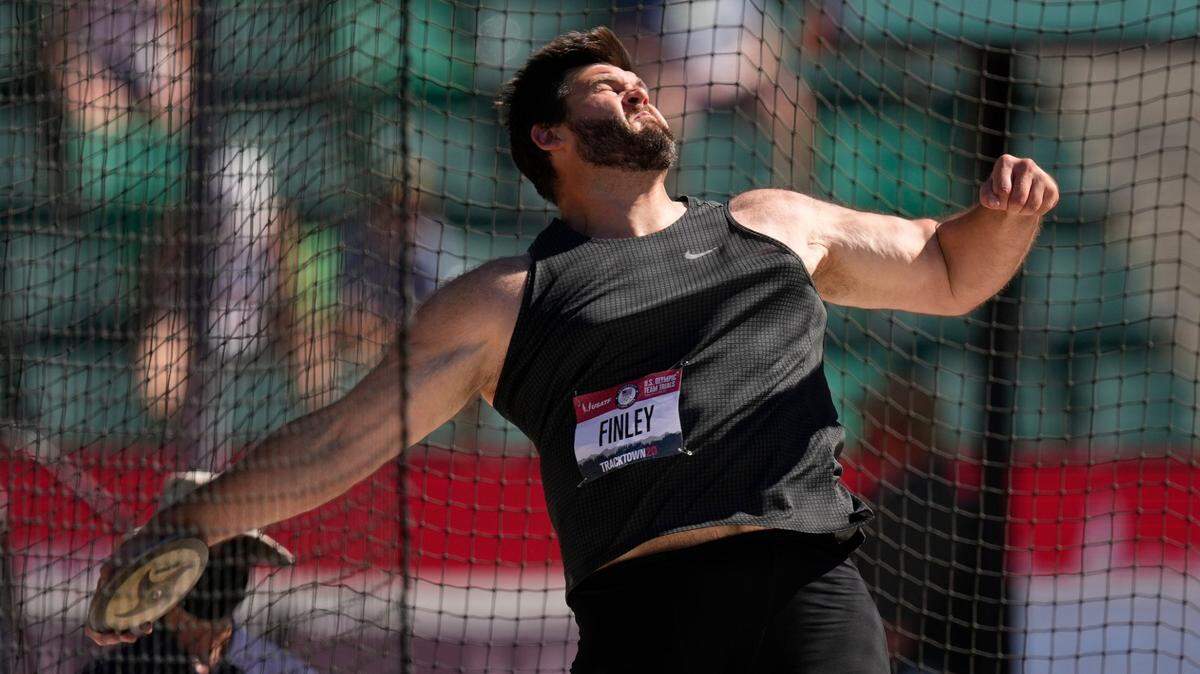
Mason Finley, a former University of Kansas track and field athlete and a current volunteer weights coach at KU, actually completed his collegiate career at the University of Wyoming during the 2013-14 school year.
A fan favorite at the two schools, the outgoing Finley, a theatre major in college, is about to compete in his second Olympics representing not only his country — the United States — but two universities in the men’s discus competition.
“I’m a Jayhawk and a Cowboy. Some people call me a ‘Cow-Hawk,’’’ the 6-foot-8, 330-pound Finley, a 30-year-old native of Salida, Colorado, told The Star in a recent interview.
“I love them both. I’ve had great experiences at both schools. The only reason I transferred to Wyoming was just personal, family reasons. It had nothing to do with anything else. I was fortunate to go out there and train. Now I’m back here (training with KU weights coach Andy Kokhanovsky). Life is good.”
Finley enters the Tokyo Summer Games coming off the biggest accomplishment in his competitive discus career, which dates to his first competition in seventh grade.
Finley, who in college placed second in the 2012 NCAA outdoor discus as a Jayhawk and sixth in the 2014 outdoor discus as a Wyoming Cowboy, outdistanced Reggie Jagers and Sam Mattis to place first at the U.S. Olympic Trials on June 25 in Eugene, Oregon. Finley threw 206 feet, 11 inches, while Jagers and Mattis also qualified for Tokyo with throws of 205-5 and 205-1 respectively.
“To win, I mean that’s pretty special,” Finley said of emerging as the U.S. Olympic Trials champion and thus America’s best hope of winning discus gold in Japan. The qualifying round in the men’s discus is set for 7:45 p.m. Central time Thursday at Olympic Stadium in Tokyo. The discus final is 6:15 a.m. Saturday.
It’s Finley’s second Olympics. He was 11th in the discus at the 2016 Rio Games.
“My first time at the Olympics in ’16, I was totally star struck. I was watching all these guys on YouTube just the month before. To meet all my idols and compete against them was pretty jarring. I’ve competed against them a lot since then so I’m pretty cold to it. I’m pretty relaxed,” Finley said.
His experience in the discus event showed at trials, a competition in which he overcame some adversity to advance.
Finley hurt his back on a multi-hour flight to Oregon 10 days before Trials and nearly had to withdraw.
“I expected to win going into trials, then I got on that plane. I really got messed up,” said Finley. “I squeezed my hips sitting there for four hours. It’s nobody’s fault. I am giant. The plane is small.”
Even with the help of a chiropractor in Oregon, “six days before, I didn’t know if I’d be able to compete. After taking my first couple throws, I didn’t know,” Finley said.
He fouled on his first two attempts in the qualifying round, meaning one more foul would remove him from the competition mighty early. He threw 195-8 on his third attempt to advance to the second and final round as the 10th qualifier.
“It was a struggle. I scratched the first two throws. I took a safety throw to get into the next day. The first three throws were pretty rough,” Finley said.
Competing in just his third meet of the outdoor season and first meet since May 9, Finley fouled on his first throw of finals. He was in fifth place entering his fourth (of six) throw.
“I was like, ‘Man I don’t care about the pain. I don’t care about anything but to make this team (by finishing in top three).’ I said, ‘I have to get up there, find a way to get it done,’’’ a determined Finley said.
His fourth throw of the day (206-0) rocketed him into first place. He improved on that mark on his fifth throw and emerged the trials champion.
“It’s funny because I threw 63 (meters, 206-11 feet) which isn’t an outstanding throw for me,” Finley said.
“For a while, it wasn’t going well,” he added, smiling. “To overcome all that and get the win .. everybody was texting me like, ‘Man you were a drama major in college. You love drama.’’’
Actually he would have preferred no drama — going without the back injury heading into the meet.
“From where I was when I first got there (to Oregon) and to be able to overcome that thanks to people around me (coaches, sports psychologist, chiropractor, family members, friends), not letting me go into despair ... to be able to overcome that, that’s pretty special,” Finley said.
The back injury was pretty serious.
“He (chiropractor) said my hip flexor SI joints were mangled,” Finley said. “He adjusted me. The pain went away but I still had a couple days to get everything moving again because I was just sitting at the hotel in pain not able to move. I had to get that rigormortis out of me.”
Finley has been hurt before.
“I had my first herniated disc when I was 22. So that’s eight years ago. I’m used to pain,” said Finley. He has been throwing competitively since seventh grade. He was a three-time high school state champion (Buena Vista High School) in both discus and shot put in Colorado.
He set the U.S. national high school record in the discus with a throw of 236-6.
“This is kind of close to my lower spine, so I was like, ‘Well this is just another back issue,’ but it wasn’t going away. It was a different pain. But now I know how to deal with this. We’re just checking off body parts that want to fail me. We won’t let them,” Finley added, smiling.
Finley was to take precautions in advance of his journey to Japan. He was allowed to fly to Japan six days ahead of the discus throw.
“The chiropractor has given me a list of things to do every 30 minutes to an hour (on plane) and do stretches, just basically never let my body sit in that position for a long time,” Finley said. “For me, my training starts as soon as I get on the plane.”
Finley’s personal coach, KU assistant track coach Kokhanovsky, says he has a lot of respect for what Finley was able to accomplish at Trials with a bad back.
“The trials was more like his will,” Kokhanovsky said. “He stood up. He went after it. He didn’t give up. He kept going.”
Now the question is … how will Finley fare at the Games?
Obviously he’d like to catch fire on a good day and win the gold medal.
As far as the U.S. throwers … Jagers, 26, is the 2018 USATF national champion and 2019 Pan Am Games bronze medalist. The former Kent State track athlete and football player has the top throw by an American this year of 67.82 meters, which ranks No. 6 on the world list.
Mattis, 27, is the 2019 national champion and a world championships finalist, placing 11th. He’s a graduate of Penn.
“We’re bringing in a really solid team,” Finley said. “Jagers is very competitive. Mattis is very competitive. We’re all in that mix so I wouldn’t say any of us would have a great advantage over the other. I think one of us is going to get on that podium.”
Internationally … “Daniel Stahl, the Swedish athlete is amazing,” Finley said of the 28-year-old. “He’s going to be a force to deal with.”
Other discus standouts: Kristjan Ceh of Slovenia, Simon Pettersson of Sweden, Lukas Weihaidinger of Austria and others. Finley has the world’s 15th best throw this outdoor season.
Kokhanovsky said “the goal is probably to get in the top three. It’s adrenaline, control your nerves. His personality … if he is not there mentally he cannot do well. In training he has to see how easily he can throw far. He has to do real well and be smart in competing.”
KU track coach Stanley Redwine, who is an assistant coach for the U.S. Track and Field team in Japan, said, “I’m excited for what he (Finley) promises to do. I think when Mason goes in, he’s one of the favorites, as much a favorite as anyone else.
“That’s the only way to think. You can’t think of going in just to qualify. You can’t be excited for where we are now, you have to think about what it takes in order to be successful with the next level. I think it’s the way everyone is thinking, not just happy to be at the Games. I think that’s the mindset and that’s really exciting,” Redwine added.
For Finley, this may or may not be his last Olympics. He and his wife are expecting a baby in October. Kokhanovsky said Finley definitely “could” continue on in the sport.
“He can have one more (Olympics) I would say,” Kokhanovsky said. “It will require a lot more. He would need to get a sponsor. Financially this is hard. He’s expecting a baby. There’s a strain on family.”
Noted Finley: It’s a little tougher to do this because I am unattached (sponsorship-wise) right now.”
So will he continue on?
“That’s a good question. It’s a question I have for myself,” said Finley.
“I think I”m going to take it year by year. I love throwing. As long as I can do it I will. I have plans to start massage therapy school in the fall and hopefully do chiropractic school. Just with my own injuries I feel like I understand the pain and would like to help other people with that.”
No matter what happens in the future, Finley has had a stellar career, Kokhanovsky said.
“I think if he stopped right now, he should be proud of whatever he accomplished,” Kokhanovsky said. “He has competed a long time successfully and is now No. 1 (in USA).”
Being No. 1 in the world is Finley’s ultimate goal.
“I’m going to go there and hopefully represent my country well,” he said.