Bill Self made big shift in Tennessee loss. That means KU needs more from this player
Focus only on the micro level, and here’s the analysis following Kansas’ 80-61 road loss to Tennessee on Saturday: This was a disappointing and somewhat unfortunate result for the Jayhawks.
KU wasn’t competitive from the start, mostly because of the way both teams shot early. Tennessee was 5 for 7 from three before halftime while KU was 1 for 12, and had typical shooting numbers played out, the Volunteers may have held a slim lead at the break (or none) rather than the 14-point advantage they only extended after that.
Sometimes it’s a make or miss game. Tennessee made ’em, and KU did not, which means the Jayhawks have now lost four of five — the type of skid that hasn’t taken place in Lawrence since the 1980s.
That’s just the short-term view for KU, though. On the macro level, Kansas coach Bill Self made some interesting changes both before and during the game that should impact the Jayhawks moving forward.
If those stick, Ochai Agbaji will need to have a short memory of his rough shooting day.
KU is going to need more from him in the next contest ... and likely every one after that as well.
To understand why, let’s go back to the first domino from Saturday: Self inserted Dajuan Harris into the starting lineup for Jalen Wilson, hoping the point guard could take some pressure off teammate Marcus Garrett while becoming KU’s primary ballhandler.
Self — to his credit — isn’t settling for “good enough” late in this season. He promised to mix things up earlier in the week, and he said on ESPN+ program Jayhawk Gameday Live before the game that he hoped this would be the starting lineup KU would proceed with moving forward — though more than anything, he just wanted to see how it played out.
To me, Self had two potential paths to improve this team’s overall ceiling before the NCAA Tournament:
1. He could go back more to a five-guard lineup — it was successful for KU early in the season — while centering his offense around Wilson and embracing that KU’s defense and rebounding won’t be as good;
2. He could sell out for better defense by getting Harris in more in lineups with Garrett, while also getting bench players Tristan Enaruna and Tyon Grant-Foster additional minutes with the same thinking.
Self, for whatever reason, seems to have completely abandoned the first option. Right or wrong, he’s decided KU needs a big man in the game at all times, and he doesn’t appear to be budging on that stance.
That brings us to No. 2, which was the game plan Saturday night. With Harris in, KU becomes more active defensively, and the team also has its best passer on the floor.
Here’s the obvious problem, and why Self was hesitant to do this earlier: Putting Garrett and Harris in together can be rough for their teammates offensively. Both struggle to shoot from three, which means the players guarding them often drop into the lane to clog things up.
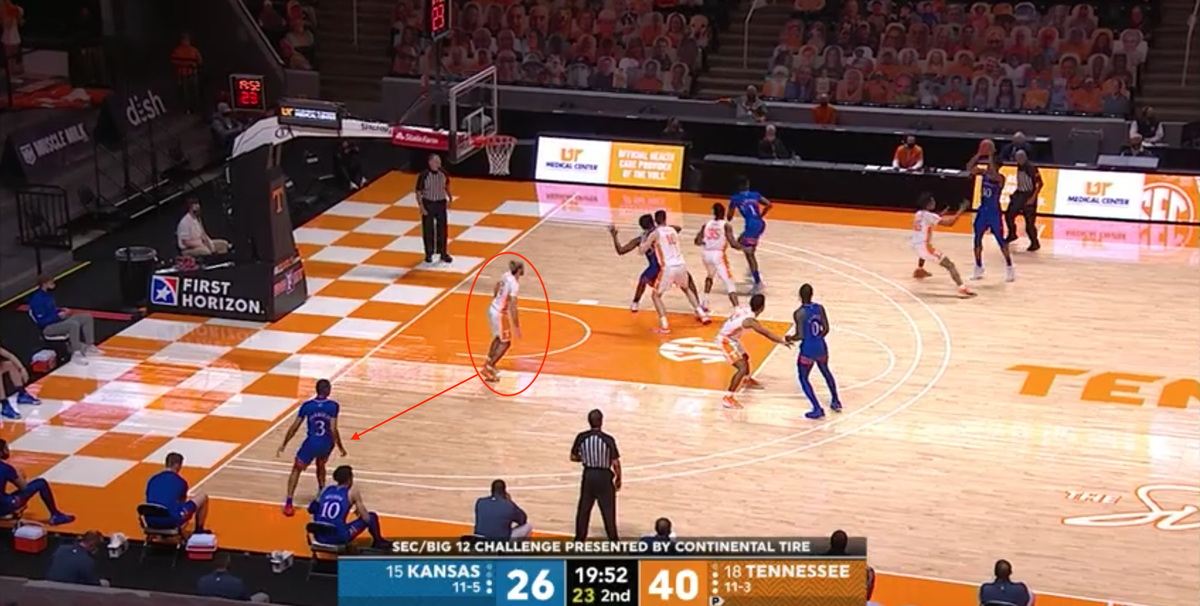
So how does KU counter that? Self and staff obviously have thought some about this, as evidenced by a new play they unveiled early against Tennessee.
Garrett — one of the non-shooters — gets a pass, so the defense must come out to guard him. On the back side, Harris is mostly getting ignored by Tennessee, but he’s working to set a screen for Agbaji to open him for a three-pointer on a skip pass; Garrett just doesn’t make that read in this instance.
This is a new wrinkle from Self. You don’t often see his guards — much less point guards — working to free up other shooters on the perimeter.
Seeing this action means Self and staff have likely been pondering a big-picture question: If KU is going to struggle to get easy baskets offensively, then why not simply play to more three-point shots while potentially reducing turnovers?
KU, in this game, switched strategies. It simply tried to get up as many shots as possible, with two potential obvious positives: the shot could go in, or KU could get the offensive rebound.
The final result in this game was ... just OK. KU’s 0.92 points per possession was the seventh-best by a Tennessee opponent in 15 games, and that came even though the Jayhawks were a no-show on the offensive glass while making only 6 of 24 threes.
Here’s a broader point, though: If Self is committed to playing this way defensively, then KU needs to play more through outside shots and its most efficient players offensively.
And by nearly every statistical measure, that person is Agbaji.
The junior guard is KU’s most efficient player in the starting lineup according to Synergy Sports Technology’s play tracking. He came into the game averaging 1.12 points per possession on spot-up attempts — that was in the 81st percentile nationally — and his overall offensive rating is most impressive of KU’s rotation players.
It only makes sense to get more out of him, even if he needs some help for that. Agbaji isn’t the most gifted ball-handler and struggles to create his own shot naturally, so working him off screens or shifting him creatively — like KU did early in the second half — only makes sense for a team that needs added volume from him on that end.
You know how this turned out Saturday. Agbaji — a 41% three-point shooter coming in — made just 1 of 9 perimeter shots, which was a big reason KU never mounted a serious comeback against Tennessee in the second half.
This happens. Bad shooting days — and good shooting days, if you’re Tennessee — are all part of variance in basketball.
The Jayhawks saw the worst of what that could look like Saturday. Given another chance, the numbers say this new style should give KU a shot — and perhaps a higher upside than it could hit in prior games.
Making a Harris-Garrett lineup feasible on the offensive end means that others will have to step up. Agbaji is at the top of that list.
Self, meanwhile, seemed to move closer to an NBA way of thinking in Saturday’s loss. Pro coaches often do everything they can to free up their best spot-up shooters, then live with the results whether those attempts go in or not.
The Warriors’ Steph Curry, for example, made 1 of 10 threes against Toronto three weeks ago. He went 3 for 8 two days after that, then 5 for 11 later that week. His three-point attempts have proven to be good shots over time, and the Warriors won’t be telling him to back off following any inaccurate night.
In a similar way, KU needs Agbaji to maintain his confidence here.
The shots he puts up — with this current setup — are the Jayhawks’ best chance at efficient offense.
And shying away, at this point, would be even worse than missing.