
Let’s talk about KU’s 3rd-and-6 play call in overtime
The most talked-about play call of Kansas’ 26-23 loss to Nicholls State came on the third play of overtime.
Let’s set the scene: Tie score, KU has third-and-6 at the Nicholls State 21. KU’s coaches inserted mobile quarterback Miles Kendrick into the game — he had only played one possession in the first half — and Nicholls State called timeout to set up its defense.
After the break, Kendrick came back on the field, and he was tackled for a 3-yard loss on a quarterback draw, forcing a KU field-goal attempt.
Because there’s so much to unpack here, I consulted a Division I assistant coach to get his thoughts.
And let’s start with this: He says this is a play call that can work.
That’s because of the defense Nicholls State is playing. The Colonels are in a Cover 1, meaning they are playing man coverage with a single high safety deep.
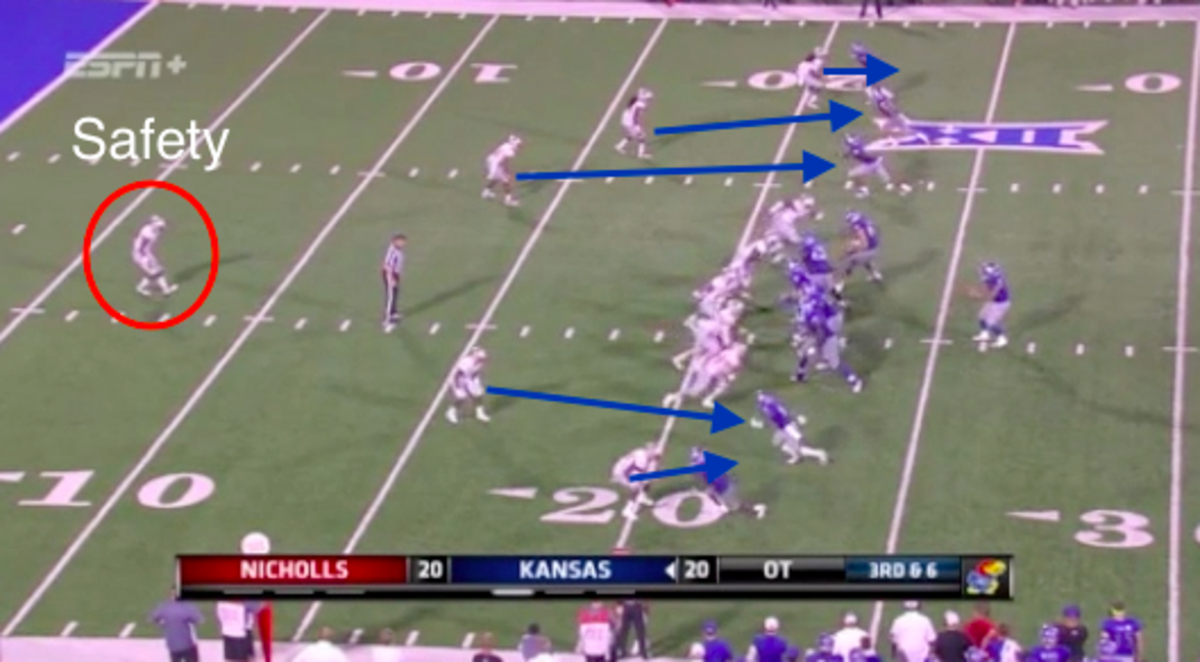
Each cornerback’s responsibility is to keep his eyes on the receiver he’s defending and not the quarterback. That means Kendrick — if he can get by the first wave of defensive linemen — should have lots of room to run in the middle of the field.
The breakdown comes up front. When Nicholls State’s defensive linemen run a twist, KU center Alex Fontana fails to keep his shoulders square and instead locks his hips toward the sideline. This gives him no chance when Sully Laiche (No. 55) loops to the inside.
The unfortunate part for KU is that left guard Andru Tovi has near-perfect technique. He keeps his body square, jabs Nicholls State’s Hezekiah White with his right hand, then is in great position to switch to blocking him. It doesn’t end up mattering, though, because of the missed assignment next to him.
But let’s say, for the sake of argument, KU does get the twisting lineman blocked. It’s likely to be a big play, but probably not a touchdown, as coach David Beaty asserted on his HawkTalk radio show Monday night.
“If we’re able to pick up the twist, (Kendrick’s) going to bounce his head off the goalpost. There was nobody left,” Beaty said. “They were in a zero coverage, and if we can just simply pick up the twist with the center who turned too flat — we pick it up — there’s nobody left.”
For one, Beaty does not appear to be correct about the zero coverage part, which means all man coverage with no safety. Nicholls State had a safety, and though he was far away from the play, he would have been an unblocked player who would’ve had an unimpeded chance at Kendrick downfield.
(Note: Beaty addressed the third-and-6 play during his opening statement at Tuesday’s weekly press conference, saying he “messed that deal up pretty good” on HawkTalk because he accidentally was describing another play. “They were actually in a Cover 1, which is man. They weren’t in Cover 0 man. I proved I’m not perfect,” he said.)
KU had another potential issue. The Jayhawks appear to be running a run-pass option play with what’s known as a “stick” concept.
There’s no need to get too deep into the specifics here, but just know it’s a common route combination that calls for the inside receiver at the top of the screen to run a hitch route where he takes about four steps and stops.
Because he does this, his defender is in the vicinity of where Kendrick will be attempting to run. It still would be a difficult play to make — the defender’s responsibility is to focus on the receiver, not the quarterback — but there’s at least a possibility he could muddy up this play.
From Kendrick’s actions, it appears the “pass” part of this run-pass play was not an option. He was likely told by KU’s coaches — who had seen Nicholls State’s defensive tendencies — to run no matter what.
If the pass was not an option at all, it would have been better for KU’s inside receiver to run a go route or out route to clear more space, but again, this appears to be a potential pass play that became a no-read run based on previous knowledge.
There’s also the matter of running this play after Nicholls State called timeout. The Colonels coaches likely schemed some on their own once they saw Kendrick come on, and it’s at least possible they could have used their own insight to make a defensive call that would be best against a run-first QB. For example, did those coaches know that Fontana had struggled with twists all game? If so, this would be a good time to run one.
The assistant coach I spoke with suggested another option for KU too: putting in starter Peyton Bender after the timeout, then running the same play.
This would serve a couple purposes. For one, the defense would be less likely to look for a run with KU’s best-throwing QB, and if the field was as open as KU’s coaches believed it would be, he still should be fast enough to pick up a first down.
His presence also would allow the play to turn back into a run-pass option. And if Bender saw Cover 1 pre-snap and wanted to throw, the coach I spoke with said his read would’ve likely been the out route at the bottom of the screen.
That’s a throw you’d expect an FBS quarterback to make for a first down.
In the end, it’s worth reiterating that the assistant coach I spoke with had no problem with the play call that KU went with here.
“A lot of times, you get it blocked up front against a Cover 1 defense, you’re going to run for a lot of yards,” he said. “It’s kind of like a first-level defense. If you break the first level, and you’re going to get a big play.”
Get that twister blocked, and it’s likely a first down — probably around a 10-yard run — with the potential for more if Kendrick can break a tackle.
The draw never had a chance, though, because of a costly mistake up front.
“Don’t mind the play call at all,” the assistant coach told me. “The thing you mind is the execution.”

Jesse Newell
Jesse Newell covers University of Kansas athletics for The Star.



This story was originally published September 4, 2018 at 12:25 PM.