
Searching for breakthrough, Kansas football faces another difficult schedule
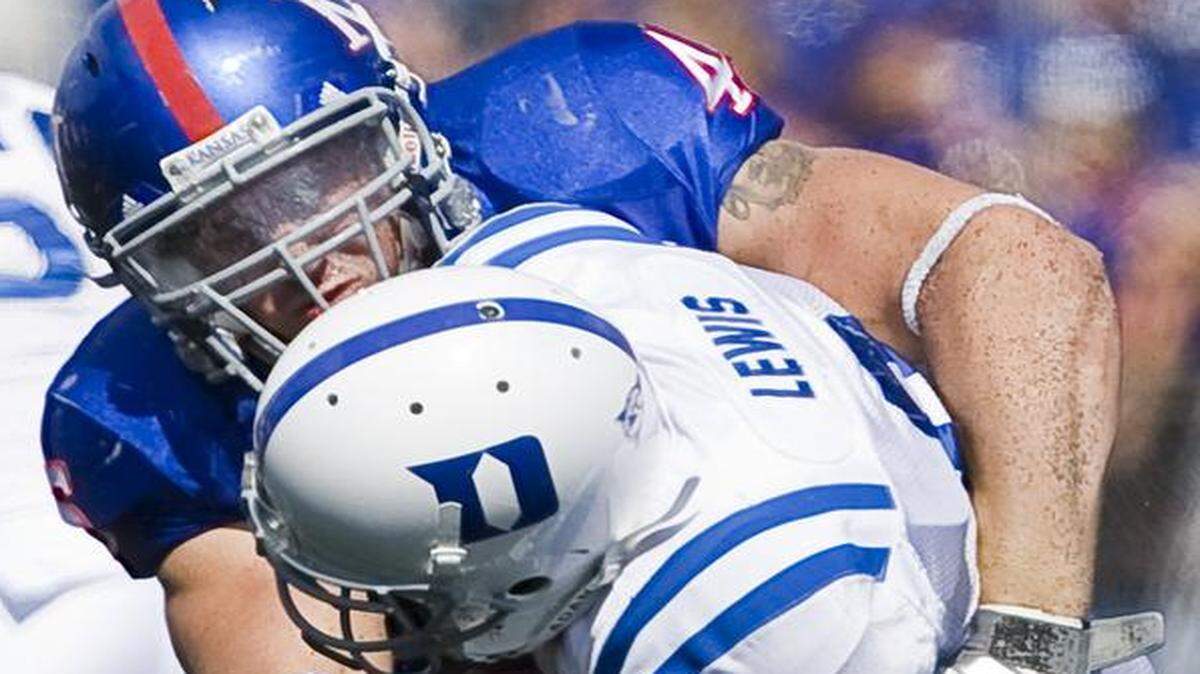
Late last spring, Charlie Weis sat in a chair and listened to a hypothetical college football schedule.
OK, so you’d play four non-conference home games — all against teams from small conferences. You’d only have eight Big 12 games. And you wouldn’t have to play Texas, Oklahoma or Texas Tech. Sounds pretty good, right?
Weis nodded along for a moment, then stopped. Perhaps the schedule sounded like heaven, perhaps not. But then came the great reveal. This was not some schedule conjured from nowhere. This was the Jayhawks’ slate in 2007, the year they finished 12-1 and won the Orange Bowl.
This is not their schedule this year.
“I’ve seen it,” Weis says of the 2007 schedule. “But I can’t complain about it.”
Weis will not complain, but you can’t blame him if he feels a little schedule-cursed. On Saturday, Weis opens his third season at Kansas, which has the country’s 23rd-toughest schedule as rated by college football analyst Phil Steele.
The Jayhawks travel to Duke, a rising program coming off an Atlantic Coast Conference division title. They play nine Big 12 games. And cruelly, of course, the Jayhawks do not get to play themselves.
For a program like Kansas, which has been on life support for four years, the grueling schedule leads to an interesting question: Why don’t the Jayhawks schedule a non-conference slate of cupcakes, guaranteeing three wins and some much-needed confidence? And if Kansas is forced to play nine Big 12 games, why would it ever think about going on the road?
“The reality of it is,” KU athletic director Sheahon Zenger says, “there’s several different philosophies with that.”
The answer, KU officials say, is more complicated than you might think — and largely based on money. The costs of “guarantee” games — where Kansas would pay a smaller-conference school for a single game in Lawrence — have risen sharply over the last decade. There are fewer Division I Football Bowl Subdivision programs willing to agree to guarantee games. And KU, for the moment, is not in position to shell out millions of dollars to pay teams from the Sun Belt, Mid-American Conference or Conference USA.
“It’s not impossible (to buy single games) if you want to put up that kind of money,” says KU’s Larry Keating, whose primary job involves making schedules for football and men’s basketball. “But even the Sun Belt teams and the teams in the MAC that were willing to get bought, they all want $1 million. So economically, it’s not worth it for us.”
At 6 p.m. Saturday, Kansas opens against Southeast Missouri State, which plays a level down in the Football Championship Subdivision. It’s the Jayhawks’ only guarantee game on the schedule. And even the guarantee games against FCS competition have become more expensive in recent years.
“Years ago, you were getting them for $200,000 a game,” Keating says. “Now it’s $350,000, $375,000 or $400,000.”
The conference schedule also has become a major variable. In 2011, the Big 12 ditched the divisional format and switched to a nine-game round-robin schedule. As a result, Kansas lost the advantage of cycling away from the conference powers in the former South Division. The Jayhawks are 1-26 in the Big 12 during the last three seasons.
Weis, who arrived before the 2012 season, was never at KU for the old version. But he has listened to K-State coach Bill Snyder, a staunch supporter of the division system.
“If you can duck a lot of the good guys,” Weis said, “you have a chance of playing for a championship every year.”
The eight-game conference schedule offered other benefits. In 2005, Kansas started 3-0 after three non-conference home wins and parlayed the start into a 6-5 regular season and a victory in the Fort Worth Bowl. Two years later, the Jayhawks cruised to a 4-0 start at home, crushing four non-BCS opponents. The end result was an Orange Bowl.
“In my opinion, everyone would like that cycling (of conference opponents in the division system),” Zenger says. “And (you would) have your non-conference opponents and have more leeway in what you’re doing. But in the Big 12, you don’t. You’re going to play those nine, and that makes those other three you schedule all the more critical.”
During his two seasons, Weis has used future non-conference openings to gain visibility in potential recruiting areas. Weis has visions of a Hawaiian pipeline, so he scheduled a home-and-home series with Hawaii beginning in 2016. He covets athletes from his home state of New Jersey, so he signed off on a series with Rutgers, beginning next season in Piscataway, N.J.
Nobody would confuse Rutgers or Hawaii for a powerhouse. But then again, sometimes schedules simply hinge on timing. In 2012, the Jayhawks played a road game at a Northern Illinois program that would play in the Orange Bowl. The series was scheduled years before.
And yes, the Duke game. The series was originally agreed to back in 2006, nearly seven years before the Blue Devils won the ACC’s Coastal Division. The first game was set for Durham in 2009, with a return game in Lawrence in 2010. But before the 2009 season, Keating received a call. Duke coach David Cutcliffe was entering his second season, and the Blue Devils’ program was a mess. So Duke asked Kansas if they could play the first game in Lawrence, and push the second game into the future.
The reason: Duke was looking for some relief on a difficult schedule.
To reach Rustin Dodd, call 816-234-4937 or send email to rdodd@kcstar.com. Follow him on Twitter: @rustindodd.
This story was originally published September 3, 2014 at 5:48 PM.