
Stout against the run, Kansas State now focuses on pass defense
For two straight weeks, Kansas State safety Travis Green focused on the run.
Going up against Auburn and Texas-El Paso, a pair of teams that averaged more than 300 rushing yards, Green positioning himself near the line of scrimmage and charging forward at the first sign of a running play was his top priority.
Sure, Green defended some passes in those games, but coverage felt secondary. That mind-set has helped K-State limit a string of power-running teams to 90.2 rushing yards, which ranks 13th nationally and second in the Big 12. The Wildcats are proud of that statistic. Stopping the run is their identity.
Question is: Can a stout run defense excel against the pass-happy offenses of the Big 12? Also, how good is K-State against the pass?
Perhaps Saturday’s game against Texas Tech will provide answers. The Red Raiders, averaging 344 passing yards, should pose quite a test to the Wildcats, which are allowing 217.8 yards through the air and rank sixth in the Big 12 in pass efficiency defense.
“The challenge for me is just getting my head back to coverage,” said Green, a senior. “The last few weeks we have seen a lot of run game. A lot of run game. And it messes me up sometimes on my reads. At the end of the day, when I practice, that is what I will have to work on — coverage. That run defense still needs to be there, but we need to provide coverage, too.”
Added senior linebacker Jonathan Truman: “They are a fast-tempo offense and they are very dangerous. At any point in the game, they can make big plays and score points fast. We just have to make the most of our preparation and play the game. It’s opposite ends of the spectrum.”
K-State has no choice but to adjust to contrasting offensive styles in its final eight games.
The Big 12 is filled with dynamic, versatile offenses. Six teams average more than 250 yards passing. Seven teams average more than 150 yards rushing. Baylor, Oklahoma and TCU are strong in both categories, all averaging more than 272 passing yards and 211 rushing yards. And no team prides itself purely on running.
Defenders have to be able to adapt.
“It shouldn’t be (difficult). If we do it the right way it isn’t,” K-State coach Bill Snyder said. “Their eyes are supposed to tell them whether it’s run or pass. It’s a matter of discipline and staying focused and putting your eyes in the right place and responding rapidly to what you see. ... It just goes with the territory. It is going to happen every week. It’s one snap at a time. This snap could be a run, this snap could be a pass. You have to prepare for both.”
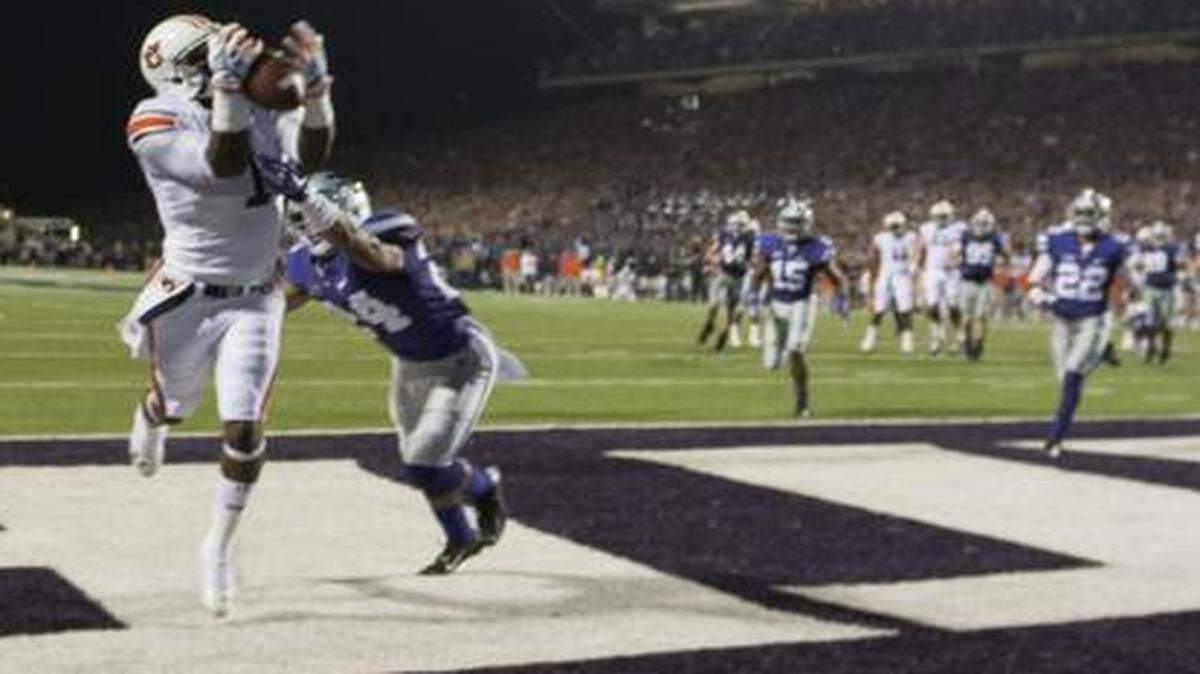
So far, K-State hasn’t appeared ready against the pass. Every time Auburn needed a big play, the Tigers went to the air in a 20-14 victory. Their receivers continually beat K-State’s defensive backs deep, hauling in 17 passes for 231 yards and two touchdowns. If not for drops, those numbers would have been higher. Stephen F. Austin, Iowa State and UTEP also found success throwing the ball, all topping 200 passing yards.
The Wildcats’ biggest weakness has been coverage. Randall Evans and Morgan Burns are the only players on the roster with multiple pass breakups, and the team’s two interceptions were not the result of assignment-sound defending in the secondary. One came on a tipped pass at the line of scrimmage from Dakorey Johnson. On the other, Evans wrestled a pass away from an Iowa State receiver
It’s worth pointing out that the Wildcats wanted those teams to throw. With cornerbacks lining up in single coverage, and as many as six defensive linemen up front, they dared them to abandon the run. Texas Tech likely will see more balanced formations with linebackers and safeties dropping into zone coverage.
“Deep balls and tackling, that is all our focus is,” Green said. “When you make tackles, you are good to go. But you can’t get beat deep. Coach harps on it in practice all the time to stay on top of the receivers and make sure you are coming down on the receivers. Don’t let nothing go deep. We can live with short routes and stopping them where we stand, but we can’t tolerate deep balls. He has been doing a great job with helping us do that.”
K-State’s secondary will be pushed in new ways against Texas Tech.
How it responds is unknown. But for now, the Wildcats appear ready for the challenge.
“I’m ready to let everybody know I’m not just a run defender,” Green said. “I can also cover, too. That is what our defense wants to do, put our talents out there and let everyone know that we can play football.”
To reach Kellis Robinett, send email to krobinett@kcstar.com. Follow him on Twitter @KellisRobinett.